Human Phys Lect exam 1
 Call Kai
 Learn
Learn Practice Test
 Spaced Repetition
 Match
Match Flashcards
 Knowt Play
1/137

There's no tags or description
Looks like no tags are added yet.
Name | Mastery | Learn | Test | Matching | Spaced | Call with Kai | Chat |
|---|
No analytics yet
Send a link to your students to track their progress
138 Terms
Cell membrane
Plasma membranes are complex structures that determine what substances enter or leave the cell essential for cell signaling, transport, and other processes
Cell communication
cells pass information to one another to coordinate
their activities. These processes include
endocrine and neural signaling.
Flowdown gradients
Transport of “stuff” (ions, molecules, blood,
and air) is a central process at all levels of
organization in the organism, and this transport
is described by a simple model
What are the two main control systems in the body?
nervous and endocrine system
Which organ system exchanges materials between the internal/ external environments?
Digestive and respiratory system
Homeostasis
body's ability to maintain a steady state regulated in a range of values (disequilibrium)
Can be influenced by environmental factors, materials needed for cells, and depends on what type of cell communication used
What is the disease state of homeostasis?
– Failure to maintain homeostasis
– Study of body functions in a disease state is called pathophysiology
– Example: diabetes mellitus – abnormally high blood glucose
Does homeostasis mean equilibrium?
NO
Dynamic steady state
Materials are constantly moving between two compartments But no net movement between the compartments
Equilibrium
implies composition of compartments are identical But not the same as steady state
ICF
pumps K+ in
ECF
pumps Na+ and Cl- out
Local control restricted to a tissue or cell
Intrinsic control
Long-distance signaling
extrinsic control
Feedback loops modulate the response loop
– Stimulus, sensor, input signal, integrating center, output signal, target/effector, response/action
– Negative feedback loops are homeostatic - stabilize variable (brings back to set point)
– Positive feedback loops are not homeostatic - reinforce (birth of a baby) pushed away from set point shut off by an outside factor (sends variable farther from set point)
– Feedforward control allows the body to anticipate change
Example of control system
stimulus-> receptor/sensor->control center-> effector(target)-> response
What is the set point
the normal value that homeostasis tries to keep within range via negative feedback
After Bobby severed the artery in his leg a cascading event arising from the rough edges of the artery and chemicals released by the damaged cells led to the
formation of a clot.
Answer: stimulus- severed artery receptor- damaged cells control center- damaged cells effector- chemical cascade response- clot formation
What type of feedback is this? Positive feedback via intrinsic control
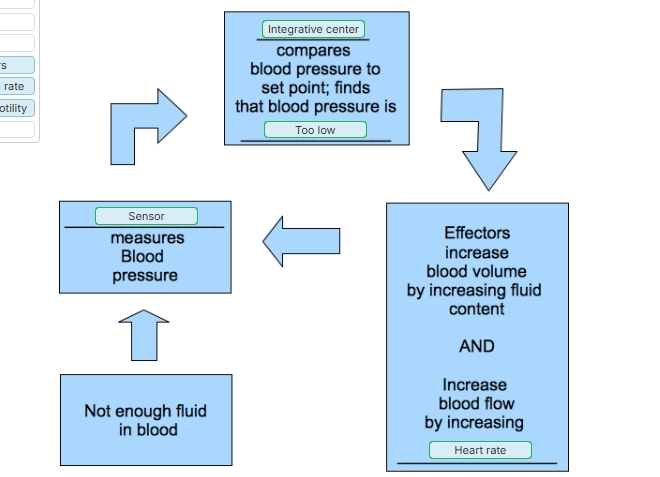
Because of the large amount of blood Bobby has lost his blood pressure drops. This is detected by baroreceptors in the carotid arteries and the information is relayed to the medulla oblongata in turn the heart is stimulated to beat faster to increase the blood pressure
Answer: Stimulus- bp drop Receptor- baroreceptors Control center-medulla Effector- heart Response- increased bp
What type of feedback is this? Negative feedback via extrinsic control
Nico is waiting at the starting line for the race to begin. His heart rate speeds up as well as his breathing. What is this an example of?
Feedforward control because it is anticipated.
which body system does not exchange material with the internal/external environment?
Circulatory system!
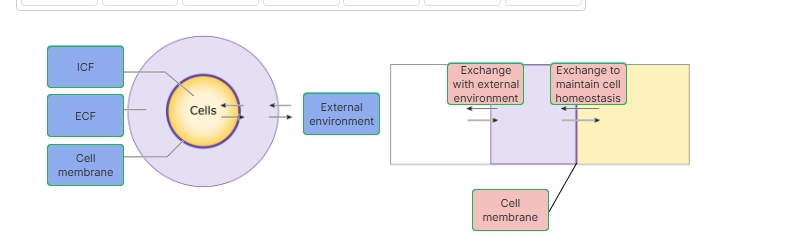
chart explaining movement between internal/external environments
Oxytocin is a hormone released in response to cervical dilation. This causes more uterine contractions that will further dilate the cervix. Which type of feedback does oxytocin trigger?
posiitve feedback
You go outside on a very cold day and you start to shiver because you do not have on the proper clothing. The act of shivering would represent what step in a response loop?
response
Which control system is used to keep our regulated variables at or near their setpoints?
negative feedback loops
Which term best describes the part of a control system that receives information about a homeostatically regulated variable and initiates an appropriate response?
Integrating center
flow chart feedback loop
is osmolarity an accurate depiction of a cells tonicity?
no!
A hypertonic cell can have what kind of osmolarity?
Hyperosmotic only
a hypotonic cell can have what kind of osmolarity?
hyposmotic, Isosmotic, or hyperosmotic
an isotonic cell can have what kind of osmolarity?
Isosmotic or hyperosmotic
What are the two fluid compartments that make up the body?
ICF (⅔ total body water volume) and ECF (⅓)
What makes up ECF (1/3)?
Interstitial fluid (between circulatory system and cells)
plasma ( liquid matrix of the blood)
Where are proteins mainly found?
Intracellular fluid and plasma while sodium is higher in interstitial fluid and plasma
what is osmotic equilibrium?
the body is in osmotic equilibrium where the movement of water in the body is in response to solute concentration gradients.
Osmotic movement can be through the
membrane,
aquaporins,
water-filled ion channels.
Osmotic pressure- pressure that must be applied to oppose osmosis
* due to the difference in concentration between two compartments separated by a semipermeable membrane can be determined by pie = g C Q RT
pie = Osmotic Pressure
g = number of particles per mole in solution
C= concentration (moles/L)
Q=reflection coefficient
R= Gas constant
T= Absolute temperature
Molarity
expresses concentration =moles/L
Osmolarity
Osmolarity expresses number of osmotically active particles =particles/L
Equals molarity(moles/L) X dissociation factor
Osmolality
solute particles/ kg of solvent 1L=1kg
What is the osmolarity (in milliosmolar) of 0.9% saline (NaCl) solution?
disassociation factor (1.8) MM for NaCl: 58.44g/mole
step 1
9g X 1mole/58.44g X (1.8)= 0.277 osmolar
step 2 *Convert to milli!
0.277×1000= 277 milli osmolar
solution tonicity table

how are interstitial fluid and plasma alike?
Both have Na+ which is non-penetrating
Penetrating solutes
Urea is penetrating Q = 0.05
nonpenetrating solutes in the ECF
Mannitol nonpenetrating (outside the cell) Q = 0.9
NaCl is nonpenetrating (outside the cell) = 1
nonpenetrating solutes in the ICF
Glucose nonpenetrating (inside the cell)
What are the different types of signalling?
Gap junctions – peristalsis, cardiac muscle cells
Autocrine– self signaling
Paracrine – neighbor signaling
Endocrine– distant signaling via circulation
Neural– alternating electrical, chemical signaling
what does tonicity depend on?
depends on the concentration of nonpenetrating solute
How to compare tonicity vs osmolarity?
*Determine the osmolarity before the cell was introduced to the solution.
*Tonicity can be determined when comparing the nonpenetrating solute concentration in the cell and solution, movement is into the side with more concentration of nonpenetrating solutes!
nonpenetrating solutes
Glucose- ICF
NaCl, Mannitol-ECF
What equation can be used to determine how much solute is in ECF and ICF?
S=CV, C=S/V, V= S/C
S=solute (mosmoles)
V= Volume (L)
C= Osmolarity (mOsM)= solute/ volume
assume that all initial body solutes are nonpenetrating (NP) and will remain in either the ECF or ICF.
We have a 3-liter body that is 300 mOsM. The ECF is 1 liter and the ICF is 2 liters. Use / S V C = to find out how much solute is in each of the two compartments. Rearrange the equation to solve for S: S = CV

A person with a total body volume of 24 L, with 8 L of ECF and 16 L of ICF, is working in the sun loses 4 L of sweat that is equivalent to 130mOsM NaCl solution. Assume all the NaCl loss comes from the ECF. Complete the table.
1. The sweat lost is _____osmotic to the body.
a) Iso b) Hypo c) hyper
2. The osmolarity of the body after the sweat loss will _________?
a) Increase b) Decrease c) Stay the same
3. As a result of this sweat loss, the body’s cell volume will _________?
b) hypo
a) increase
Decrease
A red blood cell has an intracellular concentration of 300 mOsM of nonpenetrating solute. Which describes a solution containing 150 mM NaCl and 100 mM urea compared to the red blood cell?
hyperosmotic
isotonic- no change in the cell
A red blood cell has an intracellular concentration of 300 mOsM of nonpenetrating solute. Which describes a solution containing 200 mM NaCl and 150 mM urea compared to the red blood cell?
hyperosmotic
hypertonic- the cell will shrink
active vs passive transport across the cell membrane

what is diffusion?
. High concentration to low concentration– Chemical gradient
. Net movement until concentration is equal– Equilibrium
faster is low mw and small size which can affect diffusion rate
what affects the rate of diffusion?
lipid solubility
MW
concentration gradient. surface area of membrane
lipid layer composition
what is an electrochemical gradient?
ions that move by being attracted to opposing charges
Molecule X is transported across a cell membrane by simple diffusion. Which is NOT true?
a. The concentration of X is higher on one side of the membrane than the other.
b. Potential energy is being used to transport X.
c. At equilibrium, molecules of X will no longer move across the membrane.
d. X is small and lipophilic.
b. Potential energy is being used to transport X.
what are the two types of protein mediated transport?
Facilitated diffusion-
Active transport-
what are the three active transport pumps?
uniport- one thing at a time across the membrane
symport- 2 different at a time across the cell membrane
antiport- 2 different things 2 different directions across the membrane
what are the three transport protuens used in facilitated diffusion and active transport?
– Channel proteins- allows them through
– Carrier proteins- needs carrier protien to allows substance through
– Pumps
what are the types of water filled passageways made by channel protiens?
Open channels
– Leak channels
– Pores (for example, water pores)
Gated channels
– Chemically gated channels
– Voltage-gated channels
– Mechanically gated channels
what are the three principles that apply to all types of protein mediated transport?
• Specificity
• Competition
• Saturation– Transport maximum
The ability of a carrier molecule to transport only one type of substance or a group of closely related substances is called
a. competition. b. specificity. c. affinity. d. saturation. e. facilitation.
b. specificity
what is active transport?
carrier proteins used to move molecules against their concentration gradient
Primary active transport-
requires the (direct) use of ATP
Secondary active transport-
indirect, uses stored potential energy from concentration gradient of one molecule to push a different molecule against the gradient.
what are the types of uniports and antiports seen in active transport?
uniport-
proton pump (H+)
Ca2-ATPase
antiport-
Na-K ATPase or sodium potassium pump- pumps Na+ out and K into cell
H-K ATPase
What are the different types of cell signalling?
Gap junctions – peristalsis, cardiac muscle cells
Autocrine– self signaling
Paracrine – neighbor signaling
Endocrine– distant signaling via circulation
Neural– alternating electrical, chemical signaling
what are the Lipophilic signal molecules?
– Diffuse through the cell membrane– Usually bind cytosolic receptors or nuclear receptors
what are the Lipophobic signal molecules?
– Bind receptors on the cell membrane
What is a ligand?
They may stimulate different responses in different target cells or after binding with different receptor types.
Hormones are secreted by endocrine glands into the bloodstream and ______?
travel to all cells but stimulate responses only in cells with receptors for that hormone.
what are the four major groups of cell surface receptors?
IRC receptor channel- ligand binding which opnes or closes the channel
G protein-coupled receptor- ligand binding to a G protein opens an ion channel or alters enzyme activity
Catalytic receptors -
3. Receptor enzyme- ligand binds to a receptor enzyme activates intracellular enzyme
4. Integrin receptor- ligand binds to integrin receptor alters enzymes/ cytoskeleton
What do most signal transductions use?
G proteins!
how does ligand binding to a G protein opens an ion channel or alters enzyme activity work?
• G protein-coupled receptors (GPCR) - cytoplasmic tail linked to G protein, a three-part transducer molecule
• Many lipophobic hormones use GPCR-cAMP pathways
– G protein-coupled adenylyl cyclase-cAMP system
• G protein-coupled receptors also use lipid-derived second messengers
– phopholipase C (PLC)
* diacyglycerol (DAG)–> interacts with protein kinase C (PKC) -cell membrane
*inositol triphosphate 3 (IP )→ increases calcium (ICF)
Which is the correct sequence for G protein-coupled signal transduction?
ligand → GPCR → G protein → adenylyl cyclase → protein kinase → tissue response
What is the function of a protein kinase?
It transfers phosphate groups to proteins. (phosphorylates them)
What has enzyme activity?
Catalytic receptors due to ligand binding activating the intracellular enzyme.
what are the Catalytic receptor enzymes?
– Protein kinases (for example, tyrosine kinase): a type of insulin receptor that binds to insulin leading to a signaling cascade leading to the GLUT 4 glucose transporters into the cell membrane to allow glucose uptake and lowering blood sugar
– Guanylyl cyclase – converts GTP to cyclic GMP (cGMP)
signal transduction
decreasing plasma glucose; response
first messenger; insulin
second messenger; cAMP
transducer; receptor protein
A ligand binding to a receptor can stimulate a large number of second messenger molecules inside the cell. This is called
signal amplification
Which stimulates the most rapid intracellular responses?
Receptor-channels
Calcium ions are important intracellular signaling molecules why?
Ca2+ channels can be voltage-, ligand- or mechanically gated.
Cytosolic Ca2+ is stored within endoplasmic reticulum using active transport.
Ca2+ is involved in muscle contraction.
Ca2+ is involved in insulin release.
what are the advantages and disadvantages of second messenger systems?
advantages: signal amplification, rapid response, signal diversity, and casacades
disadvanntages: complex cascades can lead to errors, slow signal termination, cross-communication between pathways initiating unwanted responses
T/F one ligand may have multiple receptors?
T
T/f up/down regulation enables cells to modulate responses-
T
What blocks a receptor response
antagonist
What allows the receptor response?
Primary ligand and/or an agonist
what is the difference between upregulation and down regulation?
upregulation-increases the number of receptors
downregulation- decreases in the number of receptors
An increase in receptor number?
makes the cell more sensitive to the signal molecules
Norepinephrine (NE) and epinephrine (E) both have specificity for alpha adrenergic receptors, but NE has a higher affinity for the receptor. E and NE are
agonists and competitors.
what are hormones?
Hormones are a form of long distance communication. *
can be are secreted by neurons and immune cells.
are secreted into the blood
released at very low concentrations
Pheromones are specialized ectohormones
Different tissues may respond differently to the same hormone
what determines the length of activity of a hormone?
the half life (chemical makeup) of the hormone
if it is degraded by the kidneys or liver
what are the three chemical classes of hormones ?
peptide hormones- chains of amino acids; water soluble
exp) Insulin, Growth hormone
steroid hormones- derived from cholesterol; lipid soluble
exp) Cortisol, Testosterone, Estrogen
Amine hormones-derived from single amino acids tyrosine/ trytophan
exp) Adrenaline, Thyroid hormones (T3, T4)
tryptophan and Tyrosine derived from single amino acids
Tryptophan
Melatonin from pineal gland
Tyrosine
– Single tyrosine give rise to catecholamine
▪ Epinephrine, norepinephrine, and dopamine
▪ Behave like peptide hormones
– Two tyrosine molecules give rise to thyroid hormones (T3,T4)
▪ Behave like steroid hormones
know all of the hormones and what organs/ grands they come from

what are the chemical characteristics of peptide (protien hormones) and Steroid hormones?
Peptides (protiens)- hydrophillic, lipophobic
peptides→amino acids
Steroids- hydrophoblic- lipophillic
similarities and differences of peptide and steroid hormones

Peptide hormone synthesis
Peptide hormones are made as large inactive pre-pro hormones that include a signal sequence, one more copies of the hormone and additional peptide fragments released from Secretary vesicles by exocytosis into the extra cellular space to go into circulation
Peptide hormone signal transduction?
Peptide hormones cannot directly enter the target cells, they have to combine with membrane receptors to initiate the signal transduction process then go through second messenger systems, phosphate proteins, and then initiate the cellular responses
Insulin is a peptide hormone released by beta cells of the pancreas. What organelle(s) would you expect to be increased in the cytoplasm of beta cells?
secretory vesicles