CHEM 105 - Flashcards
 Call Kai
 Learn
Learn Practice Test
 Spaced Repetition
 Match
Match Flashcards
 Knowt Play
1/25

There's no tags or description
Looks like no tags are added yet.
Name | Mastery | Learn | Test | Matching | Spaced | Call with Kai | Chat |
|---|
No analytics yet
Send a link to your students to track their progress
26 Terms
CH1 - Is CO2 a pure substance or a mixture? Element or compound / homogeneous or heterogenous?
Pure substance, compound.
CH1 - What is a tentative interpretation or explanation of an observation?
A hypothesis
CH1 - Which statement best explains the difference between a law and a theory?
A law is truth; a theory is mere speculation.
A law summarizes a series of related observations; a theory gives the underlying reasons for them.
A theory describes what nature does; a law describes why nature does it.
A law summarizes a series of related observations; a theory gives the underlying reasons for them
CH1 - What does crystalline mean? How does it compare to amorphous? Examples? And vice versa
Crystalline describes a solid in which atoms, molecules, or ions are arranged in patterns with long-range, repeating order (ex. table salt, diamond); Amorphous describes a solid in which atoms or molecules do not have any long-range order (ex. glass, plastic).
CH1 - How do we classify pure substances? Mixtures? Examples?
Pure substances can be elements or compounds (H2O, O2, Li); mixtures can be homo- or heterogeneous (milk, soup)
CH1 - Define chemistry
the science that seeks to understand the behavior of matter by studying the behavior of atoms and molecules
CH1 - Define matter. How do we classify matter?
Anything that has mass and occupies space. Solid, liquid, gas (for now…) OR pure substance/mixture
CH1 - Define atoms & molecules
Atoms: the building blocks of molecules, organic or inorganic origin
Molecules: species that contain atoms connected in a specific geometrical arrangement
CH1 - What determines properties of matter?
The atoms and molecules within it
CH1 - What is a pure substance? What is a mixture?
PS: matter of invariable composition (elements/compounds, 1 kind)
M: matter of variable composition (several different kinds)
CH1 - What is an element?
A substance that cannot be broken down into simpler substances by chemical means (and don’t say wHaT aBoUt FiSsIoN)
CH1 - What is a compound?
a substances composed of atoms of two or more elements joined together by a chemical bond, TWO DIFFERENT
CH1 - Difference between a molecule and a compound?
Molecules are any 2+ atoms joined together, compounds are any VARYING 2+ atoms joined together. Compounds have to have 2+ different elements. Ex. H2 is a molecule and not a compound. H2O is a molecule and a compound
CH1 - What is homo- vs heterogeneous?
Both are ways to classify mixtures:
Homo: multicomponent substances that are uniformly distributed (miscible) ex. MILK
Hetero: multicomponent substances that are not uniformly distributed (not miscible) ex. SOUP
CH1 - Classify the following as a pure substance or mixture, then element/compound or homo/heterogeneous:
Pacific Oregon Chai Tea
Carbon Monoxide (CO) gas
Copper (Cu) wire
simple syrup
ice water
Chai: mixture, homo
CO: pure substance, compound
Cu: pure substance, element
syrup: mixture, homo
ice water: pure substance, compound
CH1 - How are scientific measurements reported in regards to sig figs?
Scientific measurements are reported so that every digit is certain except the last, which is estimated.
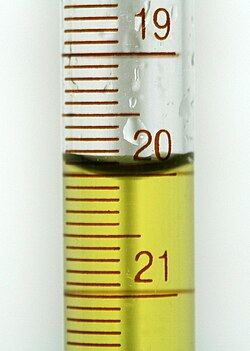
CH1 - Where do we draw the line when reporting volume measurements of liquids with a meniscus?
At the bottom of the U (ex. photo would be ~20, or a measurement just below IDK why 19 is above and 21 is below LOLZ)
CH1 - What are exact numbers? Example?
numbers with no uncertainty, ex. 3 distinct objects (like 3 kids even if one is an amputee)
CH1 - How many sig figs do numbers coming from counting discrete objects have? Ex. 7 pennies
Unlimited
CH1 - When are sig figs ambiguous?
When trailing zeroes are before an implied decimal point (ex. 21,000)
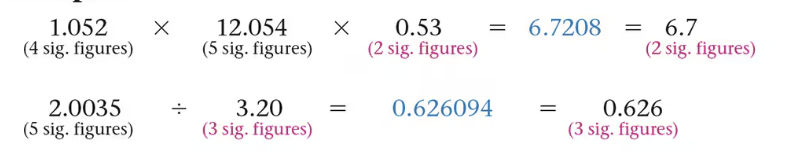
CH1 - What are the rules around sig figs when multiplying/dividing?
Final answer must have the lowest number of sig figs, don’t round intermediate calculations
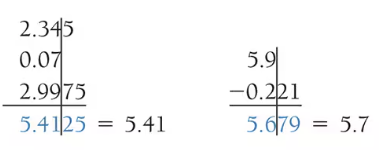
CH1 - What are the rules around sig figs when adding/subtracting?
Final answer must have lowest number of decimal places, don’t round intermediate calculations
CH1 - What does 5.349 round to?
5.3 no relay rounding
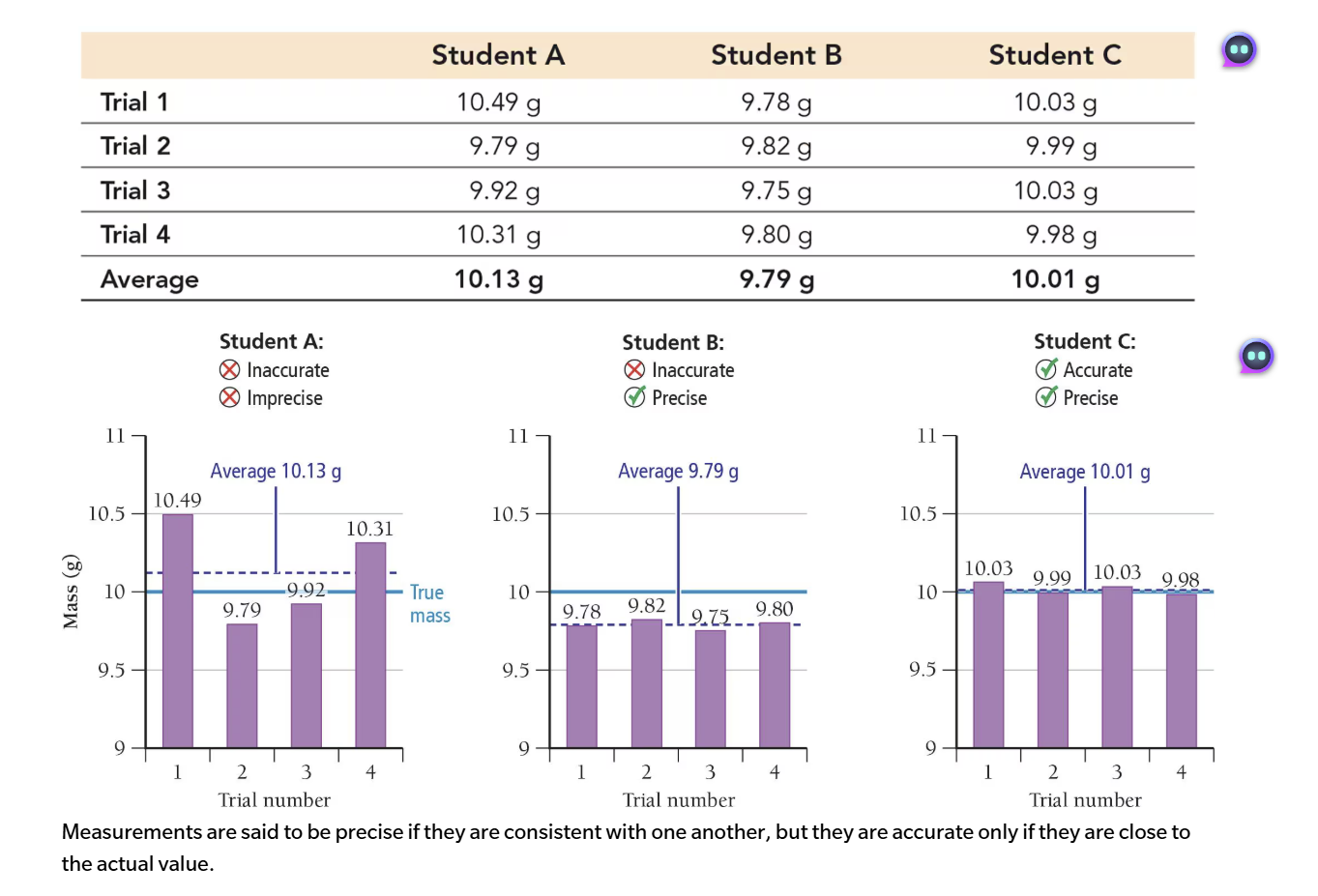
CH1 - What is accuracy vs precision?
Accuracy refers to how close the measured value is to the actual value. Precision refers to how close a series of measurements are to one another or how reproducible they are.
CH1 - What is random error?
error that has equal probability of being too high or too low. Random error can, with enough trials, average itself out.
CH1 - What is systematic error?
error that tends to repeatedly be either too high or too low. In contrast to random error, systematic error does not average out with repeated trials.