CMMA chapter 2
 Call Kai
 Learn
Learn Practice Test
 Spaced Repetition
 Match
Match Flashcards
 Knowt Play
1/44

There's no tags or description
Looks like no tags are added yet.
Name | Mastery | Learn | Test | Matching | Spaced | Call with Kai | Chat |
|---|
No analytics yet
Send a link to your students to track their progress
45 Terms
Plasma membrane
A permeable membrane which surrounds the cell. Its made of phospholipids and proteins and only allows certain substances through.
Cytoplasm
A gel like fluid which fills the inside of the cell. Its composed of water, electrolytes, metabolic waste products, and nutrients dissolved within. There are many suspended organelles and cell structures for chemical reactions.
Nucleus
The main spherical body which contains the genetic material of the DNA and is the main control center of the cell. Regulates all cell activity.
Nuclear membrane
Double-layered, porous membrane surrounding the nucleus
Protects the nucleus, allowing in only specific materials
Nucleolus
The dense body within the nucleus without an enclosing membrane. One to four are located inside. Forms RNA and ribosomes.
Mitochondria
Convert nutrients into energy for use by the cell/body; create adenosine triphosphate (ATP)
Ribosomes
Small granules of RNA found in the nucleolus or cytoplasm that synthesize protein for both intern and external use.
Rough Endoplasmic reticulum
A deep and complex connection of membranous sacs filled with fluids and tubular channels. Connects the cell membrane to the nucleus membrane as well as some organelles. Transport materials within the cell and throughout. Supports synthesis and transport of proteins.
Smooth Endoplasmic reticulum
Complex connection of membranous fluid-filled flat sacs and tubular channels. Connects the membrane to the nucleus membrane and some organelles. Supports the synthesis of certain lipid molecules including steroids.
Golgi apparatus
Four to six flat membranous sacs, connected to the endoplasmic reticulum; typically found near the nucleus
A section of four to six flat membranous sacs. They are connected to the endoplasmic reticulum; found near the nucleus. They handle packaging and shipping of materials for externa use. It also forms lysosomes for use within the cell.
Lysosomes
These sacs are created by the Golgi apparatus, they digest waste materials including damage materials found in the cell, other older cell components, and materials that enter the cell.
Cytoskeleton
A skeleton comprised of protein microfilaments and microtubules. Maintains the shape and structure of the cell. Keeps organelles in place and moves them throughout the cell as needed.
Centrioles
They are a pair of rods made of microtubules found near the nucleus that help in cell reproduction through the distribution of DNA to new cells.
Cilia
Hair like micro tubules that are short which project from the cell membrane and aid in the movement of substances along the surface of the cell.
Flagella
Through a whip like motion, these long, hair-like microtubules, which project from the cell membrane, move the cell itself.
What is the sagittal plane of the body?
Divides the body into left and right sides of the body.
What is the transverse plane of the body?
Divides the body into upper and lower sections. Not equally.
What is the frontal / coronal plane of the body?
Divides the plane of the body into front and back. Refers to the front. Posterior is back, anterior is front.
What is the cranial cavity?
The section within the skull that houses the menges / brain.
What is the spinal cavity?
This cavity travels down the middle of the back, containing the vertebrae of the back and spine.
Thoracic Cavity
The cavity within’ the chest area, contains the lungs, heart, thymus, etc.
Abdominal cavity
The cavity near the stomach, houses the stomach, gallbladder, liver, and intestines.
Pelvic Cavity
Below the abdomin, houses reproductive organs and bladder, prostate, etc.
What are the 9 regions of the stomach called?
Right-Left-Hypochondriac region. Right-left Lumbar region. Right-Left iliac region. Epi(above)-Hypo(below) gastric region. And the umbilical region.
What makes up the Integumentary System?
Skin:
Epi : Outer layer.
Dermis : Thick layer, contains arteries, veins and nerves.
Subcutaneous : Loose tissue composed of adipose and lipocytes.
Sudoriferous (sweat) glands: Produce sweat to aid in cooling the body
What does the skeletal system compose of?
Axial :has 80 bones, including the skull, vertebrae, and ribs.
Appendicular: The adult appendicular skeleton has 126 bones, including arms, legs, and pelvic girdle.
Tendons, ligaments, cartilage : Move, Stabilize, Protects/Smoothens.
What are long bones?
They have epiphysis, diaphysis, and medullary cavities which contain yellow bone marrow. The ends of these are covered by articular cartilage to allow joint movement without causing friction.
What are short bones?
Found in the ankles, wrist, usually small and round.
Flat Bones
Are the majority. Slightly curved and flat. For example skull and ribs.
Irregular bones
Have unusual shapes related to its functions. For example the vertebrae and pelvis.
Sesamoid bones
Small round bones held together by tendons. For example the patella.
What bones are in the superior part of the body?
Upper extremities
Scapula
Clavicle
Humerus
Radius
Ulna
Carpals
Metacarpals
Phalanges
What about the anterior part of the body?
Lower extremities
Pelvic girdle
Femur
Patella
Tibia
Fibula
Tarsals
Metatarsals
Phalanges
What bones are located in the axial realm of bones?
Skull
Cervical vertebrae
Thoracic vertebrae
Lumbar vertebrae
Sacrum
Coccyx
Ribs
What muscles make up the muscular system?
Skeletal muscle: Controls bodily movement. Also called voluntary or striated muscle.
Smooth muscle: Muscle within the walls of hollow organs, blood vessels and iris. Also called involuntary muscle.
Cardiac muscle: Found only in the heart; cross-fibered to allow the heart to contract from the top and bottom to pump blood
Tendons: Ends of skeletal muscles that attach the muscle to a bone
Whats the difference between lymph nodes and lymph nodules?
One is smaller, contain macrophages that filter lymph, and they store lymphocytes. The other is a mass of tissue related to lymphs.
Spleen
Largest lymphoid organ, located in the upper-left quadrant of the abdomen. It is home to macrophages that filter the blood.
What is Interstitial fluid?
Tissue fluid found between cells. Once collected and filtered, it is called lymph.
What’s the difference between b and t cells?
B are a type of lymphocyte that turns into plasma cells which turn into antibodies (Immunoglobulins). T are a type of lymphocytes that attack antigens directly.
What are monocytes?
Engulf and destroy pathogens that have been coagulated with antibodies.
What are the different types of immunity?
Naturally acquired active immunity: Occurs when a person infected by a disease develops antibodies against the pathogen that caused the disease. The antibodies have memory that prevents future infections.
Artificially acquired active immunity: This type of immunity is the result of administering a vaccination. The antibodies are activated by the vaccine and develop memory to recognize the pathogen in the future.
Naturally acquired passive immunity: This is a short-lasting immunity transferred through the placenta and breast milk.
Artificially acquired passive immunity: Also a short-lasting immunity, this is created by giving an exposed person antibodies containing blood products, as in an immune globulin.
What is a Artery/Arteriole?
Thick walled vessels / tubes that carry blood away from the heart. They propel blood with each heartbeat. Smaller ones are the called the ladder.
What are the different cardiums?
Endocardium: Innermost layer of cells that lines the atria, ventricles, and heart valves
Myocardium: Muscular layer of the heart
Pericardium: Outermost layer of the heart; a membrane that surrounds the heart and secretes pericardial (a protective) fluid
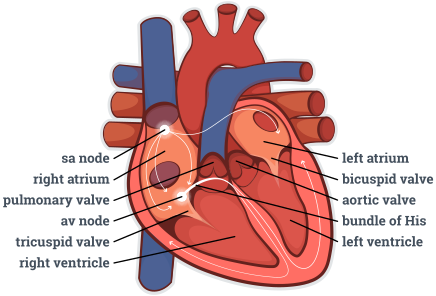
What do the upper chambers of the heart do?
The right and left atria are the top chambers of the heart. The right atrium receives deoxygenated blood from the superior and inferior vena cava. The left atrium receives oxygenated blood from the pulmonary veins (the only veins in the body that carry oxygenated blood).
These atria then send deoxyg- blood to the ventricles below it which then the right ventricle exchange it to the lungs to reoxyg-. The left atrium send the oxygenated blood to the left ventricle which sends it through the aortic valve to the aorta, which then branches off into smaller arteries that carry the blood to the body.