Week 2: Enzymes
 Call Kai
 Learn
Learn Practice Test
 Spaced Repetition
 Match
Match Flashcards
 Knowt Play
1/39

There's no tags or description
Looks like no tags are added yet.
Name | Mastery | Learn | Test | Matching | Spaced | Call with Kai | Chat |
|---|
No analytics yet
Send a link to your students to track their progress
40 Terms
What is the main reason proteins are used a catalyst?
proteins can be regulated
The molecule that is catalyzed is referred to as the?
substrate
What does the active site on an enzyme do?
active site is lined with residues that bind the substrate and catalyze its chemical transformation
What is the Transition State Theory?
Transition state theory states that reactants must pass through a high‑energy, unstable transition state before forming products, and the rate of a reaction depends on how easily this transition state is reached
Define Transition State
The transition state is the highest‑energy, most unstable form of a molecule during a chemical reaction, where old bonds are partially broken and new bonds are partially formed. It exists only for an instant and cannot be isolated.
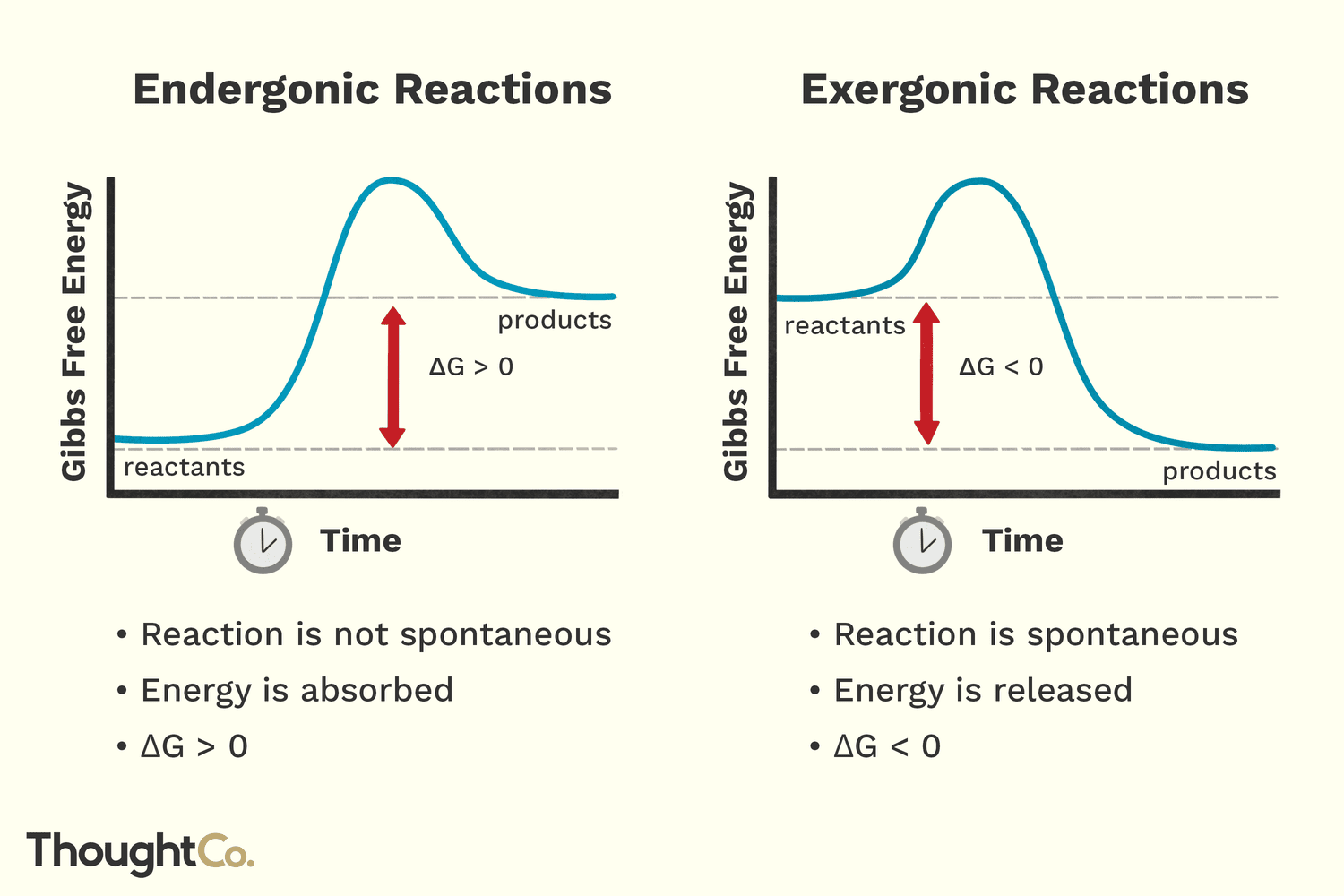
What is an exergonic reaction?
Reactants have higher free energy than products; delta G is negative and energy is released
-Reactants (high free energy)
-Products (low free energy)
Does an exergonic reaction release or absorb energy?
Releases
What’s an endergonic reaction?
A reaction with positive delta G where energy must be added because products have higher free energy than reactants
-Reactants (low free energy)
-Products (high free energy)
Does an endergonic reaction release or absorb energy?
Absorbs
N.A
What does a large negative delta G favor?
Favors product formation
The higher the delta G is the reaction faster or slower?
slower
What is activation energy?
the energy required to reach the transition state
What happens if you lower the activation energy?
Lowering the activation energy (Ea) makes a reaction happen faster because it becomes easier for reactant molecules to reach the transition state.
Delta G is the different in what?
the difference in free energy between reactants and products
According to delta G, when is a reaction favorable?
if the difference in free energy between reactants and products is negative
According to delta G, when is a reaction not favorable?
if the difference in free energy between reactants and products is positive
What does it mean when a reaction reaches equilibrium?
Equilibrium means the reaction has produced some amount of product, and now the forward and reverse reaction rates are equal.
What is the rate-limiting step?
the slowest step in reaction pathway, so it has really high activation energy, and it controls the overall reaction rate
What are the 3 mechanisms that enzymes use to lower activation energy?
covalent bond rearrangement
proximity effect
stabilization of transition state
How do enzymes lower activation energy through covalent bond rearrangement?
The enzyme forms a temporary covalent bond with the substrate using side chain or active sites, and this changes the reaction pathway, so the transition state requires less energy
-Ser, Cys, Lys, His
How do enzymes lower the activation energy through the proximity effect?
-The enzyme brings reactive groups close together and in the correct orientation. this increases rate by lowering the energy needed to get molecules into the right position
How do enzymes lower the activation energy through the stabilization of transition states?
Enzymes form optimized weak interactions (H‑bonds, ionic, Van der Waals, hydrophobic) with the transition state, stabilizing it and lowering activation energy
What is enzyme kinetics?
Enzyme kinetics is the quantitative study of reaction rates and how they change with substrate concentration, enzyme concentration, inhibitors, and other conditions.
In enzyme kinetics what does reaction rate (v) represent?
how fast product is being formed
In enzyme kinetics what does Vmax represent?
the maximum rate when the enzyme is saturated with substrate
In enzyme kinetics what does Km represent?
The substrate concentration at ½ Vmax. Reflects how tightly the enzyme binds the substrate
-aka Michaelis constant
In enzyme kinetics what does kcat represent?
the turnover number; how many substrate molecules each enzyme converts per second
In enzyme kinetics what does the Michaelis-Menten equation represent?
Describes how reaction rate depends on substrate concentration
In the equation of Michaelis Constant, what does a low Km mean?
the enzyme has high affinity for its substrate — it binds the substrate very well and reaches half‑maximal velocity at a low substrate concentration.
In the equation of Michaelis Constant, what does a high Km mean?
A high Km means the enzyme has low affinity for its substrate — it does not bind the substrate very well, and it needs a higher substrate concentration to reach half‑maximal velocity
In a two-substrate reaction, what is the sequential mechanism in a random order?
It is where one substrate binds first then the other and the order can be random as long as both substrates bind; forms a ternary complex
In a two-substrate reaction, what is the sequential mechanism if it’s ordered?
It means that the substrates need to bind in a specific order
In a two-substrate reaction, what is the Ping-Pong Mechanism?
-no ternary complex.
The enzyme binds Substrate A, performs chemistry, releases Product P, and is left in a modified form (E\).
Only then can Substrate B bind to E\, producing Product Q.
At no point are A and B bound at the same time.
In enzyme inhibition, what are irreversible inhibitors?
Irreversible inhibitors bind to an enzyme and permanently destroy its activity, usually by forming a covalent bond with an essential amino acid in the active site.
In enzyme inhibition, what are reversible inhibitors?
they bind non‑covalently, can come on and off, and the enzyme is not permanently damaged.
often used as drugs to slow down a specific enzyme
What are the 3 types of reversible inhibitions?
-competitive
-uncompetitive
-noncompetitive
What is competitive inhibition?
where the inhibitor competes with the substrate for the active site.
What is uncompetitive inhibition?
Where the inhibitor binds an allosteric site, not the active site. Substrate can still bind, but catalysis is blocked.
What is mixed inhibition?
-Inhibitor binds only to the ES complex, never to free enzyme. This “locks” substrate in place and prevents product formation.