ISCI 1A24 - biogeochemical cycles
 Studied by 0 people
 Call Kai
 Learn
Learn Practice Test
 Spaced Repetition
 Match
Match Flashcards
 Knowt Play
1/47

There's no tags or description
Looks like no tags are added yet.
Name | Mastery | Learn | Test | Matching | Spaced |
|---|
No study sessions yet.
48 Terms
Biogeochemical cycles
the movement/cycling of matter through a system
why do biogeochemical cycles exist?
elements required for life are relatively stable, distribution of elements varies over the globe, elements are sequestered and released by organics
Water Cycle
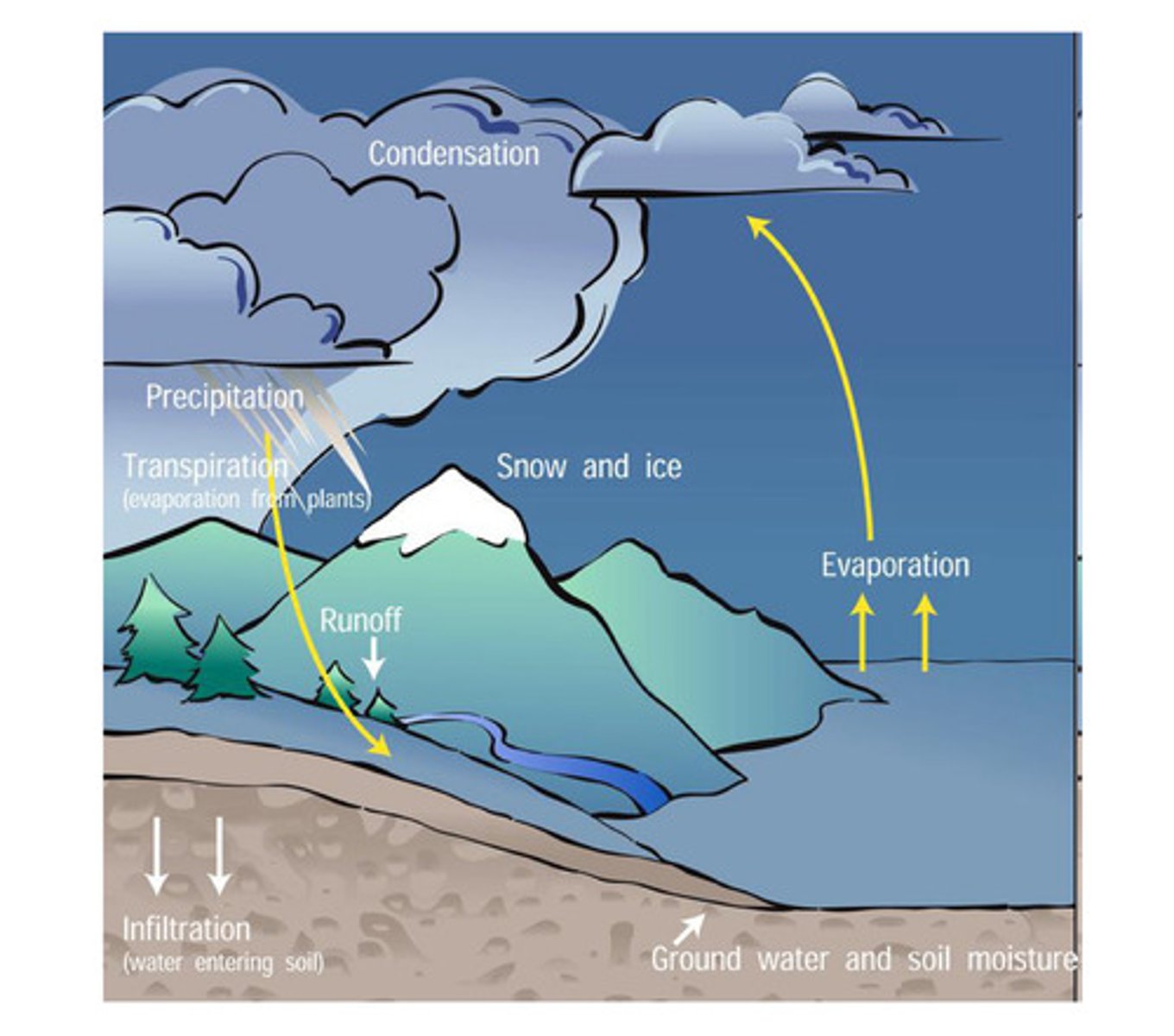
Process of precipitation, evaporation, and condensation on Earth, including transpiration, runoff, and infiltration
Precipitation
Water falling from the atmosphere to the Earth's surface.
Evaporation
Process of water turning into vapor and rising into the atmosphere.
condensation
the process of water vapor in the atmosphere changing to a liquid/precipitation
Transpiration
Release of water vapor from plants into the atmosphere.
Runoff
Excess precipitation that flows over the land surface.
Subsurface runoff
Water that seeps into the ground and flows underground.
Water Cycle: Precipitation on Land
more precipitation falls on land (71cm/yr) than evaporates or transpires (47cm/yr); the excess precipitation leaves as runoff and subsurface runoff
Water Cycle: Precipitation in the Ocean
less precipitation falls on the ocean (110cm/yr) than evaporates or transpires (120cm/yr), therefore there is an export of water from the ocean to the land via the atmosphere
Carbon Cycle
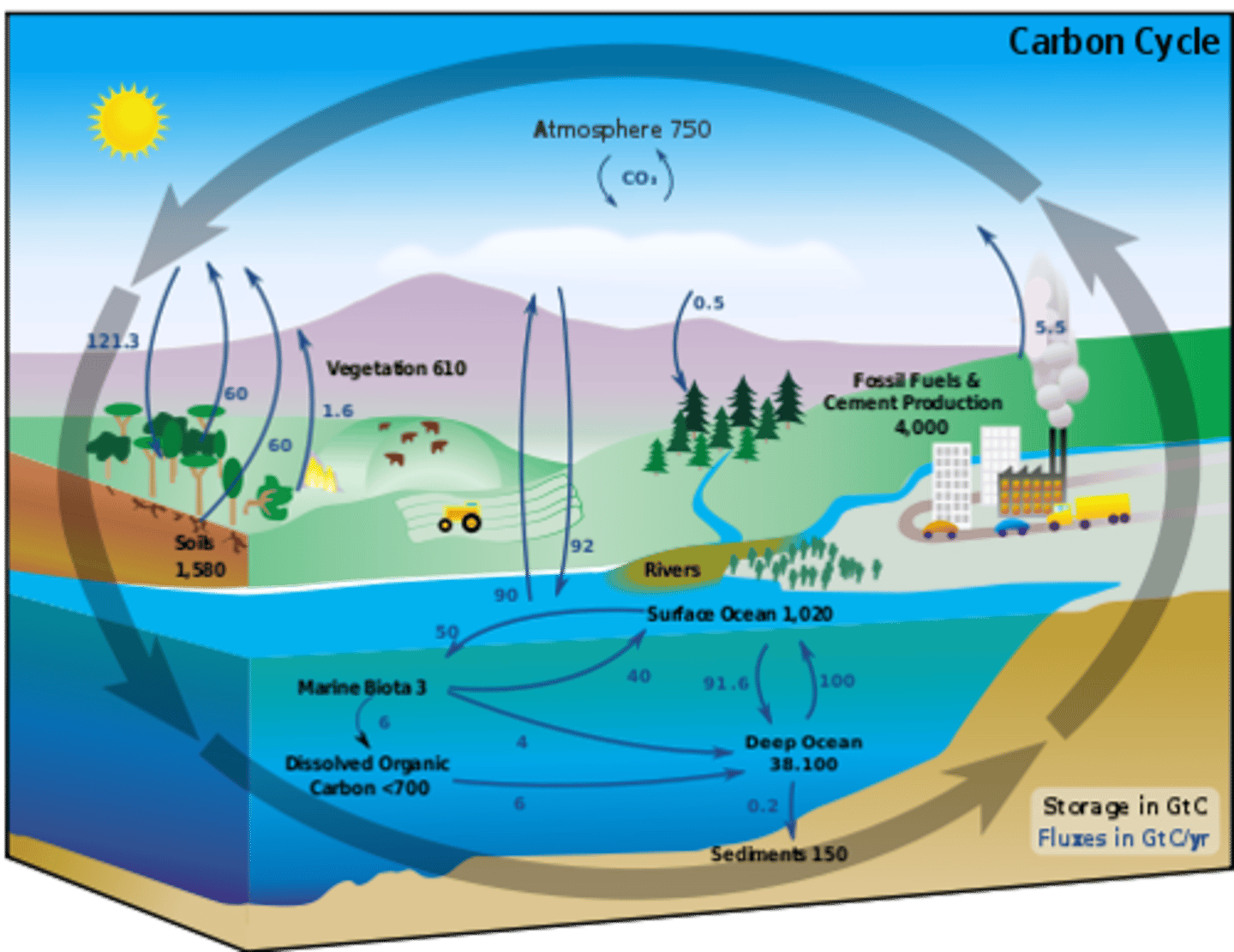
Movement of carbon between the atmosphere, plants, and oceans.
Carbon Fluxes
Transfer of carbon through various processes; the largest carbon fluxes occur between land plants and the atmosphere, and between the ocean and the atmosphere.
what are the four major reservoirs of carbon, in order?
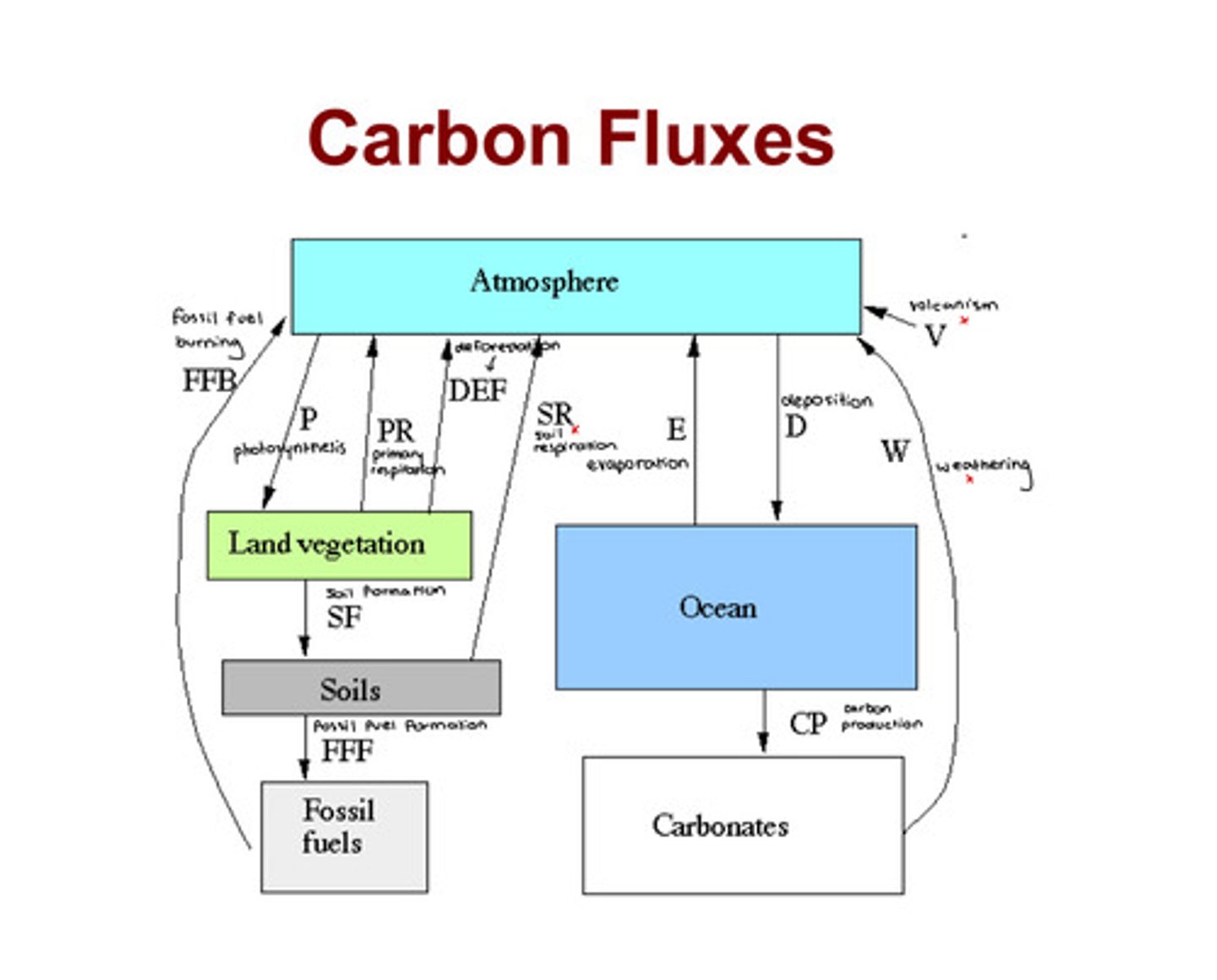
the atmosphere, the oceans, land, and fossil fuels
anthropogenic vs non-anthropogenic fluxes
non-anthropogenic fluxes between key major reservoirs are about even, while anthropogenic fluxes are an extra addition that are not massive, but are persistent
fossil fuels and carbon flux
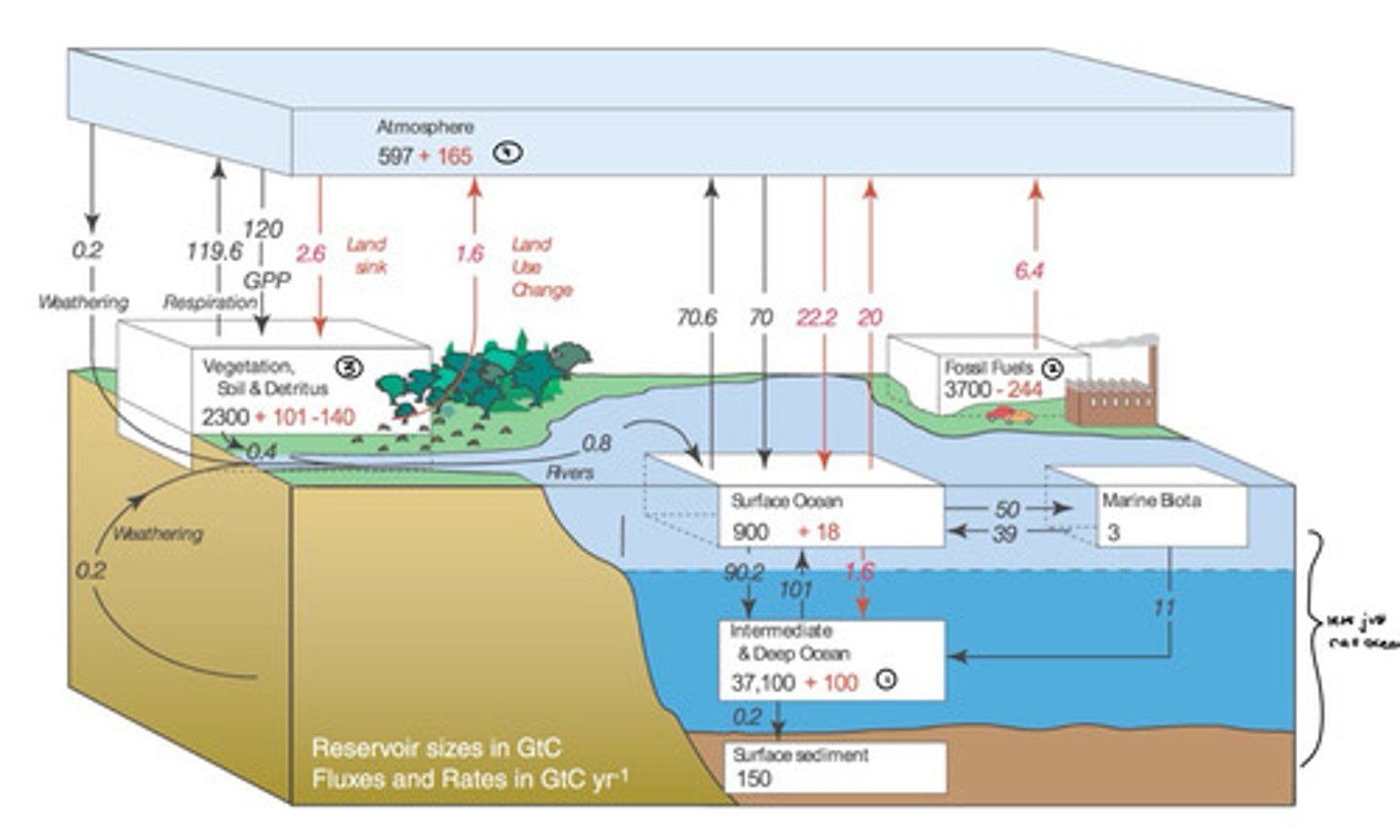
the flux out of fossil fuels is MUCH faster (60 000 times) than the flux in
net carbon flux to the atmosphere
the buildup of carbon dioxide in the atmosphere is about 4GtC/yr; to the atmosphere (plant respiration, soil respiration, fossil fuel burning, deforestation, ocean evaporation, weathering) > from the atmosphere (plant photosynthesis, ocean dissolving)
why is the net carbon accumulation in the atmosphere less than the anthropogenic flux addition?
because the ocean exchange works by diffusion! (i.e. flux to the atmosphere from fossil fuel and deforestation (6+2 GtC/yr) returns back to ocean because of gradient of CO₂, therefore the net flux ends up being less)
Plant respiration
Release of carbon dioxide by plants during cellular respiration.
Soil respiration
Release of carbon dioxide by microorganisms in the soil.
Fossil fuel burning
Combustion of fossil fuels, releasing carbon dioxide.
Deforestation
Clearing of forests, releasing carbon dioxide.
Ocean exsolving
Release of carbon dioxide from the ocean.
Weathering
Breakdown of rocks, releasing carbon dioxide.
Plant photosynthesis
Process by which plants convert carbon dioxide into oxygen.
Ocean dissolving
Absorption of carbon dioxide by the ocean.
Net Carbon Fluxes
Difference between carbon fluxes into and out of the atmosphere.
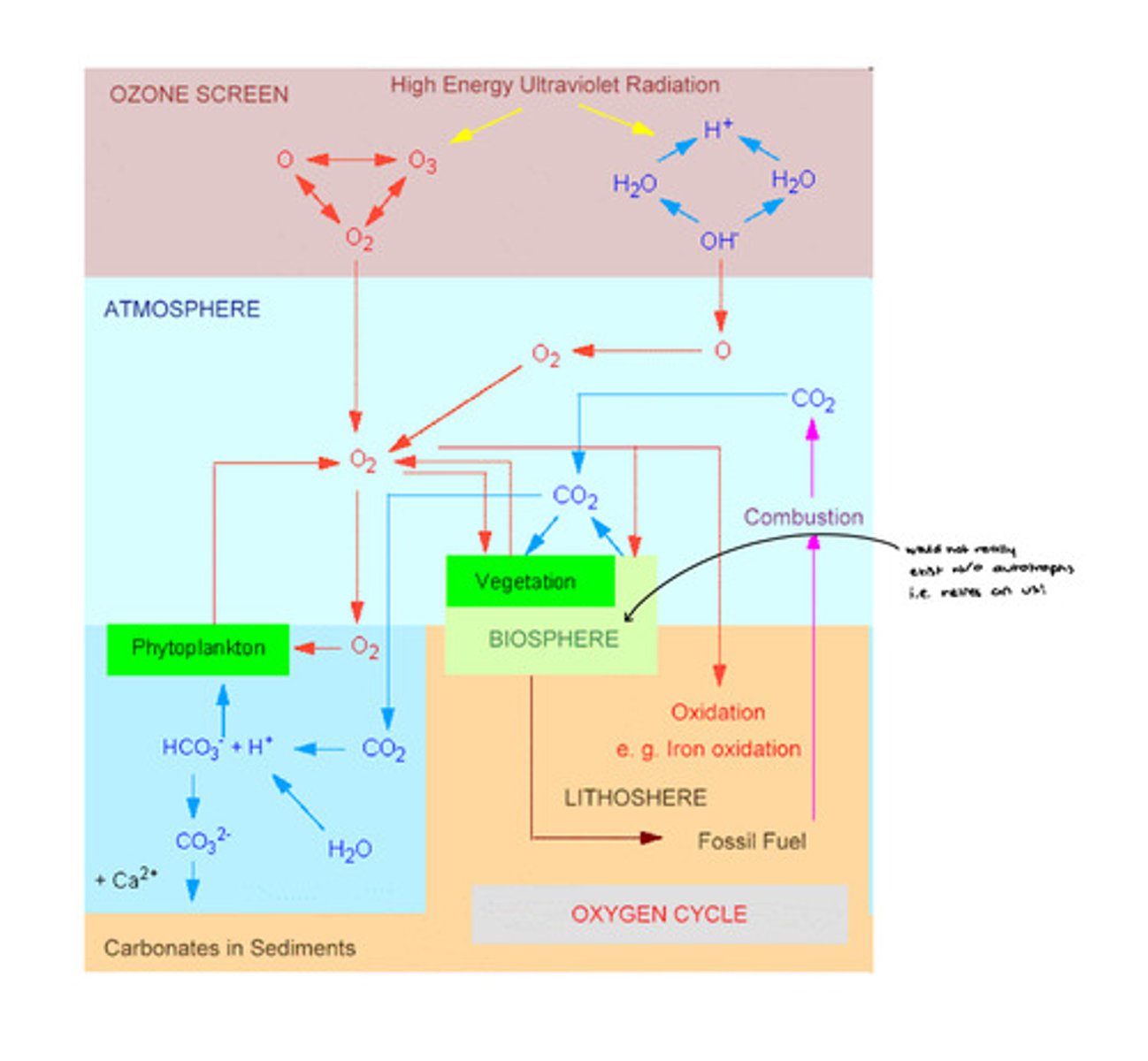
Oxygen Cycle
Movement of oxygen between the atmosphere, plants, and lithosphere.
Glucose
A sugar molecule used as an energy source in cellular respiration, acting as an electron donor
what is the importance of oxygen in cellular respiration?
it makes cellular respiration much more efficient when used as the final electron acceptor (change in free energy is 237kJ/mol)
what is the key catalyst of the oxygen cycle
biosphere
where are the largest fluxes of oxygen?
between (land + marine) plants and the atmosphere (i.e. photosynthesis)
what is the greatest reservoir of oxygen?
lithosphere
small amounts of oxygen are also generated where?
in the upper atmosphere through photolysis
Nitrogen Cycle
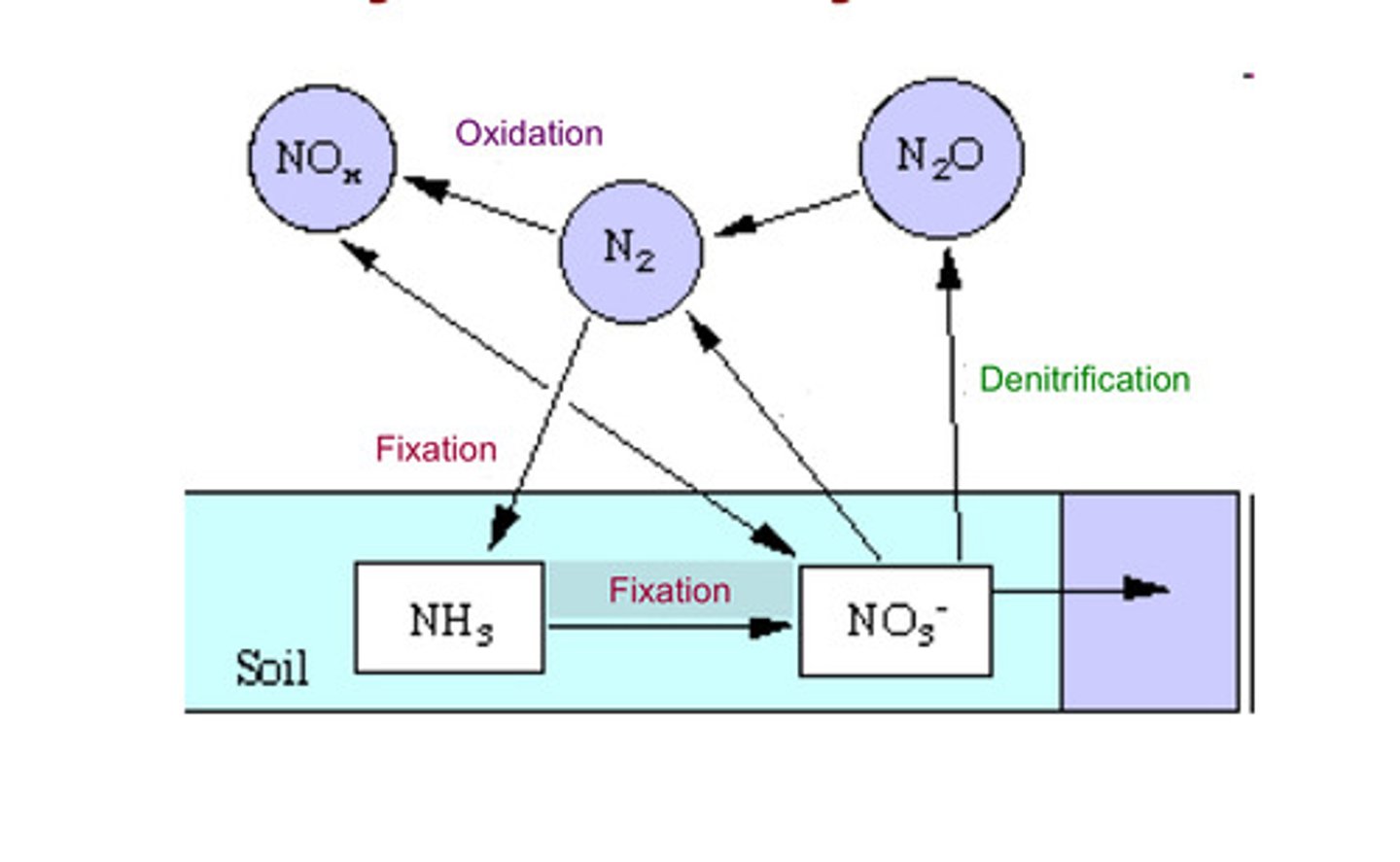
Movement of nitrogen between the atmosphere, soil, and organisms; dependent on microbes for nitrogen fixation and denitrification
what is the nitrogen cycle affected by?
naturally - biological fixation and lightning; human sources - fossil fuels nitrogen-fixing crops, nitrogen fertilizer; they contribute similar amounts
why is nitrogen the most abundant atmospheric element?
it is very stable as N₂ (triple bond!) in the presence of solar radiation, and it is unreactive with materials that make up the solid earth
Nitrogen fixation
Conversion of atmospheric nitrogen into a usable form by bacteria.
Denitrification
Conversion of nitrates back into atmospheric nitrogen.
nitrogen as a pollutant
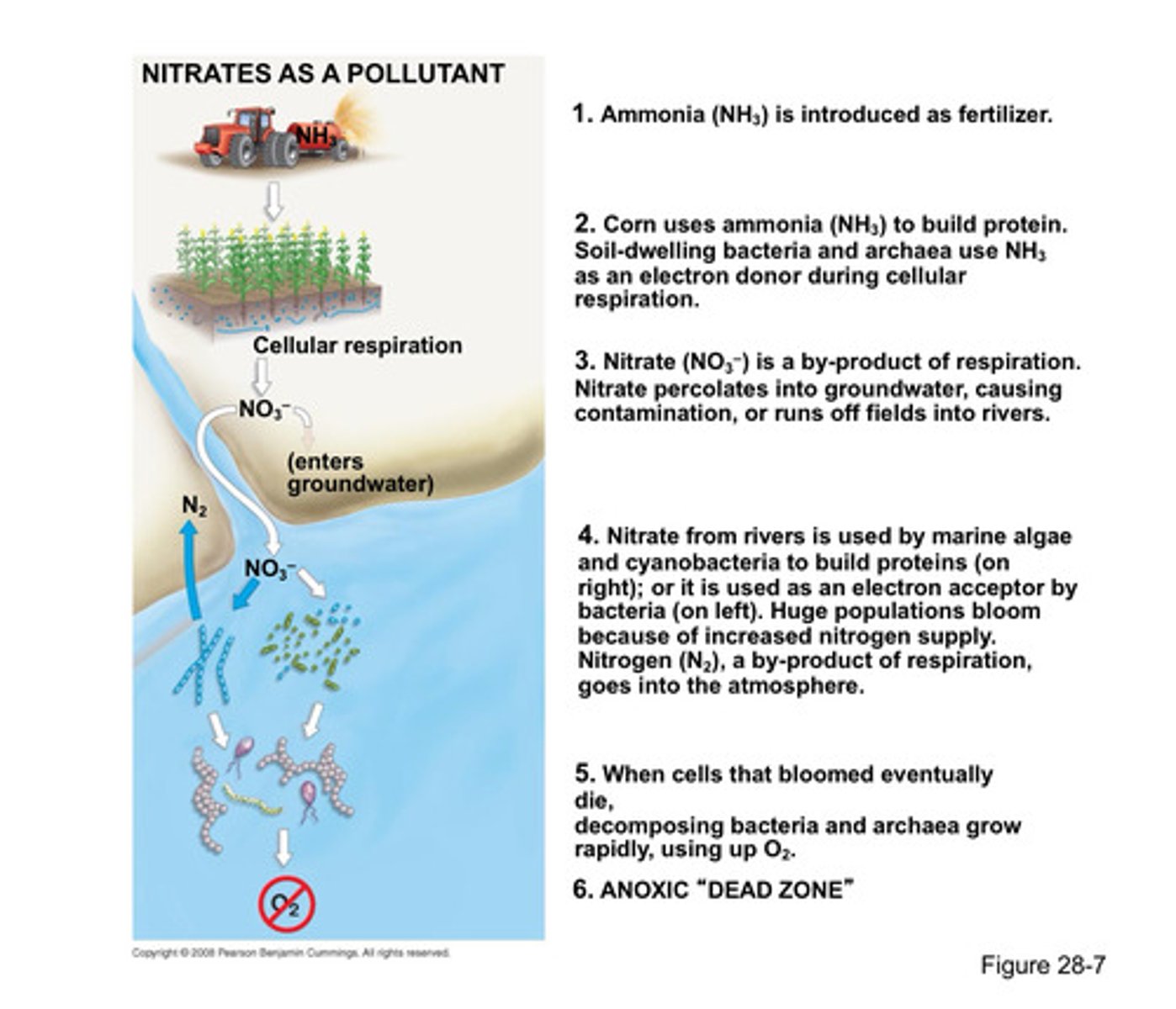
ammonia in fertilizer → nitrate as a byproduct of respiration by plants and soil bacteria → contaminates groundwater and creates runoff into rivers → nitrate causes massive algae blooms, releasing N₂ → blooms die and decomposing bacteria/archaea grow rapidly and use up O₂ → anoxic zone
Phosphorous Cycle
Movement of phosphorous between the lithosphere, water, and organisms; acts like nitrogen cycle and is found only in soluble forms
Active volcanism
ongoing volcanic activity that provides reduced chemical species for organic synthesis; methane and carbon dioxide come as greenhouse gases
Liquid water
Presence of water in a liquid state, crucial for life.
Volcanism on Mars
Eruption of volcanoes on the surface of Mars.
key evidence of past or present water on the surface of Mars
an early period of precipitation (evidence for surface runoff); martian hematite; and layered deposits and putative paleolakes
Martian hematite
Mineral on Mars that indicates the presence of water.
Layered deposits
Stratified rock formations that suggest the existence of ancient lakes.
Recurring slope lineae (RSL)
dark lines on Mars that may be caused by transient flowing water.