Module 6 Antibodies
 Call Kai
 Learn
Learn Practice Test
 Spaced Repetition
 Match
Match Flashcards
 Knowt Play
1/26

There's no tags or description
Looks like no tags are added yet.
Name | Mastery | Learn | Test | Matching | Spaced | Call with Kai | Chat |
|---|
No analytics yet
Send a link to your students to track their progress
27 Terms
Immunoglobulin A (IgA)
Structure: Primarily exists as a monomeric Y-shape in serum, but commonly found as a dimer (two Y-shapes joined by a J-chain and a secretory component) in secretions.
Immunoglobulin A (IgA)
Properties: Found in mucus, saliva, tears, and breast milk. Its primary role is to protect against pathogens at mucosal surfaces. IgA is "squirted out of the body" in secretions.
Immunoglobulin D (IgD)
Structure: Monomeric Y-shape (D
Immunoglobulin D (IgD)
Properties: Primarily found attached to the surface of B cells, where it acts as part of the B cell receptor. It plays a role in activating basophils and mast cells and is involved in the early stages of immunity. Historically, its exact function has been enigmatic, but it is known to help activate antibody-producing cells.
Immunoglobulin E (IgE)
Structure: Monomeric Y-shape
Immunoglobulin E (IgE)
Properties: Primarily found in the blood in very low concentrations. It is responsible for allergic reactions (e.g., to pollen or peanuts) and plays a crucial role in defense against parasitic worms. IgE binds to mast cells and basophils, triggering the release of inflammatory mediators upon antigen binding.
Immunoglobulin G (IgG)
Structure: Monomeric Y-shape. G
Immunoglobulin G (IgG)
Properties: The most abundant antibody class in the blood. It is secreted by plasma cells and is the "major workhorse" of the immune system. IgG is capable of crossing the placenta from a pregnant mother to the fetus, providing passive immunity to the newborn until their own immune system develops. It plays a vital role in neutralizing toxins, opsonizing pathogens, and activating complement.
Immunoglobulin M (IgM)
Structure: Exists as a monomeric Y-shape on the surface of B cells as part of the B cell receptor. When secreted, it typically forms a pentamer (five Y-shapes joined by a J-chain), giving it a structure resembling a multi-armed entity.
Immunoglobulin M (IgM)
Properties: It is the first type of antibody produced after initial exposure to an antigen. Although each individual arm of the pentameric IgM binds an antigen relatively weakly, the presence of ten antigen-binding sites allows the pentamer to bind antigens very tightly. It is crucial in the early stages of humoral immunity, effectively agglutinating (clumping) pathogens and activating complement.
Marking for Destruction
Once bound to an antigen, antibodies mark the invader for destruction by other components of the immune system.
Direct Neutralization
Some antibodies can directly neutralize a threat by preventing a pathogen from entering host cells.
Tagging for Removal
Antibodies can tag invaders, making them easier targets for removal by phagocytic immune cells like macrophages.
Antibodies
also known as immunoglobulins (Ig), share a basic Y-shaped structure.
Two Light Chains
These are the shorter polypeptide chains in the antibody molecule.
Two Heavy Chains
These are the longer polypeptide chains.
Fc (Fragment Crystallizable) Region
The bottom of the Y-shape, or the stalk. This part binds to various immune system compounds and cells.
disulfide bonds
It helds the ligth and heavy chains together
Binding to Foreign Invaders (lock-and-key mechanism)
Antibodies bind specifically to antigens, which are molecules or molecular fragments found on foreign invaders like viruses, bacteria, fungi, and parasites.
Marking for Destruction
Once bound to an antigen, antibodies mark the invader for destruction by other components of the immune system.
Direct Neutralization
Some antibodies can directly neutralize a threat by preventing a pathogen from entering host cells.
Complement Activation
The stalk (Fc region) of an antibody can bind to other immune system compounds, triggering pathways like the complement cascade, which helps kill the antigen or mobilize the immune system.
Tagging for Removal
Antibodies can tag invaders, making them easier targets for removal by phagocytic immune cells like macrophages.
Coating Invaders
Some antibodies may wrap viruses or bacteria in a coating, facilitating their removal by immune cells.

Shape of Ig G, E, D
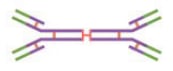
Shape of IgA

Shape of IgM