Aerobic respiration
 Studied by 0 people
 Call Kai
 Learn
Learn Practice Test
 Spaced Repetition
 Match
Match Flashcards
 Knowt Play
1/5

There's no tags or description
Looks like no tags are added yet.
Name | Mastery | Learn | Test | Matching | Spaced |
|---|
No study sessions yet.
6 Terms
What are the stages of aerobic respiration and where do they occur?
Glycolysis- cytoplasm of cell
Link reaction- mitochondrial matrix
Krebs cycle- mitochondrial matrix
Oxidative phosphorylation- cristae of mitochondria
What is the equation of photosynthesis?
C6H12O6 + 6O2 → 6CO2 + 6H2O + ATP
Glucose + Oxygen → Carbon dioxide + Water + Energy
What happens during glycolysis?
Overall:
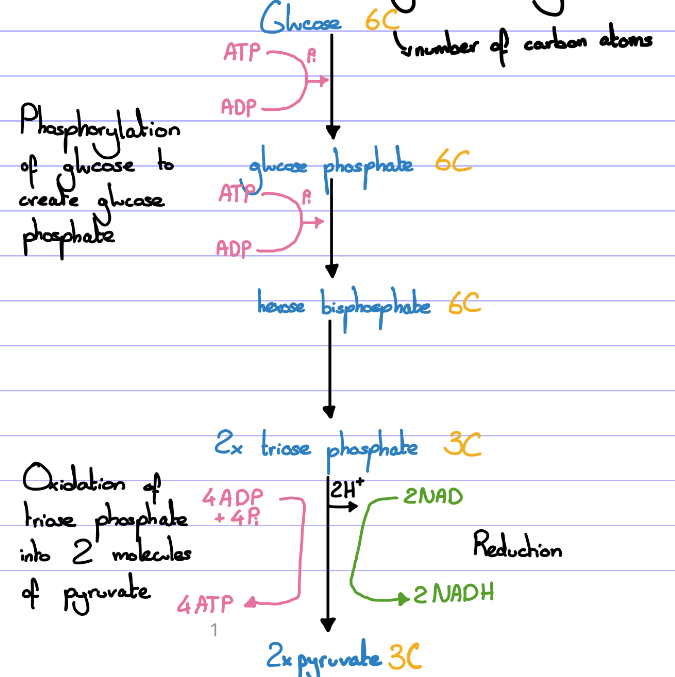
Glucose gains 2 phosphate groups from 2x ATP and so is phosphorylated to form glucose bisphosphate (6C) and then splits into 2x TP (3C)
TP is then oxidised (as 2NAD is reduced to 2NADH) and has its phosphate group removed by ADP to form pyruvate (this happens twice to form 2x pyruvate) (3C). During this 4ADP + 4Pi forms 4 molecules of ATP.
Pyruvate is small enough to pass through the outer membrane of the mitochondria for aerobic respiration to occur.
4 molecules of ATP produced + 2 used at the start, giving a net gain of 2 ATP molecules.
The coenzyme NAD is also used and reduced to NADH.
What happens during the link reaction?
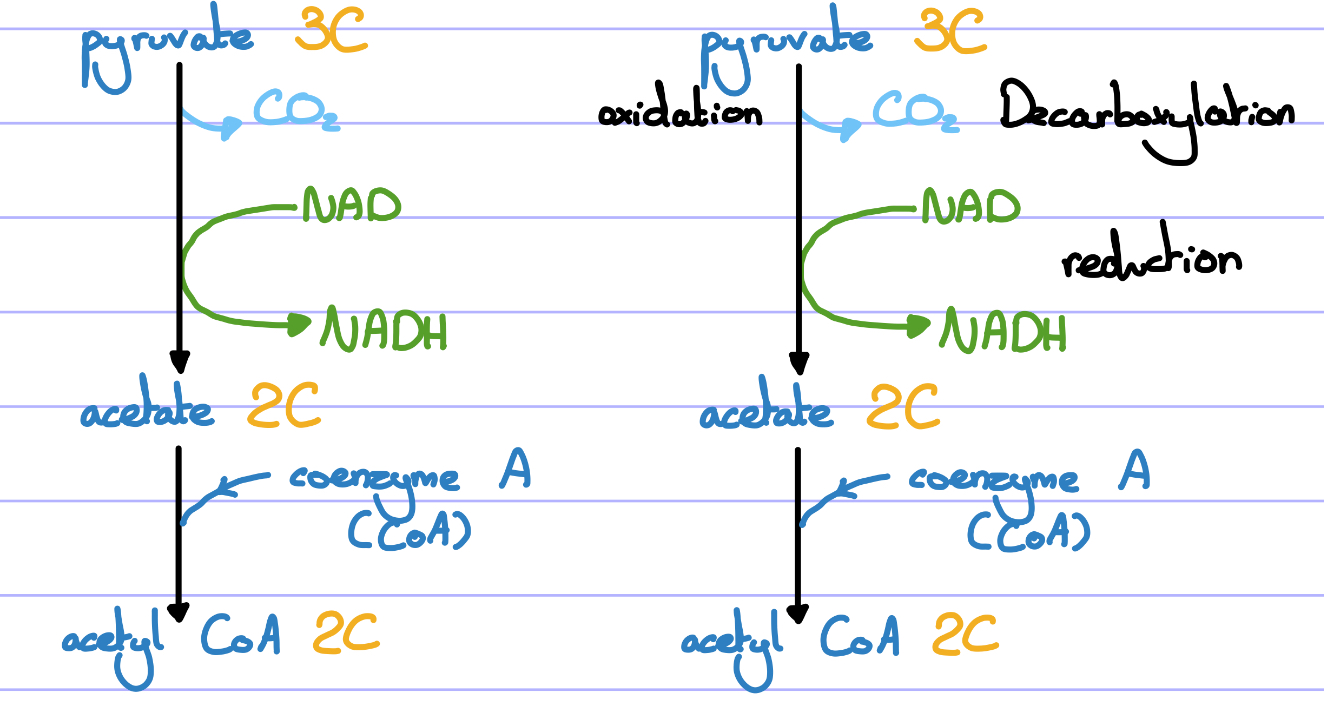
The two molecules of pyruvate produced previously are actively transported into the mitochondrial matrix where decarboxylation occurs.
The pyruvate will be oxidised using another NAD molecule and then one carbon atom is lost to form CO2. This produces acetate (2C).
Coenzyme A is then combined with acetate to form acetyl coenzyme A.
This process happens twice because 2 molecules of pyruvate were produced from glycolysis.
What happens during the Krebs cycle?
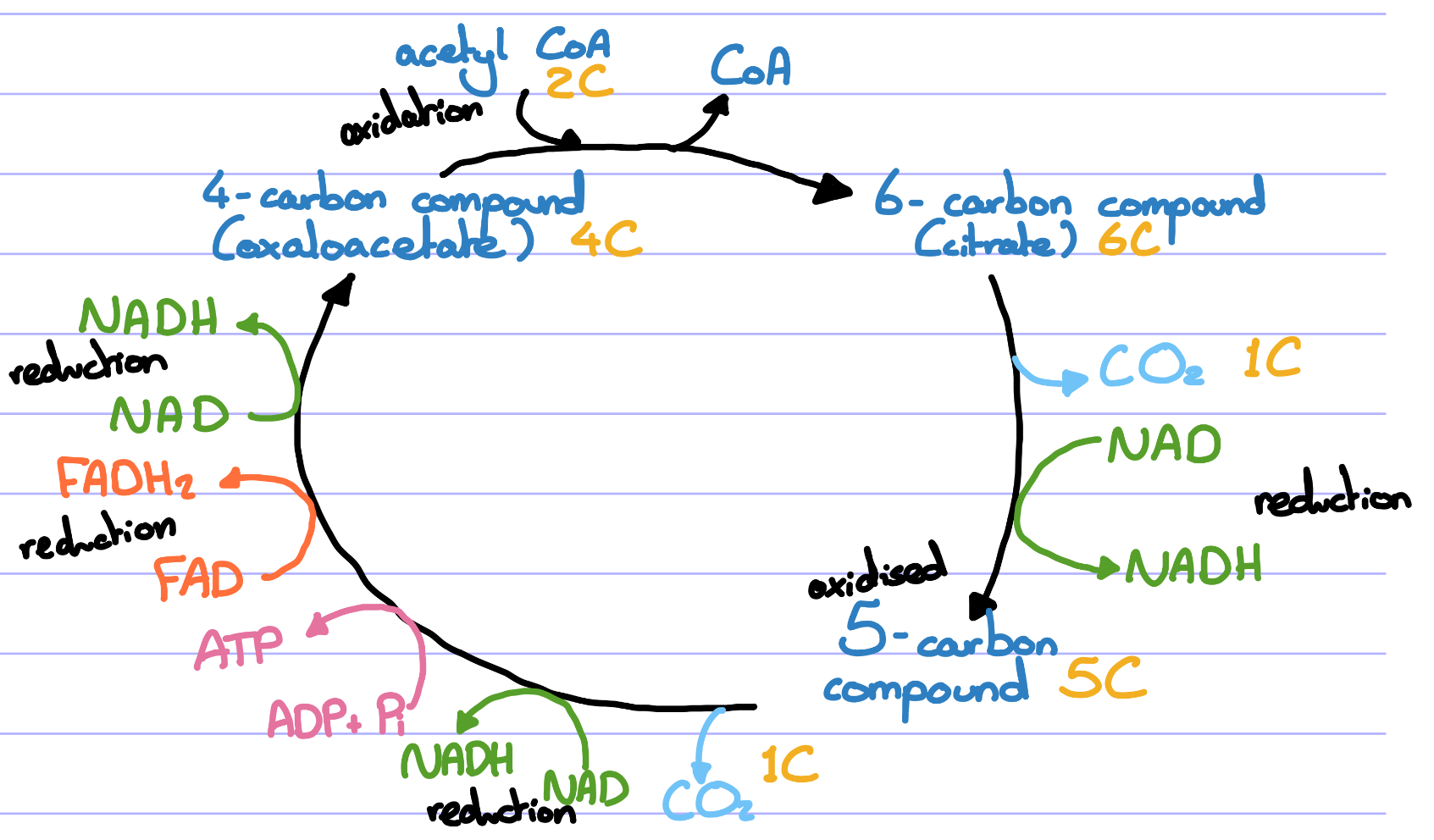
Acetyl CoA (2C) combines with oxaloacetate (4C) to form Citrate (6C).
Coenzyme A is released to be reused in the link reaction.
Citric acid (6C) is decarboxylated and oxidised (NAD to NADH) to form an intermediate 5C compound.
The compound is again decarboxylated and oxidised to produce 1 molecule of ATP, 2 NADH molecules and 1 FADH2 molecule.
Oxaloacetate is regenerated ready to combine with another acetyl CoA.
What happens during oxidative phosphorylation?
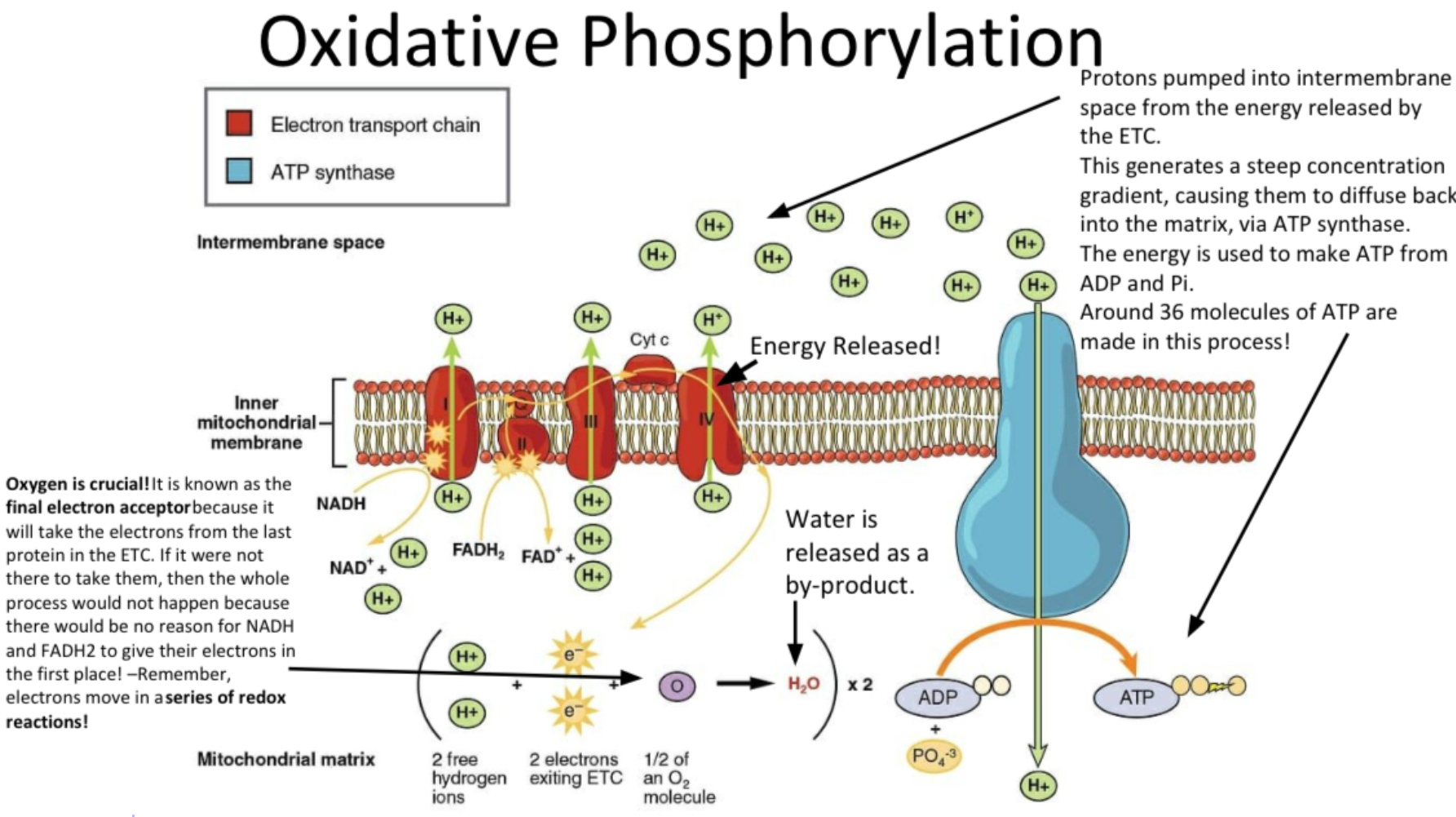
NADH and FADH2 release their hydrogen atoms which split into protons (H+) and electrons. The coenzymes are then reused in earlier stages.
The electrons are then passed along the electron transfer chain which releases energy and stimulates some carriers to pump protons (H+) from the mitochondrial matrix into the intermembrane space. This creates an electrochemical gradient.
Protons flow back into the matrix through ATP synthase which catalyses the formation of ATP from ADP and Pi (chemiosmosis).
At the end of the chain, electrons combine with oxygen (the final electron acceptor) and protons to form water. Without oxygen, the chain would stop.
Around 36 molecules of ATP are made in this process.