Geriatric Rehabilitation
 Call Kai
 Learn
Learn Practice Test
 Spaced Repetition
 Match
Match Flashcards
 Knowt Play
1/41

Earn XP
Description and Tags
Name | Mastery | Learn | Test | Matching | Spaced | Call with Kai | Chat |
|---|
No analytics yet
Send a link to your students to track their progress
42 Terms
Elderly
Early is defined as people aged 65 years old
Elderly dependency rate is defined as ratio between the elderly population and the working age (15 – 64 years) population
4 Components of Geriatric Rehabilitation
Accommodation of Irreversible Changes of Aging.
Restoration of Function For Reversible Impairments.
Prevention of Disability.
Medical Treatment of Existing Conditions.
Factors Affecting Rehabilitation

Activity Recommendation in Older Adults with No Limitations

Physiological Changes: Muscle
Overall decreased in lean body mass with increased in fat content.
Loss of type II with predominance of type I muscle fibers.
Type I: slow-twitch, for endurance
Type II: fast-twitch, for short powerful movements
Decreased number of motor units.
Cachexia
Weakness and muscle wasting due to a disease
Type 1 Muscle Fiber Loss
Sarcopenia
Weakness and skeletal muscle loss is due to aging.
Type 2 Muscle Fiber Loss
Neurologic
Decreased brain volume, frontal gray matter loss decreased cerebral blood flow.
Cognitive deficits
Decline in episodic and long-term memory with personal context
Stable and is even improved procedural and semantic memory.
Vision declines due to challenges in all ophthalmic tissues.
Retinal aging is associated with muscular degeneration and loss of central vision.
Optic nerve damage can result in glaucoma and visual field loss.
Lens aging may result in cataracts.
Age related hearing loss (Presbycusis) is a bilateral and symmetrical process
Affected by intrinsic and extrinsic factors
Conductive hearing loss with a narrow range of audibility
Inability to hear high-frequency sounds.
Cardiovascular
Progressive decline in maximal heart rate at 6–10 beats/min/decade after the age of 25.
Changes in Aging:
Decreased Arterial Compliance
Increased Systolic Pressure
Left Ventricular Hypertrophy with Impaired Filling
Decreased Beta-Adrenergic Receptor Stimulation Response
Decreased Sa Node Automaticity
Decreased Number of Myocytes
Pulmonary
Lung surface area decreases due to alveolar and duct enlargement.
Loss of elastic recoil and lung stiffening resulting in increased lung compliance and decreased thoracic wall mobility.
Decreased respiratory muscle strength.

Gastrointestinal
Increased Cholecystokinin and Leptin
Decreased gastric acid production
Cholecystokinin (CCK)
Stimulates satiety center in the brain and delays gastric emptying time.
Leptin
Inhibits hunger
Decreased Gastric Acid Production
Impaired absorption of Vitamin B12, calcium, iron, zinc, and folic acid.
Change in microbial flora within GI tract.
Genitorurinary
Reduction in bladder capacity and urethra & bladder compliance.
Inability to postpone voiding
Postmenopausal changes include increased vaginal wall fragility and decreased vaginal lubrication.
Benign prostatic hyperplasia develops under hormonal influence and is almost universal in men over 40 years of age.
Incontinence and erectile dysfunction are not a consequence of aging.
Endocrine
Decreased anabolic hormones such as testosterone, GH, insulin-like growth factor, estrogen:
Changes in Body Composition
Impaired Glucose Tolerance
Collagen Loss and Thinning of the Skin
Bone Loss
Skin
Consider changes due to normal aging as well as environmental factors:
Thinning of the Epidermis
Decreased Cell Turnover
Impaired Immune Response and Wound Healing
Decreased Moisture Content, Elasticity, Blood Supply and Sensory Sensitivity
Medication Metabolism
Increase in adipose tissue increases the volume of distribution of fat-soluble drugs and prolongs their half-life.
Reduce frequency of medication
Total body water decreases, which decreases the volume of distribution of water-soluble drugs, resulting in higher serum concentration
Reduce dose of medication
Hepatic and renal clearance could also be decreased by 30–50% in elderly.
Gait
Associated with falls and fear of falling.
Characteristic Gait of Elderly
Decreased Speed
Increased Double Limb Support
Shorter Stride Length
Broader Base of Support
Recommendations for Fall and Injury Prevention in the Elderly

Health Concerns
Frailty
Falls
Osteoporosis
Malnutrition
Depression
Delirium
Dementia
Frailty
Age- and disease-related loss of adaptation, such that events of previously minor stress result in disproportionate biomedical and social consequences.
Clinical syndrome in which THREE OR MORE of the following are present:
Unintentional weight loss of at least 10 lbs over the past year
Self-reported exhaustion
Weakness (grip strength)
Slow speed walking
Low physical activity
Falls
Falls and near-falls occur in more than 30% of people aged 65 years or older.
Causes significant injury:
90% of fractures in the hips, pelvis, and forearm result from falls
Most common cause of TBI
Primary etiology of accidental deaths in those older than 65 years
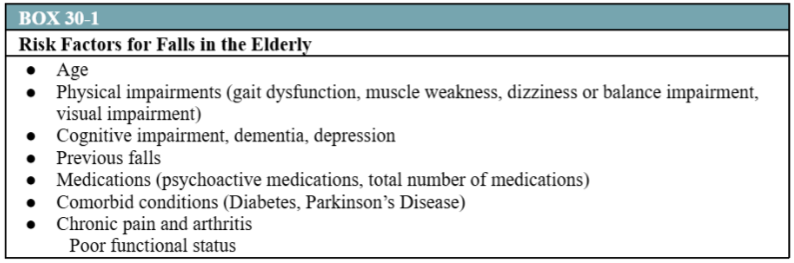
Risk Factors for Falls in the Elderly
Osteoporosis
Extremely prevalent
Affect ⅓ of postmenopausal women.
½ of the population is older than 75 years.
An important consequence of osteoporosis is fracture.
Risk Factors: Malnutrition
Physiologic Factors of Aging
Physical Conditions
Consequences
Physiologic Factors of Aging
Decreased Total Body Protein Level
Decreased Taste and Smell Sensation
Increased Levels of Neurotransmitters that Decrease Appetite and Promote Early Satiety
Physical Conditions
Reduced Physical Activity
Poor Dentition
Digestive Disorders
Consequences
Decrease Immunity
Poor Wound Healing
Increased Skin Fragility
Increased Risk of Complications from Existing Comorbidities
Depression
Most common mood disorder in geriatric population
Risk of suicide is 5x higher than that of any other age group
Early diagnosis and management can help to decrease further disability, restore function and reduce risk of suicide.
RIsk Factors: Depression
Poor Self-Rated Health
Poor Cognitive Function
Impaired ADLs
2 or More Medical Visits in the Past Month
Frequent Falls
Delirium
DSM V criteria
Disturbance in attention and awareness
Usually of acute onset and temporary
Frequently due to physical disease or drug effects
Risk of delirium is higher in severely ill patients with co–morbidities.
MMSE is helpful in determining delirium
MMSE <24 is abnormal, with attention, concentration, and recall subscales being the most sensitive for detecting delirium.
Dementia
WHO definition:
Memory decline, especially in the learning of new information, lasting longer than 6 months.
It is not a normal part of aging
Diagnosis is based on the gradual onset of cognitive impairment and continuing decline, when all other causes have been excluded.
Alzheimer’s Disease is the most common cause of dementia (60–70 % of geriatric patients has dementia)
Risk Factors:
Advanced Age and Family History
Down Syndrome
Head Trauma
Clinical Depression
Low Educational Level
Small Head Circumference and Brain Size have been Associated with Early Onset of Alzheimer’s Disease
Driver’s Evaluation
Elderly have the highest accident rate per mile driven.
Failure to yield the right-of-way
Not abiding by signs or signals
Account for 13% of all driving fatalities
Factors Affecting Driving Ability
Physiological Factors
Cognition
Psychomotor Functioning
Medical Condition
Physiological Factors
Vision is the most important sensory change in predicting driving impairment.
Cognition
Distraction while driving.
Psychomotor Functioning
Limited cervical range of motion.
Medical Condition
Risk of collision resulting in injury is substantially increased among older diabetic drivers who are taking insulin or oral agents for more than 5 years.
Driver’s Test Step

Driver’s Evaluation

Cessation of Driving
Common factors associated with driving cessation
Increasing Age
Female S3x
Functional Impairments
Neurologic Disease
Visual Impairment
Those who stop driving are at risk for social isolation, depression and functional impairment.