ACCA MA
 Call Kai
 Learn
Learn Practice Test
 Spaced Repetition
 Match
Match Flashcards
 Knowt Play
1/307

There's no tags or description
Looks like no tags are added yet.
Name | Mastery | Learn | Test | Matching | Spaced | Call with Kai | Chat |
|---|
No analytics yet
Send a link to your students to track their progress
308 Terms
Aims and objectives should be.... [acronym]
SMART
Specific
Measureable
Attainable / achievable
Relevant
Timed
At each level, describe how managers will need non-financial information...
At a strategic level: management need to know about developments in their markets and in the economic situation. They also need to know about any new tech that emerges and about activities of competitors
At a tactical level: they might want to know about issues such as product or service quality, speed of handling customer complaints, customer satisfaction levels, employee skill levels and employee morale
At an operational level: might want to know about the number of rejects per machine, the lead time for delivering materials and the number of labour and machine hours available
By following the SMART hierarchy, a business should be able to...
produce plans that lead to goal congrunce throughout the departments, centres and/or regional offices (the whole business)
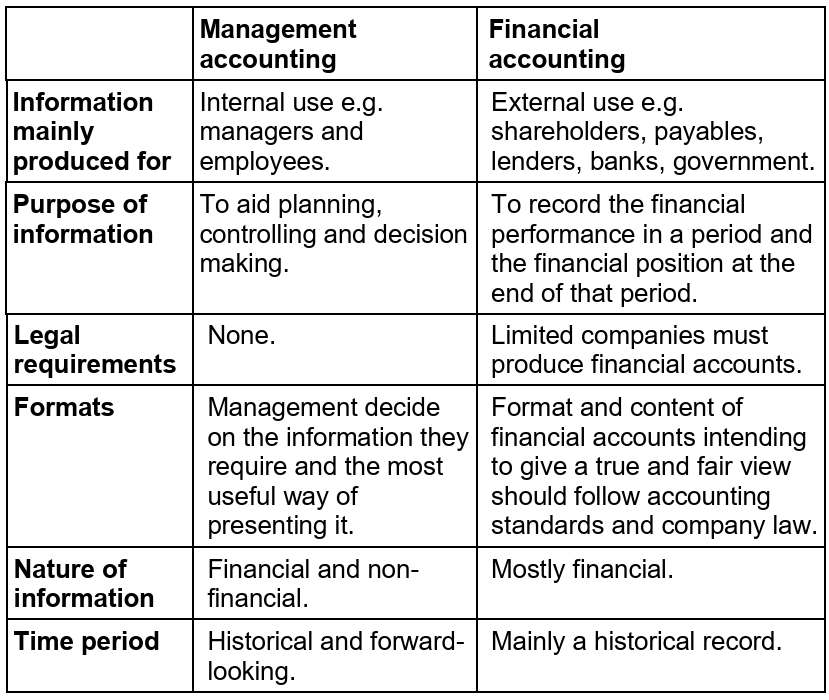
Compare and contrast financial accounting with cost and management accounting
Control involves...
gathering information about actual results achieved
compare actual results and expected results - evaluate outcome
revise original objectives if necessary
Cost Accounting
A system for recording data and producing information about costs for the products produced by an organisation and/or the services it provides.
It is also used to establish costs for particular activities or responsibility centres
Cost accounting involves...
a careful evaluation of the resources used within the enterprise
Costs and benefits of reporting relate to...
the frequency of reporting
Info has to be gathered, collated and reported in proportion to frequency, and costs will move in line with this.
Initially benefits increase sharply, but this inc starts to tail off. --> A point may come where info overload sets in and benefits actually start to decline and even become negative. --> If managers are overwhelmed with information this can actually get in the way of completing a job.
Decision Support System (DSS)
(Management Control / Tactical)
An aid to making decisions. The system predicts the consequences of a number of possible scenarios and the manager then uses their judgement to make the final decision.
Decision-making involves
implementing decisions
Decision-making involves...
Considering information that has been provided and making an informed decision.
In most situations, involves making a choice between two or more alternatives.
Managers need reliable information to compare the different courses of action available and understand what the consequences might be of choosing each of them
1st part of decision-making = planning
2nd part of decision-making = control
Describe operational information
Used mainly by managers on the operational level such as supervisors and section heads who have to ensure that routine tasks are properly planned and controlled.
E.g)
listings of debtors and creditors / payroll details / raw materials requirements and usage
Describe strategic information
Mainly used by directors and senior managers to choose between alternative courses of action, to plan the organisation's overall objectives and strategy and to measure whether these are being achieved.
Describe tactical information
Used by managers at all levels, but mainly at the middle level for tactical planning and management control activities such as: pricing, purchasing, distribution and stocking.
e.g)
sales analysis, stock levels, productivity measures
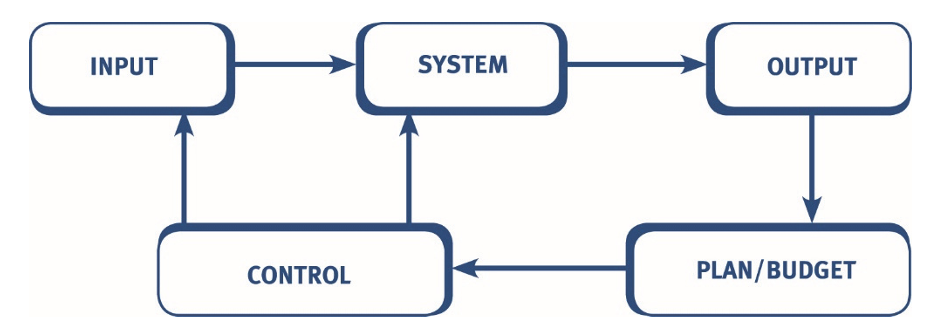
Describe the 'feedback-loop'
Managment prepare a plan,
The plan is put into action by the managers with control over the input resources (labour, money, materials, equipment)
Output from operations is measured and reported 'fed-back' to management and actual results are compared against the plan in conrol reports
Managers take corrective action, where appropriate especially in cases of exceptionally good/bad performance
Feedback can also be used to revise plans or prepare the plan for the next period
Describe the operational level of decision-making
D2D decisions made by junior managers
Describe the purpose and role of cost and management accounting within an organisation.
Provides information for each cost, revenue, profit and investment centre so that managers know about the costs and profits of individual systems.
Describe the strategic level of decision-making
long-term, complex decisions made by senior management
Describe the tactical level of decision-making
medium-term, less complex decisions made by junior managers
Distinguish between data and information
Data: means facts. Consists of numbers, letters, symbols, raw facts, events and transactions which have been recorded but not yet processed into a form for suitable use
Information: is data which has been processed in such a way that it is meaningful to the person who receives it (for making decisions)
NOTE: as data is converted into information, some of the detail of the data is eliminated and replaced by summaries which are easier to understand
During the planning process, the mission statement of a business is used to...
produce effective aims and objectives for employees and the company as a whole
Executive Information System (EIS)
(Strategic Planning)
Gives senior executives access to internal and external information. Information is provided in a summarised form with the option to 'drill down' to a greater level of activity.
Explain the difference between strategic, tactical and operational planning
The difference lies in the time horizon, management level and resource commitment required.
Explain the limitations of management information in providing guidance for managerial decision-making
Accuracy
Timeliness
Understandable
Relevance
Non-financial information
External influence
Financial Accounting
Involves recording financial the financial transactions of an organisation and summarising them in periodic FSs for external users who wish to analyse and interpret the financial position of the organisation
How is 'non-financial information' a limitation to management information?
Managers will not always be guided by financial and other info supplied by the Management Accounting System.
The will also look into the following factors:
qualitative
behavioural
motivational
environmental
While these can be equally as important as financial info, they are hard to estimate and quantify
How is 'relevant costs and revenues' a limitation of management information?
Not all info produced by an accounting system is relevant to the decisions made by management.
In particular, info produced mainly for financial reporting purposes and then taken as the basis for management decisions will often need significant modification to be useful to management
figures presented to assist in management decision-making are those that will be affected by the decision
i.e they should be:
future: costs and revenues that are going to be incurred sometime in the future. costs and revenues that have already been incurred are known as sunk costs and aren't relevant to the decisions to be made
incremental: the extra cost or revenue that is created as a result of a decision taken
cash flows: actual cash being spent or received not monetary items that are produced via accounting convention
How is a failure to comply with the qualities of useful information a limitation of management information?
If info supplied to managers is deficient in any of these respects then inappropriate management decisions may be made.
Consider the following:
accuracy
timeliness
understandable
How is knowledge different from data and information?
Much more personal and the presence or absence of knowledge can only be seen through the actions of individuals.
When knowledge is written down it effectively becomes information.
Identify and explain the attributes of good information
Identified by the 'ACCURATE' acronym.
Accurate
Complete
Cost-effective
Understandable
Relevant
Authoritative
Timely
Easy to use
In what form is management information usually supplied to management...
In the form of reports.
Sometimes these reports are routine and on a regular basis, or they may be prepared for a special purpose (ad-hoc report)
Information produced by the financial accounting system is usually insufficient for...
the needs of management for decision-making
Kaplan's Core Values
Integrity
Knowledge
Support
Opportunity
Results
Kaplan's UK Mission Statement
Helps individuals achieve their educational and career goals.
Limitations of management information:
Failure to comply with the qualities of useful information
Relevant costs and revenues
Non-financial information
External information
Main duties of Financial Accounting include...
maintaining the bookkeeping system of the nominal ledger, payables control account, receivables control account, and to prepare FSs as required by law and accounting standards
Mission Statement
A statement in writing that describes the overall aims of an organisation, that is, what it is trying to accomplish (i.e it sets out the whole purpose of the business).
It should express what the business wants to achieve overall and the aims & objectives managers produce should all work towards achieving this
Mission Statements have some of or all of the following characteristics...
1. Usually a brief statement of no more than a page in length
2. Very general statement of entity culture
3. States the aims of the organisation
4. States the business areas in which the organisation intends to operate
5. Open-ended (not in quantifiable terms)
6. Doesn't include commercial terms, such as profit
7. Not time-assigned
8. Forms a basis of communication to the people inside the organisation and to people outside the organisation
9. Used to formulate goal statements, objectives, and short-term targets
10. Guides the direction of the entity's strategy and as such is part of management information
Outline the managerial processes of planning, decision making and control
Planning can be either...
Short-term (tactical planning)
Long-term (strategic planning)
Planning involves...
Establishing the objectives of an organisation and formulating relevant strategies that can be used to achieve those objectives
In order to make plans, helpful to know what has happened in the past so that decisions about what is achievable in future can be made
Techniques employed in cost accounting are designed to...
provide financial information about the performance of the enterprise and possibly the direction that future operations should take
The MIS (Management Information System) of an organisation is likely to be able to prepare the following:
Annual statutory accounts
Budgets and forecasts
Product profitability reports
Cash flow reports
Investment Appraisal reports
Standard cost and variance analysis reports
Returns to government departments (e.g Sales Tax Returns)
Transaction Processing System (TPS)
(Operational Control)
A system for processing routine business transactions, often in large volumes (e.g sales and purchase information)
What are the 3 different levels of planning? What are they known as?
They are known as 'planning horizons'. They depend on the time-span and seniorirty of the manager responsible for the task involved.
Strategic planning
Tactical Planning
Operational Planning
What are the 4 key elements to a mission statement?
1. Purpose (why does the business exist and who does it exist for)
2. Strategy (what does the business provide and how is it provided)
3. Policies & Culture (how does the business expect its staff to act/behave)
4. Values (what are the core principles of the business)
What are the main functions that management is involved with:
planning
decision-making
control
What does 'feedback' refer to?
Internally sourced information, produced largely for control purposes
What does external information refer to?
All the external factors that affect a company and includes government actions, competitor actions, customer demands and other factors (e.g the weather)
These will influence a company's actions and will reflect in their decision-making processes
What does it mean for good info to be 'authoritative'?
Information should be trusted and provided from reliable sources so that the users can have confidence in their decision-making skills
What does it mean for good info to be 'easy-to-use'?
Must always think about the person using the info we provide and make sure the info meets their needs
What does it mean for good info to be 'relevant'?
The info contained within a report should be relevant to its purpose. Redundant parts should be removed
What does it mean for good info to be 'timely'?
Information should be provided to a manager in time for decisions to be made based on that information
What does it mean for good info to be 'understandable'?
Use of technical jargon must be limited. Accountants must always be careful about the way in which they present financial information to non-financial managers
What does it mean for info to be 'cost-effective'?
The value of information should exceed the cost of producing it.
Management information is valuable because it assists decision-making.
If a decision backed by information is different from what it would have been without the information:
value of info = the amount of money saved as a result
What does it mean to provide 'complete' information?
managers should be given all the information they need, but info should not be excessive.
What is Operational Planning?
Involves making day-to-day decisions about what to do next and how to deal with problems as they arise.
All managers are involved in d2d decisions
What is Strategic Planning?
a.k.a 'long-term planning' / 'corporate planning'
It considers:
the longer term (5+ years)
the whole organisation
Senior managers formulate long-term objectives (goals) and plans (strategies) for an organisation as a whole. These objectives and plasn should all be aiming to achieve the company's mission.
What is Tactical Planning?
Takes the strategic plan and breaks it down into manageable chunks, i.e shorter term plans for individual areas of the business to enable the strategic plan to be achieved.
Senior and middle managers make short to medium term plans for the next year.
What is wisdom?
Something to do with understanding or insight. It is to do with achieving a good long-term outcome in relation to the circumstances you're in.
What must be done before any planning can take place in a business?
The mission of the business must be established.
Why is information provided to management?
to assist them with planning, controlling operations and making decisions.
Management decisions are improved when they are provided with better quality information
Why should good information be accurate? What does the degree of accuracy depend on?
Degree of accuracy depends on the reason why the info is needed
Distinguish between cost, profit, investment and revenue centres
Describe the differing needs for information of cost, profit, investment and revenue centres managers
Explain and illustrate production and non-production costs
Describe the different elements of non-production cost — administrative, selling, distribution, and finance
Describe the different elements of production cost — materials, labour, and overheads
Explain the importance of the distinction between production and non-production costs when valuing output and inventories
Explain and illustrate with examples classifications used in the analysis of the product / service costs including by function, direct and indirect, fixed and variable, stepped fixed and semi variable costs
Identify and interpret graphical representations of different types of cost behaviour
Use high low analysis to separate the fixed and variable elements of total costs including situations involving semi variable and stepped fixed costs and changes in the variable cost per unit
Explain the advantages and disadvantages of using high low method to estimate the fixed and variable element of costing
Explain the structure of linear functions and equations
Explain and illustrate the concepts of cost objects, cost units and cost centres
Explain and illustrate the use of codes in categorising transaction
Responsibility centre
an individual part of a business whose manager has personal responsibility for its performance
Cost centre
a production or service location, function, activity or item of equipment whose costs are identified and recorded
Cost centre managers need to have infor about
the costs that are incurred and charged to their cost centres
The performance of a cost centre manager is judged on…
the extend to which cost targets have been achieved
Revenue centre
a part of the organisation that earns sales revenue. It’s similar to a cost centre, but only revenues, and not costs, are recorded (generally associated with selling activities)
Sales revenues earned must be able to be traced back to the individual (regional) revenue centres so that…
the performance of individual revenue centre managers can be assessed
Profit centres
a part of the business for which both the costs incurred and the revenues earned are identified
Where are profit centres often found?
In large organisations with a divisionalized structure, and each division is treated as a profit centre
Since the performance of a profit centre manager is measured in terms of the profit made by the centre they are responsible for both….
costs and revenues and in a position to plan and control both
Managers of investment centres are responsible for…
investment decisions as well as decisions affecting costs and revenues
How is the performance of an investment centre measured?
in terms of profit earned relative to the capital invested (employed), a.k.a ROCE (Return on capital employed/invested)
Cost object
Any activity for which a separate measurement of cost is undertaken
Cost unit
A unit of product or service in relation to which costs are ascertained
Cost cards
A cost card is used to show the breakdown of the costs of producing output based on the classification of each cost. A cost card can be produced for one unit or a planned level of production
Name the costs that are brought together on a cost card
Direct materials
Direct labour
Direct expenses
Prime cost (total direct costs)
Variable production overheads
Fixed production overheads
Non-production overheads
Management require a variety of different cost summaries, these include…
Costs for a particular product - a cost unit or cost object
Costs for use in the preparation of external financial reports
Costs for a particular department - a cost centre
Costs to be used for decision making
Costs that are useful for planning and control
What are the 4 ways costs can be classified…
Element - whether they relate to material, labour or expenses. This is useful for cost control
Nature - how they relate to production (e.g directly or indirectly involved). This is useful for cost accounting
Function - based on whether they are production costs or non-production costs. This is useful for the financial accounts
Behaviour - based on how they change in relation to levels of output or activity. This is useful for budgeting and decision-making
Classification by element
material - all costs of materials purchased for production or non-production activities
labour - all staff costs relating to employees on the payroll of the organisation
expenses - all other costs which are not materials or labour. This includes all bought-in services (e.g rent, telephone, sub-contractors and costs such as depreciation of equipment)
Direct costs
costs which can be directly identified with a specific cost unit or cost centre
3 main types of direct costs
Direct material
Direct labour
Direct expenses
The total of direct costs is known as …
prime cost
Indirect costs
costs which cannot be directly identified with a specific cost unit or cost centre
The total of indirect costs are known as…
overheads
Production costs
costs that relate to the manufacture of a product or provision of a service