Leukocyte Patterns and Fibrinogen
 Call Kai
 Learn
Learn Practice Test
 Spaced Repetition
 Match
Match Flashcards
 Knowt Play
1/26

There's no tags or description
Looks like no tags are added yet.
Name | Mastery | Learn | Test | Matching | Spaced | Call with Kai | Chat |
|---|
No analytics yet
Send a link to your students to track their progress
27 Terms
What are the 3 classic patterns of Leukocyte responses?
Physiologic Leukocytosis
Stress Leukocytosis
Inflammatory Leukocytosis
What causes a physiologic leukocytosis?
Excitement (epinephrine release)
What are the characteristic findings of an excitement leukon?
Mild neutrophilia w.o a left shift
Mild/Moderate lymphocytosis
Although can be normal lymphocyte count
Normal monocyte, eosinophils and basophils, but can be mildly increased
T/F: Physiologic leukogram can be a common occurrence in young healthy cats
True, they can be excited/scared from visiting the clinic and or getting blood drawn
What is the mechanism by which a Physiologic Leukocytosis occurs?
Patient is excited or scared
Increased B.P and HR → Rapid mobilization of marginated neutrophils
What are the characteristic findings of a stress leukon (4)?
Neutrophilia
Usually mild, sometimes moderate
NEVER MARKED
No left shift
Lymphopenia
Most reliable finding
Mild, moderate, marked
Eosinopenia
If detectable
Monocytosis
Usually mild
NEVR MARKED
What are the mechanisms that cause a Stress Leukon?
Neutrophilia is caused by increased release from B.M
Also from decreased “stickiness“ and emigration of neutrophils from the vasculature
Lymphopenia is due to short term redistribution
occurs when lymphocytes shift from the circulating blood pool to the marginal pool (endothelium), lymphoid tissues (lymph nodes, spleen), or specific infection sites, resulting in a lower lymphocyte count in peripheral blood tests despite normal total lymphocyte counts in the body
Eosinopenia
Short-term due to decrease marrow release
Long-term due to prolonged use of corticosteroids → Dec. eosinophil production
Monocytosis due to decreased emigration
Longterm use of what drug can cause lymphopenia via lympholysis
Corticosteroids
After a single treatment of corticosteroids, the leukogram will return to normal after how long?
24 hours
After prolonged treatment of corticosteroids, the leukogram will return to normal after how long?
2-3 days
If a __________ is present then a stress leukogram should be on your differential list
Lymphopenia
What can cause a Lymphopenia to be present without a neutrophilia in a stress leukogram?
Prolonged corticosteroid use
Hyperadrenocorticism
What are the characteristic findings of an Inflammatory Leukon?
Neutrophilia with a regenerative left shift
± monocytosis
When an inflammatory disease is present what is a more favorable sign, neutrophilia or neutropenia? Why?
Neutrophila
The B.M is releasing neutrophils at a rate higher than they are entering the tissues
If a ____ ____ is present then there is always inflammation
Left Shift
A __________ can persist or intensify following abrupt removal of the inflammatory site
Neutrophilia
Ex: A day a a pyo the neutrophils can still be high/elevated
Because inflammatory disease can cause Leukocytosis, it can commonly be confused with ________, what can aid in differentiating between these conditions?
Leukemia
Clinical Signs and toxic changes
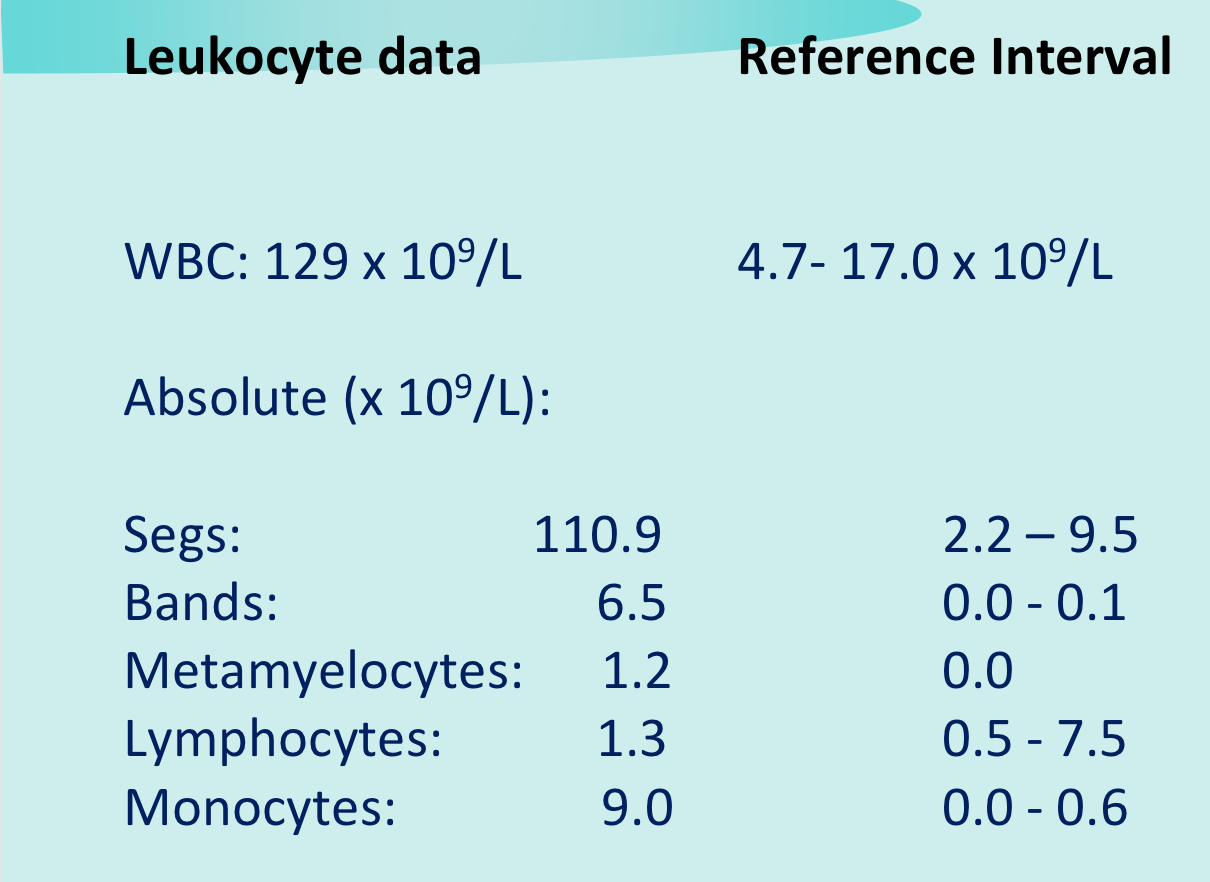
Provide a morph for the leukogram
Marked leukocytosis
Marked neutrophilia
Mild regenerative left shift
Marked monocytosis
Categorizing the chronicity of inflammatory disease/inflammatory leukograms can be difficult, what tools/indicators can you use to do so?
Clinical Signs (how long has the patient experienced inflammation)
# of segs
How long has the bone marrow had to expand production?
If it has had enough time then it could be a regenerative left shift
Degree of monocytosis
Marked = chronic inflammation
Presence of degenerative left shift = acute
T/F: Chronic inflammation with no left shift can occur
True, in this case the bone marrow has had the chance to respond, the body essentially adapts to a new normal and ramps up production
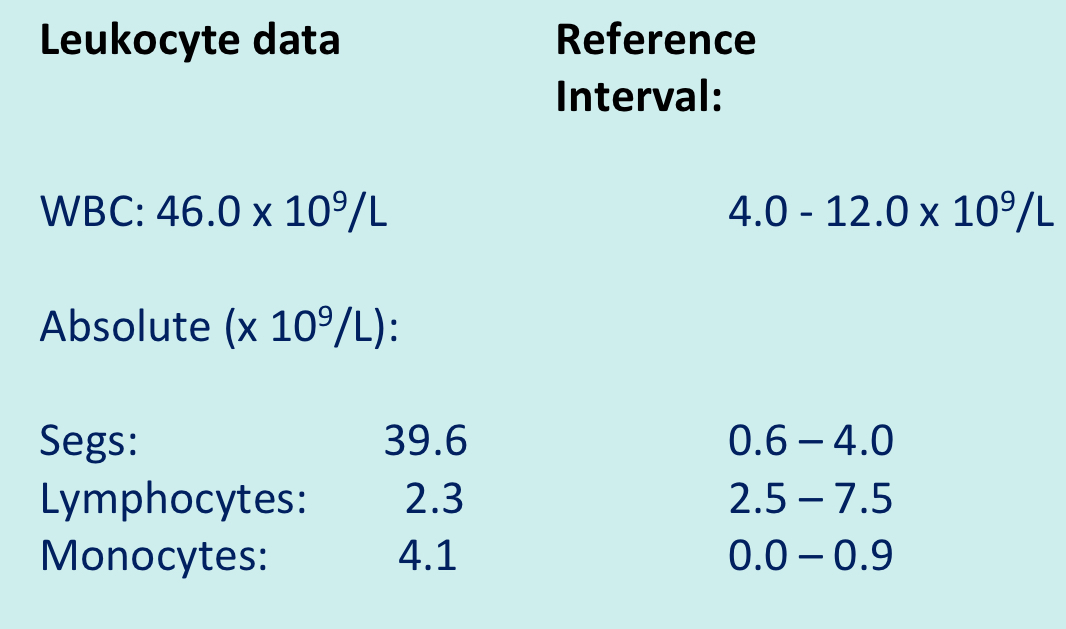
Provide a morph for this leukogram. What pattern is this?
Marked leukocytosis
Marked neutrophilia
Mild lymphopenia
Marked monocytosis
Chronic Inflammation
No bands are present because the bone marrow has caught up in the production of neutrophils
The marked segs, marked leukocytosis, and marked monocytosis
T/F: Leukogram pattern can present as combination
True
An animal with lumphopenia, a neutrophilia and a left shift has what leukogram pattern(s)
Inflammatory leukogram
Stress (corticosteroid) leukogram
What is fibrinogen?
An inflammatory protein made by the liver when the body is experiencing inflammation
the liver will produce more fibrinogen when an inflammatory process is going on anywhere in the body
It acts in the coagulation cascade as a coagulation factor
Elevated fibrinogen would be indicative of __________ or __________
Inflammation
Dehydration (less water in bloodstream → increase of protein concentration)
What is a Protein/Fibrinogen ratio? What is its importance?
A veterinary diagnostic tool used to differentiate dehydration from inflammation in animals, particularly horses and cattle (large animal)
What do the following P/F ratios tell us?
If the P/F ration is <10
The P/F ration is >15
P/F ratios between 10-15
Inflammation (Fibrinogen has gone up relatively more than P)
Dehydration (or just normal)
Grey Zone (no interpretation)