Energetics
 Call Kai
 Learn
Learn Practice Test
 Spaced Repetition
 Match
Match Flashcards
 Knowt Play
1/21

There's no tags or description
Looks like no tags are added yet.
Name | Mastery | Learn | Test | Matching | Spaced | Call with Kai | Chat |
|---|
No analytics yet
Send a link to your students to track their progress
22 Terms
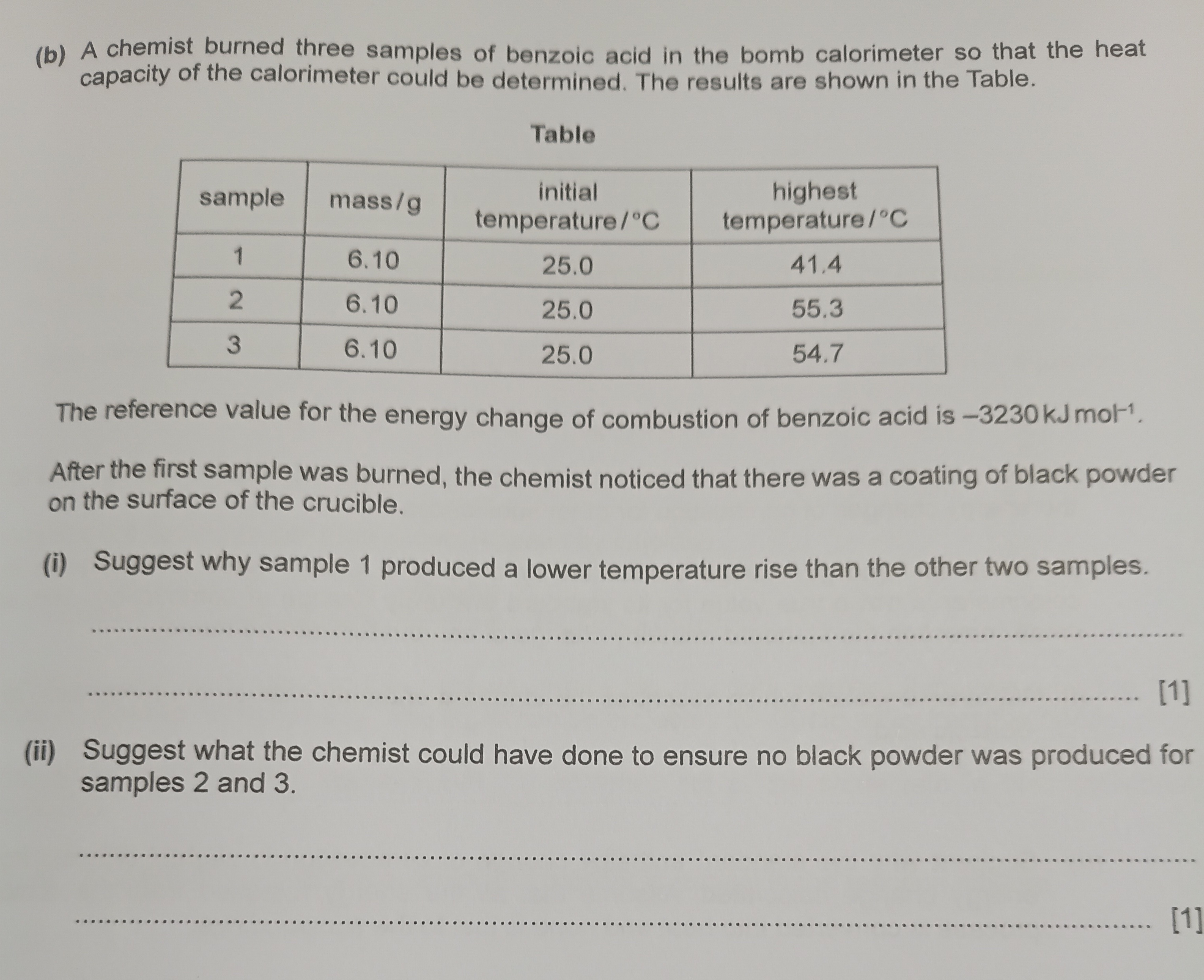
(i) insufficient oxygen led to incomplete combustion of benzoic acid, forming soot. Less energy is absorbed by calorimeter and water.
(ii) Use excess amount of oxygen gas to ensure complete combustion of benzoic acid.
Define entropy
Measure of disorder in a system
what causes increase in entropy?
increase in no. of ways to arrange particles
increase in no. of ways to distribute energy among particles
both lead to more disorder which leads to increase in entropy (denoted with ∆S > 0)

what are the units of entropy change (∆S)?
J K-1 mol-1
how do changes in systems affect entropy:
increase in volume of gaseous system
change in phase
increase in number of gaseous particles
increase in temperature
A gas will spontaneously expand to occupy the entire container.
In a larger volume, there are more ways to arrange the gas particles in the system,
the gas expand from a less disordered system to a more disordered system. hence the entropy of the system increases. ∆S >0
During melting and boiling, there are more ways to arrange the particles in the system, from
a less disordered solid phase to a more disordered liquid phase or from a less
disordered liquid phase to a more disordered gaseous phase. Hence, entropy of the system increases, and ∆S value >0
The increase in the total number of gaseous molecules in the system leads to an increase in
the number of ways to arrange the molecules. It changes from a less disordered system
to a more disordered system.Hence, the entropy of the
system increases. ∆S >0
The higher the temperature, the more kinetic energy the system possesses, resulting in more
ways to distribute the energy among the particles. It changes from a less disordered
system to a more disordered system. Hence, the entropy of
the system increases. ∆S >0
how to answer ∆S questions?
Factor
More/less ways to arrange the particles
More/less disordered system to a more/less disordered system
Entropy of system increase/decrease
∆S is positive/negative
Which process, boiling or melting, has a more positive ∆S value?
FYI, don’t write in answer: S (gas) >> S (liquid) > S (solid)
∆S for boiling is greater than ∆S for melting.
This is because the increase in volume from liquid to gaseous phase is greater than the increase
in volume from the solid to liquid phase, hence there is a greater change in disorder from liquid
to gas than from solid to liquid as there are more ways to arrange the particles in the gaseous
phase.
what is Gibbs free energy change of reaction?
∆G = ∆H − T∆S
Under standard conditions (298K and 101 kPa),
∆G⦵ < 0 : The reaction is energetically feasible. The reaction is spontaneous.
2. ∆G⦵ > 0 : The reaction is not energetically feasible. The reaction is not
spontaneous.
3. ∆G⦵ = 0 : The reaction is at equilibrium.
∆G is temperature-dependent.
• ∆H and ∆S changes relatively little with temperature. They may be assumed to be temperature independent as long as the reactant did not undergo a phase change when the temperature is varied
limitations of using ∆G to determine spontaneity of reaction
it does not tell us anything about the rate of reaction.
• One factor that affects the rate of reaction is the activation energy, Ea.
• The ∆G of a reaction may be negative, indicating the reaction is spontaneous but in practice,
the reaction may not occur because the reaction may be too slow (reaction is kinetically unfavourable / have high Ea).
• For example, although the conversion of diamond to graphite is a spontaneous process under
standard condition (∆G < 0), this process is so slow that it cannot be observed in a human
lifetime
in experiments with calorimeter, what formula should you use?
heat change = mc∆T
∆Hrxn = mc∆T / no. of moles (remember to add + or - sign accordingly)
which enthalpy changes are always negative (exothermic)?
recall: bond forming releases energy (exothermic)
combustion
lattice energy (gaseous ions combine to form ionic solid, ionic bond formed)
neutralisation (H+ and OH- ions combine to form H2O)
hydration (gaseous ion hydrated, forms ion-dipole interactions with water)
which enthalpy changes are always positive (endothermic)?
recall: bond breaking requires energy (endothermic)
atomisation (break element at standard state into gaseous atom eg 1/2Cl2 (g) —> Cl (g) )
1st ionisation energy (1 mol electron removed from 1 mol gaseous atom, break bond between +ve nucleus and electrons)
bond energy (break 1 mol covalent bonds)
what is Hess’ law?
Hess’ Law states that the enthalpy change for a chemical reaction is the same regardless of
the route the reaction takes, provided the reactants and products, initial and final conditions
are the same
Hess’ Law is used to calculate enthalpy of reactions which
cannot be determined experimentally.
also ACW = CW for energy cycle (see below) and energy level diagram
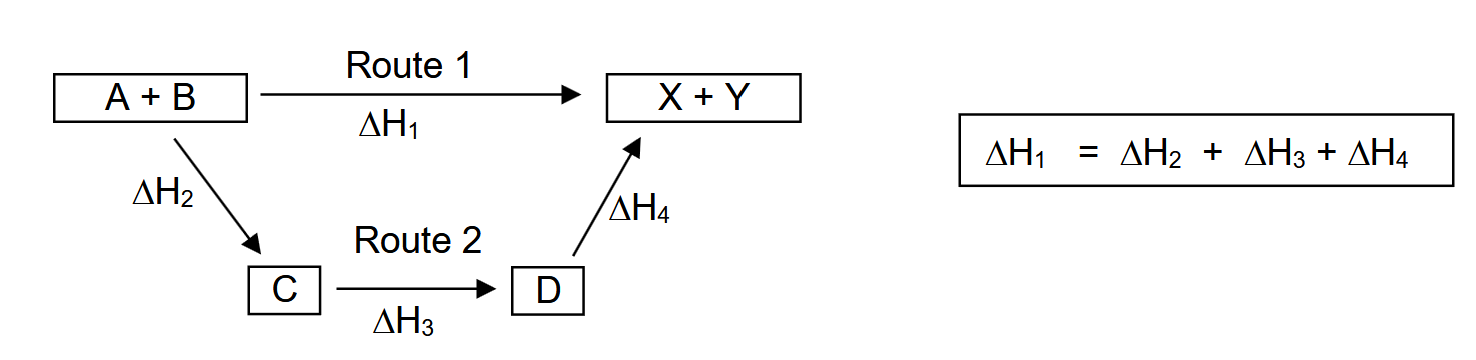
what is energy level diagram?
Check that the quantities and stoichiometric ratios are consistent.
Multiply the enthalpy values accordingly
ACW = CW and solve for unknown
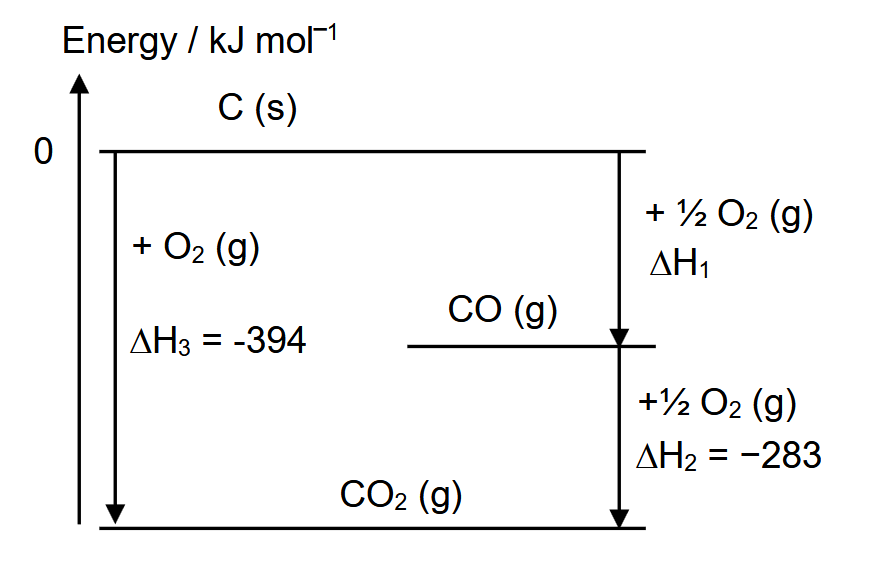
how to calculate ∆Hrxn using ∆Hform?
∆Hrxn = ∆Hform (products) - ∆Hform (reactants)
how to calculate ∆Hrxn using ∆Hc?
∆Hrxn = ∆Hc (reactants) - ∆Hc (products)
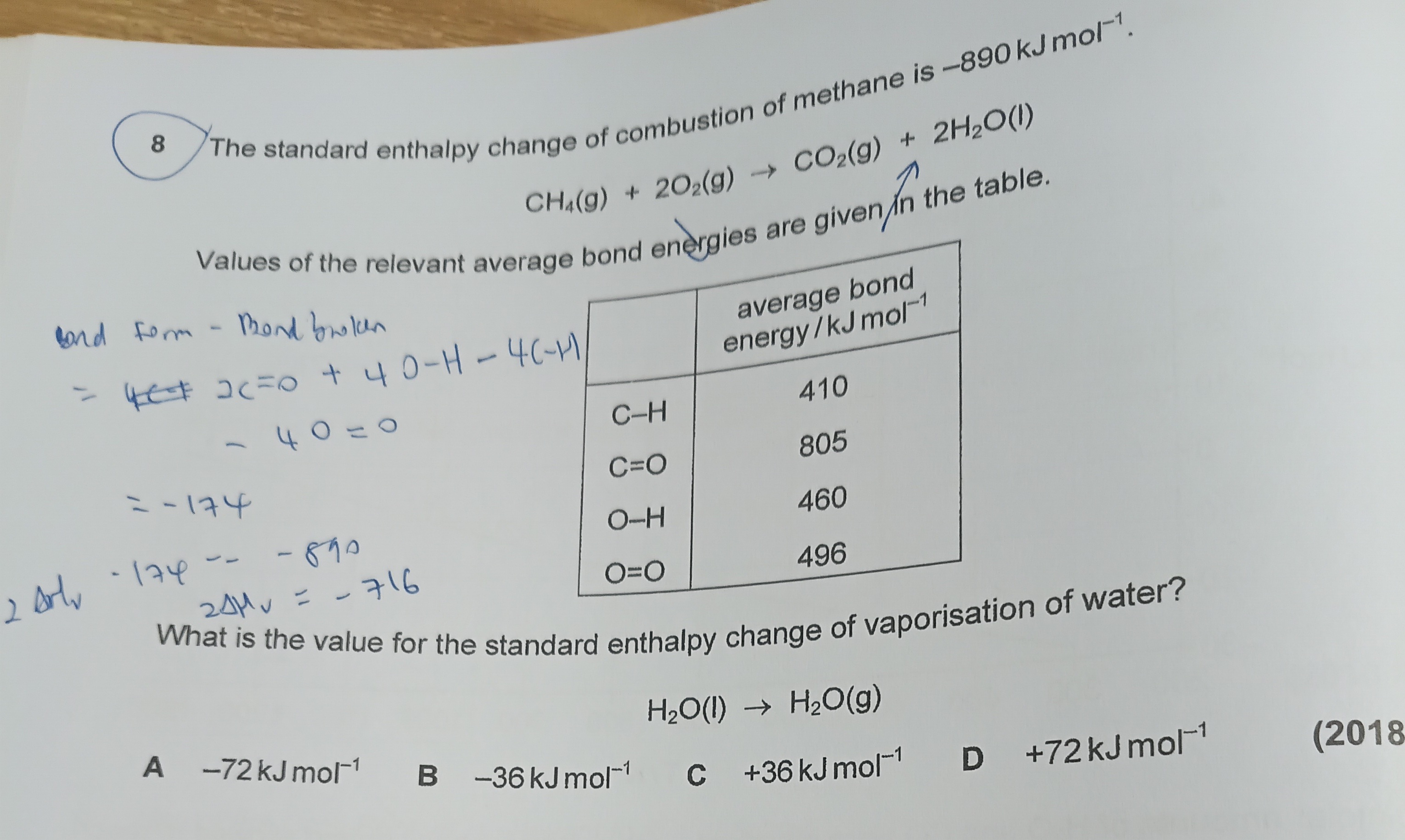
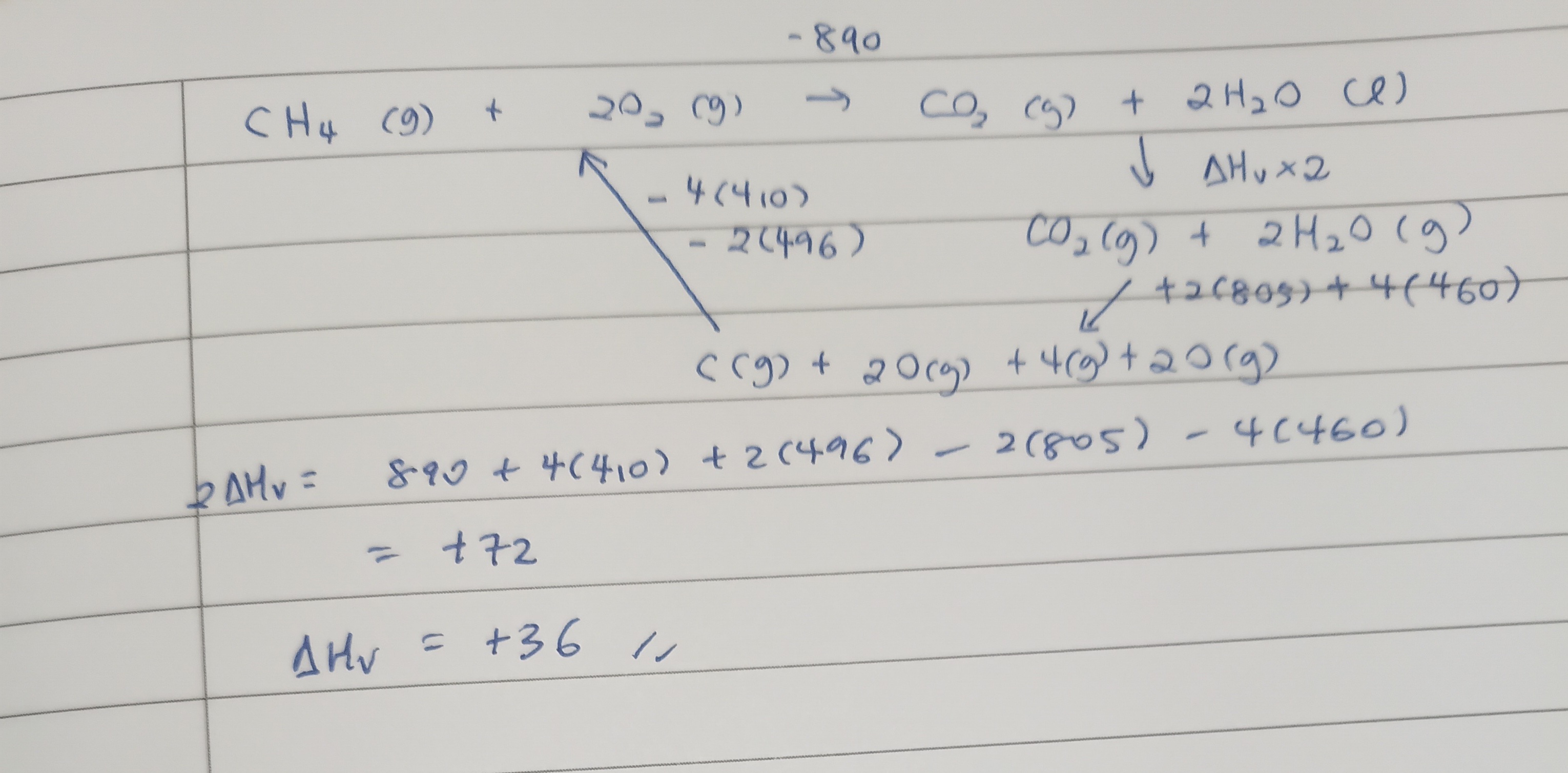
how to calculate ∆Hrxn using BE?
recall: breaking bonds requires energy so endothermic so +ve. forming bonds releases energy so exothermic so -ve.
∆Hrxn = BE (broken) - BE (formed)
how to calculate ∆Hsol of ionic compound?
∆Hsol = -L.E. + ∆Hhyd (ions)
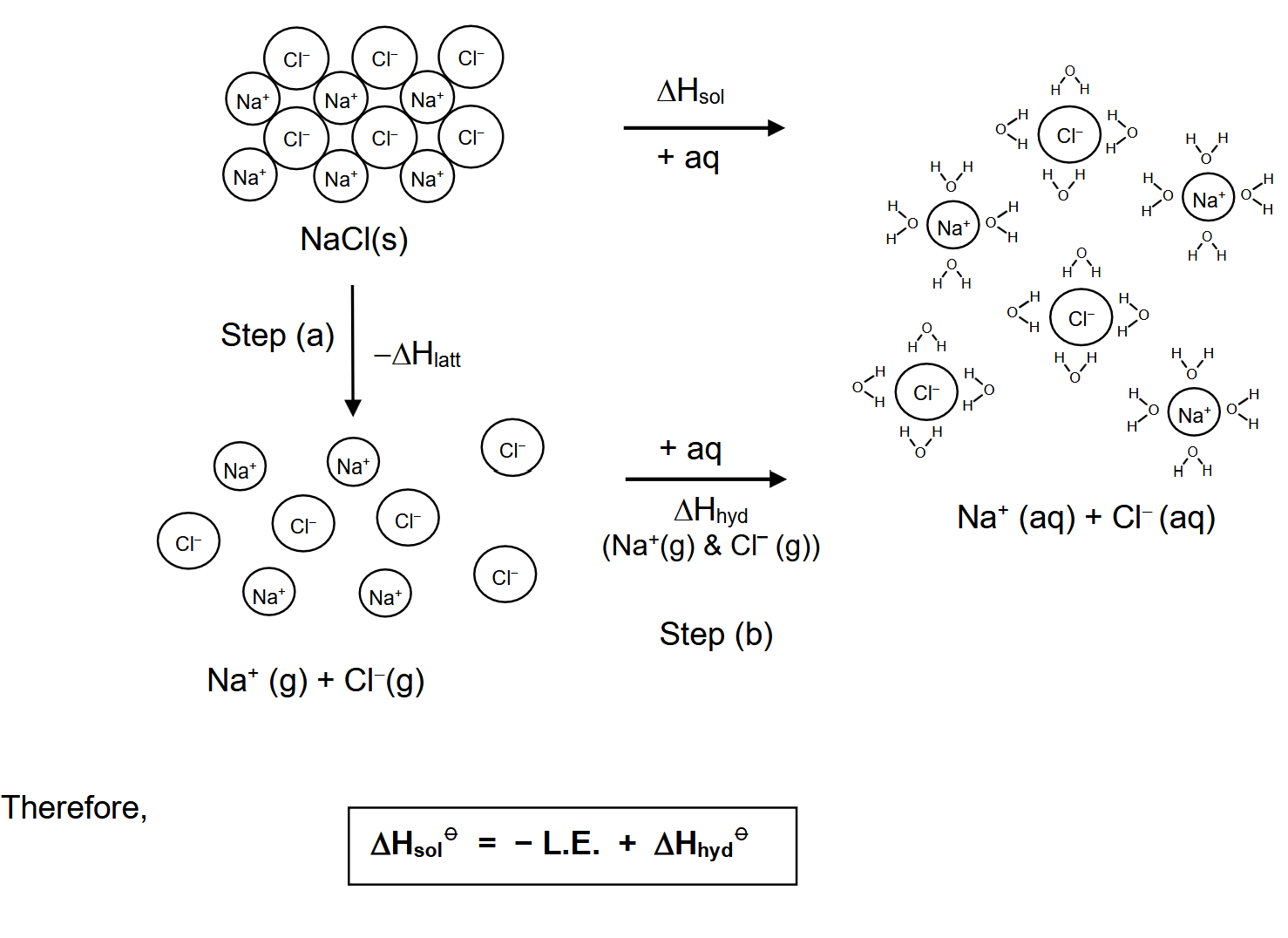
what is standard lattice energy (L.E.)?
It is the energy evolved when one mole of an ionic compound is formed from its constituent gaseous ions under standard conditions
what does |L.E.| indicate?
measures the ionic bond strength: the more exothermic the lattice energy (|L.E.| is greater),
the stronger the ionic bond.
The magnitude of the lattice energy is dependent on the ionic charges and radii of the cation and anion.
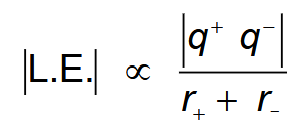
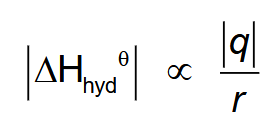
what affects magnitude of ∆Hhyd?
charge divided by radius of the gaseous ion