BIOL 348 Chapter 6 - Bones
 Call Kai
 Learn
Learn Practice Test
 Spaced Repetition
 Match
Match Flashcards
 Knowt Play
1/59

There's no tags or description
Looks like no tags are added yet.
Name | Mastery | Learn | Test | Matching | Spaced | Call with Kai | Chat |
|---|
No analytics yet
Send a link to your students to track their progress
60 Terms
Functions of the Skeletal System
Support, Storage, Blood Cell Production, Protection, and Leverage
Skeletal System
Organ system for protection and support, it is composed of Bones, Cartilages, and Ligaments
Bone (Osseus) Tissue
Dense, supportive connective tissue that produces a solid matrix of calcium and salt around collagen fibers
Bone Matrix
A mixture of organic compounds such as collagen and inorganic compounds such as hydroxyapatite that allows for bone to have compressional strength and flexibility (Reinforced concrete)
Hydroxyapatite
A mixture of calcium phosphate and calcium hydroxide that makes up the hard bone
Osteoprogenitor cells
Mesenchymal stem cells within the endosteum and priosteum
Osteoblasts
Bone forming cells that secretes Osteoids
Osteocytes
Mature Osteoblasts
Osteoclasts
Bone breaking cells (Secretes HCl and other enzymes)
Compact bone
Solid, dense, and forms the external surface of long and flat bones
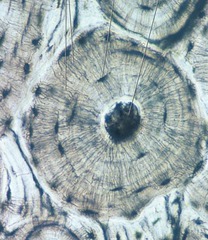
Spongy Bone
Also known as Trabeculae (beans) and forms the internal surface of bones

Osteon
Basic structural unit of compact bone and are arranged in concentric lamellae around a central canal that has blood vessels.
Circumferential Lamellae
Fills the outer region of compact bone and binds osteons together
Periosteum
Collagen that surrounds the bone and ties everything together
Perforating fibers
Fibers that anchor the periosteum to the lamellae
Endosteum
Incomplete cellular layer that lines the medullary cavity (cavity inside the bone)
How many bones does a typical adult have?
~206 bones
Bone Classifications
Shape, Internal tissue organization, bone markings
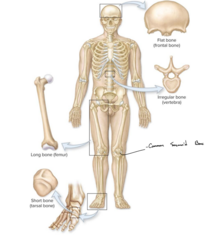
Bone Shapes (6)
Sutural, Irregular, Short, Long, Flat, Sesamoid
Diaphysis
Shaft of a long bone, composed of compact bone and the medullary cavity

Epiphysis
Ends of a long bone, mostly spongy bone surrounded by compact bone
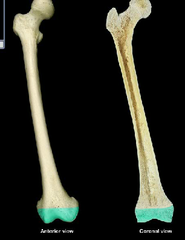
Metaphysis
Where Diaphysis and Epiphysis meet
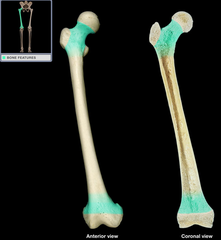
Red Bone Marrow
Produces blood cells in spongy bone
Yellow Bone Marrow
Adipose tissue storage in the medullary cavity
Distribution of force on bones
Compression on the medial side results in tension on the lateral side of long bones (Vice versa)
How long do bones grow for?
~25 years
Osteogenesis
Process of bone formation
Calcification
The process of depositing calcium salts
Occurs during bone ossification and in other tissues
Ossification
Process of replacing other tissues with bone, it can be Endochondral or Intramembranous ossification
Endochondral Ossification
Ossifies bones that originate as hyaline cartilage and occurs in 6 steps for most bones
Endochondral Ossification Step 1
Cartilage model forms

Endochondral Ossification Step 2
Bone collar forms

Endochondral Ossification Step 3
1st ossification center

Endochondral Ossification Step 4
Medullary cavity
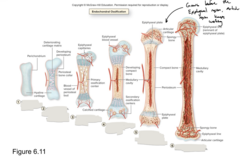
Endochondral Ossification Step 5
2nd ossification center

Endochondral Ossification Step 6
Growth continues

Appositional Growth
Thickens and strengthens long bones by addition of layers in the circumferential lamellae

What happens to Epiphyseal cartilage after puberty?
It ossifies and appears as an epiphyseal line on Xrays
Intermembranous Ossification
Also known as dermal ossification, this is the process where mesenchyme turn into bone tissue without cartilage model, it occurs in three steps
Intermembranous Ossification Step 1
Mesenchymal cells aggregate and differentiate into osteoblasts to begin ossification process as a series of spicules

Intermembranous Ossification Step 2
As spicules interconnect, they trap blood vessels within the bone

Intermembranous Ossification Step 3
Over time, the bone structure takes the shape of spongy bone, and then areas of the spongy bone may be removed later to create the medullary cavities.
What is the function of the nutrient artery?
It supplies epiphyseal cartilage.
What is the function of the nutrient vein?
It drains blood from the bone.
What do the nutrient artery and vein enter through?
The nutrient foramen.

What type of blood vessels are the nutrient artery and vein?
A single pair of large blood vessels.
Metaphyseal Vessels
supply the epiphyseal cartilage
where bone growth occurs
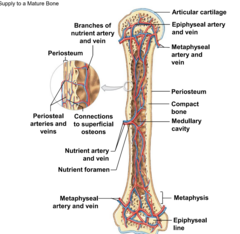
Periosteal Vessels
blood to superficial osteons
secondary ossification centers during development

Process of Remodeling
Replacement of mineral reserves, recycles and renews bone matrix, involves osteocytes, osteoblasts, and osteoclasts.
Vitamin C
Stimulates osteoblast differentiation and collagen synthesis
Vitamin A
Stimulates osteoblast activity
Vitamin K and B12
Synthesizes bone proteins
Calcium ions are vital to
Membranes, Neurons, and Muscle Cells
Fracture Repair Step 1
Clot forms and bone cells die

Fracture Repair Step 2
Formation of Fibrocartilage to stabilize fracture
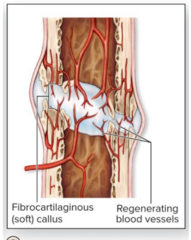
Fracture Repair Step 3
Ossification of Cartilage

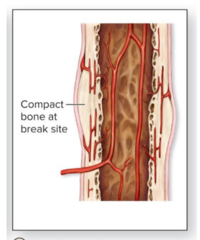
Fracture Repair Step 4
Remodeled to original look
Osteopenia
Occurs when 30-40 years old and results in thinner/weaker bones
Osteoporosis
Occurs when 45 and results in severe bone loss
Effects of menopause
Loss of estrogen and loss of signaling for osteoblasts