Lecture 18: Histology of the Glandular GI System
 Call Kai
 Learn
Learn Practice Test
 Spaced Repetition
 Match
Match Flashcards
 Knowt Play
1/81

There's no tags or description
Looks like no tags are added yet.
Name | Mastery | Learn | Test | Matching | Spaced | Call with Kai | Chat |
|---|
No analytics yet
Send a link to your students to track their progress
82 Terms
Pancreas
Functions :Exocrine and Endocrine
• Secretes digestive enzymes that act in the small intestine
• Secretes hormones important for metabolism of absorbed nutrients
Endocrine Glands
What type of gland?
-produce hormones adn are always rich in capillaries
-hormones are released outside the body and picked up by blood vessels
Exocrine Glands
What type of gland?
-secrete substance to specific organs via duct systems
Islets
I
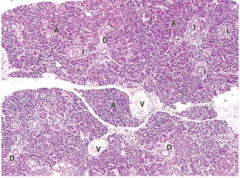
Serous Acini
A
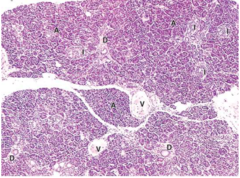
Intralobular Ducts
D
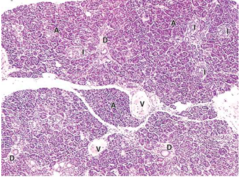
Ducts and Blood Vessels
V
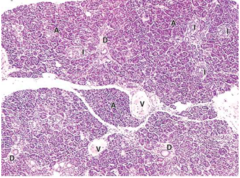
Pancreatic Cancer
-usually carcinoma of duct cells
-usually at the head of the organ near the duodenum
-tumor usually asymptomatic until growth and metastasis are advanced
Pancreatic Adenocarcinoma
the most common tumor arising in the pancreas
Pancreatic Adenocarcinoma
-arise form the pancreatic ductal epithelium
-arise in the head of the pancreas where they tend to obstruct the common bile duct
-pts present with painless obstructive jaundice
Courvoisier's Law
"A painless jaundice in the presence of a palpable gallbladder is rarely due to gallstones"
Exocrine Pancreas
Acini composed of serous cells
High rate of protein synthesis
Secretion of digestive enzymes
Duct Cells
-in the exocrine pancreas
-pale staining and secrete a solution of sodium bicarbonate
Pancreatic Acini
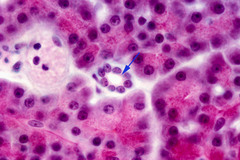
Secretin
-hormone that initiates centroacinar and intercalated duct cells to secrete HCO3- to hydrate, flush, and alkalinize enzymatic secretions
-Centroacinar Ducts
-Intercalated Ducts
-Intralobular Ducts
-Interlobular Ducts
name the Exocrine Pancreatic Ducts from Distal to Proximal
Higher
there is a _____________ pH in acini and ducts which keeps enzymes inactive
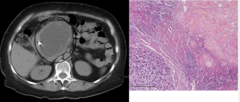
Acute Pancreatitis
-proenzymes may be activated and digest pancreatic tissues
-possible causes: infection, gallstones, alcoholism, drugs, and trauma
Pancreatitis
CCK
-stimulates enzyme secretion from acinar cells
Secretin
promotes water and HO3- secretion by duct cells
Islets of Langerhans (pancreatic islets)
-~1-2 million per pancreas, mainly in tail
-Origination from endoderm (same origin as acini)
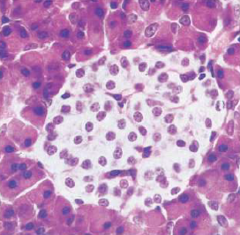
Islets of Langerhans (pancreatic islets)
•Small polygonal or round lightly stained cells
•Separated by fenestrated capillaries
•Autonomic nerve fibers also found in association with each
Alpha Cells
-release glucagon
Raises concentration of glucose and fatty acids in blood - catabolic
More peripheral
Beta Cells
-release insulin and amylin
Decreases concentration of glucose in blood -anabolic
More central
Delta Cells
-release small amounts of somatostatin
Growth hormone inhibiting hormone
Regulates endocrine, neurotransmission, and cell proliferation
Epsilon Cells
-produce ghrelin
-Influences appetite and rate of energy use
PP Cells
-pancreatic polypeptide
-self regulates panceratic secretion
Alpha Cells
-acts on several tissues to make energy stored in glycogen and fat available thru glycogenolysis and lipolysis
-increases blood glucose content
Beta Cells
-acts on several tissues to cause entry of glucose into cells
-promotes decrease of blood glucose content
Delta Cells
-inhibits release of other islet cell hormones thru local paracrine action
-inhibits release of GH and TSH in anterior pituitary and HCl secretion by gastric parietal cells
PP Cells
-stimulates activity of gastric chief cells
-inhibits bile secretion, pancreatic enzyme, and bicarbonate secretion, and intestinal motility
Glucose
Activity of Alpha and Beta cells is regulated by
______________ levels
Decreased
___________________ glucose: stimulates Alpha cells and inhibits Beta cells
The Hilum
the liver is surrounded by a capsule which thickens where?
Hepatocytes
-synthesize and secrete major plasma proteins
-gluconeogensis
-detoxification
-deamination
-storage of vitamin A
-removal of erythrocytes
-storage of iron
-production of bile
-storage of glucose
Hepatocytes
Large polyhedral cells with spherical, centrally located nuclei arranged in cords
Eosinophilic cytoplasm
Basophilic bodies
Glycogen granules
Fatty Liver Disease
-reversible condition
-large lipid droplets containing TGs accumulate in hepatocytes cia steatosis
-occurs in ppl with alcoholism or obesity
-may progessive to hepatitis or steatohepatitis
Venule
-branch of portal vein
-blood rich in nutrients but low in oxygen
Arteriole
-branch of hepatic artery
-brings oxygen
Bile Ductule
-branch of bile conducting system
-lined by cuboidal epithelium
Sinusoids
•Emerge from the peripheral branches of portal vein and hepatic artery
•Flow towards and converge on central vein
•Contain thin, discontinuous linings of fenestrated endothelial cells
Sinusoids
-allow plasma to fill Space of Disse and contact hepatocytes for uptake and release of proteins, toxins, and nutrients
Sinusoids
Contains:
-endothelial cells (fenestrated)
-Kupffer cells
-Stellate Cells
Kupffer Cells
Fixed macrophages that phagocytizeFixed macrophages that phagocytize particulate matter and senescent RBCs
Free heme and iron for reuse or storage in ferritin complex
May act as APC for bacteria particulate matter and senescent RBCs
Stellate Cells
-not distinguishable with light microscopy
Store vitamin A and fat soluble vitamins
Produce extracellular matrix, including collagen.
Smooth ER
location where bilirubin and bile acids taken up from perisinusoidal space
and secreted into bile canaliculi
RER
location of synthesis of plasma proteins for perisinusoidal space
Perisinusoidal Space
-location of stellate cells
-produces ECM and stores vitamin A
IVC
hepatic veins drain into the _________________-
oxygen and nutrient poor
describe the blood in the central vein
Nutrient Rich
describe the blood in the portal vein
Zone 1
What Zone?
-rely on aerobic metabolism, often active protein synthesis
-periportal
Zone 3
What Zone:
-lower oxygen and nutrients, involved in detoxification and glycogen metabolism
-most likely site of fatty accumulation and ischemic necrosis
-pericentral
Hepatic Acinus
supplies oxygenated blood to hepatocytes
Portal Lobule
drains bile from hepatocytes to the bile duct
Hepatic Lobule
-drains blood form the portal vein and the hepatic artery to the hepatic or the central vein
Zone 1
what zone is the MOST oxygenated?
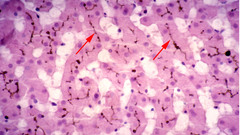
Bile Canaliculi
form from grooves in surfaces of adjacent hepatocytes, with edges sealed by tight junctions
Smooth ER
location where bilirubin and bile acids taken up from perisinusoidal space and secreted into bile canaliculi
Canals of Hering
canaliculi empty into ___________________-
Cholangiocytes
Epithelial cells of hepatic ductules that modify the composition of bile.
Opposite
Bile and blood flow ______________ directions in the lobule
Bile Canaliculi
Bilirubin
-pigmented breakdown product of heme that is released from splenic macrophages primarily, but also from Kupffer cells,
-carried to hepatocytes bound to albumen.
Bilirubin
give feces and urine their characteristic colors.
Prehepatic
Jaundice classification:
-due to overproduction or impaired uptake by the liver
Hepatic
Jaundice Classification:
-decreased conjugation
Posthepatic
Jaundice Classification:
-decreased excretion
-intra or extrahepatic obstruction
Underdeveloped state of the Hepatocytes SER
frequent cause of jaundice in newborns
Blue light
what is a common treatment for jaundice in newborns?
Prehaptic Jaundice
assoc with unconjugated hyperbilirubinemia
Posthepatic Jaundice
assoc with conjugated hyperbilirubinemia
Canaliculi ---> Ductules ---> Ducts
flow of bile
Gallbladder
Mucosa - simple columnar epithelium (cholangiocytes)
Microvilli on surface
Many mitochondria for energy for pump to move sodium into the intracellular space (concentrating bile) then into intercellular space
Lamina propria and submucosa are thin : may contain mucous glands
Muscularis externa arranged in oblique spiral to propel bile out.
Gallbladder
saclike structure that stores and concentrates bile, and releases it into the duodenum after a meal.
CCK
Stimulation of the Gallbladder:
lipid in duodenum promotes release of ______________
CCK
-stimulates contraction of the gallbladder in order to empty bile into the duodenum
Bile
emulsifies fat facilitating hydrolysis of lipids by pancreatic lipases
Cholelithiasis
-presence of stones within the biliary system
Hepatocytes
-large eosinophilic cells with central nuclei and prominent nucleoli
-cells arranged in plates one cell thick with intervening sinusoids
-diverse metabolic functions
-secretion of bile into canaliculi
Liver
-fat metabolism
-carbohydrate metabolism
-protein metabolism
-storage of glycogen, vitamins, and iron
-intermediary metabolism
-interface between organs and blood supply
-secretion