Veterinary Immunology Test 1
 Call Kai
 Learn
Learn Practice Test
 Spaced Repetition
 Match
Match Flashcards
 Knowt Play
1/124

There's no tags or description
Looks like no tags are added yet.
Name | Mastery | Learn | Test | Matching | Spaced | Call with Kai | Chat |
|---|
No analytics yet
Send a link to your students to track their progress
125 Terms
Variolation
controlled exposure
ex: infected people with pus from smallpox sores
effective, often deadly, spread the disease
practiced in the US 1700s
Vaccination
Edward Jenner: 1st to produce vaccine
used milkmaid cowpox infection against smallpox and challenged boy twice
did not spread smallpox, mild disease
Functions of the immune system
its a sensory & regulatory network
detects internal disruptions
eliminates pathogens
clears cellular debris
promotes tissue repair
tolerate self & maintain homeostasis
Bad aspects of immunity
allergic reactions, chronic inflammation, autoimmune disease
Innate Immunity
physical & chemical barriers (skin)
granulocytes (phagocytes/ blood cells that eat pathogens)
Complement
Antimicrobial peptides (tears, saliva)
NK cells
always present, act within seconds post injury
detection based on broad molecular patterns (Microbial associated molecular patterns, MAMPs)
Microbial Molecular pattern
present in microbes but not in host
ex: bacteria cell wall components, targeted bc not present in host
Key features of innate immunity
rapid response
pattern based recognition (PAMPS & DAMPS)
activates & shapes the adaptive response
Pattern recognition receptor (PRRs)
recognize PAMPS and DAMPS
Toll like receptors & Complement receptors
Describe adaptive immunity
B cells & T cells
activated by exposure
takes days to weeks
specific
memory
B cells receptor secrete __ when it finds its ligand antigen
an antibody or immunoglobulin
they bind to antigens in native state (recognize protein shape)
What do variable regions allow for in B & T cell receptors
allow for generation of different receptors to recognize more antigens
What do B & T cells recognize
B cells: proteins, carbs, lipids, nucelic acids
T cells: peptides (short amino acid/protein)
T cells only recognize short peptides and need what to do this
Dendritic Cells digest proteins & present it to them with a MHC carrier protein
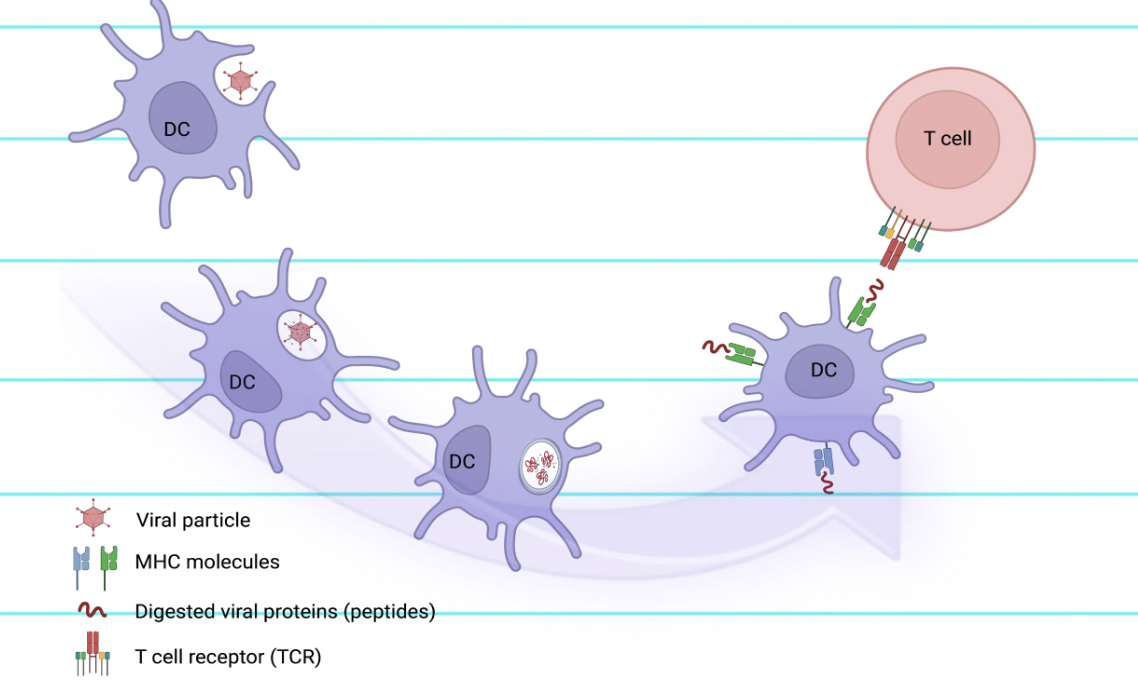
What is an epitope
specific part of an antigen that is recognized by the immune system
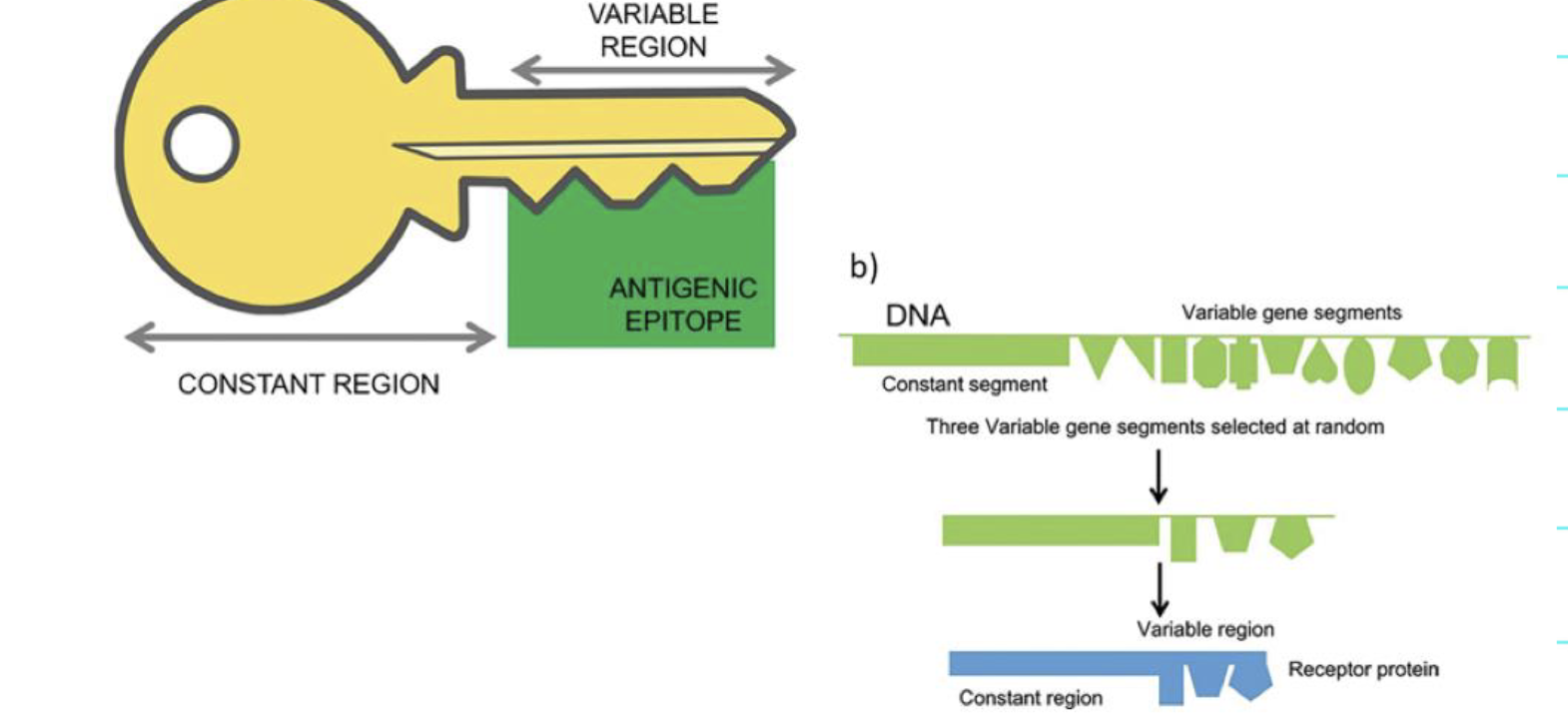
How are lymphocyte antigen receptors created
antigenic epitope genetic recombination (lock, variable region)
BCR/B cells: stay in bone marrow (primary lymphoid ogran)
TCR/T cells: thymus (primary lymphoid organ)
Immunological Tolerance
suppression of self reactive lymphocytes are usually sufficient to avoid reactivity against self tissues
How will the small number of lymphocytes encounter antigens in large body
lymph nodes are located all around the body & places for antigen accumulation and lymphocyte migration ( increase chances of lymphocyte encountering corresponding antigen)
What happens when individual lymphocyte encounters target antigen
stops migrating, starts proliferating to create army response
afterwards portion of them die, portion of them retained as memory cells (fight off second infection)
T/F adaptive and innate immunity work together
true, innate present antigens to adaptive immune system
innate immunity is blank and blank; adaptive immunity is blank and blank
nonspecific & rapid
specific & slower
Name the primary lymphoid organs in mammals and birds
thymus, bone marrow, bursa of fabricius
Sort these into innate, adaptive, or both: neutrophil, macrophage, complement, B cell, T cell, antibody, dendritic cell.
innate: neutrophil, macrophage, complement, dendritic cell. Adaptove: T cell, B cell, antibody
What mechanism generates the enormous diversity of BCRs and TCRs?
The genetic recombination of the variable region/antigenic epitope
What do phagocytes do after recognizing a microbe? Name two major phagocytes.
Two major phagocytes are dendritic cells and granulocytes. Dendritic cells engulf a microbe and present them to T cells via a carrier protein (MHC)
define MAMP, PAMP, and DAMP in your own words. Then give one example of each.
MAMP is found in all microbes whether they cause disease or not. Ex: peptidoglycan
PAMP is recognized as something on a microbe that can cause disease. Ex: bacterial cell wall
DAMP is a signal that the bodies own cells are damaged. Ex: ATP leaking out of cell
A sterile crush injury releases ATP; a bacterium provides peptidoglycan. Label each signal and predict whether both can cause inflammation.
Release of ATP is a DAMP. Bacteria providing peptidoglycan is a PAMP. Yes both signals cause inflammation.
Put these in order: peptide presentation, antigen capture, lymphocyte activation, antigen processing, clonal expansion.
1. Antigen capture 2. antigen processing 3. peptide presentation 4. lymphocyte activation 5. clonal expansion
Explain the distinct jobs of lymph nodes, and of MHC molecules.
The role of the lymph nodes is to trap microbes from circulation and have T cells and B cells ready for response. The role of MHC molecules is to capture microbes, break them down, and present them to T cells for response. They also help determine self versus non self.
A dog is vaccinated and later encounters the pathogen. Contrast the first and second adaptive responses.
Vaccination leads to a slow primary response that produces a small amount of antibodies. The secondary response is rapid because of memory cells and clears the pathogen much faster.
Where do immune system cells originate
primarily from hematopoietic stem cells in the bone marrow, that then decide to be myeloid progenitor (innate immune system) or lymphoid progenitor ( adaptive immunity)
during embryonic development: yolk sac → fetal liver/spleen → bone marrow
What controls hematopoietic stem cell survival and differentiation
hormones, cytokines, and growth factors through both paracrine and endocrine signaling
What are the three ways cells communicate using secreted mediators
autocrine: cell produces & gives to itself
paracrine: cell produces factor to nearby cell
endocrine: cell produces factor to circulation to distant cell
What is the primary function of neutrophils
segmented nuclei, short lived
rapid phagocytosis and killing of microbes through granules ( make up majority of wbc’s)
innate
what do neutrophil granules contain
antimicrobial peptides, lysozyme, and proteases used for intracellular kiling
what are eosinophils primarily involved in
Helminth/parasite (large pathogens) defense and allergic/hypersensitivity reactions
short lived
why are eosinophils effective against helminths
their granule proteins damage parasites that are too large to phagocytose
how do mast cells and basophils differ
mast cells = tissue resident
basophils = circulate in blood
what do mast cells and basophils have in common
both can degranulate and release histamine and other vasoactive mediators
promote acute inflammation & allergies
low in percentage
what are monocytes
immature circulating cells (macrophages) that migrate into TISSUES and differentiate
DCs migrate to peripheral tissues, osteoclasts, circulating monocytes: respond to inflammation
what is the major function of macrophages
phagocytosis after migrating into tissues
Match macrophages with their locations
Kupffer cells — liver
→ Microglia — brain/CNS
→ Osteoclasts — bone
→ Alveolar macrophages — lungs
→ Langerhans cells — epidermis
→ Histiocytes — connective tissue
What are the three major lymphocyte types
B cells, T cells, and natural killer cells (NK)
What are the two major types of T cells
CD4 T helper cells: orchestrate immune responses
CD8 cytotoxic T cells: kill target cells
What are the major T cell activation states
Naive (havent met antigen yet)→ activated/effector (proliferate, act)→ memory cells
What is the primary function of B cells
they are the lymphocyte lineage responsible for antibody production
what are the major B cell states
Naive → germinal center B cell (stay in lymph nodes)→ plasma cell (secrete antibody)→ memory cell
NK cells do what
detect stressed cells and trigger apoptosis (ex: if MHC is repressed and not shown they will kill that cell)
tumor defense
releases perforin and granzymes granules that make holes in target cell (kill)
what happens to primary lymphoid organs with age
bone marrow: red marrow is increasingly replaced by yellow marrow
thymus/bursa: involute with age and are replaced by adipocytes
what happens to production of new naive lymphocytes with age
highest in young animals and lowest in old animals
what is the thymus and where is it located
lobular gland in the cranial mediastinum where T cell precursors mature
what happens to T cells in the thymic cortex
immature T cells undergo positive selection- cells that recognize self MHC survive ( can you make TCR)
TOLERANCE
what happens in the thymic medulla
negative selection eliminates autoreactive T cells, promoting self tolerance
What percentage of developing thymocytes become naive T cells
2%
what are the secondary lymphoid organs/tissues
encapsulated: lymph nodes, spleen,
unencapsulated: MALT, and tonsils
what are examples of MALT
GALT, BALT, Peyer’s patches, and solitary lymphoid follicles
How does lymph flow through a lymph node
afferent vessels → lymph node → single efferent vessel
what are the major regions of a lymph node
cortex: B cell follicles (outer edges)
paracortex: T cell region
medulla: plasma cells/macrophages +lymphatic sinuses
what happens to B cell follicles during an active immune response
B cells proliferate, forming secondary follicles with germinal centers
they train BCRs at germinal centers
What is special about pig lymph nodes
they are essentially inside out; T cells are in cortex and B cells are in medulla
What are peyer’s patches
unencapsulated lymphoid aggregates in the gut (SI) with B cell rich follicles surrounded by T cells
What is MALT
Mucosa associated lymphoid tissue that protects mucosal surfaces and connects with the systemic immune system
ex: Intraepithelial lymphocytes search for infection in intestines
What are the two major areas of the spleen and their functions?
Red pulp: filters blood; contains RBCs, platelets, and macrophages. (bulk of spleen, rbc disposal)
White pulp: immune function; formed by lymphocytes surrounding arterioles
What is the function of the spleen's white pulp?
It contains PALS (T-cell rich), lymphoid follicles (B-cell rich), and the marginal zone (macrophages and slower innate like B cells) allowing immune responses to blood-borne antigens.
What is important about how the spleen filters antigens?
The spleen is not connected to lymphatics. It filters antigens directly from the blood, making it especially important for blood-borne pathogens.
What is the marginal zone of the spleen?
The area surrounding lymphoid follicles that contains macrophages, few T cells, and marginal zone B cells.
What is the function of marginal zone B cells?
They rapidly produce low-affinity antibodies against bacterial capsular polysaccharides, providing early protection before a full adaptive response develops.
What happens to dendritic cells after they capture antigen in the splenic marginal zone?
They migrate into T-cell areas, where they present antigen to T cells.
What are the five major principles of cytokine behavior?
Potency: low concentrations can have strong effects
Pleiotropy: one cytokine → different effects in different cells
Redundancy: different cytokines → overlapping effects
Synergy: combined cytokines amplify/reshape responses
Cross-regulation: one cytokine can enhance or inhibit another pathway
What factors determine the effect of a cytokine?
Receptor expression, cell state, dose, and timing.
What do Type I interferons (IFN-α and IFN-β) do?
Produced by most nucleated cells
Induce antiviral proteins
Inhibit viral replication
Increase MHC I expression
MAIN ROLE: warning system
→ Create an antiviral state in nearby cells.
What does Type II interferon (IFN-γ) do?
Produced mainly by NK cells and T cells. It activates macrophages and increases antigen presentation.
key role: adaptive immune responses against intracellular pathogens
What does Type III interferon (IFN-λ) do?
Provides antiviral protection primarily at epithelial/mucosal surfaces, especially respiratory and intestinal epithelium.
What is the key concept about interferons
They do not directly kill viruses. They change the state of host cells to resist infection and enhance immune defenses.
What is the veterinary significance of IFN-τ?
IFN-τ is a Type I interferon produced by the ruminant conceptus that signals maternal recognition of pregnancy.
What are the major functions of TNF?
TNFs regulate inflammation, cell survival, and cell death, help coordinate innate and adaptive immune responses
What are the major functions of TNF-α
Produced by macrophages, T cells, and NK cells. It:
Pro inflammatory cytokine
Can trigger apoptosis or necrosis
What is TNF-β (lymphotoxin-α) and what does it do
Produced by activated T and B cells. It promotes lymphoid organ development, inflammation, and immune-cell recruitment.
What can excessive TNF cause?
Septic shock and chronic inflammatory disease.
therapeutic target: anti-TNF drugs
What are the major functions of IL-1 and IL-6
Both promote fever, acute-phase responses, and endothelial activation.
What does IL-2 do?
Promotes activated T-cell proliferation and supports regulatory T-cell survival.
What does IL-12 do? (Type 1 immunity)
Activates NK cells, promotes IFN-γ production, and drives Th1 differentiation
What does IL-4 do? (Type 2 Immunity)
Promotes Th2 differentiation and B-cell responses.
What does IL-10 do? (Immune restraint)
Acts as an immune brake by limiting inflammatory cytokine production from macrophages and dendritic cells.
What do IL-23 and IL-17 do? (Type 17 axis)
IL-23: sustains Th17 cells.
IL-17: recruits neutrophils and strengthens barrier defense.
What are chemokines & function?
Chemokines are cytokines that are a family of small chemoattractant molecules; POSITIONING CELLS
recruitment of leucocytes from blood
directs their migration in tissues guiding immune cells to the site of infection
What is the difference between inflammatory and homeostatic chemokines
Inflammatory: recruit effector cells to infection/injury.
Homeostatic: organize and maintain normal tissue/lymphoid architecture.
How do chemokines cause leukocyte migration?
Tissue/endothelial cells create a chemokine gradient
Leukocytes with the appropriate receptor sense it
Chemokine signaling activates integrins → firm adhesion
Leukocyte undergoes diapedesis
Cell follows the chemokine gradient through tissue.
What are the major cytokine functional groups to remember
IFNs: antiviral defense/macrophage activation
TNF, IL-1, IL-6: inflammation, fever, acute-phase response (local benefit, systemic danger)
IL-12/IFN-γ: Type 1 immunity
IL-4/IL-13: Type 2 immunity
IL-10/TGF-β: immune restraint, tolerance, repair
Colony-stimulating factors: leukocyte production/survival/maturation
Chemokines: cell positioning and recruitment
How can cytokines cause disease when dysregulated?
Septic shock: excessive systemic TNF, IL-1, IL-6 → vasodilation, vascular leakage, hypotension, coagulation abnormalities, organ injury
Chronic inflammation: persistent leukocyte recruitment → tissue damage
Autoimmunity: failed regulation → persistent self-reactive lymphocyte activation
Tumors: cytokines can suppress antitumor immunity, promote angiogenesis, and remodel tissue.
What is the key framework for understanding any cytokine
Source: What cell produced it and why?
2. Target: Which cells have the receptor?
3. Range: Autocrine, paracrine, or endocrine?
4. Outcome: Does it affect activation, differentiation, survival, or movement?
Bottom line: Cytokines change cell state; chemokines organize cell location; context determines whether the response is protective or pathological.
What do cytokines do and give examples of groups
hematopoiesis
development, activation, and suppression of immune cells
direct immune responses
Ex: interleukins, colony stimulating factors, interferons, tumor necrosis factor, chemokines
What are the major components of the innate immune system?
Physical barriers
Cellular components
Sentinel cells
Professional phagocytes
NK cells
gamma delta T cells
Non-cellular components
Complement
Acute-phase proteins
Polyreactive antibodies
What is the first line of defense of innate immunity?
Physical and chemical barriers that prevent pathogens from entering or establishing themselves in the body
How does intact skin protect against pathogens?
Most organisms cannot penetrate intact skin
Wounds heal rapidly
Sweat has an acidic pH
Sebaceous glands produce lysozyme and fatty acids
Dead outer skin continually desquamates, removing pathogens
What antimicrobial substances help defend epithelial barriers?
Lysozyme, phospholipase A, defensins, cathelicidins, and surfactant on alveolar surfaces. These are found in secretions such as tears, sweat, saliva, and respiratory/intestinal secretions.
How do the respiratory, GI, and urogenital tracts protect against pathogens?
Respiratory: hair, turbinates, cilia, mucus, coughing, sneezing, mucociliary escalator
GI: saliva, acidic pH, bile, peristalsis
Reproductive/urinary: acidic pH and urination
What is the role of normal microflora/microbiome in innate immunity?
Normal microflora prevent pathogens from establishing on skin and mucous membranes by competing for nutrients and physical space.
What are sentinel cells and what is their primary function?
Sentinel cells are cells positioned throughout the body—especially beneath body surfaces—that recognize and respond to invading microbes or tissue damage, initiating innate immune responses.
What are the major sentinel cell types?
Tissue-resident macrophages
Dendritic cells
Mast cells
Other cells can act as sentinels, including epithelial cells, endothelial cells, fibroblasts, and keratinocytes.
What do PRRs recognize, and what are MAMPs and DAMPs?
Pattern-recognition receptors (PRRs) detect threats.
MAMPs: microbial-associated molecular patterns
DAMPs: damage-associated molecular patterns