Biology Nucleic Acid Key terms + Practice Questions
 Call Kai
 Learn
Learn Practice Test
 Spaced Repetition
 Match
Match Flashcards
 Knowt Play
1/15

There's no tags or description
Looks like no tags are added yet.
Name | Mastery | Learn | Test | Matching | Spaced | Call with Kai | Chat |
|---|
No analytics yet
Send a link to your students to track their progress
16 Terms
DNA (Deoxyribosenucleic acid)
codes for the genome of the cell (entire genetic continent, thousands of genes), which contain instruction for producing proteins or various forms of RNA, and also controls all cellular activities by turning genes on or off.

Structure of DNA
Exhibits a double helix structure, where the sugar and phosphate lie on outside of helix, and nitrogenous are are stack in interior. Strands of helix run in opposite directions (antiperralllel orientation). In antiparallel orientation, complementary base pairing means one strand runs 5’ to 3’ and the other runs 3’ to 5’. Adenine forms hydrogen bonds (base pairs) with thymine, guanine base pairs with cytosine.
RNA (Ribonucleic Acid)
often single stranded, Complementary pairing can also occur between two RNA molecules or between parts of the same molecule. In RNA, thymine (T) is replaced by uracil (U), so A and U pair. While DNA always exists as a double helix, RNA molecules are more variable in form
nucleotides (the monomer)
DNA and RNA consist of this monomer, which contains three parts: Nitrogenous base, pentose sugar, and one or more phosphate groups.

Types of Nitrogenous bases
Pyramides (One ring) - Cytosine (C), thymine (T), uracil (U). Purines (Two rings) - adenine (A) and guanine (G)
Types Of Pentose sugars
Deoxyribose (found in DNA) Ribsone (found in RNA)
Pyramides (CTU 1 ring)
Cytosine (C), thymine (T), uracil (U). Only have one ring
Purines (AG 2 rings)
Consist of two rings, and contain adenine (A) and guanine (G)
ATP
Adenosine triphosphate, energy currency of the cell. Cells use energy released by breaking down food molecules to synthesize ATP.
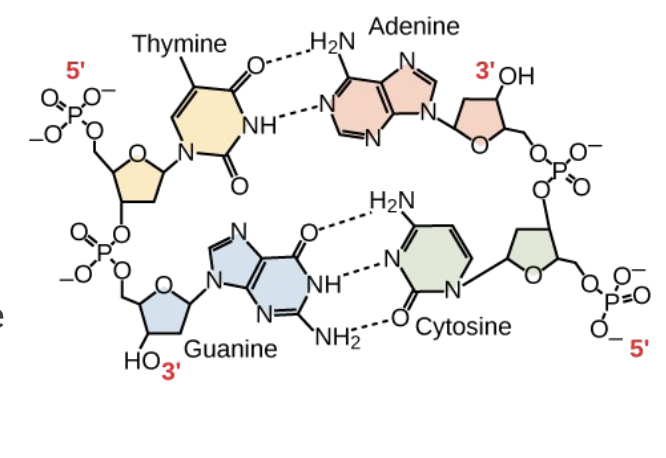
complementary base pairing concept
(purine with pyramid), In antiparallel orientation, complementary base pairing means one strand runs 5’ to 3’ and the other runs 3’ to 5’. Adenine (A) forms hydrogen bonds (base pairs) with thymine (T) [A→T] , guanine (G) base pairs with cytosine (C) [G→C] . In RNA, (A)denine base pairs with uracil (U) instead of thymine (T) [A→U]
Chromatin
complex of DNA and histone proteins
Chromosomes
threadlike structures of the DNA containing tightly wound and packed chromatin around nucleosomes
QUIZ: Nucleic Acids… (Choose what applies)
Contans a sugar
Contains an R group
can be used as an energy source
are the building blocks for polypeptides
Contains a sugar, can be used as an energy source
QUIZ: Which is the correct match of nucleotides (and #) hydrogen bonds
G/C (3 hydrogen bonds)
HW: DNA and RNA… (Select all that are true)
both form a double helix
are both commonly double stranded in human cells
contain different sugars
both contain the nucleotides: adenine (A) guanine (G) and cytosine (C)
contain different sugars, both contain the nucleotides: adenine (A) guanine (G) and cytosine (C)
HW: Pick which of these combinations falls under the nucleic acid biomolecule
Carbon, hydrogen, oxygen
Carbon, hydrogen, oxygen, nitrogen, phosphorus
Carbon, hydrogen, oxygen, nitrogen (sometimes sulfur)
Sugar, phosphate, nitrogenous base
Carbon, hydrogen, oxygen, nitrogen, phosphorus/// sugar, phosphate, nitrogenous base