Pathology Infectious Disease 3=Viruses

0.0(0)
studied byStudied by 0 people
0.0(0)
full-widthCall with Kai
learnLearn
examPractice Test
spaced repetitionSpaced Repetition
heart puzzleMatch
flashcardsFlashcards
GameKnowt Play
Card Sorting

1/23

encourage image

There's no tags or description

Looks like no tags are added yet.

Study Analytics
Name
Mastery
Learn
Test
Matching
Spaced
Call with Kai

No study sessions yet.

24 Terms

1
New cards

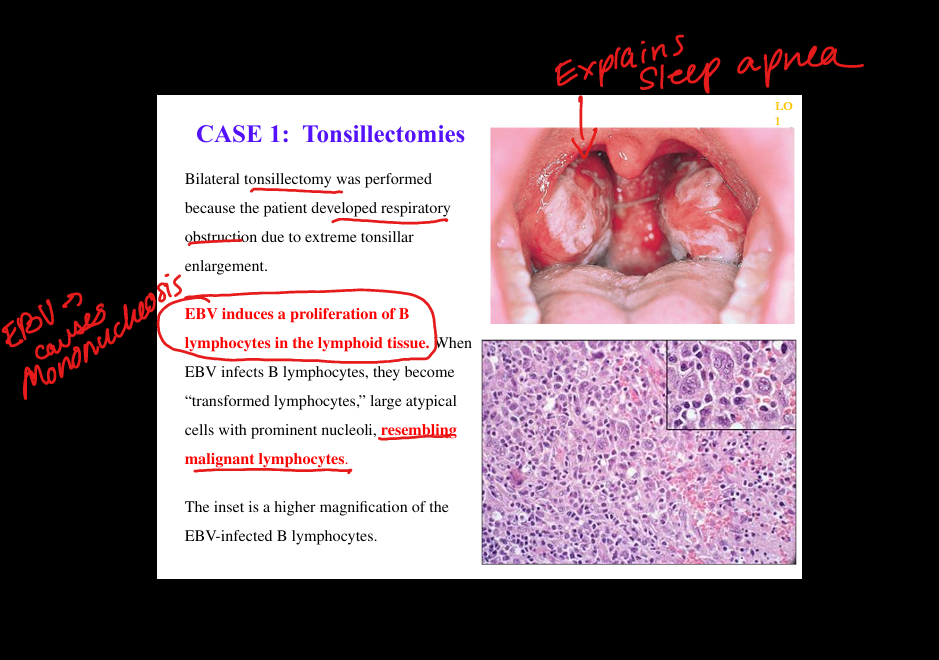
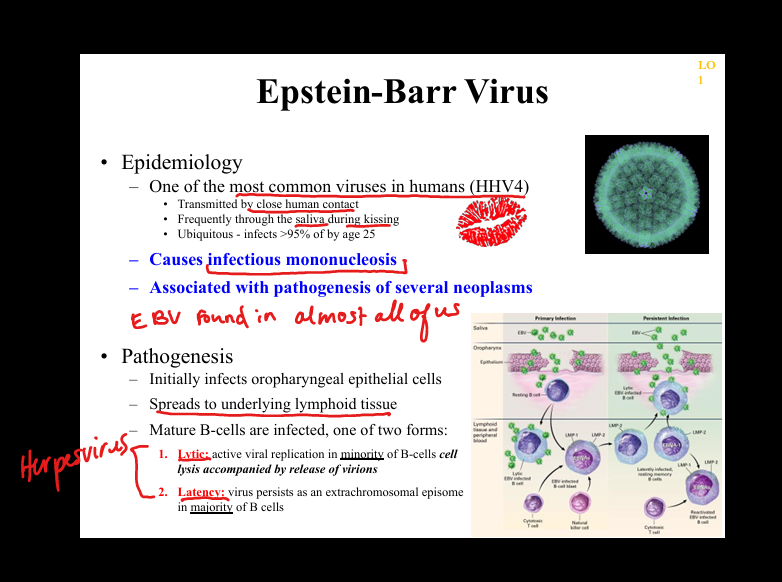
What is the natural history of primary EBV infection?

Early infection of oropharyngeal epithelium(fever, sore throat, maliase, swollen glands) → spread to lymphoid tissue → infection of B cells → lytic replication in a minority of B cells + latent infection in most B cells → strong CD8+ T‑cell response → clinical infectious mononucleosis.
knowt flashcard imageknowt flashcard image

<p>Early infection of oropharyngeal epithelium(fever, sore throat, maliase, swollen glands) → spread to lymphoid tissue → <strong>infection of B cells</strong> → lytic replication in a minority of B cells + latent infection in most B cells → strong CD8+ T‑cell response → clinical<strong> infectious mononucleosis.</strong></p><img src="https://knowt-user-attachments.s3.amazonaws.com/a70cdf26-2e46-4a0b-bc9c-0d82602931fa.png" data-width="100%" data-align="center" alt="knowt flashcard image"><img src="https://knowt-user-attachments.s3.amazonaws.com/be611452-f947-40c8-b049-5c92d42a0b44.png" data-width="100%" data-align="center" alt="knowt flashcard image"><p></p>
2
New cards

What are the phases of EBV clinicopathologic manifestations?

Primary infection (mono), latency (episomal EBV in memory B cells), reactivation (immunosuppression/immunosenescence), EBV‑driven neoplasia (e.g., DLBCL, Burkitt, Hodgkin, nasopharyngeal carcinoma).

3
New cards

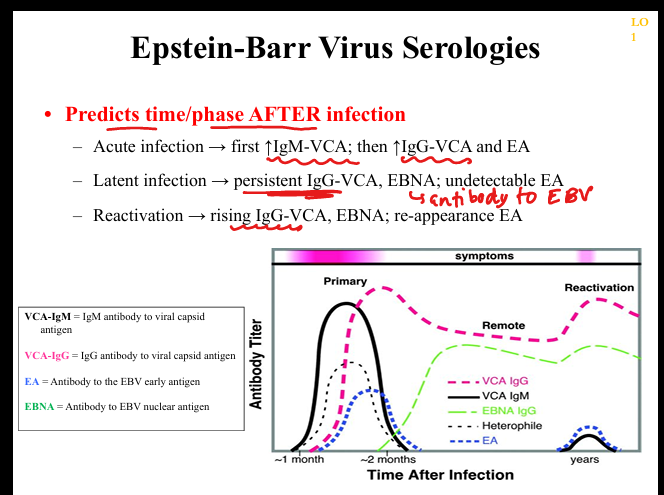
What are the key serologic markers in EBV infection?

VCA‑IgM (acute), VCA‑IgG (acute → persists for life), EA (acute/reactivation), EBNA (appears late, persists for life), heterophile antibodies (Monospot; positive in most adolescents/adults).
knowt flashcard image

<p>VCA‑IgM (acute), VCA‑IgG (acute → persists for life), EA (acute/reactivation), EBNA (appears late, persists for life), heterophile antibodies (<strong>Monospot; positive in most adolescents/adults).</strong></p><img src="https://knowt-user-attachments.s3.amazonaws.com/6f485a68-7c98-4843-814c-bd069cb0e9dd.png" data-width="100%" data-align="center" alt="knowt flashcard image"><p></p>
4
New cards

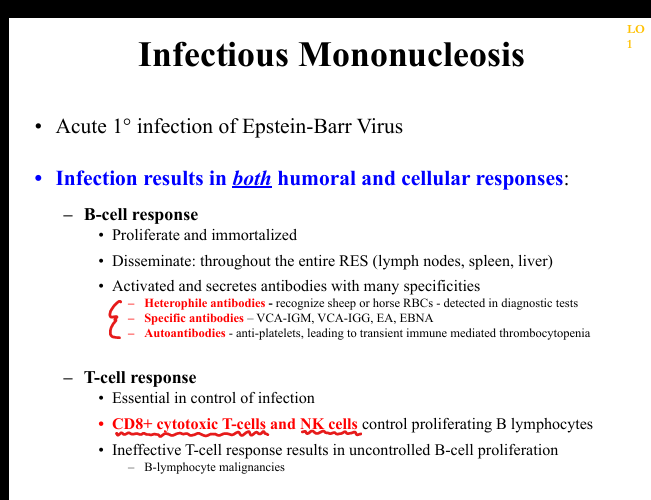
What immune abnormalities occur in EBV infection?

Marked CD8+ T‑cell activation (atypical lymphocytes), transient immune dysregulation, autoantibodies (e.g., anti‑platelet), risk of uncontrolled B‑cell proliferation if T‑cell response is impaired.
knowt flashcard image

<p>Marked CD8+ T‑cell activation (atypical lymphocytes), transient immune dysregulation, autoantibodies (e.g., anti‑platelet), risk of uncontrolled B‑cell proliferation if T‑cell response is impaired.</p><img src="https://knowt-user-attachments.s3.amazonaws.com/66fa409d-8b82-4cda-bf71-c2424d283190.png" data-width="100%" data-align="center" alt="knowt flashcard image"><p></p>
5
New cards

What are the histopathologic findings in EBV infectious mononucleosis?

Peripheral blood shows atypical CD8+ T lymphocytes; lymph nodes show paracortical expansion; tonsils show EBV‑infected large B‑cell blasts; spleen enlarged with white/red pulp expansion.
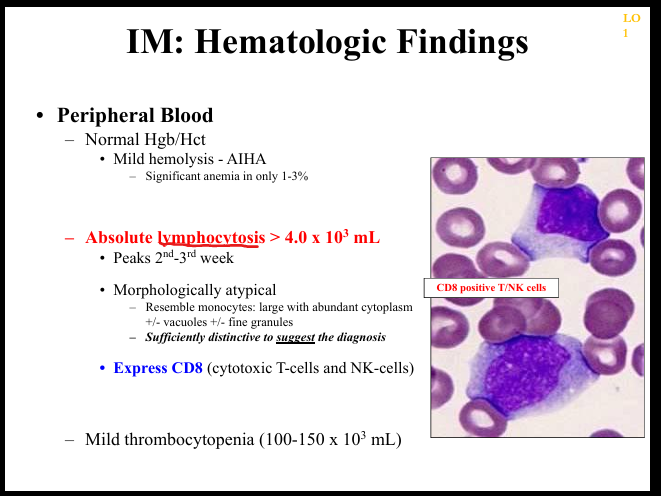
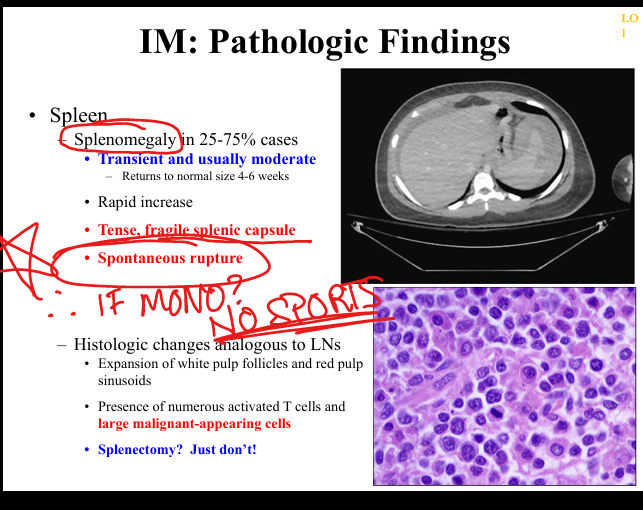
knowt flashcard imageknowt flashcard image

knowt flashcard image

<p>Peripheral blood shows atypical CD8+ T lymphocytes; lymph nodes show paracortical expansion; tonsils show EBV‑infected large B‑cell blasts; spleen enlarged with white/red pulp expansion.</p><img src="https://knowt-user-attachments.s3.amazonaws.com/edef5cff-168a-46ed-be84-50e9f081aa2e.png" data-width="100%" data-align="center" alt="knowt flashcard image"><img src="https://knowt-user-attachments.s3.amazonaws.com/edef5cff-168a-46ed-be84-50e9f081aa2e.png" data-width="100%" data-align="center" alt="knowt flashcard image"><p></p><img src="https://knowt-user-attachments.s3.amazonaws.com/593943ba-9523-4426-8f3e-4b292497c159.png" data-width="100%" data-align="center" alt="knowt flashcard image"><p></p>
6
New cards

What is the pathogenesis of HSV‑1/HSV‑2 latency?

Primary infection in mucocutaneous epithelium → retrograde transport to sensory ganglia → lifelong latency → periodic reactivation → vesicular lesions; HSV evades immunity via downregulating MHC.
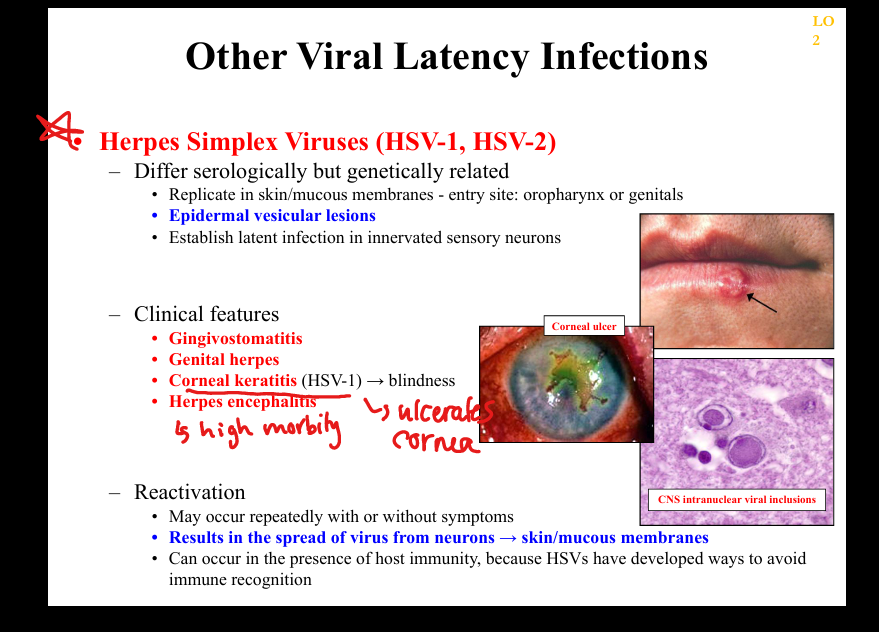
knowt flashcard image

<p>Primary infection in mucocutaneous epithelium → retrograde transport to<strong> sensory ganglia → lifelong latency</strong> → periodic reactivation → vesicular lesions; HSV evades immunity via downregulating MHC.</p><img src="https://knowt-user-attachments.s3.amazonaws.com/3e8058ab-991c-476d-b540-23d8fc033cc3.png" data-width="100%" data-align="center" alt="knowt flashcard image"><p></p>
7
New cards

What clinicopathologic changes occur in HSV latency/reactivation?

Recurrent oral/genital vesicles, gingivomatitis, corneal keratitis (HSV‑1)=>blindness, encephalitis, painful dermatomal recurrences; histology shows multinucleated giant cells and Cowdry A inclusions.
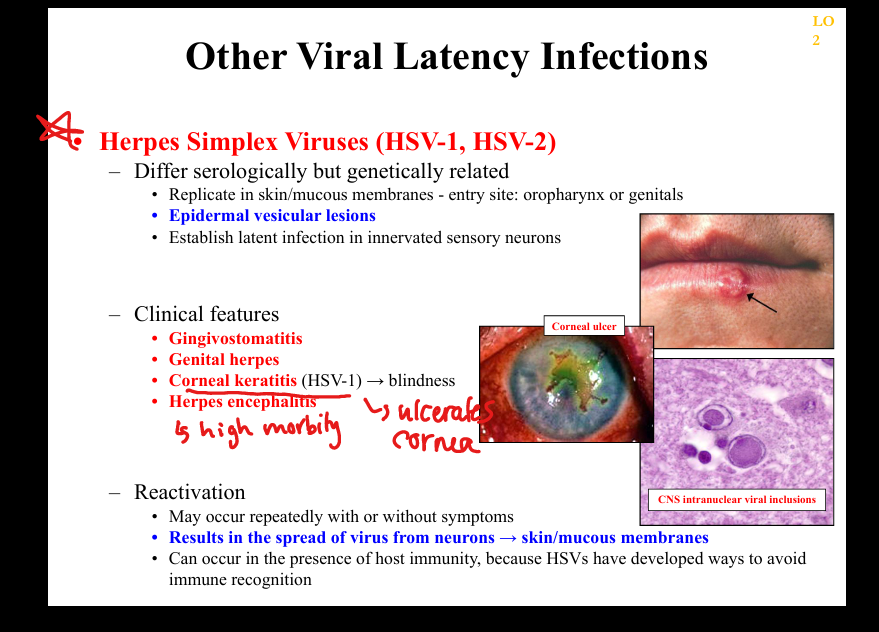
knowt flashcard image

<p>Recurrent oral/genital vesicles, gingivomatitis, corneal keratitis (HSV‑1)=&gt;blindness, encephalitis, painful dermatomal recurrences; histology shows multinucleated giant cells and Cowdry A inclusions.</p><img src="https://knowt-user-attachments.s3.amazonaws.com/b08ac98c-c50c-4f97-acd6-a504219ce7c5.png" data-width="100%" data-align="center" alt="knowt flashcard image"><p></p>
8
New cards

What is the pathogenesis of VZV latency?

Primary infection (chickenpox) → viremia → latency in dorsal root ganglia → reactivation as shingles; dermatomal vesicles with severe neuropathic pain.
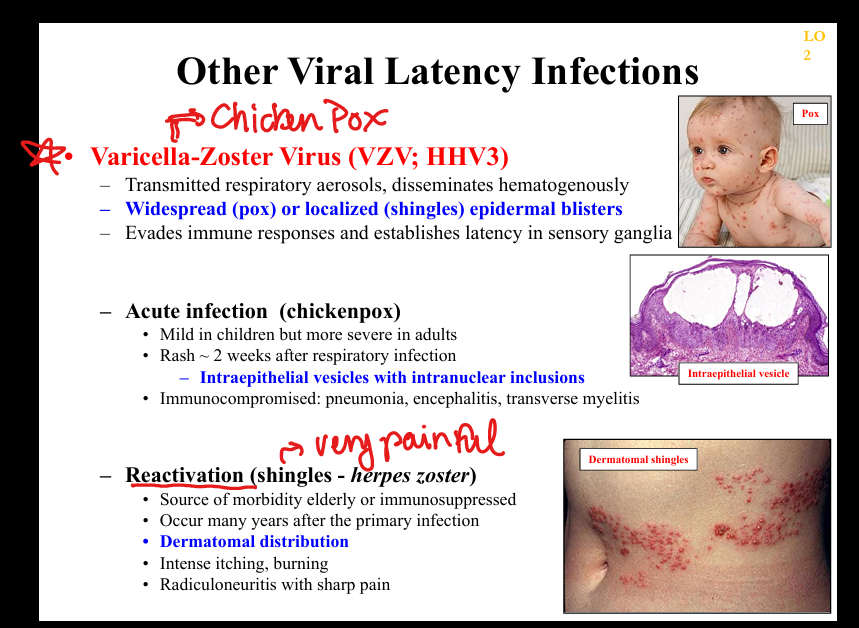
knowt flashcard image

<p>Primary infection (chickenpox) → viremia → <strong>latency in dorsal root ganglia </strong>→ reactivation as <strong>shingles</strong>; <strong>dermatomal vesicles with severe neuropathic pain</strong>.</p><img src="https://knowt-user-attachments.s3.amazonaws.com/ba78de62-c65e-45ec-b4f4-1d0365196963.png" data-width="100%" data-align="center" alt="knowt flashcard image"><p></p>
9
New cards

What clinicopathologic changes occur in VZV infection?

Chickenpox: diffuse vesicles, pneumonia, encephalitis; shingles: dermatomal vesicles, radiculoneuritis, post‑herpetic neuralgia; histology shows intraepidermal vesicles with inclusions.
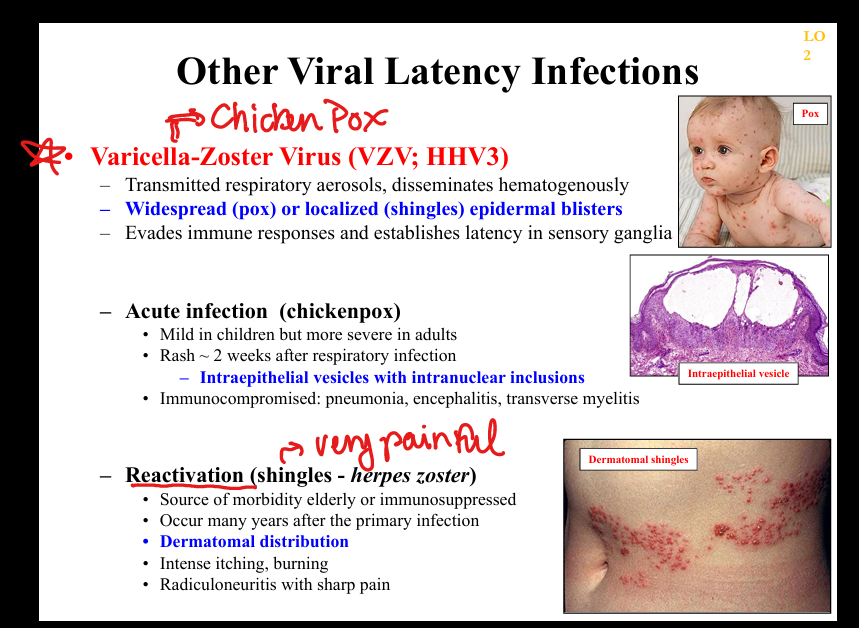
knowt flashcard image

<p>Chickenpox: diffuse vesicles, pneumonia, encephalitis; shingles: dermatomal vesicles, radiculoneuritis, post‑herpetic neuralgia; histology shows intraepidermal vesicles with inclusions.</p><img src="https://knowt-user-attachments.s3.amazonaws.com/40445aae-0996-4769-bd10-be38e4d4c950.png" data-width="100%" data-align="center" alt="knowt flashcard image"><p></p>
10
New cards

What is the pathogenesis of CMV (Cytomegalovirus) latency?

Primary infection(mono like illness), giganticism of entire cell → latency in monocytes and bone marrow progenitors → reactivation with immunosuppression; CMV downregulates MHC I/II and produces IL‑10 homologues. Owl Eye and giant monocytes
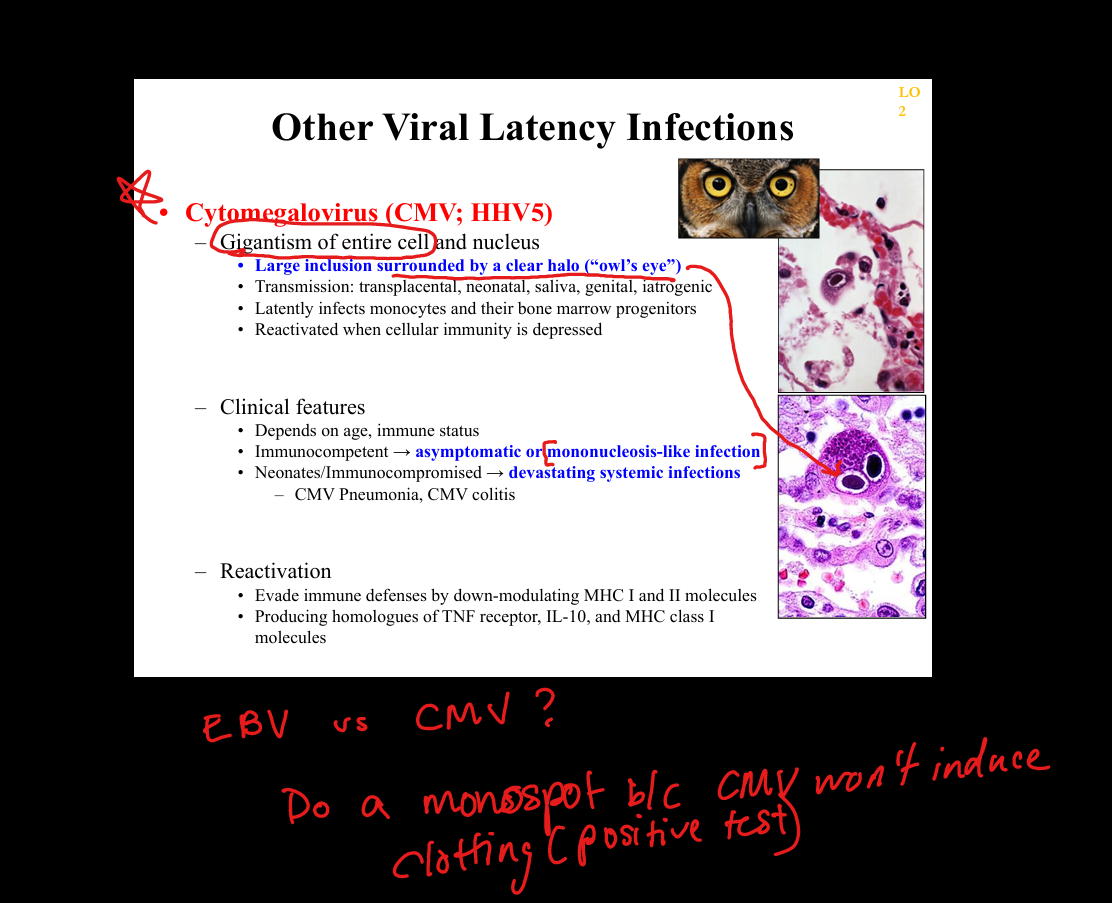
knowt flashcard image

<p>Primary infection(<strong>mono like illness</strong>), giganticism of entire cell → latency in monocytes and bone marrow progenitors → reactivation with immunosuppression; CMV downregulates MHC I/II and produces IL‑10 homologues. <strong>Owl Eye and giant monocytes</strong></p><img src="https://knowt-user-attachments.s3.amazonaws.com/492a3141-190a-4666-8ecf-e2fbcb5acb24.png" data-width="100%" data-align="center" alt="knowt flashcard image"><p></p>
11
New cards

What clinicopathologic changes occur in CMV infection?

Immunocompetent: mono‑like illness; immunocompromised: CMV colitis, retinitis (“pizza pie”), pneumonitis; histology shows large cells with “owl’s eye” inclusions.
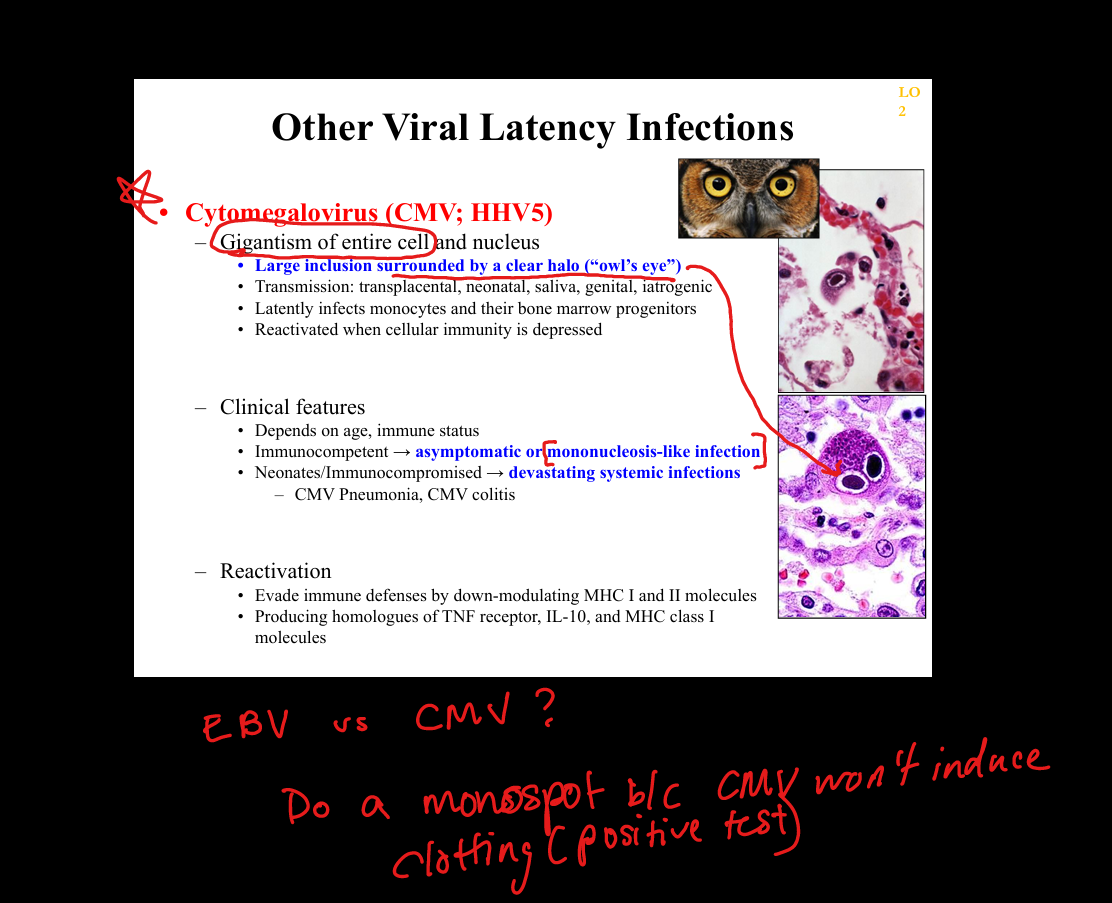
knowt flashcard image

<p>Immunocompetent: <strong>mono‑like illness</strong>; immunocompromised: CMV colitis, retinitis (“pizza pie”), pneumonitis; histology shows <strong>large cells with “owl’s eye” inclusions.</strong></p><img src="https://knowt-user-attachments.s3.amazonaws.com/17e5e522-1973-4125-8fad-9859c81bc4f1.png" data-width="100%" data-align="center" alt="knowt flashcard image"><p></p>
12
New cards

What mechanisms drive immunosenescence?

Thymic involution, chronic antigenic stimulation (e.g., CMV), stem cell exhaustion, lymph node fibrosis, reduced repertoire diversity, impaired phagocyte function.
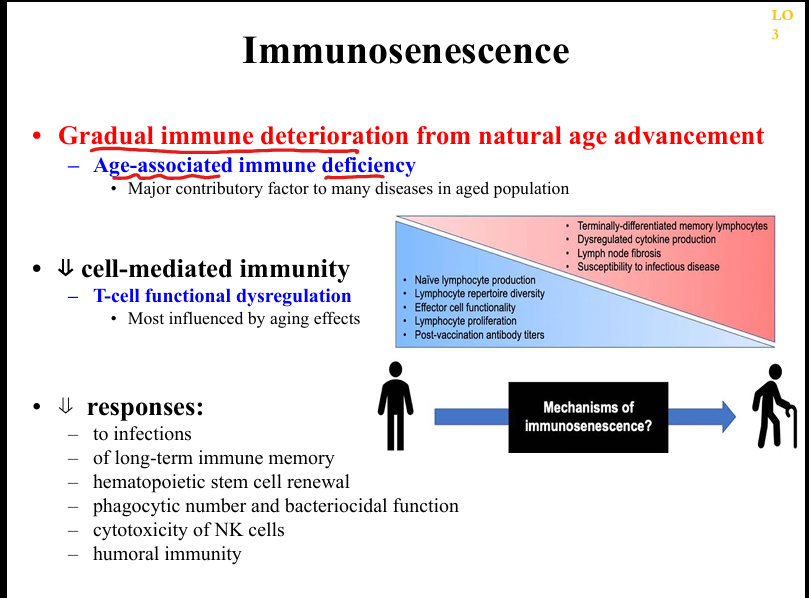
knowt flashcard image

<p>Thymic involution, chronic antigenic stimulation (e.g., CMV), stem cell exhaustion, lymph node fibrosis, reduced repertoire diversity, impaired phagocyte function.</p><img src="https://knowt-user-attachments.s3.amazonaws.com/83efc424-d8de-47ce-8d9f-541568f3453a.png" data-width="100%" data-align="center" alt="knowt flashcard image"><p></p>
13
New cards

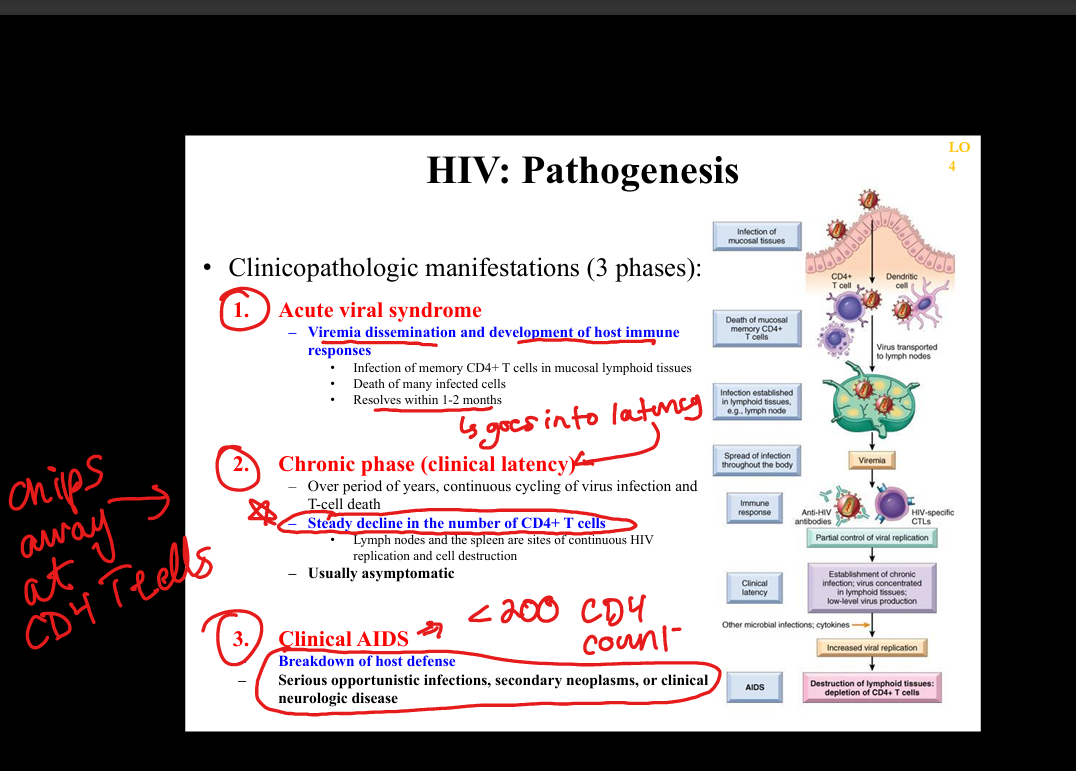
What is the natural history of HIV infection?

Acute HIV syndrome → clinical latency (persistent replication in lymphoid tissue) → progressive CD4 decline → AIDS (CD4 <200 or AIDS‑defining illness).
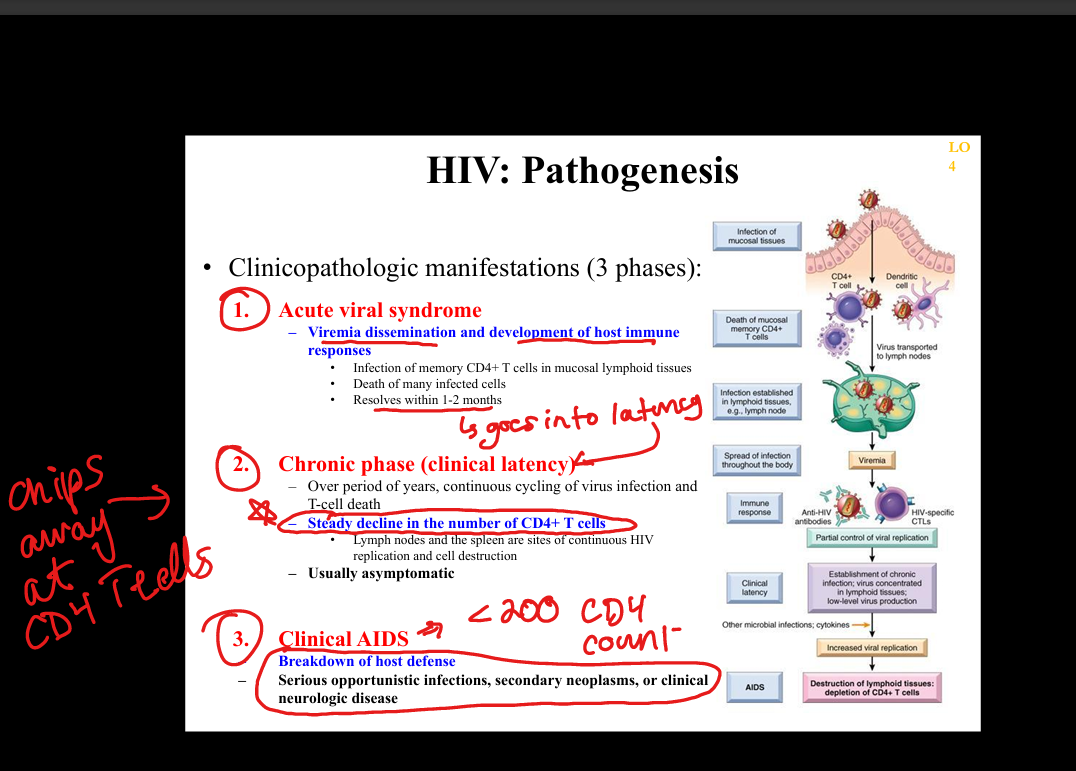
knowt flashcard image

<p>Acute HIV syndrome → clinical latency (persistent replication in lymphoid tissue) → <strong>progressive CD4 decline </strong>→ AIDS (CD4 &lt;200 or AIDS‑defining illness).</p><img src="https://knowt-user-attachments.s3.amazonaws.com/ced5dbbb-5fa3-4bdd-a951-8ba5bfb76f94.png" data-width="100%" data-align="center" alt="knowt flashcard image"><p></p>
14
New cards

What is the pathogenesis of HIV infection?

HIV infects CD4+ T cells, macrophages, dendritic cells via gp120 binding to CD4 + CCR5/CXCR4 → integration into host genome → chronic immune activation → CD4 depletion → immunodeficiency.
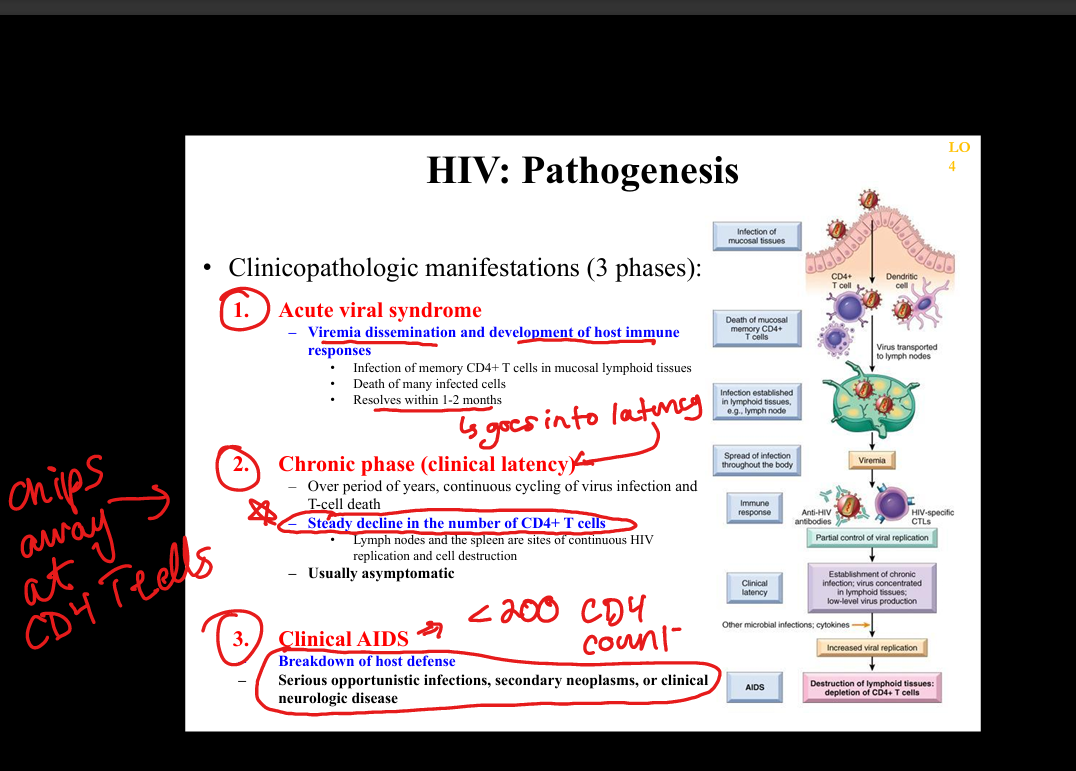
knowt flashcard image

<p>HIV infects CD4+ T cells, macrophages, dendritic cells via gp120 binding to CD4 + CCR5/CXCR4 → integration into host genome → chronic immune activation → CD4 depletion → immunodeficiency.</p><img src="https://knowt-user-attachments.s3.amazonaws.com/37c01f95-8071-4926-a106-fba428d83fe1.png" data-width="100%" data-align="center" alt="knowt flashcard image"><p></p>
15
New cards

What are the major immune abnormalities in HIV?

CD4+ T‑cell loss, impaired macrophage/dendritic function, B‑cell hyperactivation, loss of mucosal immunity, chronic inflammation, immune exhaustion.
knowt flashcard image

<p>CD4+ T‑cell loss, impaired macrophage/dendritic function, B‑cell hyperactivation, loss of mucosal immunity, chronic inflammation, immune exhaustion.</p><img src="https://knowt-user-attachments.s3.amazonaws.com/a5cf5fb0-1da4-4c0b-9abf-75ceb7121969.png" data-width="100%" data-align="center" alt="knowt flashcard image"><p></p>
16
New cards

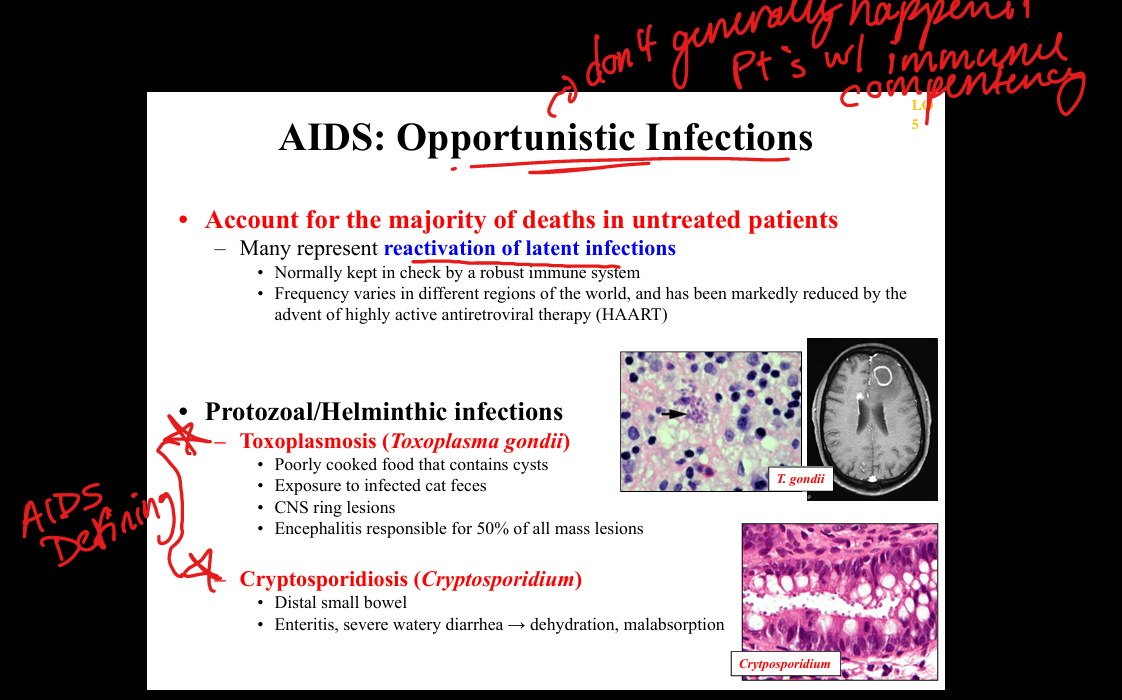
What protozoal opportunistic infections occur in AIDS?

Toxoplasma gondii (ring‑enhancing brain lesions), Cryptosporidium (chronic watery diarrhea), Isospora (diarrhea).
knowt flashcard image

<p>Toxoplasma gondii (ring‑enhancing brain lesions), Cryptosporidium (chronic watery diarrhea), Isospora (diarrhea).</p><img src="https://knowt-user-attachments.s3.amazonaws.com/c7003de3-92b1-4994-857e-aeef52d5c55f.png" data-width="100%" data-align="center" alt="knowt flashcard image"><p></p>
17
New cards

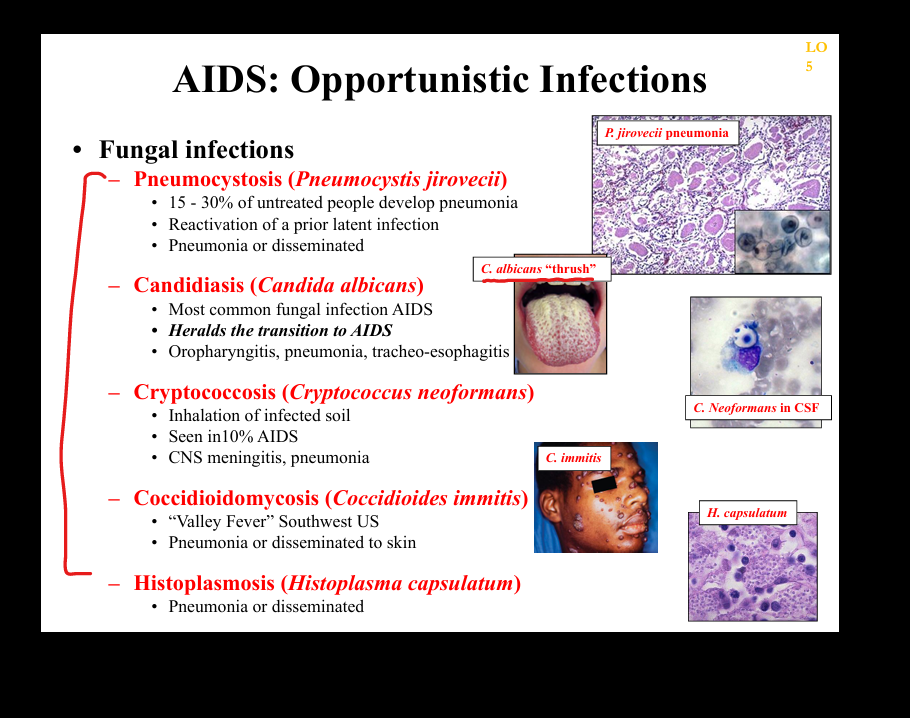
What fungal opportunistic infections occur in AIDS?

Pneumocystis jirovecii pneumonia (PCP), Cryptococcus neoformans meningitis, Histoplasma and Coccidioides disseminated infections, Candida esophagitis.
knowt flashcard image

<p>Pneumocystis jirovecii pneumonia (PCP), Cryptococcus neoformans meningitis, Histoplasma and Coccidioides disseminated infections, Candida esophagitis.</p><img src="https://knowt-user-attachments.s3.amazonaws.com/5122f63f-575b-44aa-ba48-e49db4e4946c.png" data-width="100%" data-align="center" alt="knowt flashcard image"><p></p>
18
New cards

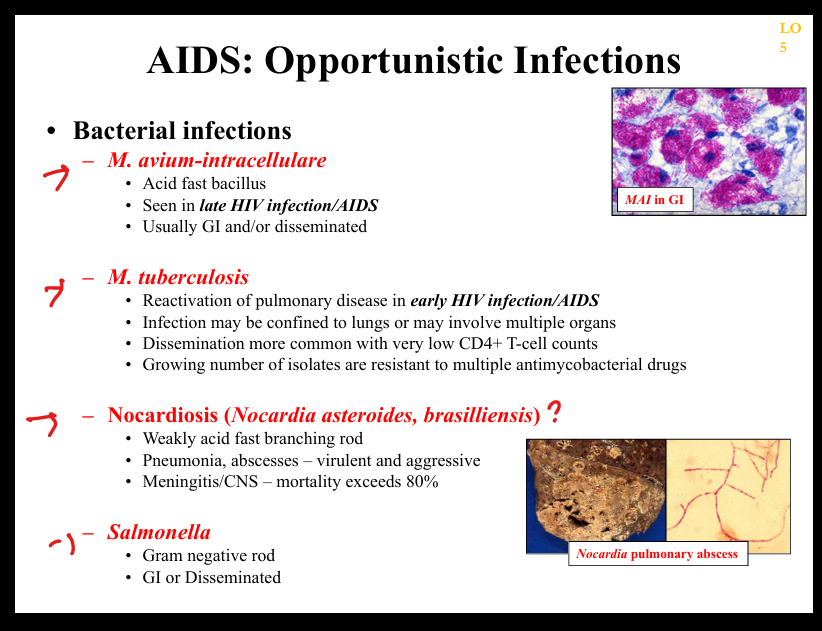
What bacterial opportunistic infections occur in AIDS?

Mycobacterium avium complex (MAC), Mycobacterium tuberculosis, Salmonella bacteremia, Listeria, typical pyogenic bacteria.
knowt flashcard image

<p>Mycobacterium avium complex (MAC), Mycobacterium tuberculosis, Salmonella bacteremia, Listeria, typical pyogenic bacteria.</p><img src="https://knowt-user-attachments.s3.amazonaws.com/c251d170-cc88-429e-b66a-79ede477748b.png" data-width="100%" data-align="center" alt="knowt flashcard image"><p></p>
19
New cards

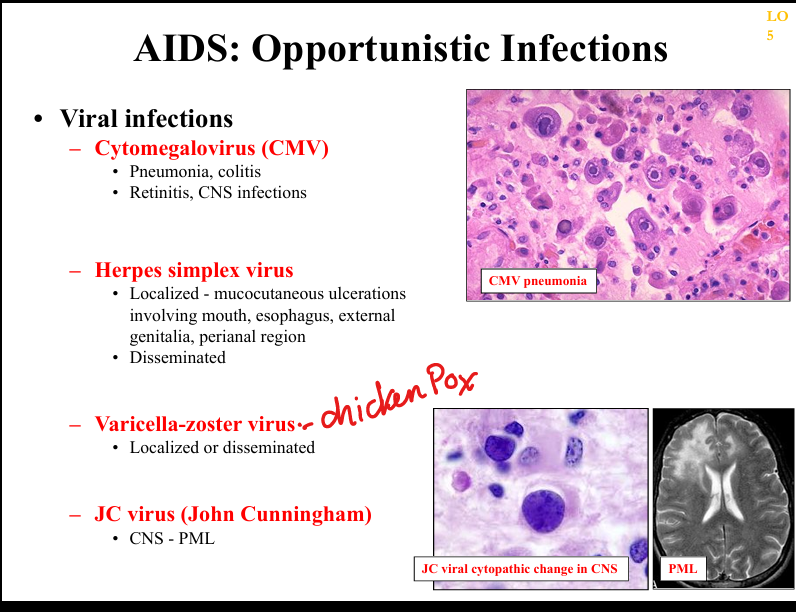
What viral opportunistic infections occur in AIDS?

CMV retinitis/colitis, HSV chronic ulcers, VZV disseminated infection, JC virus (PML), EBV‑associated lymphomas.
knowt flashcard image

<p>CMV retinitis/colitis, HSV chronic ulcers, VZV disseminated infection, JC virus (PML), EBV‑associated lymphomas.</p><img src="https://knowt-user-attachments.s3.amazonaws.com/185bf69f-b207-4a9a-aecc-32db69ad0b98.png" data-width="100%" data-align="center" alt="knowt flashcard image"><p></p>
20
New cards

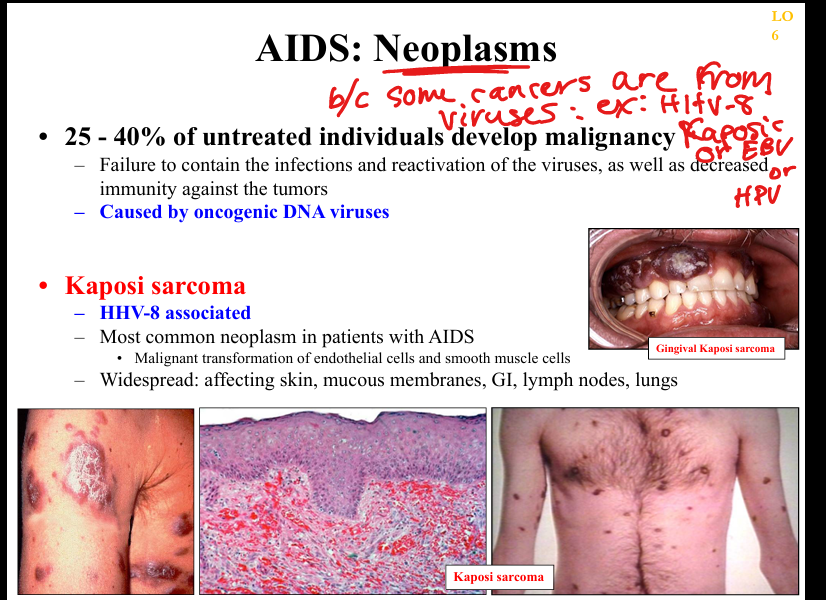
What is the pathogenesis of Kaposi sarcoma in AIDS?

HHV‑8 infection of endothelial cells → viral oncogenes promote angiogenesis and proliferation → violaceous skin lesions; worsens with immunosuppression.
knowt flashcard image

<p><strong>HHV‑8 infection of endothelial cells</strong> → viral oncogenes promote angiogenesis and proliferation → violaceous <strong>skin lesions;</strong> worsens with immunosuppression.</p><img src="https://knowt-user-attachments.s3.amazonaws.com/0cbd1e7a-258d-498b-9c5d-ad5b53df05b4.png" data-width="100%" data-align="center" alt="knowt flashcard image"><p></p>
21
New cards

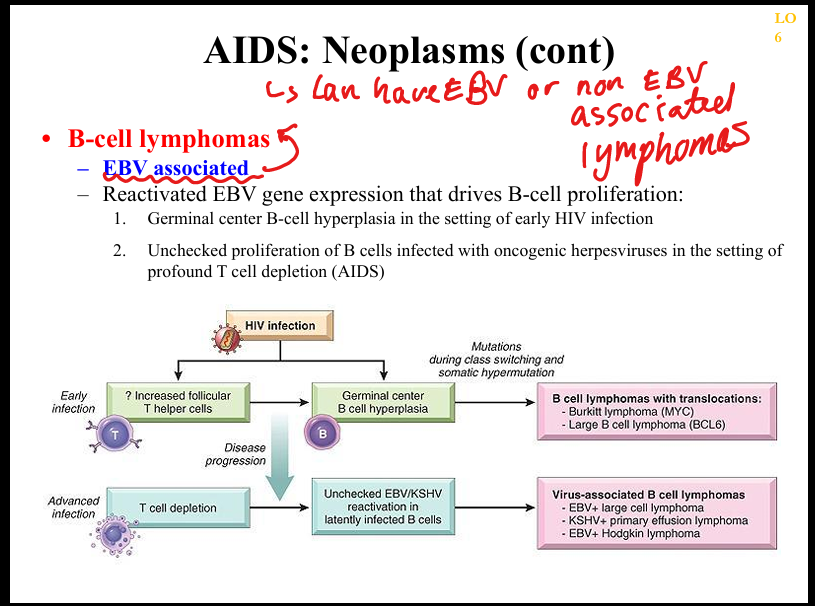
What is the pathogenesis of AIDS‑related B‑cell lymphomas?

EBV‑driven proliferation of B cells in setting of impaired T‑cell surveillance → DLBCL, primary CNS lymphoma, primary effusion lymphoma.
knowt flashcard image

<p><strong>EBV‑driven proliferation of B cells in setting of impaired T‑cell surveillance </strong>→ DLBCL, primary CNS lymphoma, primary effusion lymphoma.</p><img src="https://knowt-user-attachments.s3.amazonaws.com/ae73223b-8a6c-44f2-88b4-09a3f2a756e5.png" data-width="100%" data-align="center" alt="knowt flashcard image"><p></p>
22
New cards

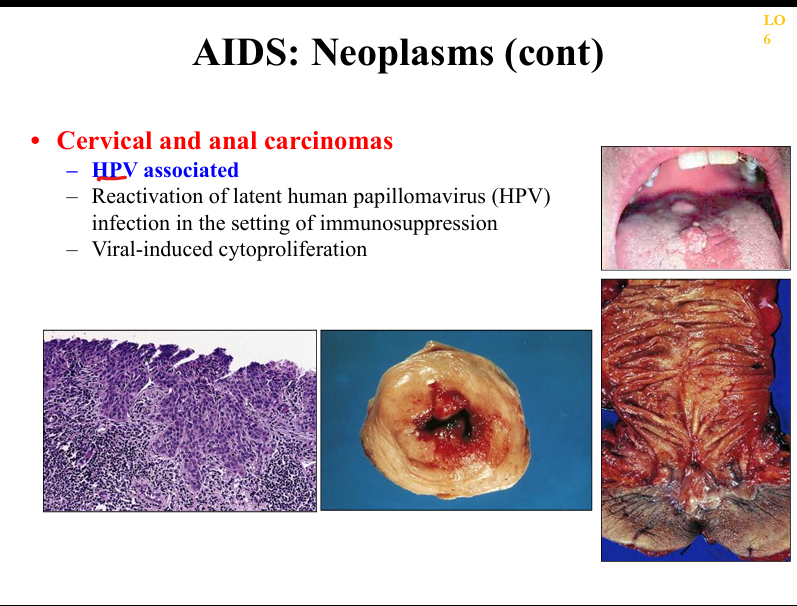
What is the pathogenesis of cervical/anal carcinoma in AIDS?

High‑risk HPV infection (16/18) with impaired immune clearance → E6/E7 inactivation of p53/Rb → dysplasia → carcinoma; incidence increased in HIV.
knowt flashcard image

<p><strong>High‑risk HPV infection (16/18)</strong> with impaired immune clearance → E6/E7 inactivation of p53/Rb → dysplasia → carcinoma; incidence increased in HIV.</p><img src="https://knowt-user-attachments.s3.amazonaws.com/4c036056-5f63-43ea-8e69-983466f6547e.png" data-width="100%" data-align="center" alt="knowt flashcard image"><p></p>
23
New cards

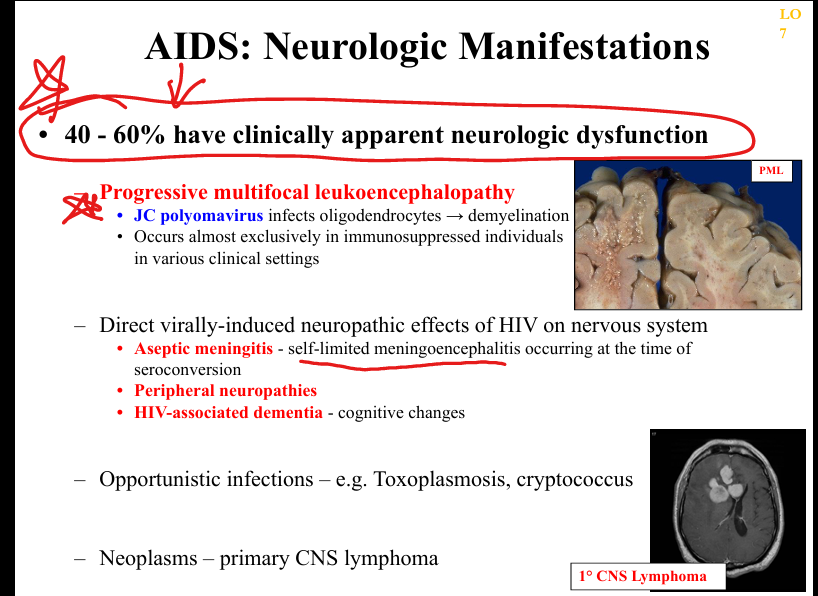
What neurological manifestations occur in AIDS?

HIV‑associated neurocognitive disorder (HIV encephalitis), PML (JC virus), CMV encephalitis, toxoplasmosis, peripheral neuropathy, vacuolar myelopathy.
knowt flashcard image

<p>HIV‑associated neurocognitive disorder (<strong>HIV encephalitis</strong>), <strong>PML (JC virus</strong>), <strong>CMV encephalitis</strong>, toxoplasmosis, peripheral neuropathy, vacuolar myelopathy.</p><img src="https://knowt-user-attachments.s3.amazonaws.com/3fefb3d6-b36a-4b0b-8a84-52b6e0bc9f06.png" data-width="100%" data-align="center" alt="knowt flashcard image"><p></p>
24
New cards

What are the clinicopathologic features of HIV encephalitis?

Microglial nodules, multinucleated giant cells, white matter pallor, cognitive decline, behavioral changes, motor deficits.
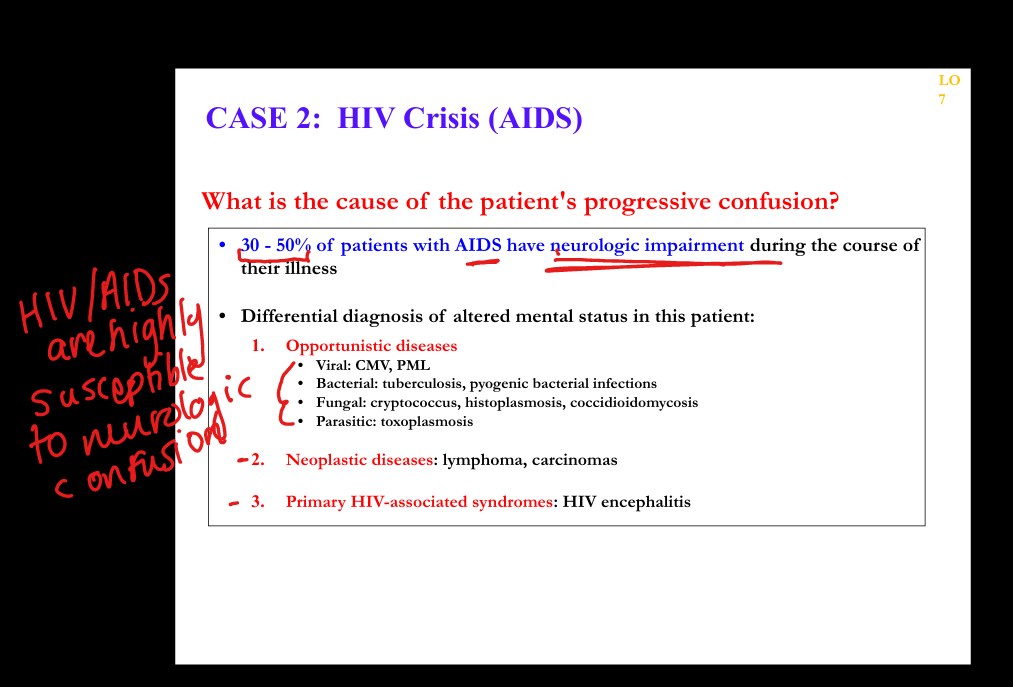
knowt flashcard image

<p>Microglial nodules, multinucleated giant cells, white matter pallor, cognitive decline, behavioral changes, motor deficits.</p><img src="https://knowt-user-attachments.s3.amazonaws.com/4bc8b8b2-8cda-4275-ac78-d94f23db4e67.png" data-width="100%" data-align="center" alt="knowt flashcard image"><p></p>