ESS 100 Questions 2
5.0(1)
Studied by 0 people Call Kai
 Learn
Learn Practice Test
 Spaced Repetition
 Match
Match Flashcards
 Knowt Play
Card Sorting
1/78

Earn XP
Description and Tags
Last updated 2:47 AM on 12/7/22
Name | Mastery | Learn | Test | Matching | Spaced | Call with Kai | Chat |
|---|
No analytics yet
Send a link to your students to track their progress
79 Terms
1
New cards
The clade Ornithopoda is comprised of
Iguanodonts and Hadrosaurs
2
New cards
A facultative quadruped
Prefers to walk on two legs but can walk on four
3
New cards
Ornithopod characteristics
Huge size, bird-shaped feet with hooves, leaf-shaped teeth, complex skull features
4
New cards
Large, closely-packed tooth batteries are characteristic of
Hadrosaurs
5
New cards
The features separating Hadrosaurs from Iguanodonts were mostly related to
more efficient food gathering
6
New cards
Gideon Mantell’s “nose spike” on Iguanodonts really belongs where?
first digit of the hand
7
New cards
Iguanodonts are
primitive ornithopods
8
New cards
Thyreophorans
quadrupedal, antorbital fenestra is closed or nearly closed, body has bony armor, small brain/body weight ratio
9
New cards
Nearly all Ankylosaurs are found in the
Cretaceous
10
New cards
An inset tooth row allows
better food gathering
11
New cards
What physical evidence suggests that Laenllynosaura was able to function in the winter darkness of high latitudes?
large orbits and optic nerve
12
New cards
All ornithischians are characterized by
Leaf-shaped teeth, backward pointing pubis, ossified tendons
13
New cards
A primitive dinosaur has
only the characteristics of the last common ancestor, but little more
14
New cards
What is the MOST LIKELY use of the plates on stegosaurs' backs?
species recognition and sexual selection
15
New cards
Sauropods have
saurischian pubis'
16
New cards
Sauropodomorph means
sauropod-shape
17
New cards
Characteristics of sauropods
Long necks and tails, small skulls, nares on top of head
18
New cards
Where have sauropod fossils been found?
all continents
19
New cards
Sauropods exhibit two distinct skull morphologies based on which two dinosaurs?
Diplodocus and Camarasaurus
20
New cards
Brachiosaurus was an unusual sauropod because
its forelimbs are longer than its hindlimbs
21
New cards
Titanosaurs lived when?
Late Cretaceous
22
New cards
The earliest sauropodomorph was Plateosaurus, which lived in the
Late Triassic
23
New cards
Advantages of gigantism
Room for large digestive system, outgrowing predators, easy to heat the body
24
New cards
One way sauropods lightened their bodies was by
having air sacs in their neck vertebrae
25
New cards
Rapid growth rate in sauropods was shown using
thin sections of bone
26
New cards
Ectothermy is another name for
cold-blooded
27
New cards
Macronarians and Diplodocids had different types of teeth. What does tis tell us about them?
both herbivores but with different diets
28
New cards
Mesotherms
Raise their body temperature above that of the surrounding air, but do not "defend" a certain temperature
29
New cards
Pachycephalosaurs are distinguished from Ceratopsia by their
thickened dome
30
New cards
characteristic of Pachycephalosaurus
bony dome and knobs and spikes on the head
31
New cards
The last major clade of dinosaurs to evolve was the
Ceratopsians
32
New cards
characteristic of Ceratopsians
tooth batteries, horns on face, frill at the back of the skull
33
New cards
Marginocephalia means
ridged head
34
New cards
Which of the following is an argument FOR ectothermy in sauropods
all living reptiles are ectotherms
35
New cards
An ectothermic animal
derives its body heat from the surrounding air
36
New cards
arguments in favor of endothermy in dinosaurs
evidence of active lifestyle, insulation, internal bone structure, large size, large chest capacity
37
New cards
Giant Carnivores
The general name for the group containing Spinosaurs, Megalosaurs, Carcharodonts, Allosaurs, and Tyrannosaurs
38
New cards
Coelurosaurs are characterized by
specialized wrist structure, long slender hands, slender rear portion of tail
39
New cards
The first theropods appeared in the
Triassic
40
New cards
The fused collar bones characteristic of theropods is called a
furcula
41
New cards
The terrestrial animal with the strongest bite force was
Tyrannosaurus rex
42
New cards
Theropod characteristics
furcula, hollow bones, pointed serrated teeth
43
New cards
Tyrannosaurids are found in rocks of what age?
Late Cretaceous
44
New cards
Tyrannosaurids are characterized by
skull modifications, massive neck muscles, D-shaped teeth
45
New cards
Theropods are found in which geologic time periods
Triassic, Jurassic, Cretaceous
46
New cards
The largest ornithomimud was
Deinocheirus
47
New cards
Deinonychosaur characteristics
backward-pointing pubis, ossified tendons in tail, hyperextendable claw on second toe
48
New cards
derived tetanurans (theropods)
Ornithomimuds, Alvarezsaurids, Therizinosaurs, and Oviraptors
49
New cards
Bony quill knobs on Velociraptor bones indicate
they had feathers
50
New cards
Some paleontologists infer that Troodon had good night vision because
it had very large eyes
51
New cards
What is different from other theropods about Deinonychosaurs' pubis?
it tilts backwards
52
New cards
largest deinonychosaur?
Utahraptor
53
New cards
What discovery finally helped paleontologists realize Spinosaurus was a good swimmer?
Caudal (tail) vertebrae with large spines on top
54
New cards
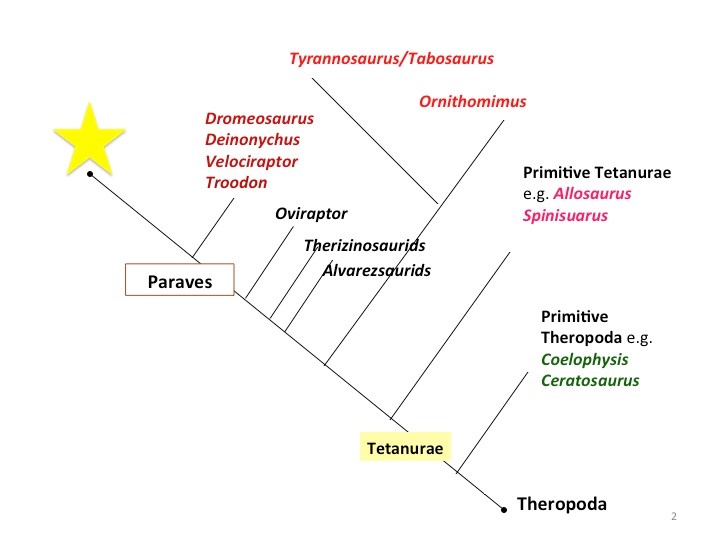
What comes where the star is on the cladogram
Aviales
55
New cards
Bird fossils are found in the
late Jurassic through Late Cretaceous
56
New cards
Archaeopteryx fossils have only been found in
Germany
57
New cards
The largest number of bird fossils are
Cretaceous water birds because that's the best place for preservation
58
New cards
Which characteristics is an evolutionary innovation that is characteristic of birds ONLY?
deep-keeled sternum
59
New cards
convergent evolution
When unrelated species develop similar behaviors or features in order to solve similar problems
60
New cards
callus
bony tissue forming around sites of injury or infection in bone
61
New cards
There is evidence which pests afflicted dinosaurs?
lice and fleas
62
New cards
Fossils of lice that infested dinosaurs were preserved in what material?
amber
63
New cards
The scalloped edge on a triceratops bone was evidence that
a T-rex had nibbled on it
64
New cards
One of the big problems in the classification of birds is
Birds were originally classified using only the features of living birds
65
New cards
features that apply to both dinosaurs and birds
bipedal, complex respiratory system, feathers, backwards pointing pubis, furcula
66
New cards
An animal is a dinosaur if it is a member of the least inclusive that includes both Passer domesticus and which animal below?
Triceratops horridus
67
New cards
A Mesozoic terrestrial reptile that walks with an upright stance defines what?
non-avian dinosaurs
68
New cards
Walter and Luis Alvarez are the authors of what important dinosaur information?
investigations that indicated a bolide impact resulted in dinosaur extinction
69
New cards
The Chicxulub crater left by the end-Cretaceous asteroid is in
the Yucatan Peninsula, Mexico
70
New cards
The Deccan traps
huge lava flows in the late Cretaceous in India
71
New cards
The fern spike was
a dramatic increase in the number of ferns just after the end-Cretaceous extinction
72
New cards
Iridium is important because
it is only found in great quantities in meteorites or comets
73
New cards
The iridium layer found globally is an indication that
a bolide impact caused the end-Cretaceous mass extinction
74
New cards
Tektites, shocked quartz, and tsunami deposits are all evidence of
a bolide impact
75
New cards
During the end-Cretaceous, the best way to survive would have been
to be small or live in freshwater
76
New cards
volcanism can cause
acid rain, an increase in poisonous gases in the atmosphere, an increase in particulate matter in the atmosphere
77
New cards
background extinction
extinction that goes on all the time
78
New cards
what percent of terrestrial animals went extinct during the end-Cretaceous extinction
40
79
New cards
mass extinction
when the rate of extinction rises significantly above background extinction for a geologically brief time