Organic Chemistry QUIZ 1
 Call Kai
 Learn
Learn Practice Test
 Spaced Repetition
 Match
Match Flashcards
 Knowt Play
1/89

Earn XP
Description and Tags
Chapter 1
Name | Mastery | Learn | Test | Matching | Spaced | Call with Kai | Chat |
|---|
No analytics yet
Send a link to your students to track their progress
90 Terms
Every atom except for H, He, and B wants to have ____________ total valence electrons.
Add lone pairs until the atom has enough electrons to be stable!
eight
Every atom except for H, He, and B wants to have eight total valence electrons.
Add _______________ until the atom has enough electrons to be stable!
lone pairs
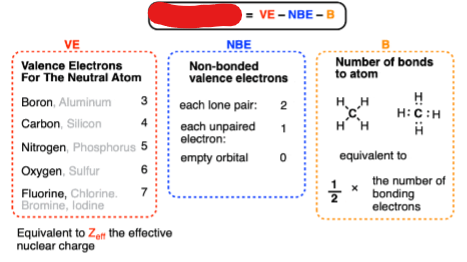
Formal charge
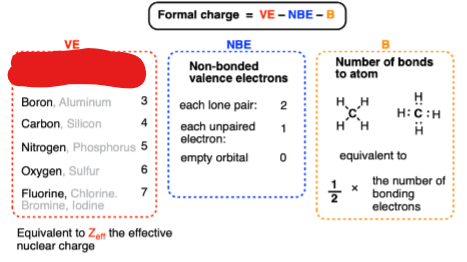
Valence Electrons (for the neutral atom)

8 — (2X # of Bonds)
Non-bonded valence electrons
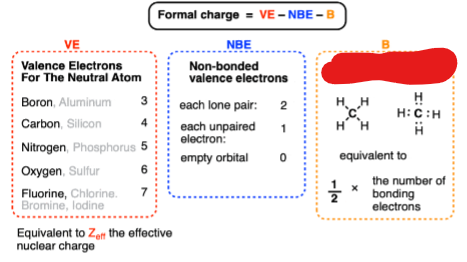
#of bonds to atom

Ionic

Polar covalent
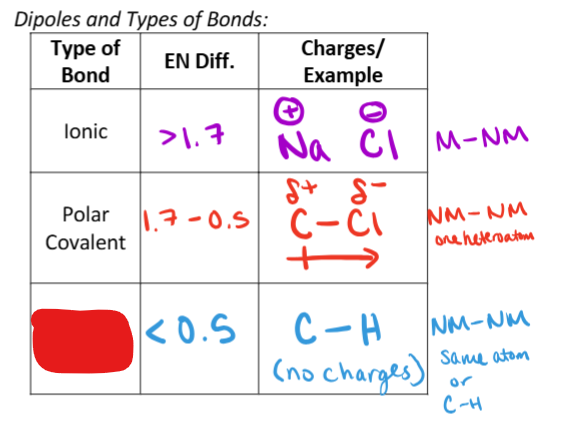
Nonpolar covalent

>1.7

1.7-0.5
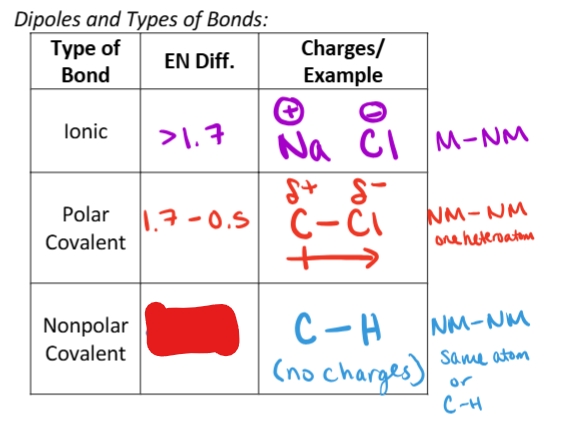
<0.5
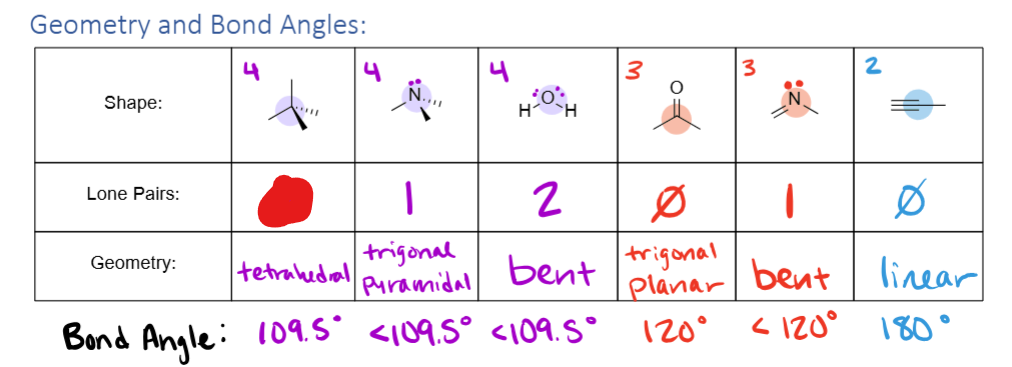
0
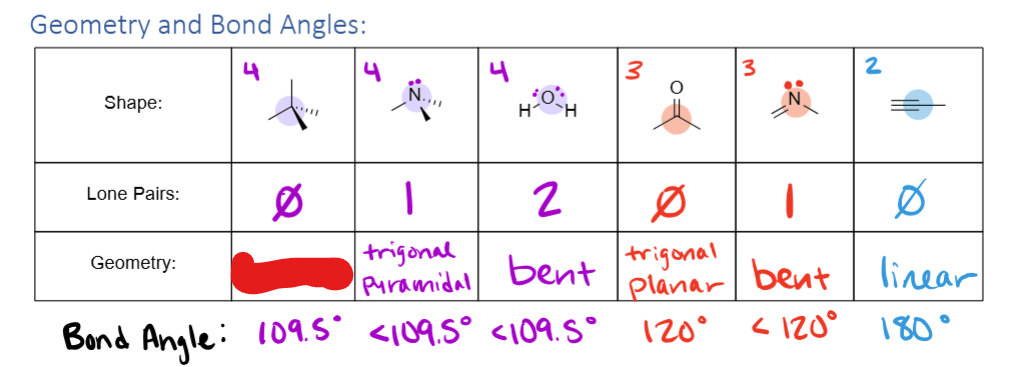
Tetrahedral
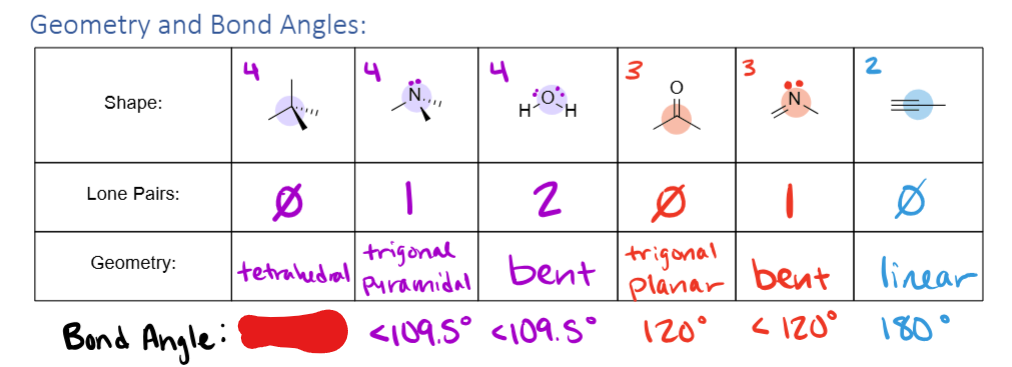
109.5
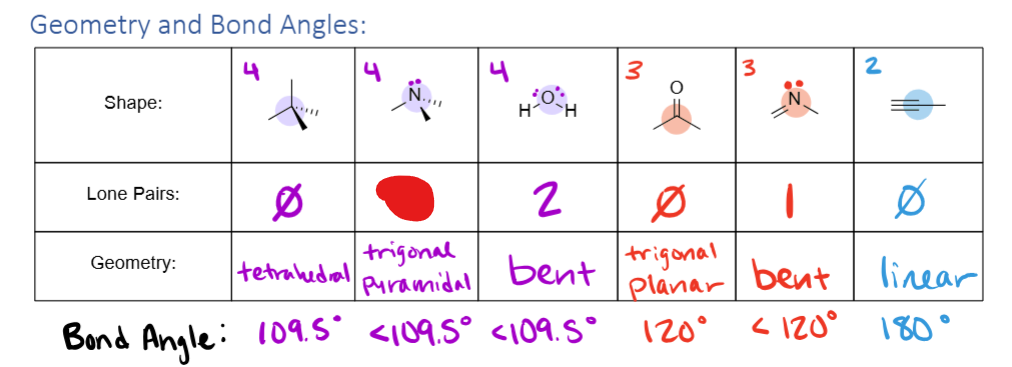
1
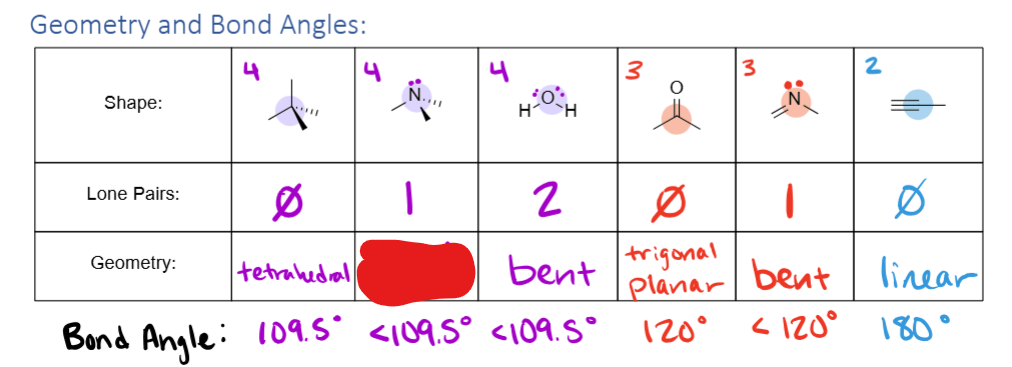
Trigonal pyramidal
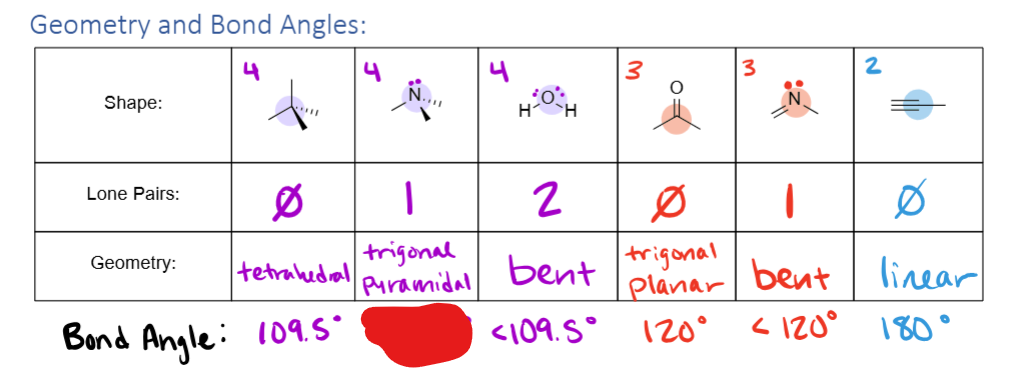
<109.5

2

Bent

<109.5
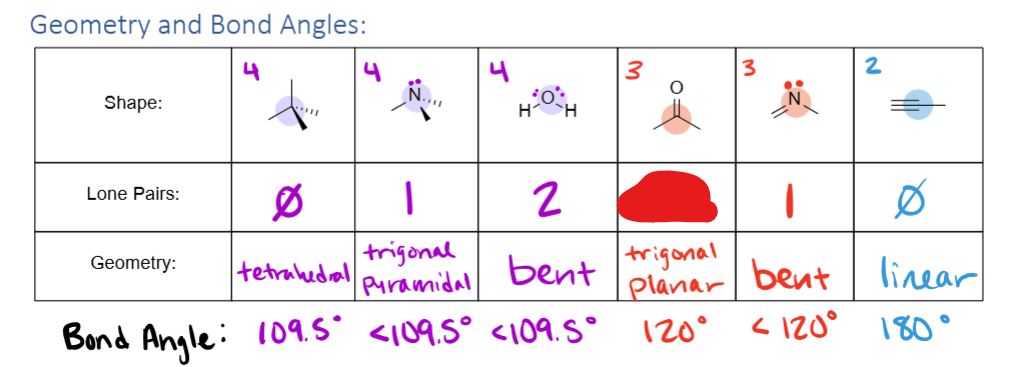
0

Trigonal planar

120
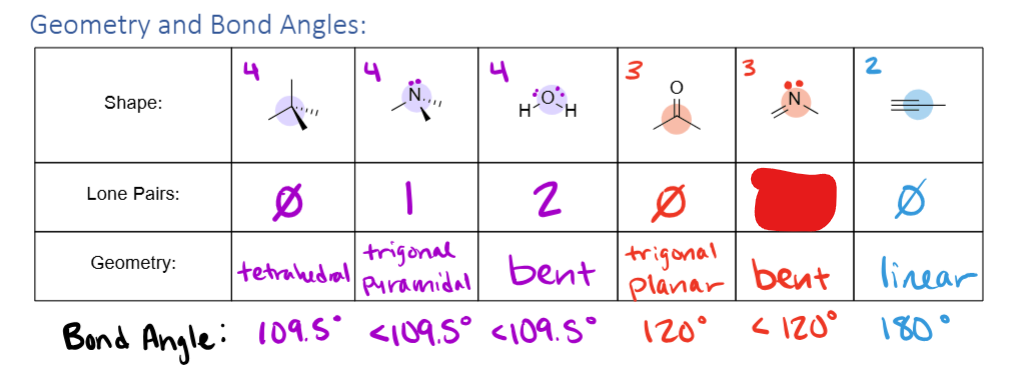
1
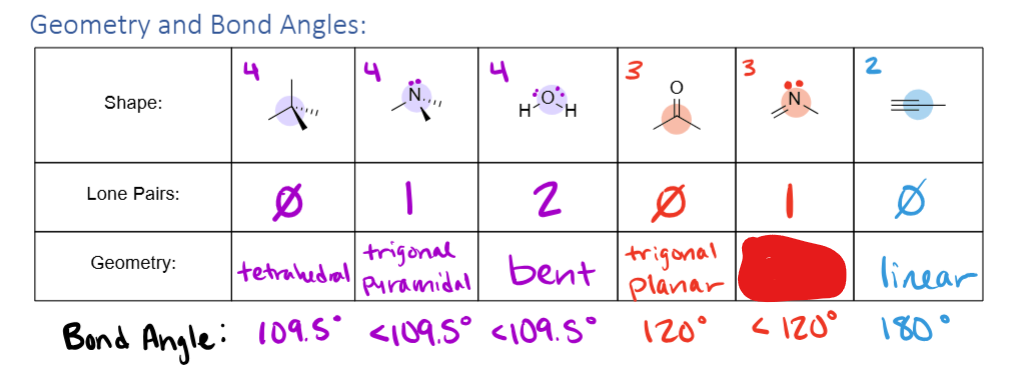
Bent

<120

0
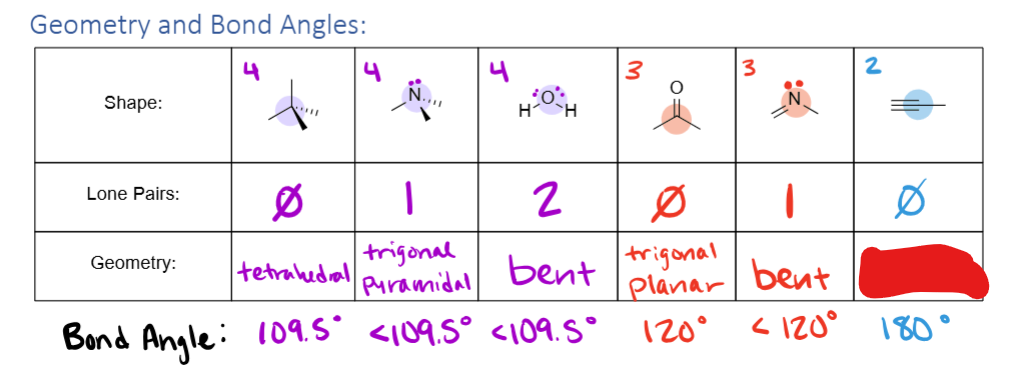
Linear

180
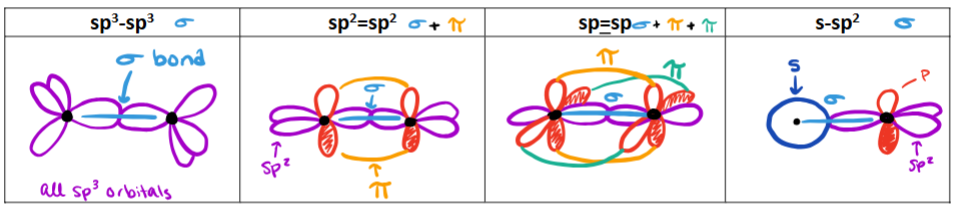
______________ bonds: Made of 1 sigma bond and 0 pi bonds.
Single
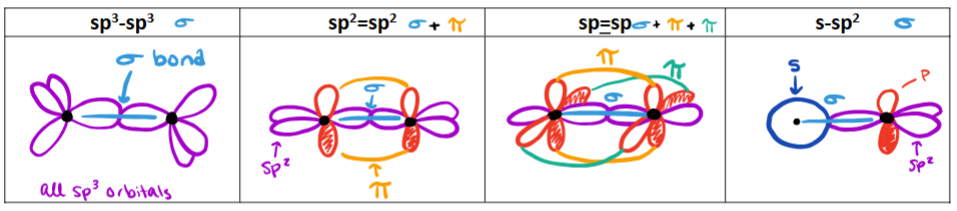
_____________ bonds: Made of 1 sigma bond and 1 pi bond.
Double
![<p>______________<strong> bonds:</strong> Made of <strong>1 sigma bond</strong> and <strong>2 pi bonds</strong>. [1, 2, 3]</p>](https://assets.knowt.com/user-attachments/17bb4849-2cda-43ef-af6a-a5076399a46f.png)
______________ bonds: Made of 1 sigma bond and 2 pi bonds. [1, 2, 3]
Triple
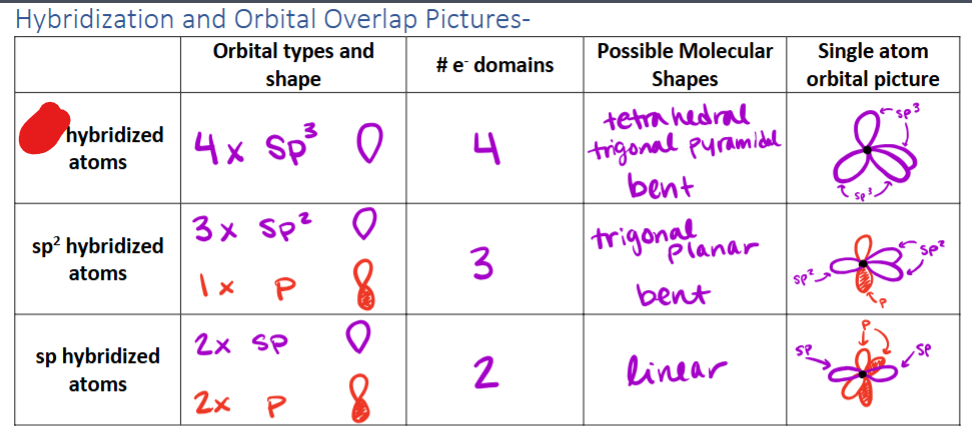
sp³

sp²
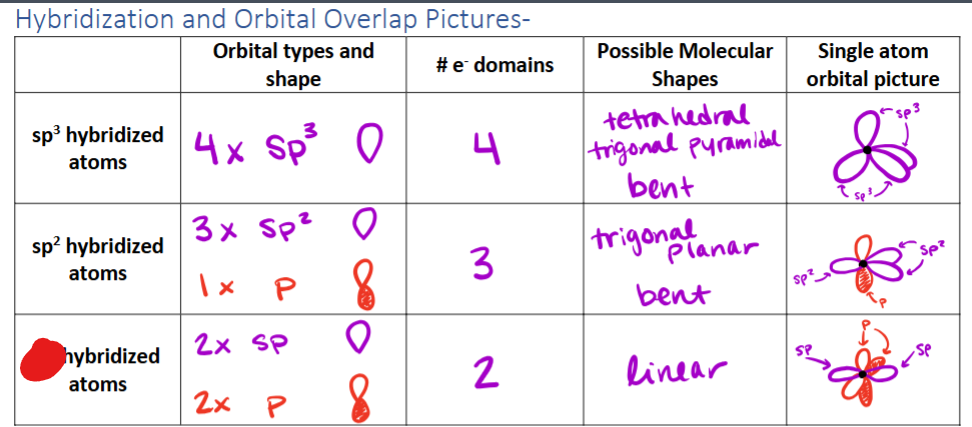
sp
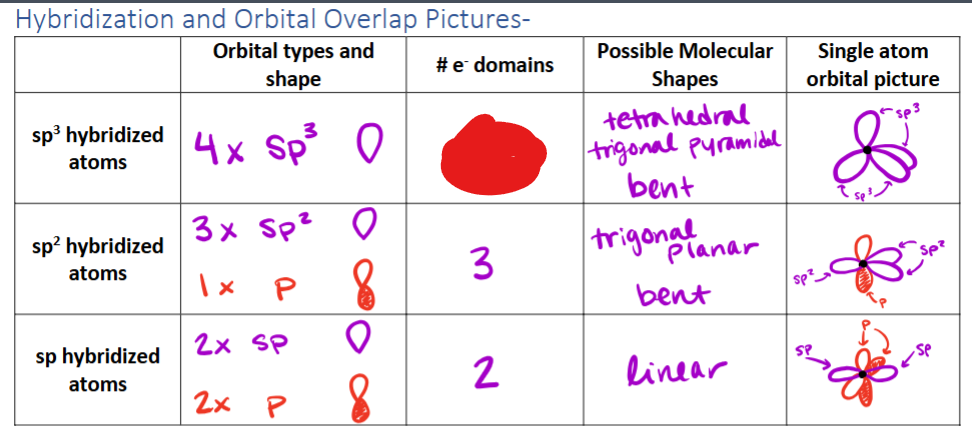
4

3

2
All ___________ bonds = hybrid orbitals or s-orbitals kissing
sigma
All sigma bonds = ______________ orbitals or s-orbitals kissing
hybrid
All ____________ bonds = p-orbitals waving hello
pi
More intermolecular forces = ________________ boiling point
higher
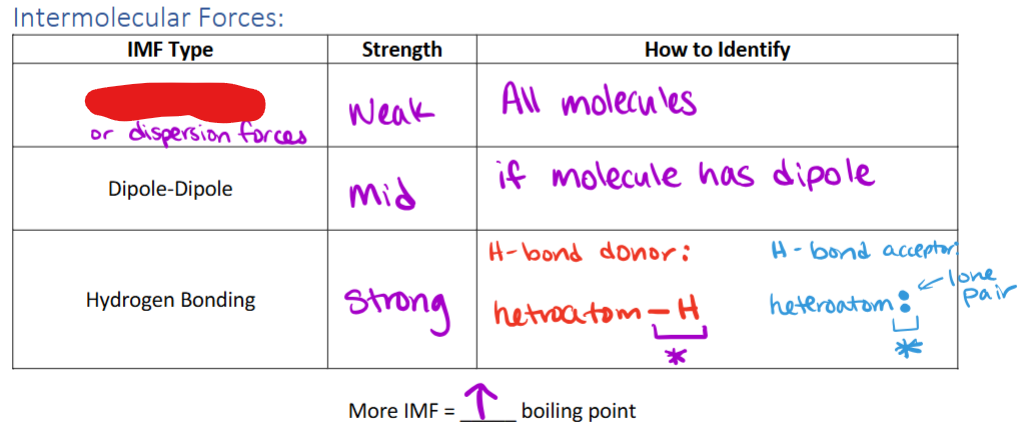
London dispersion

Dipole-dipole
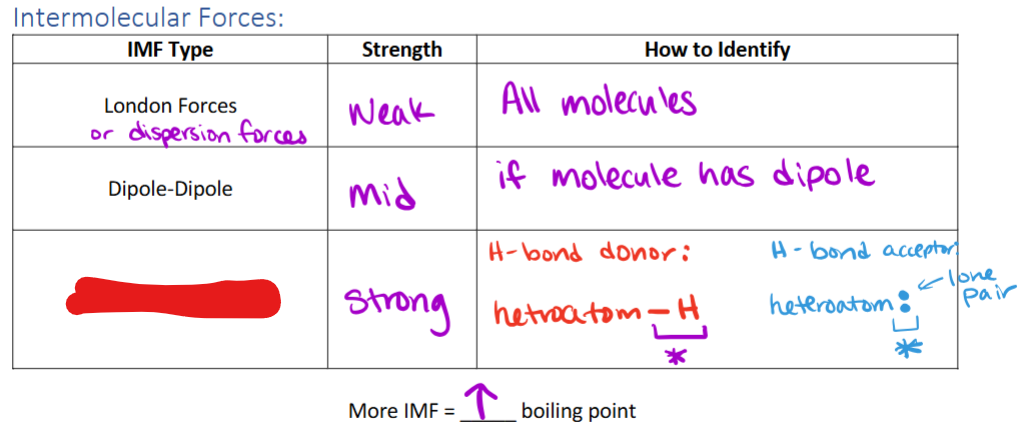
Hydrogen bonding
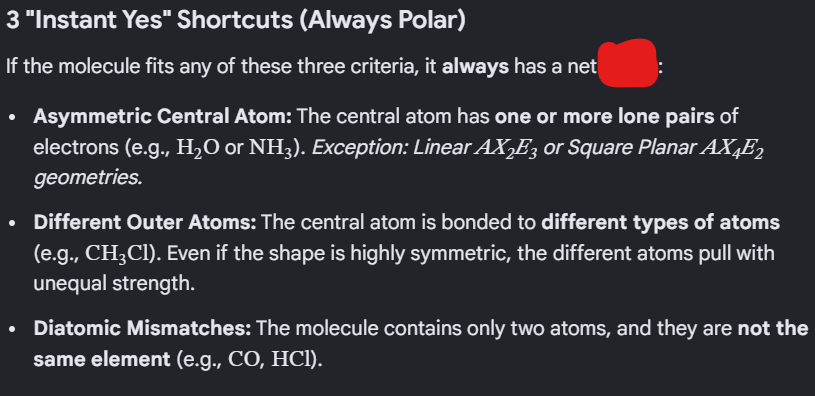
A molecule has a ____________ if it contains polar bonds that do not cancel each other out in 3D space
dipole
Bonds that are ____________________ are weaker
longer
Bonds that are __________ are stronger
shorter
The # of bonds & polarity of bonds ___________ the length and strength
affect
More bonds = ___________ than less bonds
stronger
More polar = __________ bond
stronger
If there are several polar molecules, you can determine which is most polar by considering which has the greatest ________________ difference
electronegativity

Ionic

Polar covalent

Hydrogen bond donor
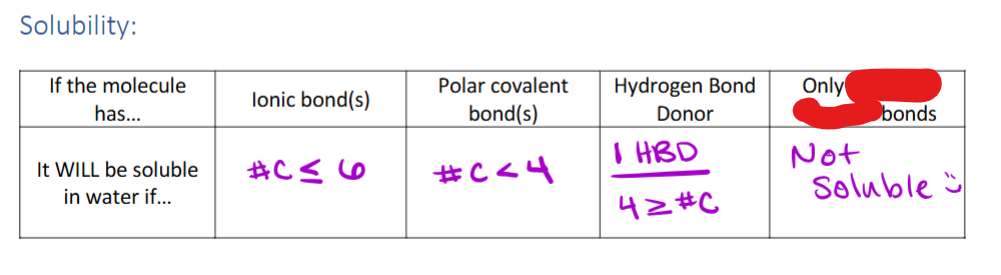
Nonpolar covalent
2 nonmetals share 2 electrons =
Covalent bond
Pi and sigma bonds are types of _____________ bonds
covalent
______ bonds are head-on
Sigma
________ bonds include s, p, or hybrids along the internuclear axis
Sigma
Sigma bonds are _______ than pi bonds
stronger
___________ bonds are sideways
Pi
_________ bonds include unhybridized p & are perpendicular to the internuclear axis
Pi
Polar =_________
hydrophilic
Nonpolar = __________
Hydrophobic
Larger atomic radius = _______________
longer
For neutral atoms, follow the _________ rule = outer shell = 8 valence electrons!
Ex.) Oxygen is in group 16, so it has 6 valence electrons.
So, 8-6 = 2.
So, it is divalent.
Octet
If the electronegativity difference is:
__________: metal + nonmetal
ΔEN = ≥2Polar: unequal/asymmetrical
ΔEN = 0.5-1.9Nonpolar: equal/symmetrical
ΔEN =< 0.5
Ionic
If the electronegativity difference is:
Ionic: metal + nonmetal
ΔEN = ≥2__________: unequal/asymmetrical
ΔEN = 0.5-1.9Nonpolar: equal/symmetrical
ΔEN =< 0.5
Polar
If the electronegativity difference is:
Ionic: metal + nonmetal
ΔEN = ≥2Polar: unequal/asymmetrical
ΔEN = 0.5-1.9___________: equal/symmetrical
ΔEN =< 0.5
Nonpolar
In _______________ bonds, metal transfers electrons to the nonmetal
ionic
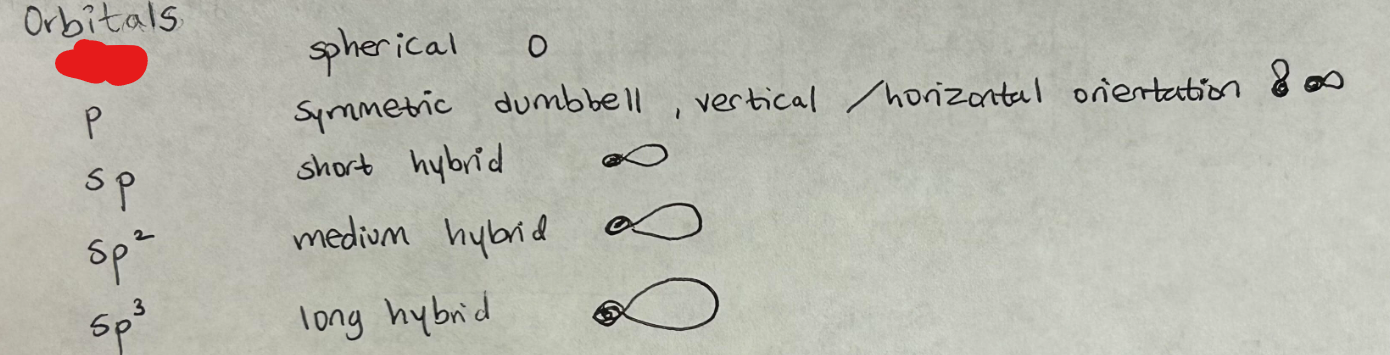
s
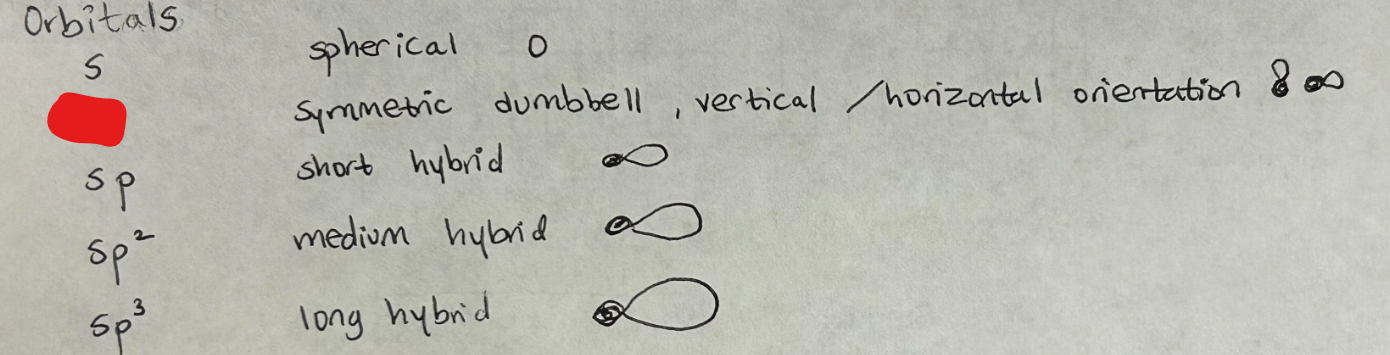
p
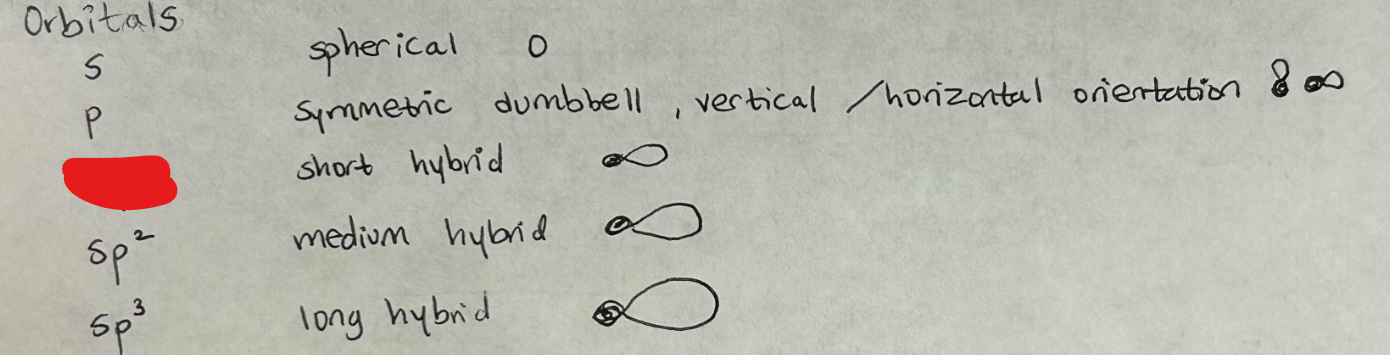
sp

sp²

sp³
Hydrogen bond _____________:
Hydrogen bond covalently bonded to a strongly electronegative atom such as N, O, F
Usually written as D—H, where D would be the _______ of the atom
donor
Hydrogen bond ______________:
Consists of an electronegative atom that possesses a lone pair of electrons
Common examples include lone pairs on N, O, F
acceptor
Intermolecular Forces ordered from ______________ strong:
Ion > H > D-D > London
most to least
Stronger IMF’s = ____________ boiling point
higher
Molecules that result from constructive interference— lower energy & holds bonding electrons
Bonding molecules
Molecules that result from destructive interference— higher energy & contains a node
Antibonding molecules
Highest Occupied Molecular Orbital
HOMO
Lowest Unoccupied Molecular Orbital
Receives incoming electrons during reactions
LUMO
Electrons fill orbitals in order of increasing energy, starting with the lowest energy orbital first
1s → 2s → 2p
Aufbau principle
Each orbital can hold a maximum of two electrons, and they must have opposite spins.
Pauli Exclusion principle
When filling degenerate orbitals, one electron is placed in each orbital singly before pairing up.
Hund’s rule
Orbitals that reside at the exact same energy level
Ex.) 2p, 2px, 2py, 2pz
Degenerate orbitals
A point or plane where the wavefunction Ψ = 0 , meaning the electron density (Ψ²) is zero
Node