Physics Definitions Unit 4
 Call Kai
 Learn
Learn Practice Test
 Spaced Repetition
 Match
Match Flashcards
 Knowt Play
1/106

Earn XP
Description and Tags
Capacitance, gravitational fields and Orbits, Doppler, Dark Matter, Electrostatic fields, Physics of sport, Electromagnetic induction
107 Terms
Capacitance (Capacitance)
Charge stored per unit volt (Q/V)
What is capacitance proportional to? (Capacitance)
Area of plate
Area under a VQ graph (Capacitance)
work done
Capacitor combination in Series (Capacitance)
C+C
Capacitor combination in parallel (Capacitance)
1/C +1/C
Time constant for discharge (Capacitance)
Time taken for current/pd/charge to fall to 37% original value
Time constant for charging (Capacitance)
time taken for the current/pd/charge to fall to 63% original value
What type of decay happens during charging and discharging (Capacitance)
Exponential
Inverse square law of gravitational fields (gravitational fields)
The force between two masses is proportional to the product of their masses and is inversely proportional to the square of their distance apart
F∝ mxm
F∝1/r2
Gravitational field (gravitational fields)
region where a mass experiences a force
Gravitational field strength (gravitational fields)
force per unit mass at that point
Is gravitational field strength vector or scalar? (gravitational fields)
Vector
What is the direction of the gravitational field strength given by? (gravitational fields)
The direction of the force acting on the mass in the field
Uniform gravitational field (gravitational fields)
field with the same size and direction at all points
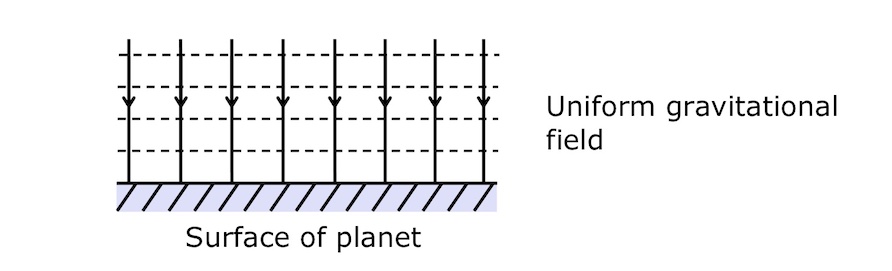
Gravitational potential energy (gravitational fields)
energy a body has because of its position above the ground
what type of field does mgh apply to? (gravitational fields)
Uniform
Non-uniform gravitational field (gravitational fields)
where size and/direction of field changes within the field
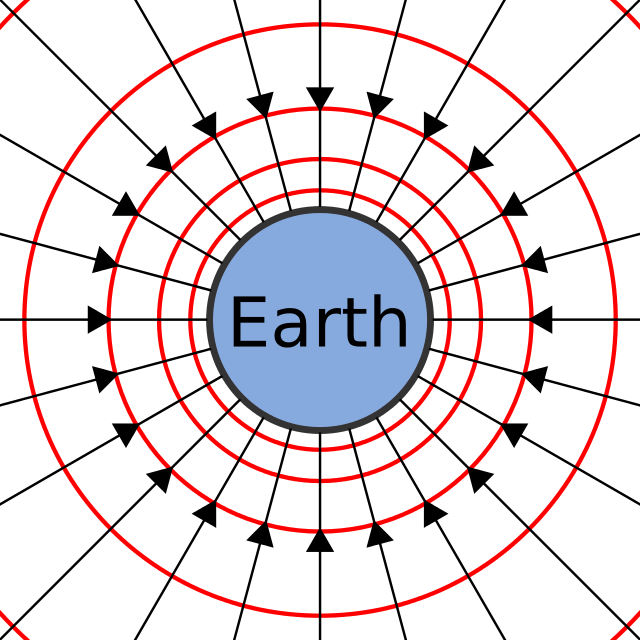
Equipotential Surfaces (gravitational fields)
spheres around a planet where the radius is constant - so potential is constant
Radial Field (gravitational fields)
Field produced by a spherical mass (both size and direction alters)
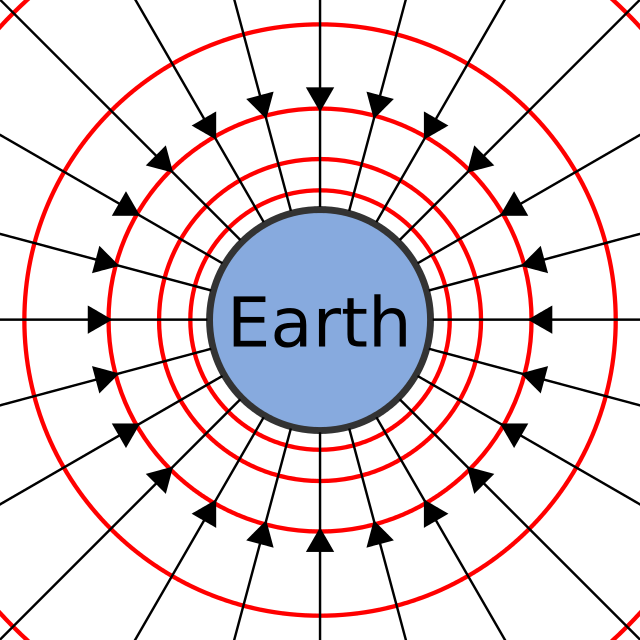
Gravitational potential (gravitational fields)
Work done in bringing a mass from infinity to that point per unit mass
What is the potential at infinity? (gravitational fields)
0
Gravitational potential energy (gravitational fields)
Work done in bringing a mass from infinity to that point
Gravitational potential energy for a system of 2 masses (gravitational fields)
work done in bringing either (or both) of the masses from infinity to that separation (r)
Why are GPE and potential negative (gravitational fields)
Because the field does the work (masses are attracted to each other)
e.g. you don’t have to do work to make and object fall to earth (gravity does that)
K1 Law (Orbits, Doppler and Dark Matter)
The orbit of every planet is an ellipse with the star at one focus
K2 Law (Orbits, Doppler and Dark Matter)
The radius vector (from the sun to the planet) sweeps out equal areas in equal time
K3 Law (Orbits, Doppler and Dark Matter)
The square of the period of orbit (T) is directly proportional to the cube of the semi-major axis (r)
Semi-major axis (Orbits, Doppler and Dark Matter)
Half the major axis
Major axis (Orbits, Doppler and Dark Matter)
longest diameter in an eclipse
Semi-major axis in a circle (Orbits, Doppler and Dark Matter)
radius
What type of force is the force between two masses (Orbits, Doppler and Dark Matter)
ALWAYS attractive
G (Orbits, Doppler and Dark Matter)
universal constant of gravitation
What accounts for missing mass in the universe?(Orbits, Doppler and Dark Matter)
Dark matter
Extended response for evidence of dark matter (Orbits, Doppler and Dark Matter) 4 points
measured velocities too high (from graph)
according to equation, line should drop off as 1/√r
∴ we have extra mass
extra mass = dark matter
What could be an explanation for dark matter? (Orbits, Doppler and Dark Matter)
Higgs Boson
Doppler Effect (Orbits, Doppler and Dark Matter)
When received frequency differs from actual frequency due to movement of the object
When is received frequency higher? (doppler)(Orbits, Doppler and Dark Matter)
When object is moving closer
When is received frequency lower? (doppler)(Orbits, Doppler and Dark Matter)
When object is moving away
When do we get red shift? (due to doppler) (Orbits, Doppler and Dark Matter)
Object moving away
When do we get blue shift? (due to doppler) (Orbits, Doppler and Dark Matter)
Object moving closer
Gradient of what graph gives Hubble constant? (Orbits, Doppler and Dark Matter)
How fast galaxy is moving away by how far away galaxy is
Hubble Constant (Orbits, Doppler and Dark Matter)
Expansion rate of the universe
1/ hubble constant (Orbits, Doppler and Dark Matter)
age of the universe
open universe (Orbits, Doppler and Dark Matter)
universe continues to expand forever
kinetic energy to spare after reaching infinity
closed universe (Orbits, Doppler and Dark Matter)
gravity of galaxies too great and pulls the universe back into big crunch!
Flat Universe (Orbits, Doppler and Dark Matter)
universe continues to expand but comes to rest at infinite size (escape velocity theory)
Electric Field (Electric fields)
region where an electric charge experiences a force
electric field strength (Electric fields)
force acting on a unit positive charge placed at that point in the field
What is direction of electric field given by? (Electric fields)
the direction a positive charge would move if placed in the field at that point (conventional current)
Where is all charge concentrated in a sphere? (Electric fields)
centre
Direction of radial field from positive charge? (Electric fields)
Out
Direction of radial field from negative charge? (Electric fields)
In
What happens to the strength of radial fields when you get further away (Electric fields)
get weaker
What are stronger: magnetic fields or electric fields? (Electric fields)
Electric fields
Are Radial fields uniform? (Electric fields)
No
Uniform electric field? (Electric fields)
doesn’t vary in size or direction
Direction of electric fields? (Electric fields)
Positive to negative (with conventional current)
potential difference between two points (Electric fields)
work done per unit charge in moving from one point to another
potential at a point (Electric fields)
work done in bringing unit positive charge from infinity to that point
Is potential a scalar or vector? (Electric fields)
scalar (ignore direction)
What two things are assigned a potential of 0? (Electric fields)
Infinity and Earth
Equipotential (Electric fields)
a line joining points in an electric field which have the same potential
Where are equipotentials in relation to the electric field lines? (Electric fields)
at right angles
What does the gradient of an electric potential against distance graph give you? (electric fields)
potential gradient
What does the negative potential gradient give you? (electric fields)
electric field strength at that point
What are B-fields produced by? (Magnetic fields)
permanent magnets or currents
which way do field lines go? (Magnetic fields)
North → South
What is a solenoid? (Magnetic fields)
Long coil of wire - such that length is much bigger than diameter
What is μ0 ? (Magnetic fields)
permeability of free space
n (Magnetic fields)
number of turns per meter
What fields do static vs moving charges cause?
static - electric
moving - magnetic
what direction does conventional current flow?
positive to negative
What direction do electrons flow?
negative to positive
What is magnetic flux density also known as? (Magnetic fields)
Magnetic field strength
B-field strength
B (Magnetic fields)
force per unit length of current carrying wire
At what angle is force maximum in a B-field?
90 (sinθ = 1)
Why does a mass spectrometer have slits? (Magnetic fields)
to narrow the electron beam
What happens in section 1 (velocity selector) of a mass spectrometer? (Magnetic fields)
electric force = magnetic force ∴ straight line motion
What happens in section 2 (detection) of a mass spectrometer? (Magnetic fields)
no electric force ∴ no equilibrium ∴ particle in circular motion due to B-field
Area used in Hall probe calculations? (Magnetic fields)
area that current goes into
What do we use a hall probe to measure? (Magnetic fields)
B-field
What placed inside a solenoid increases magnetic field strength? (Magnetic fields)
An Iron core (up to 200,000 times for pure iron)
Electron volt (Magnetic fields)
energy gained by an electron when accelerated through a pd of 1V
What type of acceleration do particles experience in a particle accelerator? (Magnetic fields)
constant
3 types of particle accelerators? (Magnetic fields)
linear accelerator (Linac)
cyclotron
synchrotron
Centre of Gravity (physics of sport)
point at which the weight of the object seems to act
2 things that increase stability (physics of sport)
lower centre of gravity
wider base
What leads to toppling?
When line of action of weight is outside the base
Moment of inertia (I) (physics of sport)
reluctance of an object to stop spinning around an axis
Angular acceleration (⍺) (physics of sport)
rate of change of angular velocity
L (physics of sport)
angular momentum
principle of conservation of angular momentum (physics of sport)
total angular momentum of a system with no external resultant torque remains constant
what does it mean when theres no slipping (e.g when a ball is rolling down a hill) (physics of sport)
velocity of the point of the ball touching the ground is zero
(forward velocity of CoM of the ball must cancel the rotational velocity at that point)
Why does a rolling object not accelerate with gsinθ? (physics of sport)
less acceleration because some of the energy goes into rotational KE rather than purely linear KE
what happens to pressure at high speeds? (physics of sport)
decreases
Drag (physics of sport)
resistive force that always acts in the opposite direction to the motion
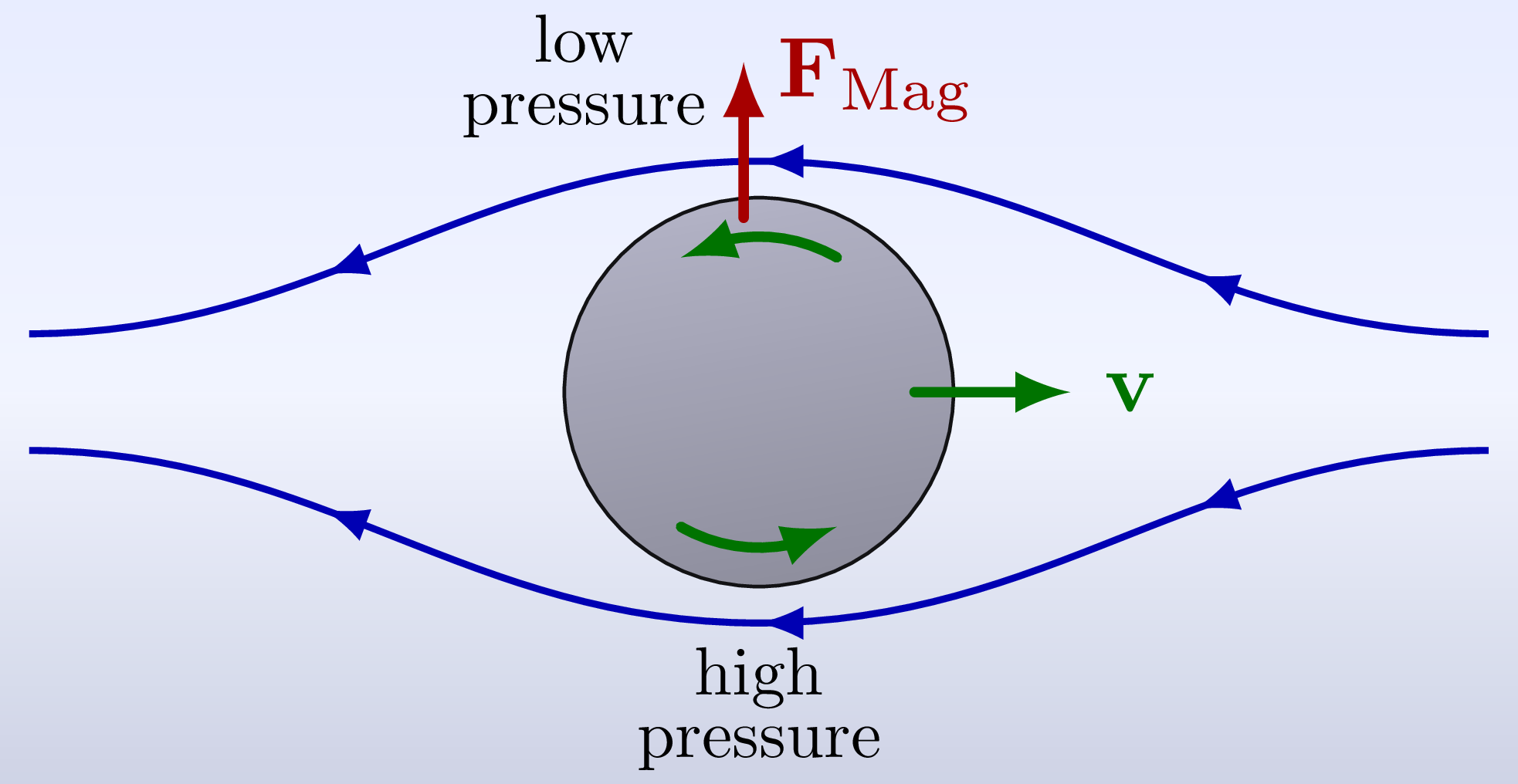
Magnus Effect Force (physics of sport)
lift - at right angles to the direction of motion and its at right angles to the axis of rotation
Magnetic Flux (Electromagnetic Induction)
BA with B-field strength at 90° to coil of area A
ɸ (Electromagnetic Induction)
Magnetic Flux
Magnetic Flux Unit (Electromagnetic Induction)
Webers (Wb)