AP Calc AB - Unit 6: Integration and Accumulation of Change
 Call Kai
 Learn
Learn Practice Test
 Spaced Repetition
 Match
Match Flashcards
 Knowt Play
1/17

There's no tags or description
Looks like no tags are added yet.
Name | Mastery | Learn | Test | Matching | Spaced | Call with Kai | Chat |
|---|
No analytics yet
Send a link to your students to track their progress
18 Terms
Area Approximation Methods
- displacement occurs when there are negative numbers in table and given function is not absolute value
- distance is when there are all positive numbers in table
There are 4 different ways to approximate the area under the curve
1. LRAM - Left Rectangular Approximation Method
- signifies that you start on left side of interval
- put given interval in [a,b] form and number of subintervals is value of n
- do b-a / n to get number you are counting by
- since LRAM, you leave off right end point and vice versa
- create x and f(x) chart, where you put down x values and calculate f(x) values by plugging each x value from chart into function
- then write Area = (number you are counting by)(f(x) value) + and then you continue for each f(x) value and simplify if MCQ
2. RRAM - Right Rectangular Approximation Method
- same as left hand except start on right side of interval, so you leave off left endpoint and only have to simplify area if MCQ
3. MRAM - Midpoint Rectangular Approximation Method
- meaning you are finding the midpoint (middle) of each rectangle
- same steps as LRAM and RRAM, but now based on how many subintervals you have (n value), you take the middle values that represent x value for chart
- obtain f(x) same way by plugging back into function and calculate area the same way too
Trapezoidal Approximation Method
Area for Trapezoid = 1/2 h(b1 + b2) or Area = 1/2 delta x (f(x1) + f(x2))
- first obtain n value by doing delta x = b - a / n
- second make x and f(x) chart with x value and substitute in x value into function to get f(x) values
- then write Area = 1/2 (number you are counting by) and add together f(x) one by one in brackets
- each set of f(x) values added together need 1/2 and n number in front of it and add all of the sets together
- amount of bracket sets of f(x) value should add up to original subinterval value
- or you could do LRAM + RRAM / 2
Definite Integral Notation
Reimann sums on an interval [a,b] with n subintervals can be written using integral notation.
- notation is where dx (delta x) = b - a / n
![<p>Reimann sums on an interval [a,b] with n subintervals can be written using integral notation.</p><p>- notation is where dx (delta x) = b - a / n</p>](https://assets.knowt.com/user-attachments/4cd7939b-89de-46d7-a576-b969b62b39bd.png)
Reimann Sum FRQ Practice
Distance = Rate x Time
- when velocity is positive, then the given integral represents total distance
- R in distance equation represents the area under the curve that is actually finding distance
- for questions that ask you to approximate a value that is not from the table, you do average rate of change formula with proper units
- for questions that ask you to use to interpret what a Reimann sum mean, rewrite the given integral notation, decide if its total distance or displacment, and include proper interval with context
- for LRAM, leave off right end value and for RRAM, leave off the left end value
- if doing total distance, because v(t) or function is in absolute value form, then convert all negative numbers in table to positive
- remember, differentiability implies continuity if coming across questions that involve IVT
- when problem states "indicated by data" often means there is no universal delta x value; change in x differs for each number
Limits of Reimann Sums and Definite Integrals
- summation notation indicates that you add together numbers in a sequence
To approximate area of the region, begin by subdividing the interval [a,b] into n subintervals each of a width: delta x = b-a/n
- so as the number of subintervals approach infinity: look at formula sheet to see area formula
The definite integral of a continuous function f over the interval [a,b] is the limit of a Riemann sum as the number of subintervals approaching infinity --> look at formula sheet
Writing Definite Integral as a Limit of Reimann Sum:
1. write out area formula
2. find delta x = b-a/n by taking upper limit of integral (b) and lower limit of integral (a), which will give you a #/n
3. find xK (lower subscript K) = a + delta x K by doing xK = a value + delta x value (#/n you just found) with k next to it
4. go back to original formula and substitute in xK value from parentheses and delta x value next to parentheses
Writing Limit of a Reimann Sum as Definite Integral:
1. find a value --> first number within parentheses that goes before #k/n value
2. find b value --> go to numerator of delta x value and set that equal to b-a and solve
3. set up integral --> b on top integral, a on bottom f(x) dx
4. substitute in upper and lower limit --> a value becomes upper limit and b value becomes lower limit; keep f(x) dx just how it is
General Notes:
- if there is no a value in front of xK, then can just assume a value is 0
- value on top of sigma will always be infinity?
- if there is no x with function (f(x)), there is no xK value
![<p>- summation notation indicates that you add together numbers in a sequence</p><p>To approximate area of the region, begin by subdividing the interval [a,b] into n subintervals each of a width: delta x = b-a/n</p><p>- so as the number of subintervals approach infinity: look at formula sheet to see area formula</p><p>The definite integral of a continuous function f over the interval [a,b] is the limit of a Riemann sum as the number of subintervals approaching infinity --> look at formula sheet </p><p>Writing Definite Integral as a Limit of Reimann Sum:</p><p>1. write out area formula </p><p>2. find delta x = b-a/n by taking upper limit of integral (b) and lower limit of integral (a), which will give you a #/n</p><p>3. find xK (lower subscript K) = a + delta x K by doing xK = a value + delta x value (#/n you just found) with k next to it</p><p>4. go back to original formula and substitute in xK value from parentheses and delta x value next to parentheses</p><p>Writing Limit of a Reimann Sum as Definite Integral:</p><p>1. find a value --> first number within parentheses that goes before #k/n value</p><p>2. find b value --> go to numerator of delta x value and set that equal to b-a and solve</p><p>3. set up integral --> b on top integral, a on bottom f(x) dx</p><p>4. substitute in upper and lower limit --> a value becomes upper limit and b value becomes lower limit; keep f(x) dx just how it is</p><p>General Notes:</p><p>- if there is no a value in front of xK, then can just assume a value is 0</p><p>- value on top of sigma will always be infinity?</p><p>- if there is no x with function (f(x)), there is no xK value</p>](https://assets.knowt.com/user-attachments/0bcf824c-533f-43eb-aeee-de443595798f.png)
Properties of Definite Integrals
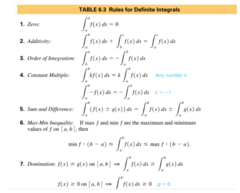
- look at formula sheet for a 5 properties: zero, additivity, order of integration, constant multiple, sum and difference
- given values of definite integrals, you have to evaluate expression
Order of Integration Problems:
1. identify that upper and lower limit are switched from given integrals
2. switch upper and lower limit so that it matches given integral and put negative sign in front of it
3. simplify by putting -(#) - number derived from given interval and then get answer
Additivity Problems:
1. identify that upper and lower limit will be from two different integrals that are given
2. break up equation into two integral added together; place integral with the same lower limit first and then add other integral
3. simplify equation with given values from integrals
Constant Multiple Problems:
1. place k value (number in front of function) outside of integral notation
2. simplify by multiplying coefficent number to integral value of function
General Notes:
- for integral questions that don't have a upper or lower limit that matches any given integrals to choose from, you say it "cannot be determined)
Properties of Definite Integrals (continued)
Zero Problems:
1. identify that upper and lower limit integral are the same
2. usually will not match any of given integrals, so it always equals 0
Sum and Difference Problems:
1. split up equation into two integrals added/subtracted to each other with same provided upper and lower limit
2. if k value for either or both integrals, place them outside of the integral notation
3. simplify inside integrals with provided integrals so that it's coefficient times integral value +/- coefficient times integral value, then solve
General Notes:
- for u substitution problems, substitute in x for u to make f(x) and dx and then solve for integral; should match with one of options from given integrals
- for fractions with function, separate and do 1/denominator # times f(x), then take coefficient and place outside of integral and simplify using above given integrals
- if negative integral, and have to switch upper and lower limit, integral changes signs and becomes positive and then simplify
Fundamental Theorem of Calculus Part 1
If f(x) is continuous over an interval [a,b], and the function F(x) is defined by: look at formula sheet
- F(x) represent anti-derivative (basically original function)
- f(t) represents derivative of function
- velocity times time = displacement (velocity is a derivative)
- F(x) is the area under f on [a,x]
Note: This theorem establishes a relationship between integration and differentiation. It guarantees that any continuous function has an antiderivative, F(x).
Steps for finding dy/dx:
1. take upper limit of x and substitute it in for t
2. multiply by derivative of x and simplify; keep rest of equation the same, just take away dt
General Notes:
- x must always be upper limit
- for problems that have coefficient with x or x has a power, use chain rule and take derivative
Fundamental Theorem of Calculus Part 1 with Two Variable Limits of Integration:
- for problems where x is on the bottom, use order of integration to flip upper and lower limit, switching the sign of integral
- sometimes might have to use additivity property to split up upper and lower limit into two integrals (lower limit goes first and put other side of integral as 0), and then order of integration to ensure x is always upper limit
- then rest of the steps the same, substitute x for all values of and use chain rule to take derivative to coefficients/powers of x, then simplify if needed
![<p>If f(x) is continuous over an interval [a,b], and the function F(x) is defined by: look at formula sheet</p><p>- F(x) represent anti-derivative (basically original function) </p><p>- f(t) represents derivative of function</p><p>- velocity times time = displacement (velocity is a derivative)</p><p>- F(x) is the area under f on [a,x]</p><p>Note: This theorem establishes a relationship between integration and differentiation. It guarantees that any continuous function has an antiderivative, F(x). </p><p>Steps for finding dy/dx:</p><p>1. take upper limit of x and substitute it in for t </p><p>2. multiply by derivative of x and simplify; keep rest of equation the same, just take away dt</p><p>General Notes:</p><p>- x must always be upper limit</p><p>- for problems that have coefficient with x or x has a power, use chain rule and take derivative</p><p>Fundamental Theorem of Calculus Part 1 with Two Variable Limits of Integration:</p><p>- for problems where x is on the bottom, use order of integration to flip upper and lower limit, switching the sign of integral</p><p>- sometimes might have to use additivity property to split up upper and lower limit into two integrals (lower limit goes first and put other side of integral as 0), and then order of integration to ensure x is always upper limit</p><p>- then rest of the steps the same, substitute x for all values of and use chain rule to take derivative to coefficients/powers of x, then simplify if needed</p>](https://assets.knowt.com/user-attachments/b3a00fab-8a30-446a-945e-8880284d8f94.jpg)
FTC Part 1 to Justify Behavior of g(x) from a Graph of f(t) = g'(x)
g(x) = integral with x (upper limit) and # (lower limit) f(t)dt indicates that were using Fundamental Theorem of Calc Part 1 (connecting anti-derivative to derivative)
- area between the x-axis and g'(x) provides function values for g(x)
- f(t) is derivative; g'(x) = f(x)
- lower limit value of integral (number) is our START value
- y = f(t) mean g'(x)
- left of START and above x-axis --> area is negative
- left of START and below x-axis --> area is positive
- right of START and above x-axis --> area is positive
- right of START and below x-axis --> area is negative
Steps to solving:
1. identify which direction and sign you're using: left/right, above/below x axis to decide if area with be positive or negative
- if area is negative, all shapes you use must have negative area for each shape
2. decide what shapes to use when filling area
- triangles: 1/2 bh
- rectangle: bh
- semi-circle: 1/2 pie (r)^2 (find radius)
3. add all shape dimensions together
- keep track of signs! (whether area is negative or positive) and simplify if needed
FTC Part 1 to Justify Behavior of g(x) from a Graph of f(t) = g'(x) (continued)
g(x) increasing --> g'(x) above x-axis
g(x) decreasing --> g'(x) below x-axis
g(x) maximum --> g'(x) positive to negative
g(x) minimum --> g'(x) negative to positive
g(x) point of inflection --> g'(x) change of sign (decreasing to increasing and vice versa)
g(x) concave up --> g'(x) increases
g(x) concave down --> g'(x) decreases
General Notes:
- increase or decrease to constant (meaning 0) is not a sign change, so does not count as point of inflection
- keep an eye out if question asks for open interval, use parentheses!
- for when g is increasing and decreasing (g'(x) above or below x-axis) corners don't matter so don't split up interval
- concavity is always parentheses, except for endpoints receive brackets
- horizontal line means that slope = 0
- when asking for g(#) = that is doing whole process of shape dimension adding
- when asking for g'(#) = answer is y value for that coordinate because g'(x) = f(x)
- g''(x) is the slope of g'(x); so just take slope of value; if point is on horizontal line, the slope would be 0
Quiz Review Notes
- remember to add units when estimating value from table
- use given integral when evaluating Reimann Sums, don't say "Area" =
- for LRAM, leave off right end and for RRAM leave off left end
- displacement = negative number in table and no absolute value around function
- distance = all positive numbers or there is absolute value around function that has negative numbers
- for FTC, if both upper and lower limit have x, break it apart putting lower limit first (other side of integral will be 0) and add other integral
- might have to switch signs to ensure that x is always upper limit for both integrals in equation
- don't forget chain rule for x value if there is power or coefficient of x
- then substitute x in for t with chain rule (if applies) and simplify if needed
- when finding area using shapes, if given f(#) = #; x=# in parenthesis is lower limit (that is your START value and the number that is equals is your initial condition)
- if given f(#) = #, make sure to add initial condition value (the number after the equal sign) to equation when calculating area
Basic Integration
**memorize given paper on basic derivatives and basic integrals
Steps to solving:
1. if no coefficient in front of x, add 1 to exponent and add 1 to exponent's number in denominator + C
2. simplify to get x as exponent in numerator and number in denominator (power of x and number in denominator should match) + C
3. for MC question, can convert x with power to fraction of 1/# + C
- can check work by doing derivative of answer to get back to original problem
- if problem has coefficent, place coefficent outside of integral sign and multiply
- make sure to add C, right after you simplify and take away integral sign
- for questions with exponent as fraction, do same steps by some MCQ might have answer as denominator becomes reciprocal, like a new coefficient of x
- question that have values inside squared function, do box method to solve it out to make quadratic equation, and then find antiderivative of every term and add C; some for division
- once you start doing things with exponent value, integral notation goes away and added C comes in

Fundamental Theorem of Calculus Part 2 (Evaluating Definite Integrals)
If f is continuous at every point [a,b] and if F is any antiderivative of f on [a,b] then: look at formula sheet
- using this when upper and lower limit provided
Steps to Solving:
1. Find antiderivative of each term --> adding one to exponent and then 1 to denominator and add C
2. Place one bracket around end of above equation with upper limit on top of bracket and lower limit below bracket
3. Substitute in upper limit into antiderivative equation + C - (subtraction) lower limit substitution of antiderivative equation
4. Simplify if needed to get down to singular value as answer
General Notes:
- keep dx when just simplify equation, when starting to manipulate exponents by finding antidervative, then add C and integral notation goes away
- when subtracting by lower limit substitution, can put it into parentheses after minus sign
- antiderivative of a constant, is that number with x
- rewrite square roots as exponent
- if number is as fraction like 1/x^#, rewrite as negative exponent
- when simplifying number with exponent as fraction, turn it into square root with numerator and then power it
![<p>If f is continuous at every point [a,b] and if F is any antiderivative of f on [a,b] then: look at formula sheet</p><p>- using this when upper and lower limit provided</p><p>Steps to Solving:</p><p>1. Find antiderivative of each term --> adding one to exponent and then 1 to denominator and add C</p><p>2. Place one bracket around end of above equation with upper limit on top of bracket and lower limit below bracket</p><p>3. Substitute in upper limit into antiderivative equation + C - (subtraction) lower limit substitution of antiderivative equation</p><p>4. Simplify if needed to get down to singular value as answer</p><p>General Notes: </p><p>- keep dx when just simplify equation, when starting to manipulate exponents by finding antidervative, then add C and integral notation goes away</p><p>- when subtracting by lower limit substitution, can put it into parentheses after minus sign</p><p>- antiderivative of a constant, is that number with x</p><p>- rewrite square roots as exponent</p><p>- if number is as fraction like 1/x^#, rewrite as negative exponent</p><p>- when simplifying number with exponent as fraction, turn it into square root with numerator and then power it</p>](https://assets.knowt.com/user-attachments/62cd8998-8d64-458b-a511-1073142f57c8.jpg)
Integration Using U-Substitution
This is a technique to integrate that is like the chain rule for derivatives.
Steps for Finding Antiderivative with U-Sub:
1. Label u and du terms --> u is often inside value and du is rest of equation
2. Get u and du --> write on side of paper u=value and then du= derivative of that function with dx
3. Go back to original equation and substitute --> write integral notation and rewrite equation with only u and du
4. Take away integral notation and substitute value back in for u --> substitute only u value into new equation and add C
- also don't forget to find antiderivative -- adding 1 to exponent in numerator and denominator
General Notes:
- if negative sign already outside of given integral notation, that stays even when you find antiderivative
- when it comes to e, after rewrite equation using u can just substitute u value back in with +C; no antiderivative
- if when finding du value it doesn't match with initial integral problem bc of coefficient, add it into original problem and put reciprocal of that number outside of integral
- if u value in denominator, bring it up as 1/u that would be lnlxl
Evaluate Definite Integrals with U-Substitution
- definite integrals indicates there is upper and lower limit
- you know you are changing upper and lower limit when there is u-sub involved
Steps to Solving:
1. Find u and du value --> on the write u = __ then du = derivative of u value with dx; include reciprocal outside of integral notation if needed
2. Write integral with u sub --> write integral notation with u and du as positioned in original problem with no upper or lower limit written
3. Find new upper and lower limit --> for upper limit: substitute in upper original limit into u value and simplify; for lower limit: substitute in lower original limit into u value
4. Rewrite integral with new upper and lower limit --> keep outside reciprocal if applies
5. Du goes away and find antiderivative of u --> add one to exponent and one in denominator; don't forget about outside reciprocal (if applies)!
6. Substitute upper and lower limit into antiderivative equation --> keep outside reciprocal (if applies) and multiply by u antiderivative with one open bracket with upper limit on top of bracket and lower limit below bracket
- its always subtraction between substitution of upper and lower limit in u antiderivative equation and simplify if needed
Antiderivatives (Inverse Trigonometric Functions)
recall inverse sin and tan function --> look at formula sheet
- to find derivative of tan --> you do dy/dx and substitute in given x value into inverse function with chain rule
- to find derivative of sin --> you do dy/dx and substitute in given x value into inverse function with chain rule
- look inverse trigonometric antiderivative formulas
- for problems, you cannot do u-sub if there is no x in numerator
Steps for Solving:
1. Identify if its inverse sin or tan --> based on denominator; if denominator is square root = sin, if denominator there is no square root = tan
2. Find a^2 and u^2 --> from denominator identify and simplify to find a and u value
3. Rewrite integral by substitution of sin and tan --> for sin, you do sin^-1 (u/a) + C; for tan, you do 1/a tan^-1 (u/a)+ C
Steps for U-Sub:
1. Find u and du terms --> add dx to du term and find u value (internal function)
- do same reciprocal and find antiderivative; then sub in u vale and add +C
- this is not tied to inverse sin and tan
General Notes:
- take numerator and put it outside integral notation
Rate in Rate Out FRQs
- underline parts of problem and label each equation at y1 and y2
- rates of change mean it is a derivative; also units indicate a derivative
- to go from units per hour to units, use antiderivative
- for questions that are asking for something being added or removed using an interval, hit MATH 9, press VAR after and put lower and upper limit for integral
- then press right arrow and go to Y-VARS and press 1: Function and hit 1: Y1 then put x d; you get approximation number
Question Part b: Rising or Falling at t=
1. Set up equation; it is always adding equation minus subtracting equation with t value H(t) and R(t)
- for this question, plug in both function for Y1 and Y2 and look at table for that time value
- don't need to find actual value, just figure out it's greater than or less than 0
- negative number = decreasing
- positive number = increasing
- write sentence stating that the context is increasing or decreasing at t=#
Rate In and Rate Out FRQs (continued)
- question for asking what is the total amount of something, you take initial value and then take integral of given interval and in parentheses do adding function H(t) - removing function R(t) dt
- you plug in Y1 and Y2 in calculator and do MATH 9
- to unhighlight equal signs on Y1 and Y2 for each y= button, go to each equation and highlight over equal sign and press enter
- this way both graphs don't show up when you press graphing button
- for looking at max or min, do adding equation minus removing equation = 0 and find x-values
- change window by upper and lower limit of integral and then do 2nd TRACE and find both zeroes
- then create t-chart