Databases and Database Users Flashcards
 Call Kai
 Learn
Learn Practice Test
 Spaced Repetition
 Match
Match Flashcards
 Knowt Play
1/9

Earn XP
Description and Tags
Flashcards covering key concepts from Chapter 1: Databases and Database Users, including DBMS architecture, metadata, user roles, transaction properties, and catalog structures.
Name | Mastery | Learn | Test | Matching | Spaced | Call with Kai | Chat |
|---|
No analytics yet
Send a link to your students to track their progress
10 Terms
What is a Database Management System (DBMS)?
A Database Management System (DBMS) is a collection of software programs that enables users to create, maintain, and manage databases, acting as an interface between application programs and physical data files.
What is meant by Universe of Discourse (UoD) or Miniworld in database systems?
It refers to a specific aspect of the real world represented in a database, where changes in the miniworld are directly reflected in the database.

According to this diagram of a simplified database system environment, what two main components make up the DBMS Software layer?
Software to Process Queries/Programs and Software to Access Stored Data.
What is metadata, and where is it stored in a DBMS?
Metadata is data about data that describes the structure, data types, formats, and constraints of a database; it is stored inside the DBMS database catalog or data dictionary.
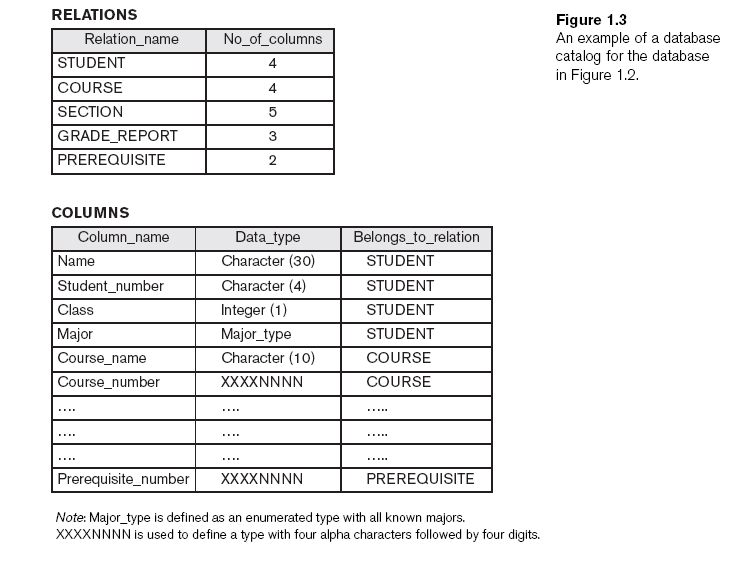
Based on the database catalog example shown, how many columns does the RELATIONS table specify for the SECTION relation?
5 columns.
What are the Isolation Property and Atomicity Property in database transaction management?
Isolation Property ensures that each transaction is executed independently and isolated from other operations. Atomicity Property ensures that either all operations in a transaction are executed completely or none are executed at all.
What are the primary responsibilities of a Database Administrator (DBA)?
Managing the database system, granting and revoking access permissions, monitoring and coordinating usage, managing system backups, acquiring software and hardware resources, and holding accountability for database operations.
What standard markup language is used for exchanging data on the Web in e-commerce applications?
XML (Extensible Markup Language).
When is it preferable NOT to use a Database Management System (DBMS)?
When the database application is simple and not expected to change, when real-time constraints cannot accommodate DBMS overhead, when storage capacity is strictly limited, or when multi-user access is not required.
What type of database constraint ensures that a record in one table correctly references an existing record in another table (such as a section linked to a course)?
Referential Integrity Constraint.