CHapter 3, Movement of light, heat, and chemicals in Water
 Call Kai
 Learn
Learn Practice Test
 Spaced Repetition
 Match
Match Flashcards
 Knowt Play
1/16

There's no tags or description
Looks like no tags are added yet.
Name | Mastery | Learn | Test | Matching | Spaced | Call with Kai | Chat |
|---|
No analytics yet
Send a link to your students to track their progress
17 Terms
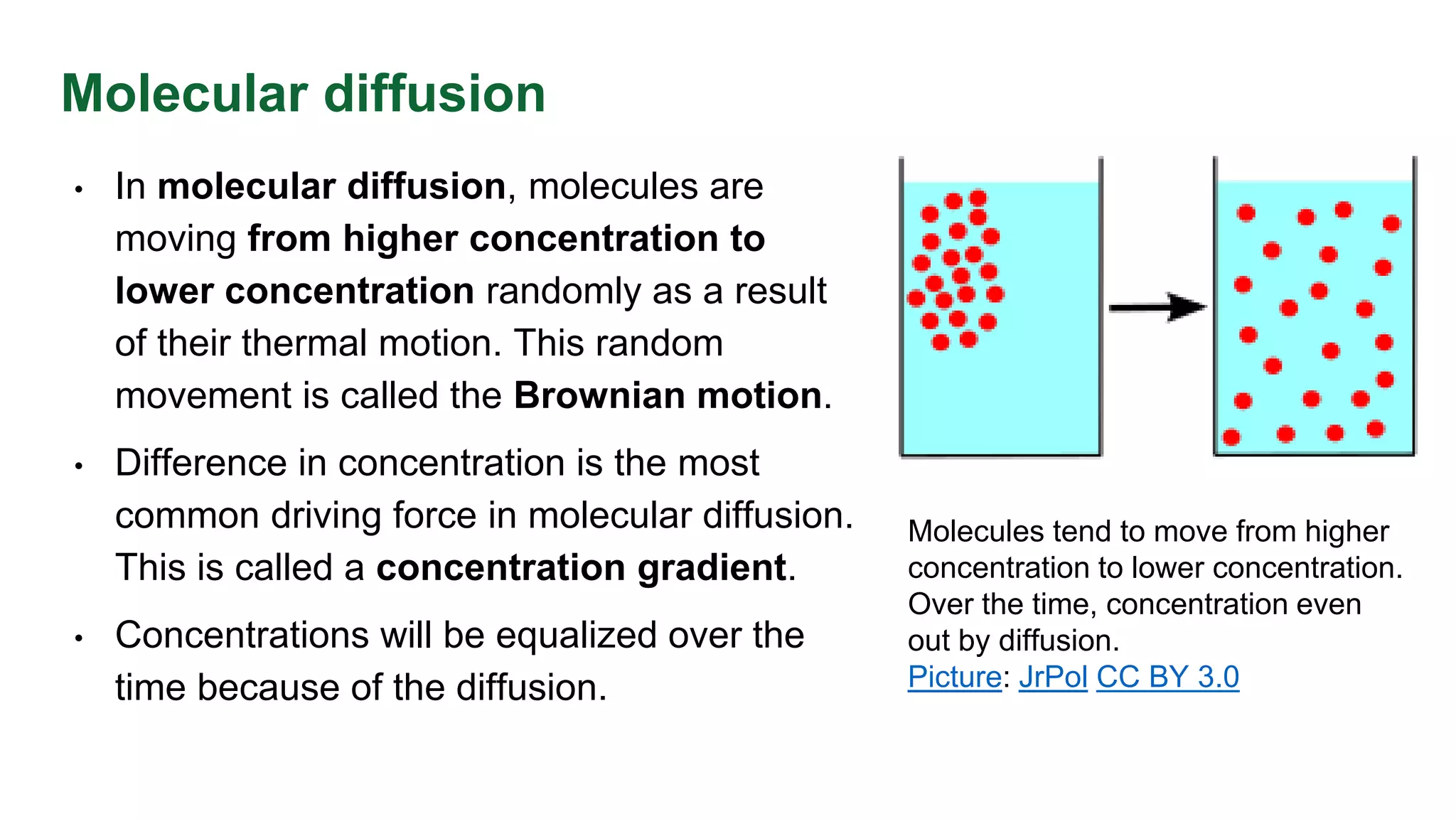
What is diffusion?
Movement of molecules from an area of high concentration to a low concentration.
It's affected by the concentration gradient between two points, the advective transport of water, temperature, size of molecules
What is Ficks Law?

J=D ((C1 -C2))/((x1 -x2))
Used to describe chemical diffusion, the rate is greatest with large concentration gradients and small distances.
D is the function of fluid, size of diffusing molecules, temperature, obstruction of diffusion by pore structure in sediments
What is molecular diffusion?
related to spatial scale ( greater at small scales and lesser at larger scales). In the absence of moving water, molecular diffusion dominates.
What is transport diffusion?
(Diffusion with water movement) will dominate over molecular diffusion
What is sherwoods number?
ratio of molecular to transport diffusion
Sh= Ul/D
When Sh is large, transport domminimates diffusion, when its small molecular diffusion dominates
How does the path and size of pores influence the rate of diffusion?
Short wide paths equal greater rates of diffusion ( smaller distance to travel to the other side) Longer path creates a longer distance to travel to other side. Larger poles allow for free diffusion through pores, smaller acts as a filter affecting rate of diffusion.
What is the diffusion boundary layer?
Water velocity nears zero as a solid surface is approached, transport diffusion slows, and molecular diffusion predominates. This region near a solid surface where molecular diffusion predominates

What is Bioturbation?
•the disturbance of sediments by benthic animals – can also increase movement of chemicals. (Cycling the minerals up)
example filter feeders
What are the three reasons why the interaction of light and water important?
Light is needed for photosynthesis
Organisms with eyes or light sensors use light as a sneroy cue
Light heats water and leads to stratification
How can light be reflected or enter the water?

Reflection occurs when the critical angle of light reaching the water interface is too great. The amount of light reflected is highly variable because it can be altered.
When the surface is covered in snow, almost all light is reflected, whereas clear ice covers transmit most of the light that enters
What occurs when water is refracted?
As light enters water, it causes the bending of light as it moves from less dense air to denser warmer air.
•Almost all light that is absorbed by water, suspended particles, or dissolved materials is converted to heat. Some light is reflected back into the atmosphere giving lakes their characteristic color.
What is the difference between Eutrophic lakes and Oligotrophic lakes?
•Eutrophic lakes (more productive water columns with a large biomass of suspended photosynthetic organisms, or those with large amounts of suspended inorganic materials or high concentrations of dissolved colored materials) have more material to absorb or reflect out the light, thus low transmittance of light.
• Oligotrophic lakes (lakes with low amounts of suspended particulate or dissolved colored material) have little to absorb or reflect out the light, thus high transmittance to great depths.

What is Extinction coefficient?
•η = (lnI1 -lnI2)/(z2 -z1) or I2=I1e-"η"(z1-z2)
•The exponential nature of the equation results describe a very rapid decline in light intensity with depth.
•Alternatively, you can think of attenuation as the percentage of transmission
•Percentage of transmission per meter =100I2/(I1(z2 -z1))
•Not only does total light intensity change with depth but also there is variation in the attenuation of relative amounts of different wavelengths.
•Pure water has maximum absorption in the visible wavelengths of red light and maximum transmission of blue.
What is the Heat balance in Water?
This determines the water temperature through heating, cooling, and heat transfer.
Changes in heating can lead to water currents

The spring and fall are essential to lakes, since during these seasons it mixes up the nutrients that settled to the bottom and it pulls them back up
How is heat energy gained?
•Solar radiation
•Diffusion of heat from the atmosphere
•Warmer water flowing into a particular area
How is heat energy lost?
•Reflection
•Back radiation
•Evaporation
•Flow of cooler water into a particular area
What is Heat budget?
•Indicates the heat content and how it changes over the course of a year.
•In temperate lakes, this is the amount of energy needed to heat the lake from the winter minimum to the summer maximum.
•Tropical lakes tend to have much smaller budgets than temperate lakes.