Eukaryotic Exam 1
 Call Kai
 Learn
Learn Practice Test
 Spaced Repetition
 Match
Match Flashcards
 Knowt Play
1/25

There's no tags or description
Looks like no tags are added yet.
Name | Mastery | Learn | Test | Matching | Spaced | Call with Kai | Chat |
|---|
No analytics yet
Send a link to your students to track their progress
26 Terms
most abundant elements in organisms vs earth’s crust
organisms: hydrogen, carbon, and oxygen
crust: oxygen, silicon, and then other elements
valence electrons
carbon: 4 valence electrons; can form 4 bonds
oxygen: 6 valence electrons; can form 6 bonds
silicon: 4 valence electrons; can for 4 bonds
why is carbon the backbone of biological molecules vs silicon?
most bc of likely electronegativity
bonds with silicon are more easily broken
electronegatives of elements
F > O > Cl > N > S > C > H > P > Si
two factors determining electronegativity
the number of positive charges in its nucleus
the distance of the outer electrons from the nucleus
covalent bonds
two atoms sharing electrons
atoms joined by a single bond are able to rotate relative to one another
ex. H2O, H:O:H
double bonds can function as energy capturing centers
ex. O2, O=O
triple bonds
ex. N2, N=-N
quadruple bonds are unknown
polar and nonpolar covalent bonds
polar: unequal sharing of electrons between two different non-metals; partial ionic charges
nonpolar: equal sharing of electrons between two identical non-metals
noncovalent bonds
ionic bonds
hydrogen bonds
hydrophobic interactions
van der waals forces
ionic bonds
bonding of oppositely charged ions; metal and non-metal
transfer of electrons
electron will only move around the ion with the stronger electronegativity
why don’t strong ionic bonds exist in cells
because they contain water
water is highly polarized so it will break an ionic bond between two ions
strong water shields will form around ions
weak ionic bonds in cells
when two big biological molecules (like a protein and DNA) come together and interact, water will be expelled at the interface (hydrophobic interactions)
atoms with partial charges will attract forming weak ionic bonds
ex. O- from DNA double helix and N+ from protein
hydrogen bonds
similar to weak ionic bond
usually between hydrogen and oxygen or nitrogen
bc they are usually electrically charged and will form a bond with positively charged hydrogen when they get close
hydrophobic interactions
in a water environment in the cell, hydrophobic molecules tend to aggregate to reduce the the surface exposed to water
hydrophobic interactions are not due to an interaction between hydrophobic molecules, it is bc the water comes together to form hydrogen bonds
when hydrophobic molecules come together, their surface that interacts with water becomes smaller and the water molecules can react with each other
hydrophobic vs hydrophilic
hydrophobic: nonpolar molecules
hydrophilic: polar molecules
van der waals forces
very small
attraction between molecules at a certain distance
optimal van der waals interaction
occurs bc of unequal charges
ex. antigen and antibody fit together, and the formation of one van der waals force between the two will trigger the unequal distribution at the labor site to form a charge again at an adjacent position, and so on
one interaction forms and induces other places to form more van der waals forces
helps form the structure of molecules as well as helps interactions between molecules
i’m sorry ava I tried
water
most important molecule for life
each molecule can form 4 hydrogen bonds
molecules hold on to each other tightly and require lots of energy to break their bonds
highly polarized; very good solvent and reacts well with many other molecules
the product of many reactions
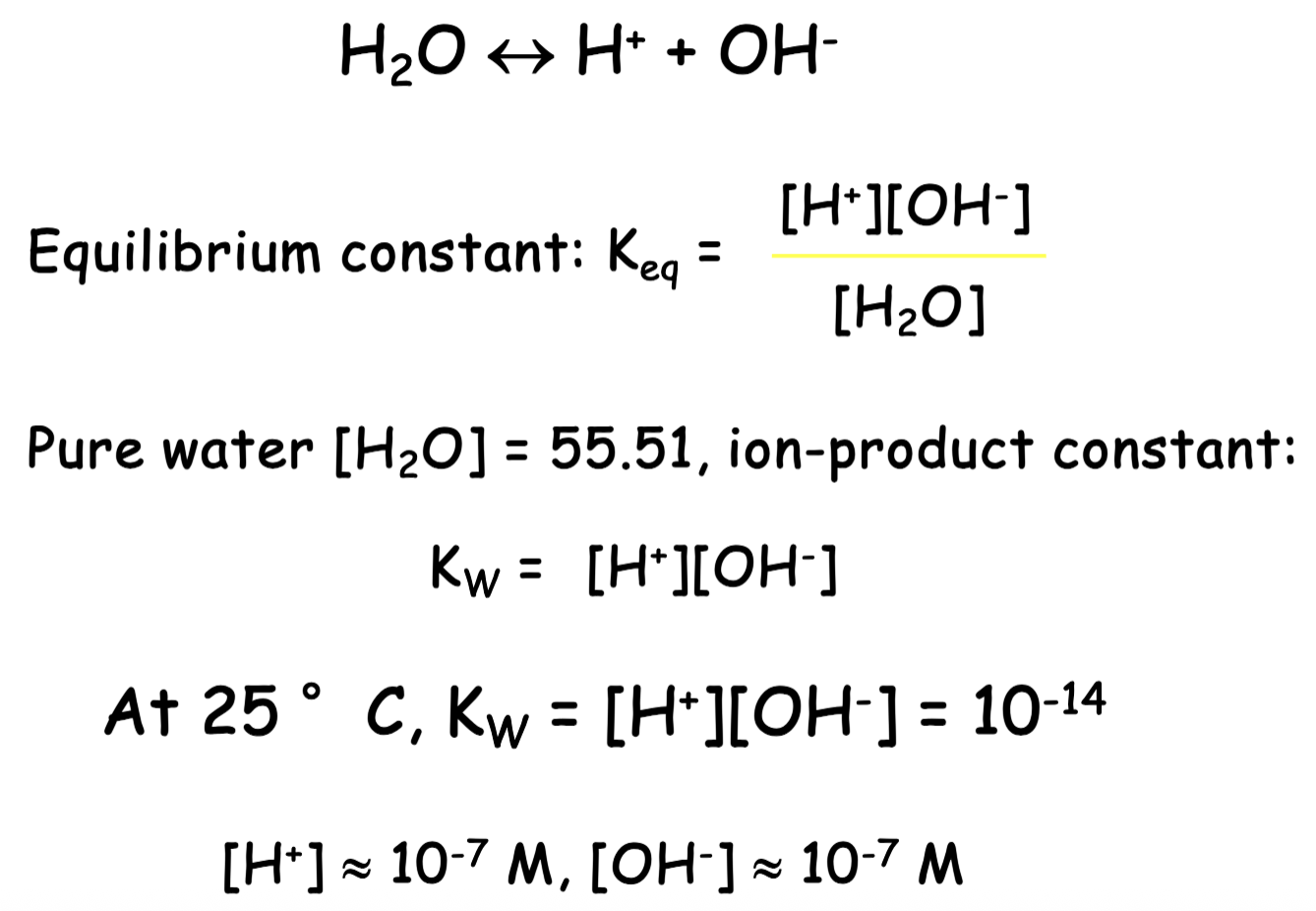
dissociation of water molecules
can dissociate into a proton and a hydroxy ion
in pure water at room temp., the concentration of protons and hydroxy ions are equal
can change the concentration of protons and ions, but 10^-14 is constant
acids and bases
acids are capable of releasing a proton
bases are capable of accepting a proton
an amphoteric molecule is capable of acting as an acid or a base
acids and bases exist in pairs
the ability of an acid or base to interaction with a proton is dependent on their strength

pH
pH is used to express the acidity of a solution
pH = -log [H+]
![<ul><li><p>pH is used to express the acidity of a solution</p><ul><li><p>pH = -log [H+]</p></li></ul></li></ul><p></p>](https://assets.knowt.com/user-attachments/10d5d240-8a20-4acb-9490-47cd277b2100.png)
buffers
a mixture of a week acid and its conjugate base or a weak base and its conjugate acid
organisms use buffers to protect cells from pH fluctuation
the blood is buffered by carbonic acid and bicarbonate ions to keep pH about 7.4
the cell fluid is buffered by H2PO4- and HPO42- to keep pH about 7