Diversity of fishes week 1
 Call Kai
 Learn
Learn Practice Test
 Spaced Repetition
 Match
Match Flashcards
 Knowt Play
1/31

There's no tags or description
Looks like no tags are added yet.
Name | Mastery | Learn | Test | Matching | Spaced | Call with Kai | Chat |
|---|
No analytics yet
Send a link to your students to track their progress
32 Terms
Spines
Usually hard and pointed
Unsegmented
Unbranched
Solid
Rays
Usually soft and not pointed
Segmented
Usually branched
Bilateral, with left and right halves
Dorsal fins
The original function of the dorsal fin was a stabilizer during swimming, but it has been modified in many different ways, e.g.:
Reduced or lost (in rays)
Confluent with caudal and anal fin (in some eels)
Converted into a suction disk (remora)
Conversion of first dorsal spine into an ilicium (anglerfish)
Anal Fins
The anal fins shows the least, but still some, variation
among fishes:
Reduced or lost (in ribbonfishes)
Elongated and used for locomotion (knifefishes)
Anterior part modified into a gonopodium for spermatophore transfer in livebearers (mollies)
Caudal fin
Caudal fins of fishes vary in both external shape and internal anatomy
The different types of caudal fins provide useful information about modes of swimming as well as phylogeny
Protocercal tail
The primitive undifferentiated caudal fin that extends around the posterior (e.g. lancelets)

Heterocercal tail
Unequal-lobed, vertebral column extends into the upper lobe (e.g. sharks)
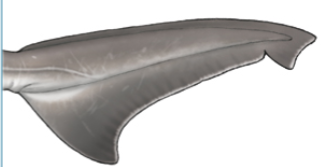
Homocercal tail
Equal-lobed, caudal fin rays arranged symmetrically (most advanced bony fish)

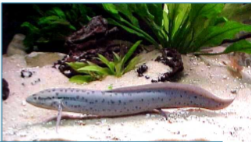
Leptocercal tail
Resembles protocercal, but secundarily derived (e.g. lungfishes)
Isocercal tail
Last vertebra modified into small plate to which caudal fin rays attach (Gadidae)
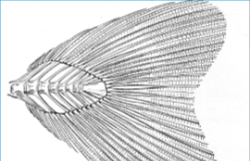
Gephyrocercal tail
Lack of true tail, modified elements of dorsal and anal fin form tail (Molidae)

Branchiocranium
That portion of the skull related to the gills, including the mandibular region, the hyal region (hyoid arch and branchiostegal series), and the branchial arches including their attached dermal plates, or the branchial skeleton proper.
Teeth and gill rakers are part of the branchiocranium
Teeth
The oral jaws and many pharyngeal bones may bear teeth which can be divided in several types suitable for various feeding modes:
1. Canine
2. Villiform
3. Molariform
4. Cardiform
5. Incisor
6. Teeth fused into beaks
7. Flattened triangular cutting teeth
8. Pharyngeal teeth
Integumentary skeleton
The integument is composed of the skin and skin derivatives, and includes scales in fishes and feathers and hair in birds and mammals
The structure of the skin in fishes is similar to that of other vertebrates, with two main layers: and outer epidermis and an inner dermis
Scales are the characteristic external covering of fishes
Placoid scales
Characteristic of Chondrichthyes
A flattened rectangular basal plate in the upper part of the dermis, from which a protruding spine projects
Placoid scales do not increase in size with growth; instead new scales are added between older scales
The teeth of elasmobranchs are evolutionary derivatives of placoid scales

Cosmoid scales
Were present in fossil coelacanths and fossil lungfishes
Probably arose form the fusion of placoid scales
Growth is by addition of new lamellar bone underneath, not over the upper surface

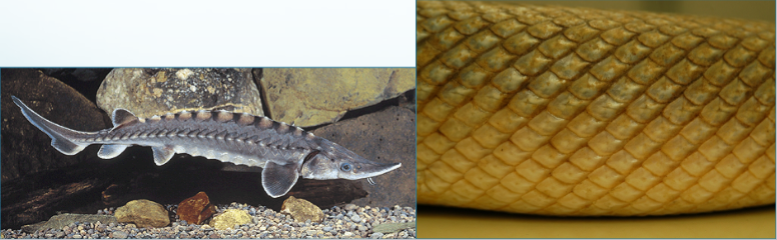
Ganoid scales
Found in Chondrostei (e.g. sturgeons, gars and paddlefish)
Modified cosmoid scales
Sturgeon scales are modified into large plates, with most of the rest of the body naked
Cycloid and ctenoid scales
Present in the Teleostei, the vast majority of the bony fishes
Evolved from ganoid scales and overlapping
Cycloid scales lack ctenii (teeth on posterior border)
Both used for studying taxonomy and life history; they grow with age, measurable by counting circuli (growth rings)

Soft Anatomy
Muscles
Cardiovascular system
Alimentary canal
Gas bladder
Kidneys
Gonads
Nervous system
Muscles
Skeletal muscle
Most of a fish's mass, other than skeleton
White muscle: used anaerobically in short-duration burst swimming but fatigues quickly. Lack myoglobin
Red muscle: forms a thin sheet under the skin; involved in sustained swimming and hard to fatigue. Abundant myoglobin
Smooth muscle
Involuntary muscle that lines the walls of the digestive tract
Cardiac muscle
Dark red involuntary heart muscle
Cardiovascular system
Serves all bodily functions but is most closely associated with respiration, excretion, osmoregulation, and digestion
Is a system of arteries, veins, and capillaries that carry respiratory gases, wastes, excretory metabolites, minerals, and nutrients
Blood flow in fishes involve a single-circuit system

Alimentary canal

Gas bladder
Also called swim bladder
Gas-filled sac located between the alimentary canal and the kidneys
Functions mainly as hydrostatic organ to help control buoyancy
Only bony fishes have gas bladders, and some species of teleost have lost their gas bladder (mostly deep-sea and benthic fishes)
Kidneys
Kidneys are one of the primary organs involved in excretion and osmoregulation
Marine and freshwater fishes differ considerably in kidney structure reflecting the different problems faced by living in very different solute concentrations
Freshwater fishes produce copious amounts of highly dilute urine, while saltwater fishes drink seawater to correct dehydration, and excrete a low volume of highly concentrated urine
Gonads
The sexes in fishes are usually separate
The testes are internal, longitudinal and usually paired
Can constitute as much as 12% of body mass
The ovaries are internal, usually longitudinal, and paired or fused
Can constitute as much as 70% of body mass
Nervous system
Fish brains are on average only 1/15 the size of the brain of a bird or mammal of equal body size
Sharks have much larger brains relative to body size than teleosts