Forces
 Call Kai
 Learn
Learn Practice Test
 Spaced Repetition
 Match
Match Flashcards
 Knowt Play
1/157

There's no tags or description
Looks like no tags are added yet.
Name | Mastery | Learn | Test | Matching | Spaced | Call with Kai | Chat |
|---|
No analytics yet
Send a link to your students to track their progress
158 Terms
What is a scalar quantity?
Quantity that only has magnitude
What is a vector quantity?
Quantity that has magnitude + direction
What is a force?
Vector
Push or pull that acts on an object due to interaction w/ another object
What is a contact force?
Force that acts b/ 2 objects physically touching
What is a non-contact force?
Force that acts b/ 2 objects physically separated
What are 4 examples of contact forces?
Friction
Air resistance
Normal contact force
Tension
What are 3 examples of non-contact forces?
Gravitational force
Electrostatic force
Magnetic force
What is weight?
Force acting on an object due to gravity
The force of gravity close to the Earth is due to the ___________ _________ around the Earth.
gravitational field
What does the weight of an object depend on?
g.f.s at point where object is
What is the equation for calculating the weight of an object?
weight = mass × gravitational field strength
W=mg
weight — newtons (N)
mass — kilograms (kg)
gravitational field strength — (N/kg)
The weight of an object may be considered to act at a single point referred to as the object’s ______ __ _____’.
centre of mass
The weight of an object and the mass of an object are ___________ ______________.
directly proportional
What do you use to measure weight?
Newtonmeter
Describe what is meant by a resultant force.
Single force that has same effect as a no. of forces acting on an object
A single force can be resolved into two components acting at ______ ______ to each other.
The two component forces together have the same effect as the ________ _________.
right angles
single force
When does an object experience a reaction force?
When it is at rest
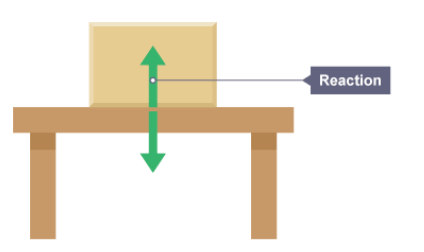
When does an object experience a tension force?
When it is being streched
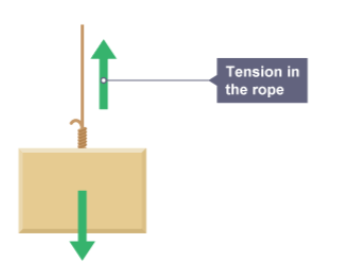
When does an object experience friction forces?
When 2 objects slide past each other
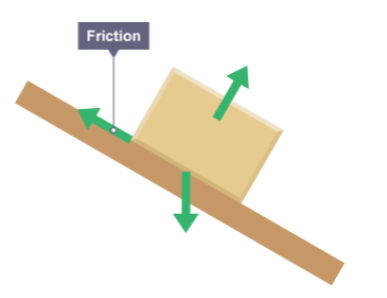
When does an object experience air resistance?
When it is moving through air
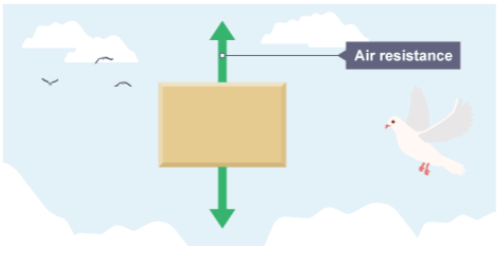
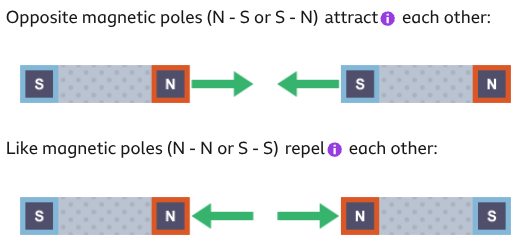
What is a magnetic force experienced by?
Any magnetic material in magnetic field
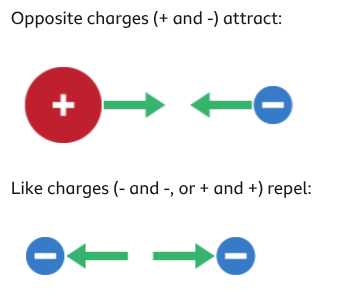
What is an electrostatic force experienced by?
Any charged particle in electric field
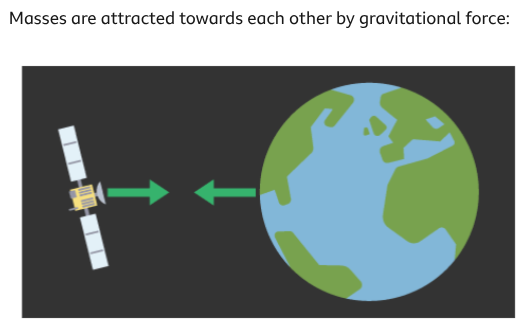
What is an gravitational force experienced by?
Any mass in gravitational field
All objects with mass produce a ____________ _____.
gravitational field
The more mass an object has, the greater its ____________ _____ will be.
gravitational field
What happens when a force causes an object to move through a distance?
Work is done on object
When does a force do work on an object?
When the force causes a displacement of object
What equation is used to calculate the work done by a force on an object?
work done = force × distance (along line of action of force)
W=Fs
work done — joules (J)
force — newtons (N)
distance — metres (m)
One joule of work is done when a force of ______ newton causes a ______________ of _____ ________.
one
displacement
one metre
What does work done against the frictional forces acting on an object cause?
Increased temp of object
What are the three ways to change the shape of an object?
Stretching
Bending
Compressing
Why do at least two forces need to be acting on a stationary object to deform it?
If only one force was acting on the object it would just move.
What is elastic deformation?
The deformation is reversible — the object returns to its original shape or length when the force has been removed.
What are elastic objects?
Objects that can be elastically deformed.
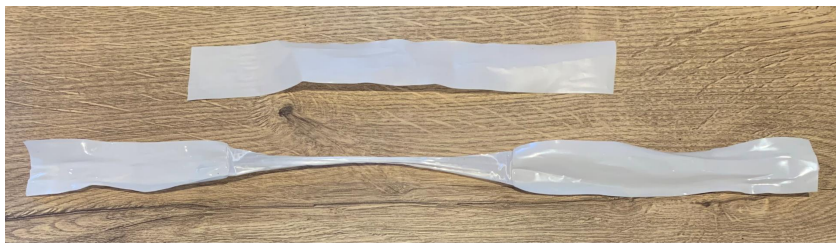
What is inelastic deformation?
The deformation is not reversible — the object does not return to its original shape or length when the force has been removed.
Hooke's Law:
The extension of an elastic object, such as a spring, is ___________ __________ to the force applied, provided that the ______ __ _____________ is not exceeded.
directly proportional
limit of proportionality
What is the equation for Hooke's Law?
F = ke
What is spring constant measured in?
Newtons per metre (N/m)
A force that stretches (or compresses) a spring does ______ and __________ __________ ________ is stored in the spring. Provided the spring is not ____________ __________, the ______ _____ on the spring and the ___________ _________ ________ stored are equal.
work
elastic potential energy
inelastically deformed
work done
elastic potential energy
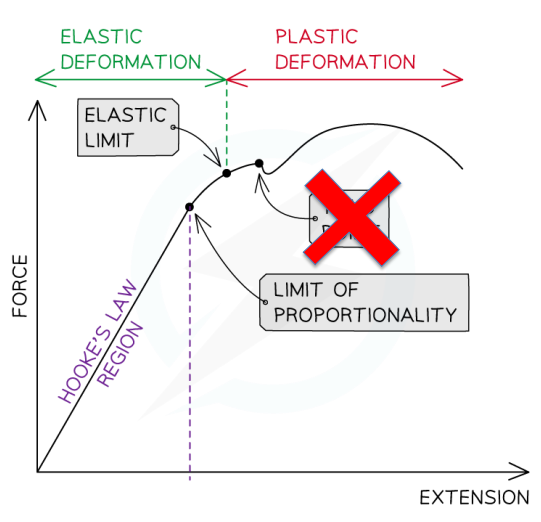
What is the limit of proportionality?
The point on a stress-strain curve where the linear, elastic deformation region transitions into a non-linear, plastic deformation.
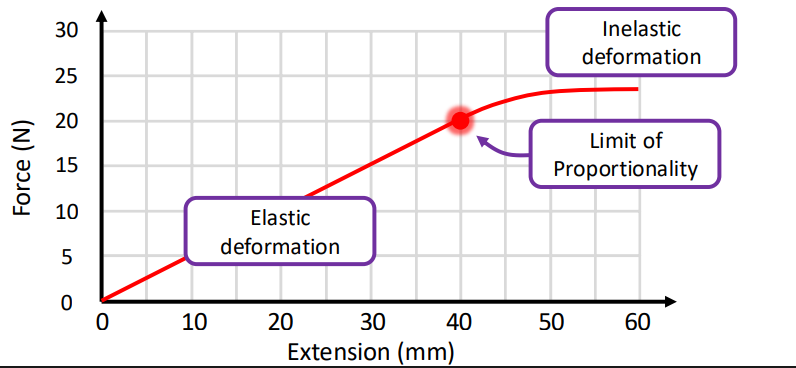
Before the limit of proportionality, elastic deformation is occurring and the relationship between force and extension is _______.
linear
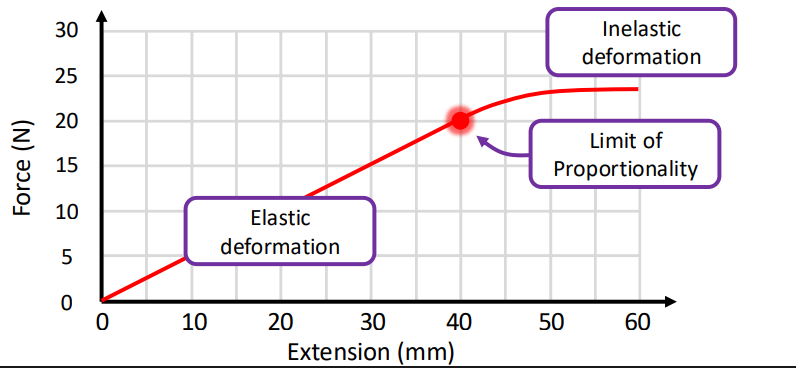
After the limit of proportionality inelastic deformation is occurring and the relationship between force and extension is __________.
non-linear
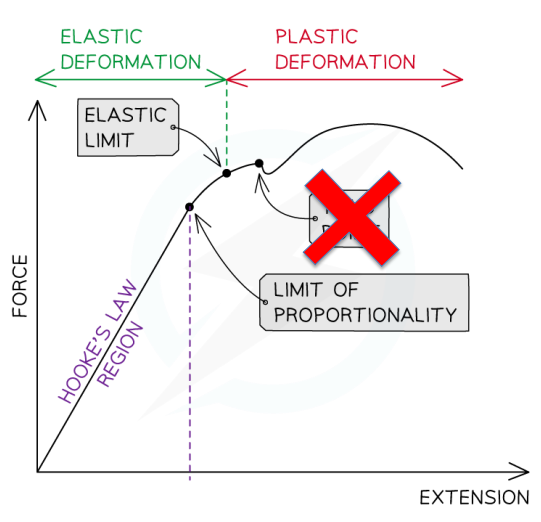
What is the elastic limit?
The maximum extent to which a solid may be stretched without permanent alteration of size or shape.
What is the equation for elastic potential energy?
Ee = ½ ke2
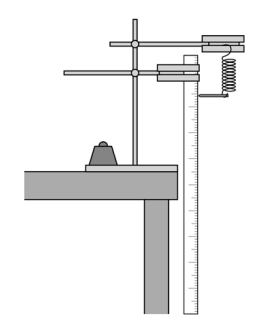
RP 6 — Force & Extension:
Set up your apparatus as in the diagram making sure that:
the ruler is ________. The zero on the scale needs to be at the ______ ________ as the top of the spring.
the splint is attached securely to the bottom of the spring. Make sure that the splint is __________ and that it rests against the scale of the ruler.
Take a reading on the ruler – this is the length of the _____________ spring.
Carefully hook the base of the weight stack onto the _________ of the spring. This weighs 1.0 newton (1.0 N). Don’t forget that the mass added will have to be converted to newtons.
Take a reading on the ruler – this is the length of the spring when a force of 1.0 N is applied to it.
Add further weights. Measure and record the length of the spring each time.
Calculate the __________ for each weight.
vertical
same height
horizontal
unstretched
bottom
extension
What may cause an object to rotate?
A force or a system of forces.
What are three real-world examples of forces causing rotation?
Turning a spanner
Opening a door
Using a see-saw
What is the moment of the force?
The turning effect of a force.
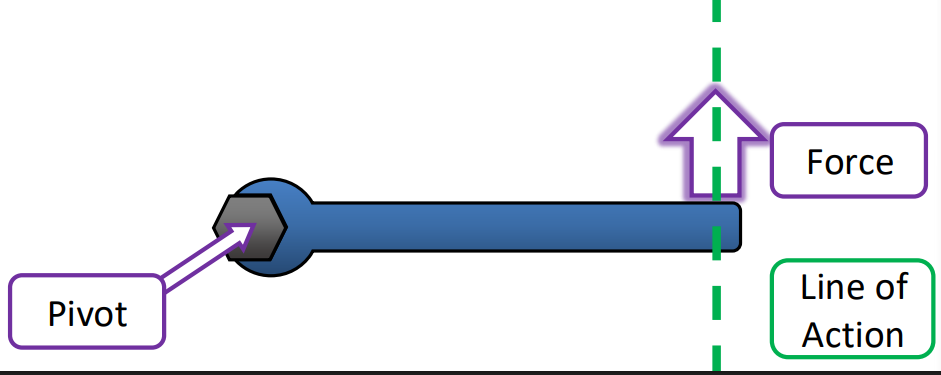
What is the pivot?
The point around which the object can rotate.
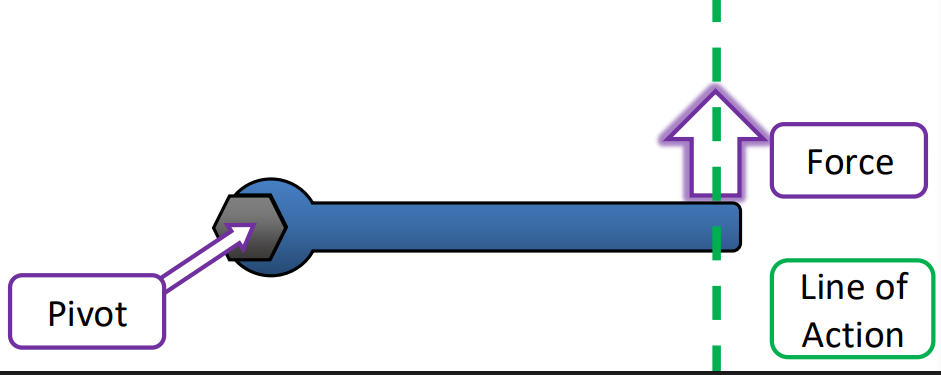
What is the line of action?
A straight line that a force acts along.
What is the equation for the moment of the force?
M = Fd
What is the moment of the force measured in?
newton-metres (Nm)
If an object is balanced, the total _____________ moment about a pivot equals the total ____________ moment about that pivot.
clockwise
anticlockwise
We measure the distance from the _______ to the ______ __ ________ of the force.
When we measure the distance we must always measure it ______________ (at right angles) to the line of action of the force.
This is the _____________ distance from the pivot to the line of action.
pivot
line of action
perpendicular
shortest
What can a simple lever and a simple gear system be used to do?
To transmit the rotational effects of forces.
Levers (and gears) can be used to increase the __________ by allowing us to apply the ________ further from the pivot.
This means _______ force is needed to get the same _________.
For this reason, levers and gears are examples of _________ __________ — a small effort force can be __________ and result in a much larger force acting on the load.
moment
force
less
moment
force multipliers
multiplied
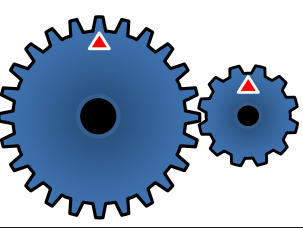
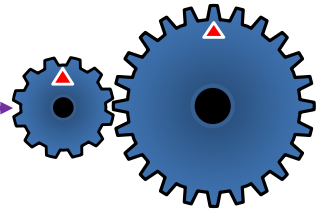
If a gear is supplying the force (first gear) and its connected to a gear with fewer teeth, what happens to the second gear?
It turns faster
with less force
in the opposite direction
If a gear is supplying the force (first gear) and its connected to a gear with more teeth, what happens to the second gear?
It turns slower
with more force
in the opposite direction
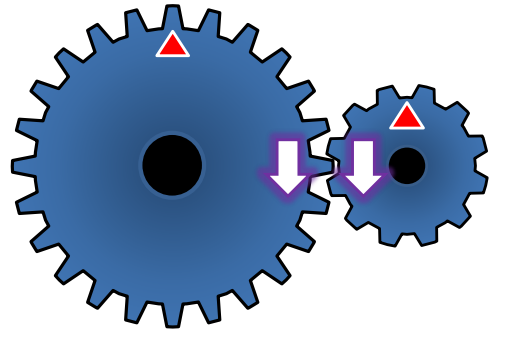
With two gears, the forces that act on the teeth are ______.
As the left gear turns its teeth exert an _____ force on the teeth of the right gear.
Despite the forces being _____ they are different ________ from their axles, which means the moments are ________.
equal
equal
equal
distances
different
What is pressure?
The force exerted on a surface per unit of area that the force is distributed over.
What are the 2 states of matter that a fluid can be?
Liquid
Gas
When a force acts on a surface it causes _________.
pressure
What are 2 ways to increase pressure?
Make the force larger
Make the surface area it is acting on smaller
What are 2 ways to decrease pressure?
Make the force smaller
Make the surface area it is acting on larger
As you increase the size of the force you ___________ the size of the pressure.
increase
As you increase the size of the area of which the force is spread acts, you ___________ the pressure.
decrease
The pressure in fluids causes a force normal (at ______ ______) to any surface.
right angles
How can the pressure at the surface of a fluid be calculated?
pressure = force normal to a surface / area of that surface (p = F ÷ A)
What is pressure measured in?
Pascals (Pa)
How can the pressure due to a column of liquid be calculated?
pressure = height of the column × density of the liquid × gfs (p=hρg)
The pressure in a liquid acts in ____ ____________.
all directions
The pressure in a liquid is ___________ at greater depths.
greater
What is the equation for density?
density = mass ÷ volume (ρ=vm )
What is density measured in?
kg/m³
A partially (or totally) submerged object experiences a greater pressure on the ___________ surface than on the _________ surface. This creates a resultant force upwards.
What is this force called?
bottom
top
upthrust
When we submerge an object, an _______ volume of fluid is _________. The weight of the fluid that is __________ is equal to the force of the ________.
equal
displaced
displaced
upthrust
An object that is more dense than the fluid around it will ______.
sink
Why does an object that is more dense than the fluid around it sink?
The object will always weigh more than the weight of the fluid it displaces which is equal to the upthrust.
Therefore the weight, pulling the object downwards, will always be larger than the upthrust pushing upwards and the object will sink.
An object that is less dense than the fluid around it will ______.
float
Why does an object that is less dense than the fluid around it float?
Object only has to be partially submerged for its whole weight (acting downwards) to be equal to weight of the fluid it displaced (e.g. upthrust, acting upwards)
Resultant force = 0
What is the atmosphere?
A layer of air around the Earth.
The atmosphere gets less dense with _____________ _________.
increasing altitude
What creates atmospheric pressure?
Air molecules colliding with a surface.
What is altitude?
The height above sea level.
The number of air molecules (and so the ________ __ ______) above a surface ___________ as the height of the surface above _________ ________ increases.
weight of air
decreases
ground level
As height increases there is always ______ air above a surface than there is at a ________ height.
less
lower
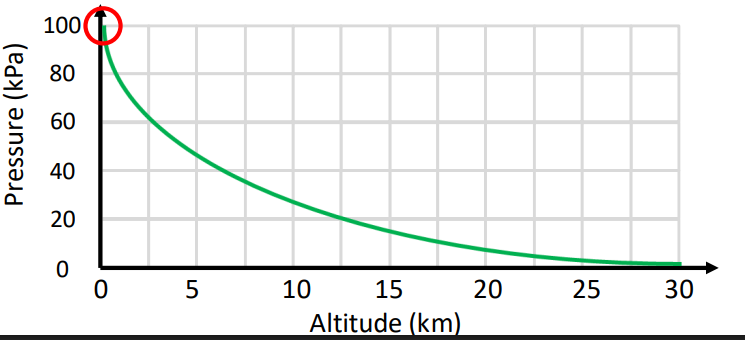
Atmospheric pressure _____________ with an increase in height.
decreases
What is distance?
How far an object moves.
Is distance a scalar or vector quantity?
Scalar
What is displacement?
The distance an object moves (measured in a straight line) and the direction of that straight line.
Is speed a scalar or vector quantity?
Scalar
What are the factors that can affect the speed at which someone walks, runs, or cycles?
Age
Distance Travelled
Fitness
Terrain
What are the typical speeds for walking, running, and cycling?
1.5 m/s
3 m/s
6 m/s
What are the typical speeds for a car, train, and aeroplane?
13 - 30 m/s
50 m/s
250 m/s
What is the typical value for the speed of sound in air?
330 m/s
What is the equation to calculate the distance travelled in a specific time for an object moving at constant speed?
s = vt
How do you calculate relative speed (when the objects are travelling in opposite directions?
speed A + speed B
How do you calculate relative speed (when the objects are travelling in the same direction)?
The difference between speed A and speed B.
What is the velocity of an object?
Speed in given direction
Is velocity a scalar or vector quantity?
Vector