Plant Science Exame 1
 Call Kai
 Learn
Learn Practice Test
 Spaced Repetition
 Match
Match Flashcards
 Knowt Play
1/153

There's no tags or description
Looks like no tags are added yet.
Name | Mastery | Learn | Test | Matching | Spaced | Call with Kai | Chat |
|---|
No analytics yet
Send a link to your students to track their progress
154 Terms
Maximum size genetically determined
-Growth stops after a time
-Usually cannot heal/regrow
Ex: Leaves, flowers, and fruits
No maxiumum size genetically
-Able to keep growing through life
-Can heal/regrow
-Only is limited by resource or environmnet
Ex: Roots and Stems
Cell Theory
-Robert Hook first spots cells under microscope
- Schleidern and Swann then say
All plants and animals are made of cells
Cell is basic unit of life
Virchow then added
Cells arise by reproduction from previous cells
General Features of All Cells
-Plasma
-Cytoplasm
-Dna
-Ribosomes
(Please Call Dr. Rob)
Have unique components like:
-Mitochondria
-Golgi app
-ER
-Endomemrbane system
-Peroxisomes and Vesicles
-Cell wall
-Cell vacuole
-Chlorplast (plastid)
Central Vacuole
A large membrane-bound structure that stores water and can fill much of the cell.
Helps regulate water concentration through osmosis
-Surrounded by tonoplast and stores nutrients, ions, and waste products
Chloroplasts
Stores chlorophyll and other pigments for photosynthesis
-Pigments are stored in sacs called thylakoids, found in stacks called Grana
-Contains its own DNA and ribosomes
Cell Wall
Made up of the middle lamella, Primary cell wall, and, secondary cell wall

-Middle lamella
Is a thin layer of pectin binding adjacent cells
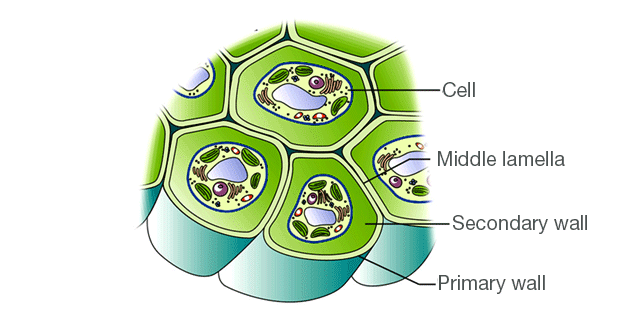
-Primary Cell wall
-Surface of all plant cells
-Composed of cellulose microfibrils
-Thin and elastic to allow for cell enlargement

Microfibrils
The orientation of these determines the direction of cell enlargement. Expands longitudinally (ex:spring)
Secondary cell wallI
-Made of layers deposited on the inner primary wall
-Ligin+Cellulose deposited, adding rigidity
-Thicker than primary wall; can even push cell to death

Plasmosdesmata
Are pores which allow for communication btwn cell walls.
Meristems
Are regions of continuous cell divison and growth located in dif points of the plant
3 types: Apical, Lateral, and Intercalary


Apical Meristem
Located at the tips/ends of roots and stem, controls height
Produce 3 primary meristematic tissues:
-Protoderm,
-Ground Meristem
-Procambium
Gives rise to epidermis
Gives rise to ground
Gives rise to vascular tissue (transport)
Lateral Meristem
Responsible for secondary growth, which is an increase in girth/width
Located in two regions:
-vascular cambium
-cork cambium

Vascular Cambium
Gives rise to vascular tissues
Produces periderm (secondary dermal tissues)
3 Types of Tissue Systems
-Ground Tissue (mesophyll, pith)
-Vasuclar tissue system (xylem and phloem)
-Dermal tissue system (epidermis and periderm)
-Composed mostly of a single cell type
3 main types:
-Parenchyma
-Collenchyma
-Sclerenchyma
-Perform essential functions like support, storage, regulation…
Parenchyma
-Spherical or elongated
-Thin primary cell walls but may develop secodnary walls
-Living cells perform many metabolic functions
-Only type of cell that when mature, can be reprogrammed to form other
- can aggregate(group) to form simple tissues like cortex,pith, and mesophy
Collenchyma
-Elongated, often containing chloroplasts, and alive at maturity
-Cell walls composed of alternating layers of pectin and cellulose, usually thicken at corners *strong and flexible
-Provides support to young stems and leaves, allowing for growth
-Outermost cells of cortex might aggregate into rights around the stem
Sclerenchyma
-Thick, lingified secondary cell walls. Dead at maturity
2 types of cells: Fibers and Sclerids
Fibers
Long narrow cells with thick, pitted walls tappered at ends
-Can aggregate into continuous cylinders around stems or form strands
Sclereids
Can have many shapes, from simple ones to highly branched
-Can form sheets or be in small clusters
Complex Tissues
Interconnected network of cells transversing the enitre plant. 3 types:
-Vasuclar
-Epidermis
-Periderm
V.E.P
Vascular System
Composed of:
-Vessel elements and tracheids
-Fibers
-Living parenchyma cells
Epidermis
Single layer of cells in the outer part of a plant, covered in cutin
Complex tissue composed of
-Epidermal cells
-Guard cells
-Trichomes: hairlike outgrowths
-Subsidiary cells
Periderm
-Protective layer that forms in older stems and roots and replaces the epidermis
A secondary tissue composed of:
-Phellem (Cork)
-Phellogen or cork cambium
-Phelloderm
Aboveground
Shoot system, which includes stems, leaves, and reproductive organs (flowers/Fruits)
Functions of Stem
-Support
-Conduction
-Photosynthesis
-Food storage
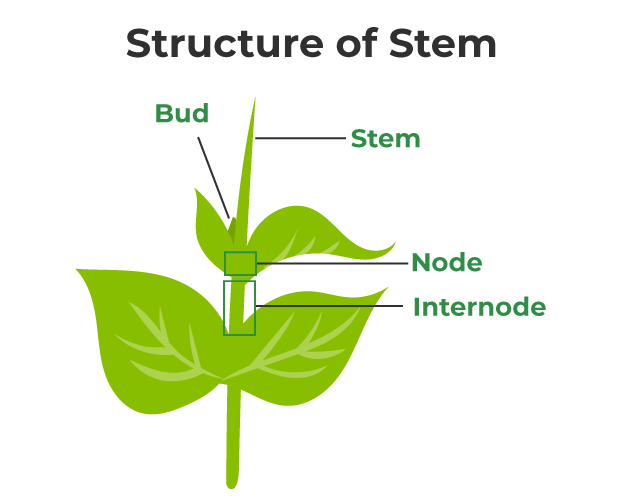
Stem Morphology
-Are characterized by their nodes, which are points of attachment of leaves
-Internode region, area between two nodes
-Axillary bud usually found in the region btwn leafe and stem
Primary Growth
Growth in length. Comes from apical meristems.
Secondary Growth
Increase in thickness or girth cause be the secondary meristem. Comes from lateral meristem
Monopodial
Buds do NOT degrade, and all shoots continue to grow
Sympodial
Terminal buds degrade, and lateral buds closest to the apex become new terminal shoot
Leaf
-Organs for performing photosynthesis
-Arise from shoot apical meristem through leaf primordia
-Determinate growth
-True leaves have a bud located j above btwn leaf and stem
Petiole
The stem-like part of the leaf, connecting the blade to the stem
Petiolate
Leaves containing a visible petiole

Peltate
A special type of petiolate where the petiole attaches underneath the blade instead

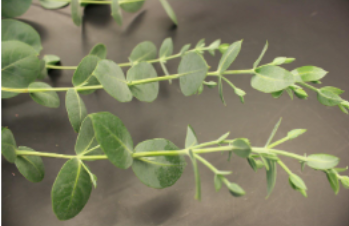
Sessile
Leaves without visible petiole
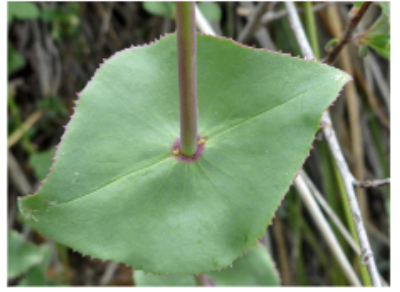
Perfoliate
Special type of sessile leaves in which the stem passed through the center of the blade
3 stages of te embryo proper in Eudicots
-Globular
-Heart
-Torpedo
Seeds
Allow populations to propagate
-Maintain genetically diversity
-survive harsh environments conditions
-Disperse into new ones
Seed Morphology
Contains a:
-embryo (new plant)
-Endosperm and/ or cotyledon (nutrient source)
-Seed coat (protection)
Seed Coat
Serves as protection and to maintain moisture
Plumule
Responsible for shoot system
-shot apical meristem
-leaf primordia
Radicle
Very small before germination, its the embryonic root.
Hypocotyl
Region btwn cotyledon attachment point and radicle
Epicotyl
Region btwn cotyledon attachment point and shoot tip
Heart Stage
The heart shape gives rise to cotyledons. The endosperm continues to divide
Torpedo Stage
The shoot apical meristem is btwn the cotyledons, and root apical meristem is anchored to the suspensore