Unit 7 - Concepts of Origin of Life, Taxonomy, and Cladograms
 Call Kai
 Learn
Learn Practice Test
 Spaced Repetition
 Match
Match Flashcards
 Knowt Play
1/36

Earn XP
Description and Tags
Based off of the reading guide over Ch. 25 & 26, slide deck/notes, and any important info from pre-test
Name | Mastery | Learn | Test | Matching | Spaced | Call with Kai | Chat |
|---|
No analytics yet
Send a link to your students to track their progress
37 Terms
Conditions on early Earth were…
volcanic, incredibly hot, and the atmosphere had very little oxyegn (O2)
not conducive to life
What are the four main stages/sequences in the formation of simple cells during the origin of life?
1) The abiotic (nonliving) synthesis of small organic molecule: simple, nonliving chemical building blocks, such as amino acids, formed on early Earth
2) Joining of these small molecules into polymers: these small molecules linked together to create larger macromolecules
3) Packaging of these molecules into protocells
4) The origin of self-replicating molecules that made inheritance: such as RNA, which made genetic inheritance and evolution possible
Describe the Pre-Mordial Soup Theory and the Miller-Uray experiment.
The Pre-Mordian Soup Theory states that life on Earth began due to volcanic gases that were released into Earth oceans. These organic molecules (gases) were then hit with energy sources such as lightning to form into organic monomers like amino acids.
The Miller-Uray experiment replicated this environment and provided evidence for this theory.
What was most likely the first genetic material?
RNA
Explain the evidence for an early “RNA world.”
proposal that states how before the evolution of DNA, early, pre-cellular life relied on RNA for both genetic storage and biological catalysts (as Ribozymes, RNA molecules acted as enzymes to speed up reactions)
In what type of rock are fossils found, and what do we not know from analyzing rock strata?
Sedimentary Rock
We don’t know the exact age, and are not able to fully see the structure as soft-tissue is not preserved
Relative Dating
uses the order of rock starta to determine the relative age of fossils
Radiometric Dating
uses the decay of radioactive isotopes to determine the age of the rocks or fossils
based on the rate of decay, or half-life, of the isotope
unstable radioactive atoms (parents) break down into stable atoms (daughters). scientists measure the remaining parent atoms and compare to daughter atoms to calculate how much time has passed.
Oxygenic Photosynthesis
originated with cyanobacteria
a biological process that uses light energy to split water molecules, producing chemical energy and releasing molecular oxygen as a byproduct
How did oxygenic photosynthesis alter life on Earth, and lead to a wave of mass extinction?
it allowed O2 to become a part of the atmosphere. through this aerobic metabolism, cellular respiration, evolved. thus giving organisms the energy needed to become complex, and then through endosymbiosis the first eukaryotes had evolved.
Explain the evolution of eukaryotes by endosymbiosis.
firstly, a prokaryotic cells engulfed a small aerobic cell, which did not get digested. it stayed inside the host cell and provided ATP energy in exchange for nutrients. this bacterium then evolved into the mitochondria.
Summarize the lines of evidence that support the model of endosymbiosis.
Membranes: some organelles have double membranes
Antibiotics: susceptible to antibiotics (indicated organelles may have bacterial origins)
Division: reproduction occurs via a fission-like process
DNA: has own DNA which is naked and circular (like prokaryotic DNA structure)
Ribosomes: have ribosomes which are 70S in size (identical to prokaryotic)
(My Aunt Doesn’t Drive a Rolls royce)
What are adaptive radiations?
periods of evolutionary change in which organisms from many new species whose adaptations allow them to fill different ecological roles in their communities
Why did large-scale adaptive radiations occur after each mass extinction?
because there are more ecological roles left vacant, thus allowing survivors to adapt to them
Taxonomy
the scientific study of naming, describing, and classifying living and extinct organisms into organized groups
Binomial System
first word is genus name
second word is specific epithet (refers to one species, of potentially many, within its genus)
Name all the classification categories going from broad to narrow.
Domain, Kingdom, Phylum, Class, Order, Family, Genus, Species
Systematics
the diversity of organisms at all levels
Clade
groups of species that include an ancestral species and all of its descendants
Monophyletic
an ancestral species and ALL of its descendants

Paraphylectic
an ancestral species and SOME of its descendants
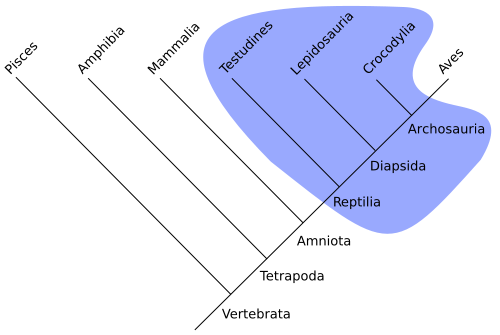
Polyphylectic
the most recent common ancestor is NOT apart of the group

Shared Derived Characteristic
an evolutionary novelty unique to that clade
How does comparing different gene sequences help us investigate the relationship between organisms that diverged a long time ago?
because the rate of evolution of DNA sequences varies from one part of the genome to another; measuring how much DNA has changed, and how much has stayed the same
rRNA changes slowly, so its useful for investigating relationships between taxa that diverged hundreds of millions of year ago
mtDNA evolves rapidly, so its useful for investigations relationships that are recent
What two domain include all prokaryotes?
Bacteria and Archae
Horizontal Gene Transfer
the movement of genetic material between organisms other than by parent-to-offspring reproduction
Examples:
Transformation: A bacterium takes up loose, free-floating DNA from its dead neighbors in the environment.
Conjugation: Two bacteria connect directly through a tiny tube called a pilus and pass a copy of plasmid DNA to each other.
Transduction: A bacteriophage (a virus that infects bacteria) accidentally carries DNA from one host cell and injects it into a new one.
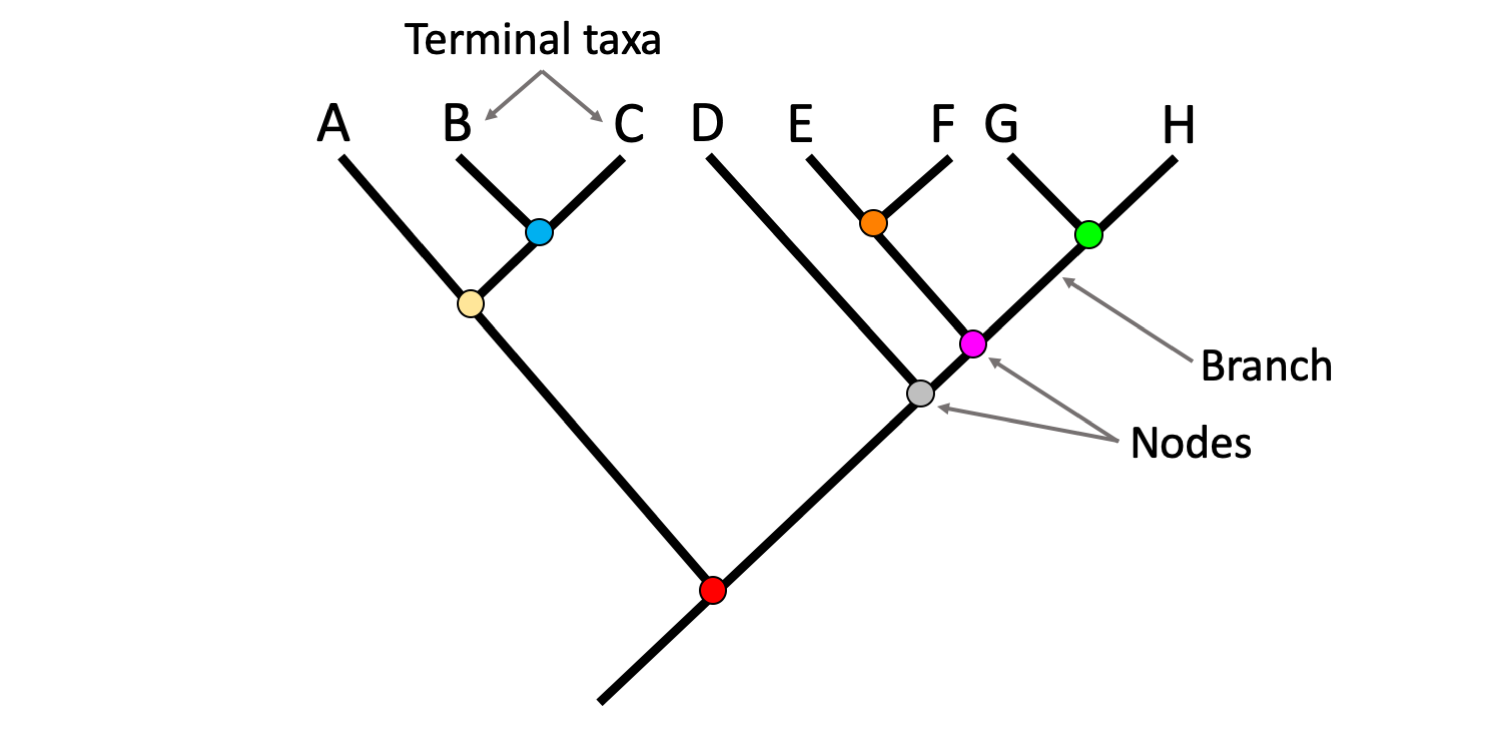
Outgroup
the group that has the least in common with everything else

Root
base of tree represents the theoretical common ancestor for all organisms on the tree

Node
the point of divergence between lineages. it represents the most recent common ancestor
Protocells
lipid membrane (lipid bubbles-separate inside from outside) and carries on energy metabolism

Primitive Characters
present in all members of a group, and present in the common ancestor
Derived Characters
present in some members of a group, but absent in the common ancestor
feature that distinguishes one group (clade) from another

Convergent Evolution
the independent development of similar traits or features in unrelated or distantly related species (due to similar environmental pressures, natural selection, or analogous structures)
feature is not present in a common ancestor
Parallel Evolution
occurs when independent, related species acquire similar traits or adaptations separately after diverging from a shared ancestor, usually because they experience similar environmental pressures
feature is not present in common ancestor
Sister Groups
two phylogenetic lineages that descend from a single immediate common ancestor

Paralogous
Paralogous genes (or paralogs) are homologous genes that split apart due to a gene duplication event in an organism's evolutionary history.
Parsimony
the principle that the best phylogenetic tree is the one requiring the fewest evolutionary changes