Cellular Function
 Call Kai
 Learn
Learn Practice Test
 Spaced Repetition
 Match
Match Flashcards
 Knowt Play
1/43

There's no tags or description
Looks like no tags are added yet.
Name | Mastery | Learn | Test | Matching | Spaced | Call with Kai | Chat |
|---|
No analytics yet
Send a link to your students to track their progress
44 Terms
What are the main cellular structures and their functions?
Cell Membrane - Outer boundary, selectively permeable
Cytoplasm - Gel-like substance filling the cell
Organelles - Specialized structures within the cell
Nucleus - Contains genetic material, controls cell activities
Cytoskeleton - Provides structural support and shape
What are the five basic cellular functions?
Cell metabolism and energy use
Synthesis of molecules
Communication
Reproduction
Inheritance
How do cells exchange materials across the plasma membrane?
Plasma membranes are selectively permeable
Passive Transport (no energy required):
Simple Diffusion - Movement from high to low concentration
Facilitated Diffusion - Uses transport proteins
Active Transport (energy required):
Moves substances against concentration gradient
Bulk Transport:
Endocytosis - Bringing substances INTO the cell
Exocytosis - Releasing substances OUT of the cell
Pinocytosis - "Cell drinking" (fluid intake)
Phagocytosis - "Cell eating" (solid particles)
What is step 1 of the process of energy production in cells?
Step 1: Breakdown of Macromolecules
Glucose → Glycolysis (converts glucose)
Fatty Acids → Fatty Acid Oxidation
Amino Acids → Amino Acid Oxidation
What is step 2 of the process of energy production in cells?
Step 2: Formation of Acetyl-CoA
All broken down molecules create Acetyl-CoA (enzyme-mediated)
What is step 3 of the process of energy production in cells?
Step 3: Citric Acid Cycle (Krebs Cycle)
Occurs in the mitochondria
Complex series of reactions
Requires oxygen
Produces CO₂ and H₂O as waste
What is step 4 of the process of energy production in cells?
Step 4: End Product = ATP (cellular energy)
What is mitosis?
cell division
What are the characteristics of mitosis?
Key Points:
Produces 2 genetically identical cells
Average cell divides 50-70 times before dying
Telomeres (ends of DNA) get shorter with each division
Process is regulated
Proliferation:
Some cells divide continuously
Some rarely divide
Affected by:
Genes
Growth factors
Environmental factors (chemical exposure, nutrition, infections)
What are the embryonic stem cells, their characteristics, and derivatives?
pluripotent
can develop into over 200 cell types
derivatives: endoderm, ectoderm, mesoderm
What are the adult stem cells, their characteristics, and derivatives?
multipotent
can differentiate into specific cell types
hematopoietic, epithelial, neuronal, mesenchymal
What are the three germ layers derived from embryonic stem cells?
Endoderm
Ectoderm
Mesoderm
Name the types of cellular adaptation and damage.
atrophy
hypertrophy
hyperplasia
metaplasia
dysplasia
atrophy
decrease in size and number when decreased demand
Hypertrophy
increase in size to meet increased demand
Hyperplasia
increase in number of cells in a tissue/organ
metaplasia
replaced by another cell type in response to chronic irritation
dysplasia
cells mutate into a different size, shape, type due to trigger, precancerous
What are the key points of cellular adaptation and damage?
Cells protect themselves through adapting
Modifications help manage changes and maintain homeostasis
May be permanent or reversible
Can become abnormal (disease)
What are the common causes of cell injury?
Physical - Mechanical trauma, temperature extremes
Chemical - Pollution, lead, drugs
Radiation - Ionizing and non-ionizing
Biological agents - Viruses, bacteria, parasites
Low oxygen levels - Hypoxia
Nutritional imbalances - Metabolic waste accumulation, ATP depletion
What is the difference between reversible and irreversible cell injury?
Normal Cell → Stress → Cell Injury
Reversible Injury:
Cell can recover and return to normal
Includes Adaptation responses
Irreversible Injury:
Cell cannot recover
Leads to Cell Death (Necrosis or Apoptosis)
What is apoptosis?
Programmed cell death
What are the characteristics of Apoptosis
Eliminates unwanted, injured, dead cells
Cell self-destructs and breaks into fragments
Fragments are ingested by macrophages
Normal process of a living organism
Does NOT initiate inflammation
What is necrosis
Cell Swells and burst
Initiates inflammatory response
Name the types of Necrosis
liquefaction
caseous
fat
coagulative
Describe Liquefaction of necrosis and give an example
Enzymes dissolve cells and liquify tissue
example: Brain, ischemic stroke
Describe caseous of necrosis and give an example
Cell debris solidifies (cottage cheese-like)
Example: Tuberculosis
Describe fat of necrosis and give an example
Lipase enzymes break down triglycerides; FFA bind with ions creating soaps
example: breast injury, pancreatitis
Describe coagulative of necrosis and give an example
Due to lack of blood flow; tissue becomes acidotic (low pH); cellular enzymes denature
Example: Kidneys, heart, adrenal gland
What is gangrene?
Type of necrosis
What are the characteristics of gangrene?
Common in lower extremities
Due to peripheral arterial disease (atherosclerosis)
Combination of impaired blood flow and bacterial infection
What are the types of gangrene?
Dry
Wet
Gas
What is carcinogenesis
Process of cancer development
What are the three phases of carcinogenesis and describe them
Initiation - Exposure to carcinogen, DNA mutation occurs
Promotion - Mutated cells exposed to factors that promote growth
Progression - Cancer cells grow and invade surrounding tissues; can metastasize or become resistant to treatment
What is metastasis?
Spread of cancer cells from primary site to distant locations
Where are the common sites of metastasis?
Follows blood flow and lymphatic drainage
(Brain, lung, liver, bone, Adrenal Gland)
What are the signs of cancer advancing/Progressing?
Anemia
Cachexia
Fatigue
Infection
Leukopenia
Thrombocytopenia
Pain
What are the two types of tumors?
benign
malignant
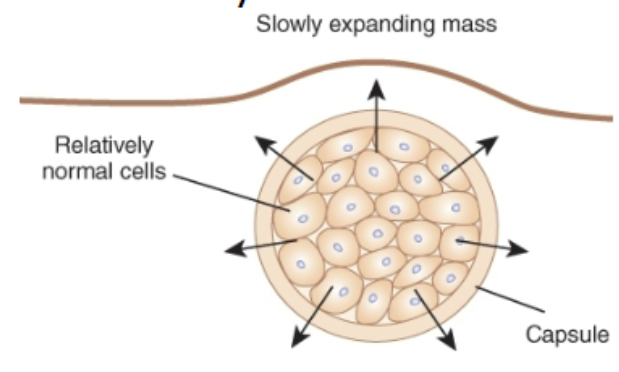
Describe a benign tumor
Cell appearance: Relatively normal cells
Replication: high replication rate but controlled
encapsulation: encapsulated
invasion: does NOT penetrate nearby tissues
Metastasis: low likelihood
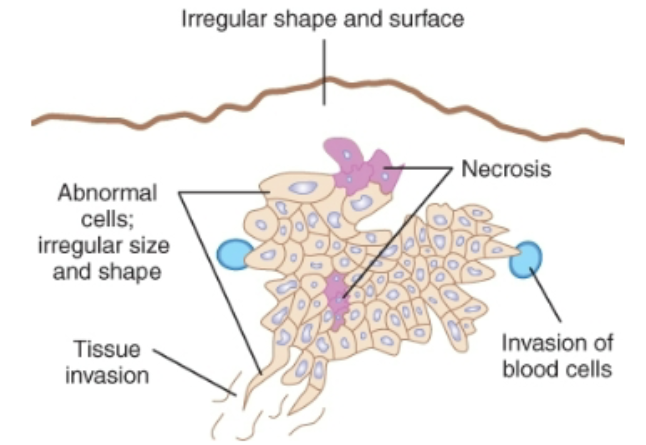
Describe a malignant tumor
Cell appearance: anaplastic (abnormal), non-functional cells
Replication: uncontrolled division
encapsulation: not encapsulated
invasion: penetrates nearby tissues
Metastasis: more likely to metastasize
What is the TNM cancer staging system?
T = Tumor (size and extent of primary tumor)
N = Node (lymph node involvement)
M = Metastasis (spread to distant organs)
Describe the cancer stages from 1 thru 4
Stage 1 - Non-invasive, minimal differentiation
Stage 2 - Invading local tissues
Stage 3 - Metastasized to local lymph nodes
Stage 4 - Invasive and metastasized to other organs
What are the signs/symptoms of cancer? (CAUTION)
C - Change in bowel or bladder habits
A - A sore that doesn't heal
U - Unusual bleeding or discharge
T - Thickening or lump in the breast or elsewhere
I - Indigestion or difficulty swallowing
O - Obvious change in a wart or mole
N - Nagging cough or hoarseness
What are the common treatments for cancer? and what are some of the goals?
Goals: Curative, Palliative, Preventative
Chemotherapy - Destroy replicating cells
Radiation - Target cancer cells and blood supply
Surgery - Remove cancer until clear margins
Targeted therapy - Specific molecular targets
Hormone therapy - Block hormones that fuel cancer
Immunotherapy - Boost immune system
Laser/Hyperthermia - Heat/light to destroy cells