psyc 337 - PTSD and OCD
 Call Kai
 Learn
Learn Practice Test
 Spaced Repetition
 Match
Match Flashcards
 Knowt Play
1/57

There's no tags or description
Looks like no tags are added yet.
Name | Mastery | Learn | Test | Matching | Spaced | Call with Kai | Chat |
|---|
No analytics yet
Send a link to your students to track their progress
58 Terms
what were ptsd and ocd formerly known as?
anxiety
HiTOP classification
internalizing -> distress, fear -> PTSD, OCD
OCD in 1691
1691 sermon on religious melancholy. Parishioners obsessed by "naughty, and sometimes Blasphemous Thoughts [which]
start in their Minds, while they are exercised in the Worship of God [despite] all their endeavors to stifle and suppress them ... the
more they struggle with them, the more they increase." - John Moore, Bishop of Norwich, England
OCD traditional classification
traditionally a DSM anxiety disorder. ICD-10 (1992) created the category of neurotic, stress-related, and somatoform disorders. ocd was its own category
ocd classification in DSM-5
no longer an anxiety disorder. the sequential order of the anxiety disorders and obsessive compulsive disorder chapters in the DSM-5 reflect the close relationship among them
OCD DSM-5 Criterion A
presence of obsessions, compulsions, or both
OCD DSM-5 Criterion B
obsessions or compulsions are time consuming (ie more than one hour per day) OR cause clinically significant distress or impairment in social, occupational, or other important areas of functioning
OCD DSM-5 Criterion C
symptoms are not attributable to the physiological effects of a substance or another medical condition
OCD DSM-5 Criterion D
the disturbance is not better explained by the symptoms of another mental disorder
for OCD specify if...
with good or fair insight, with poor insight, with absent insight. delusional beliefs. tic related - the individual has a current or past history of a tic disorder
obsessions
persistent ideas, thoughts, impulses, and images that are experienced as being intrusive and inappropriate, and cause marked anxiety or distress. ego dystonic (b/c intrusive and inappropriate). a sense of lack of control. not a natural part of the person's personality, but the person recognizes these are their thoughts. distinguished from schizophrenia or psychosis. no delusional system of thought insertion. not just worries about real life problems.
common obsessions
contamination, uncertainty, aggressive, symmetry/exactness, sexual, and somatic
people with OCD and their obsessions
people with OCD almost never act on their impulses. most patients have multiple obsessions. some developmental differences - children less likely to have sexual obsessions, more likely to have aggressive obsessions
compulsions
repetitive behaviors, sometimes thoughts. attempts to neutralize or suppress obsessions. designed to reduce anxiety from the obsession. not designed to bring pleasure or gratification. person must perform the behavior. sometimes simple actions, sometimes very bizarre and complex. frequently a form of undoing the thought or fear.
compulsive behavior example
some people engage in compulsive sexual behavior, eating, or gambling etc. these are not ocd compulsions, and are all designed for gratification
common compulsions
washing/cleaning, checking, repeating, mental
diagnosis for OCD
most people will have both obsessions and compulsion, don't need both for the diagnosis. very rare to have compulsions without obsessions. if seen, usually in children - counting, touching, ordering
how many people with OCD only have obsessions
1/4, but often these people will ritualize mentally
ocd lifetime prevalence
1.5% same in adults and children.
OCD gender ratio
slightly more common in girls/women than boys/men. in children, more common in boys
OCD age of onset
about 19, usually gradual onset
40 year follow up study of OCD natural course
first hospitalization OCD patients. at the end of 40 years, 20 percent had completely recovered. 28 percent had recovery with subclinical symptoms. 52 percent still experiencing clinically significant symptoms. of those who recovered, usually in the first 5 years of first hospitalization
cognitive models of OCD
obsessive thoughts very common. OCD = experience them as intrusive or upsetting. inflated sense of personal responsibility and self blame. if the thoughts come to pass, it's their fault. this makes them upset, increases rate of thoughts, get more upset. most ritualize to reduce anxiety. due to deficits in short term memory. people can't remember if they've checked. also very real and difficult to distinguish between real and imagined events (reality testing). can't remember if they checked, or if they thought about checking. often convinced thoughts are true
intolerance of uncertainty
Jonathan Grayson. the tendency to react negatively on an emotional, cognitive, and behavioral level to uncertain situations and events. individuals who are intolerant of uncertainty believe they lack sufficient coping or problem solving skills to effectively manage threatening situations. compulsions often attempts to increase certainty
thought/action fusion (TAF)
aka magical thinking. Moral TAF is unwanted thoughts about disturbing actions equivalent to the actions themselves. likelihood TAF is thinking about a disturbing event makes the event more probable
Neutralization
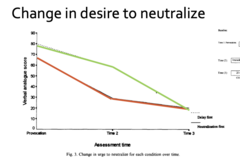
63 undergraduates with some degree of self-
reported TAF. "Keeping in mind a friend or relative who is close to you, I would like you to write out the following sentence on this piece of paper, inserting the name of the person in the blank." "I hope _____ is in a car accident." "Close your eyes and think about the situation
for a few seconds."
experimental procedure OCD study

change in anxiety OCD study

change in desire to neutralize OCD study
disgust
disgust proneness, genetic and learning influences. disgust proneness may also play a role in other disorders (spider phobics vs a cookie that a spider was on). OCD may reflect a false contamination alarm. very hard to counter-condition. can explain some of the challenges in treatment
when did PTSD first appear
1980 DSM III, roots go farther back
PTSD roots
DSM I and II stressors were seen as triggers of pre-existing diathesis. forms of dysfunction we now call PTSD were classified in other categories according to presenting symptomatology.
PTSD development
Vietnam war. high rates of disorder in soldiers, similar patterns in survivors of rape and natural disasters. departure from other DSM categories: trauma is the resumed common etiological fact. disorder is organized around it. other disorders are not organized around etiology. highly controversial
PSTD DSM-5 criteria
need exposure to a traumatic event. re-experiencing of the event in some way. avoidance (behavioral or cognitive). negative alterations of cognitions and mood. marked alterations in arousal and reactivity associate with the traumatic event. duration of the disturbance is more than 1 month
ptsd prevalence
dsm-III ptsd thought to be rare -3%. now 7-8%
ptsd gender ratio
2F:1M
trauma rates
60% men, 51% women report traumas that meet first criterion
following trauma, how many people develop PTSD
9%. women twice as likely than men, 13% vs 6%. kidnapped/tortured:54%, rape:49%
highest risk for developing PTSD
assault or violence
cross cultural PTSD studies
rates of PTSD much higher in developing non-western countries. many of these studies done following periods of turmoil and war, may be getting elevated rates. symptoms vary in different cultures
predictors of PTSD following trauma
gender - women are more likely to experience PTSD, familial psychopathology - not specific - predicts PTSD, preexisting psychopathology, internalizing symptoms in early childhood, childhood traumas/history of earlier traumas, lower IQ, nature of the trauma, social support (lack of) after trauma
nature of the ptsd trauma that impacts ptsd development
proximity, duration, level of life risk, intention, and psychological processes occurring during and after trauma. most variance in dissociation
controversy for PTSD diagnosis
what constitutes a trauma? is ptsd a normal response to an abnormal event? or an abnormal response to a normal, if stressful event? in DSM-III, event had to be outside the range of usual human experience, therefore extreme response is understandable. but, what events are outside range of normal experience? rape/murder/torture can be common.
controversies for PTSD
DSM-IV got rid of normal human experience concept, conceptual bracket creep. recent studies have looked at rates of PTSD following traumas, compared to rates of PTSD following stressful life events (not necessarily traumatic). rates of PSTD symptoms were higher after life stressors than for traumas - do you need a full blown trauma? is diathesis more important than stressor?
depression as trauma outcome
depression is as likely an outcome following a trauma as PSTD
vietnam twin studies - ptsd etiology
tested twins who were combat exposed and non combat exposed. some groups had ptsd, some not. smaller hippocampi were seen in the twins with ptsd. there is a genetic vulnerability to ptsd, smaller hippocampus changes the contextual processing of fear, predisposes you to acquire stronger emotional or hormonal responses. Pittman
ptsd and biological abnormalities
a number of biological abnormalities shown. hippocampus abnormalities, involved in explicit memory processes and encoding of context during fear conditioning. interacts critically with the amygdala during encoding of fear memories - reduced volumes, reduced neuronal integrity, reduced functional integrity
what are smaller hippocampal volumes associated with
verbal memory deficits, combat exposure severity, dissociative symptom severity, depression severity, ptsd symptom severity. evidence that hippocampal volume is heritable; smaller sizes can alter
neuroendocrine responses to stress
scars in ptsd
most of this research is cross sectional. if brain abnormalities observed in ptsd are caused by the trauma they represent a scar of the trauma. ample evidence from animal research that severe stress can damage the hippocampus. neurotic effects of cortisol; can cause atrophy and cell death of hippocampal neurons, hippocampus dense with receptors
do everyone who experience even severe acute stressors go on to develop PTSD?
no - majority do not
alternate explanations
abnormality may be an antecedent risk factor for exposure to a traumatic event that could then cause PTSD. Should then be observed in people drawn to situations associated with higher probability of trauma. Abnormality may be an antecedent vulnerability factor for developing PTSD upon exposure to a traumatic event. Should be observed prior to exposure to independent acute stressors. Abnormality may be the consequence of exposure to the traumatic event alone. Should be found in both PTSD and non-PTSD trauma survivors equally but not in unexposed persons. Abnormality may be a manifestation or product of the PTSD, that is, a PTSD sign. Should only be observed in individuals who develop PTSD, not other trauma-exposed. Abnormality may be the product of a sequel or complication of PTSD
prospective design ptsd
measure biological factor in individuals prior to traumatic event and then again afterward
twins discordant for trauma and PTSD
identify surrogates for that the trauma-exposed person would be like but for the experience of the traumatic event. non trauma exposed, identical twin. shares all the genes of exposed twin and much of the exposed twins early development environment. unique environment is non shared
Pittman study specifics
• Case-Control design
• 17 combat-exposed Vietnam veterans with PTSD (ExP+)
• 17 non-combat-exposed co-twins of ExP+ (UxP+)
• 23 combat-exposed Vietnam veterans with no PTSD (ExP-)
• 23 non-combat-exposed co-twins of ExP- (UxP-)
• All male; in their early 50s
• Examined hippocampal volumes in each of the four group
pitman study conclusions
Smaller hippocampal volumes in trauma-exposed individuals diagnosed with severe, unremitting PTSD (consistent with previous research). Non-combat-exposed co-twins show comparable hippocampal volumes. Suggest smaller hippocampi in PTSD represent a pre-existing, familial vulnerability, not the result of neurotoxic event(s). Combat-exposed vets showed higher rates of major depression, and more severe alcohol
histories. BUT combat unexposed twin brothers did not
effect of reduced hippocampal volume
Hippocampal morphology implicated in conditioning and extinction
of fear responses in animals, may be involved in the contextual
processing of fear
• Rodents with hippocampal lesions show stronger conditioned fear
• Smaller hippocampal volumes also associated with diminished
neuroendocrine regulation of the HPA axis
• Smaller inherited hippocampal volumes may therefore predispose
individuals to:
• acquire stronger and/or more persistent conditioned emotional responses
• OR stronger hormonal stress responses
• Or BOTH
• When exposed to a traumatic event
methodological issue
research on PTSD is often done on people with a vested financial interest in being diagnosed. questioning of credibility.
other controversies of ptsd
close relationship between ptsd and depression. comorbid. predict each other. similar characteristics (greater prevalence, over generalized autobiographical memories, smaller hippocampal volume, increased amygdala reactivity , risk of developing depression is just as high after a trauma as PSTD