2.6 Graphing Rational Functions New way Review but NEW WAY
 Studied by 0 people
 Call Kai
 Learn
Learn Practice Test
 Spaced Repetition
 Match
Match Flashcards
 Knowt Play
1/16

There's no tags or description
Looks like no tags are added yet.
Name | Mastery | Learn | Test | Matching | Spaced |
|---|
No study sessions yet.
17 Terms
Rational function form
f(x)= N(x)/D(x) where N(x) and D(x) are polynomials
Domain of rational functions
the domain of a rational function of includes all real numbers except x-values that make the denominator zero. Much of the discussion of rational functions will focus on their graphical behavior near the x values excluded from the domain.
Example 1
f(x)=1/x
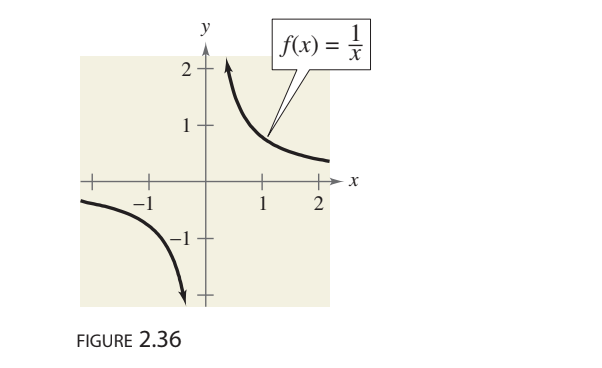
How to do example 1
Because the denominator is zero when x=0 the domain of is all real numbers except x=0 To determine the behavior of f near this excluded value, evaluate f(x) to the left and right of x=0
Limits at Infinity & Infinite Limits
NEW WAY TO DO IT EXPLAINED
“As x approaches ____, y approaches ____.”
a structured way to describe behavior near asymptotes or at infinity.
Notation for limit USED FOR VERTICAL ASYMPTOTES
x- = means this number is coming from below (left) so like 3- means 2.999
x+= means this number is coming from above (right) so like 3+ means 3.0001
Notation for limit USED FOR HORIZONTAL ASYMPTOTES
y- means the y-value is coming from below so like 5- means the value is approaching the horizontal asymptote from below
y+ means the y-value is coming from above so like 5+ means the value is approaching the horizontal asymptote from above
HARDEST PART OF THIS WAY HORIONTAL ASYMPTOTES FROM ABOVE OR BELOW📌 1. End Behavior — Using Limits as x→∞ x→−∞
End behavior tells you what the graph does far to the left or far to the right.
Example: f(x)=5x+1/x+2
now when x approaches infinity y approaches 5 because the 1 and 2 are negligative and it is 5x/x so 5
HARDEST PART APPROACHING HORIZONTAL ASYMPTOTE FROM BELOW OR ABOVE
To figure out if approaches the Horizontal asymptote from below or above the best strategy is to plug in a large number like 1,000 if positive infinity and -1,000 for negative infinity.
Example from this problem f(1000)=(5(1000)+1)/1000+2 = 5001/1002 = 4.99 so 4.99 is less than 5 so approaches from below
Example from this probles f(-1000)=(5(-1000)+1)/-1000+2. = -4999/-998 = 5.005 this is greater than 5 so approaches from below
📌 2. Vertical Asymptotes — Approaching a Number From Left or Right
Vertical asymptotes occur when the denominator equals zero:
Example with the same function:
f(x)=(5x+1)/(x+2)
Denominator zero when:
x+2=0⇒ x=−2
So: vertical asymptote at x=−2
Now we look at two approaches:
From the left: x→−2-
From the right: x→−2+
As x→−2-
(approaching -2 from BELOW — numbers like -2.1, -2.01, -2.001)
Plugging in values slightly below -2 makes the denominator very small negative, causing the fraction to blow up to positive infinity or negative infinity depending on the numerator and denominator signs.
The book wants you to state:
As x→−2- y→+∞
Example problem
(5x+1)/(x+2) as x approaches -2 from below I will plug in -2.001 and get (5(-2.001)+1)/(-2.001+2) = -9.005/-0.001 and that will be positive infinity
As x→−2+
(approaching from ABOVE — numbers like -1.9, -1.99, -1.999)
Now the denominator is very small positive, so the function shoots the other way:
As x→−2+, y→−∞
Examples problem (5x+1)/(x+2) as x approaches -2 from above I will plug in -1.999 and get (5(-1.999)+1)/(-1.999+2) = -8.995/0.001 and that will be negative infinity
📌 4. A Fully Worked Example (LOOKS EXACTLY LIKE THE BOOK)
Given:
f(x)=2x²/(x²-x-2)
Firsrt know
Vertical asymptotes at x=2 and x=-1
Domain is (-infinity, -1)U(-1,2)U(2,infinity)
Y-Intercept is (0,0)
X-intercept is (0,0)
Then do horizontal asymptote things and get
as x approaches -infinity y approaches 2 from below
as x approaches infinity y approaches 2 from above
Then you do the vertical asymptote things and get
as x approaches -1 from below y approaches infinity
as x approaches -1 from above y approaches negative infinity
as x approaches 2 from below y approaches negative infinity
as x approaches 2 from above y approaches infinity
📌 5. Why DO this Teaches It This Way
Because starting in Chapter 2.6:
You need to describe graph behavior precisely.
You need to explain asymptotes using a consistent format.
It prepares you for calculus, but without requiring calculus.
HOW TO KNOW IF HORIONTAL ASYMPTOTES COME FROM ABOVE OR BELOW
To know if a horizontal asymptote (HA) is approached from above or below, test large positive/negative x. values in the function determined by if doing negative infinity or positive infinity:
if f(x)>HA (positive difference), it's from above; if
if f(x)<HA (negative difference), it's from below
Or look at the additional parts and see.
How do find the x-intercept
set y=0 and then solve for x or it is just what makes the numerator 0
example (x²-5x+4)/(x²-4) = (x-4)(x-1)/(x+2)(x-2). so the x-intercepts are x=4 and x=1 because it makes the numerator 0
How to find the y-intercept
To find the y-intercept of any equation or function, substitute 0 for every x in the equation and solve for y. The y-intercept is the point where the graph crosses the vertical y-axis, and all points on the y-axis have an x-coordinate of 0.
You basically just look for anything that does not have an x attached to it
Examples (2x²-5x-3)/(x³-2x²-x+2). so just look at numbers so y-intercept is 0,-3/2
Examples (-x²+1)/(x). there would be none because it would be a vertical asymptote
How to find the domain
The domain is just everything that x can be. so all the vertical asymptotes and holes are not in the domain
How to find the range
The range is just everything y can be. so the horizontal asymptote and holes are not in the range
How to find a hole
To find holes, first factor the numerator and denominator of a rational function. Holes occur at x-values where a common factor in both the numerator and denominator equals zero. To find the hole's coordinates, set the canceled factor to zero to get the x-coordinate, then substitute this x-value into the simplified function to find the y-coordinate
Examples(2x²-5x+2)/(2x²-x-6) factor it and get(2x-1)(x-2)/(2x+3)(x-2)
so there is an (x-2) in the numerator and the denominator so cross it out and it is a hole at x=2 to find the y-coordinates of the hole you plug 2 into the function without the (x-2)’s so you plug it into (2x-1)/(2x+3) and get 3/7 so the hole is (2,3/7)
How to find vertical asymptote easy
whatever makes the denominator 0.
IT CAN NEVER BE CROSSES
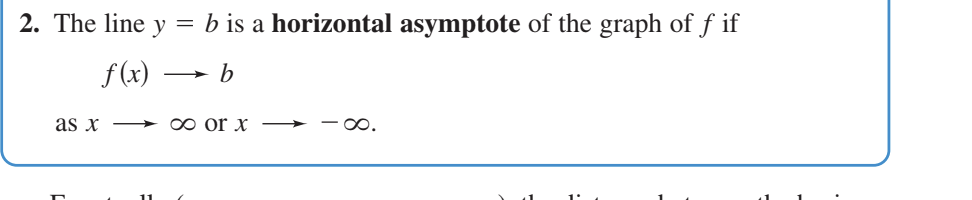
Horizontal asymptote rules and definition and formula to see if it crosses the H.A
for the rational function f(x)= P(x)/Q(x)
if the degree of p(x) is less than the degree of Q(x) then the horizontal asymptote is y=0
if the degree of p(x) is equal to the degree of Q(x) then the horizontal asymptote is what ever the coeficcents are. Examples 5x²/4x² then the horizontal asymptote is 5/4
if the degree of p(x) is greater than the degree of Q(x) then their is no horizontal asymptote but if it is one greater then a slant asymptote
.
How to know if the horizontal asuymptote gets crossed and where it gets crosses
Suppose the horizontal asymptote is y=L To find crossing points, set the function equal to the asymptote: f(x)=L
Example (5x+1)/(x+2) the horizontal asymptote is 5 so set 5 equal to the function and get 1=10 that is not an answer so it does not cross
If you see that your answer is at a hole, undefined or at a vertical asymptote then it does not cross. Only where the function is defined.
Slant asymptote rules and definition
for the functions f(x)=p(x)/q(x) A slant asymptote occurs if the degree of p(x) is one greater than the degree of q(x)
You find it by doing Polynomial long division and you ignore the remainder if you get one.
To find if it crosses the Slant asymptote you set the rational function equal to the slant asymptote you get
Example. f(x)= 3x³/(x²-x-2) you divide and get the slant asympote as 3x+3 and the remainder as 9x+6 and then set the remainder equal to 0 and then get 9x+6=0 to get x=-2/3 and it crosses there
Plotting points
If confused plot points
HW PROBLEMS
page number 193 35-45 odds 59,63
Review problems
Page 194. 38,40,42,54,56,60