Lecture 3, Chapter 53 - Species Interactions
 Call Kai
 Learn
Learn Practice Test
 Spaced Repetition
 Match
Match Flashcards
 Knowt Play
1/39

There's no tags or description
Looks like no tags are added yet.
Name | Mastery | Learn | Test | Matching | Spaced | Call with Kai | Chat |
|---|
No analytics yet
Send a link to your students to track their progress
40 Terms
True or False: Age structure suggests whether a population is growing or shrinking. But to quantify growth, we first account for additions and losses. Because populations differ in size, we express change per individual using r. If r remains constant, population size changes exponentially.
True
Population grows most rapidly when N = K/ __
when N = K/2 (pg 1190 in the book has a good visual of this)
True or False: Age structure can tell us if a population is static
True
True or False: blue whales have a lower density than a population of harbor seal
True
What is the major difference between how we define terrestrial biomes vs aquatic biomes?
Terrestrial biomes are characterized by temperature and precipitation while aquatic biomes are characterized by nutrients and light availability
Interspecific Interactions
occurs between two species that live in the same area (community) and affects each other in 3 ways:
+
-
0
Predator
prey adaptations, cycles, and impacts of non-native predators on native prey
Name 4 times of predation and define each one
parasitism - live closely within a single host organism, do not kill their host because they need it to survive
parasitoids - a single female lays eggs in or on a host, larvae develops inside the host and eats it while it is alive, killing the organism as they grow up
grazers (herbivores) - they only eat a portion of their prey without killing the entire organism (i.e. - cow eating grass)
predators - kill their prey immediately after attacking them and consume multiple prey throughout their life
Name 4 strategies that prey/predators have evolved to “get the upper hand” on
active + passive camouflage
behavioral modifications
structural defense
chemical defenses
Passive Crypsis
color/patterns are fixed (organisms cannot change what they look like), adapted to blend in with their environment to help catch prey/avoid predation
color
pattern
texture
Animal Examples: lions, frogs, leaf-tailed geckos
Active Crypsis
color/patterns of themselves can change to fit environment
Animal Examples: chameleon, seahorse, octopus (changing its own color to sand))
Name an example of Structural Defense
cactuses developing spines and producing “helmets” in their body that protect against predation
Name an example of Chemical Defense
foxgloves (a type of flower) produces a toxic chemical to protect itself from being eaten
True or False: when a predator is introduced to an area where it doesn’t belong, it can wipe out local prey
True: these prey don’t recognize danger and the prey have no defenses so it would be easier for them to get wiped out

Predator-Prey Cycling in Nature (What does the graph show?)
experiment/graph shows that hares were caused by lynx predation rather than max carrying capacity
as hare population increases, it creates food supply for lynxes and the lynx population would grow/eat so many hares that the hare population plummeted (cycle repeats)
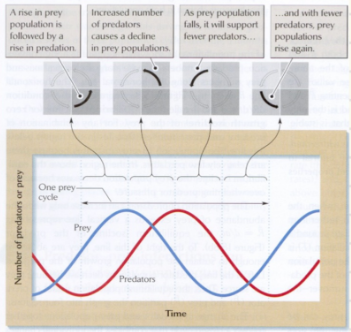
Why can’t predators hunt prey into extinction? (two reasons)
new prey move in → when predators eat prey in one specific area, new prey from other areas move in
safety zone/refugees → prey animals have hiding spots that predators cannot find
**Prey is always going to peak first and predators usually stagger behind them in graphs.
Parasite
an organism that feeds on the cell contents, tissues, and body fluids of the host while in/on the host organism
does NOT kill their host
Direct Transmission
can be transmitted directly from host to host (i.e. - human to human); can complete life cycle within one host
can transmission via: saliva, blood, surfaces (i.e. - Lice)
Intraspecific Competition
competition within a species (density based; mate to mate)
Interspecific Competition
competition between a species
Exploitative Competition
happens in interspecific competition; species compete over limiting renewable and non-renewable resources
no physical interaction between species required
Name one example of exploitative competition
mussels and barnacles (shells) compete for space on rocky intertidal
bald eagles and vultures compete to stand on the rocky land
Interference Competition
direct competition between organisms
territoriality - fighting off other species from using certain spaces
chemical warfare - killing/harming other species using chemicals
Give me an example of interference competition
lions marking their territory (male-male competition)
birds w/ their nests
female bears w/ their cubs
Competitive Exclusion Principle
two species cannot coexist indefinitely if they are both limited by the same resource (they always have to compete against each other for it)
Fundamental Niche
the range of abiotic conditions a species could survive + reproduce in (w/ no competitors)
Realized Niche
the actual range of conditions (abiotic AND biotic) a species exists in (w/ predation, competition, resource scarcity)
Name 5 Long Term Competitive Outcomes of Evolution
character displacement
resource partitioning
mutualism
facilitation
symbiosis
Character Displacement
a trait shift that reduces the strength of competitive interactions between two species
Resource Partitioning
splitting of resources between competitor species
Mutualism
occurs when two species benefit each other
Facilitation
am umbrella term for interactions that benefit one species and have either no effect (commensalism) or a positive effect (mutualism) on other species)
Symbiosis
relationships characterized by close physical contact, w/ integrated bodies + physiology (can be mutualistic, parasitic, pathogenic)
Examples: bees and flowers
Name 4 Times of Mutualisms
generalists
specialists
obligate mutualists
facultative mutualists
Generalists
one species interacts with many species (i.e. - bees)
Specialists
one species interacts with one other species or only a small number of closely related species
only benefiting that one relationship
Obligate Mutualists
species that provide benefits to each other (+,+) and needs this interaction to persist
Facultative Mutualists
species that provide benefits to each other but do NOT need this interaction to persis
Ant-Acacia Mutualism
acacia trees provide nectar & shelter for ants while ants provide defense against herbivores for the trees
conditions that could cause the Ant-Acacia mutualism to break down:
if there are no herbivores, ants are not needed
providing nectar is costly (ants cannot get supplied)
Microbiome
most organisms have microbes (bacteria, fungi, protists) in their gut to help them digest food; help us digest otherwise inaccessible compounds and produce metabolities