mole bio
 Call Kai
 Learn
Learn Practice Test
 Spaced Repetition
 Match
Match Flashcards
 Knowt Play
1/27

There's no tags or description
Looks like no tags are added yet.
Name | Mastery | Learn | Test | Matching | Spaced | Call with Kai | Chat |
|---|
No analytics yet
Send a link to your students to track their progress
28 Terms
Differentiate between genotype and phenotype
Genotype: the genes an organism possesses
Phenotype: observable attributes of an organism
Describe base substitution
a mutation that results in the same number of base pairs
What are two types of base substitution mutations that occur in a coding region?
Missense mutations: When a base substitution mutation causes a codon to code for an incorrect/different amino acid.
Nonsense mutations: When a base substitution mutation changes a codon into a stop codon, causing premature termination of translation.
Examples of stop codons (TAA, TAG, TGA)
Describe Insertions and Deletions
a mutation that results in the a change in the number of base pairs
What is a coding region?
a region that encodes an amino acid within a protein
What is a frameshift mutation
Mutation caused by the insertion or deletion of nucleotides that is not a multiple of three
(3n-1) or (3n-2) n = any integer
means that either 1 or 2 bases were affected, which shifts the reading frame
3n is NOT a frameshift bc it just means that the one codon is effect, which leaves the reading frame intact
What are open reading frames (ORFs)?
The section of an mRNA that lies between the start codon and the stop codon
start codon is on the 5’ on the mRNA
stop codon is on the 3’ on the mRNA
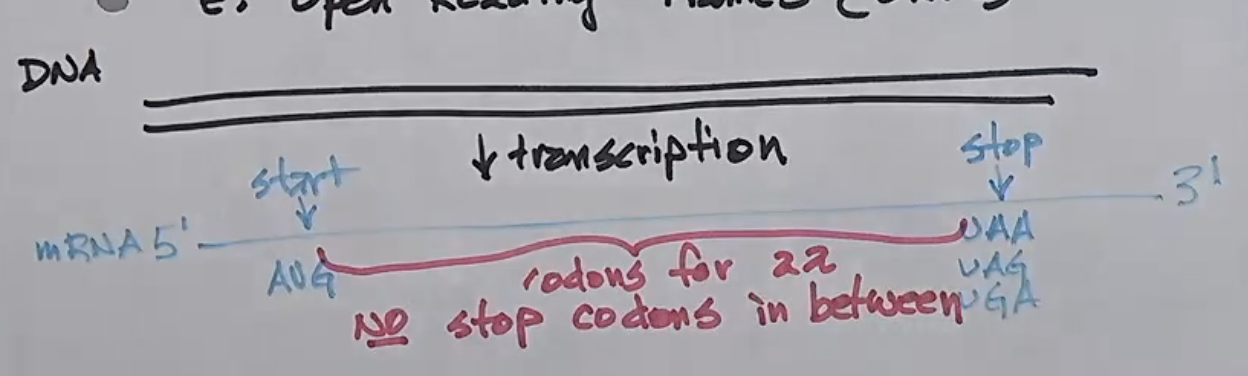
How many reading frames are there in mRNA vs dsDNA?
mRNA
mRNA is single-stranded and read in the 5' to 3' direction; we can start at the 1st, 2nd, or 3rd nucleotide.
1/3 = reading frames
2/3 = closed reading frames
2 out of the 2 nucleotides are "closed reading frames" because statistically, a stop codon shows up roughly every ~20 triplets by chance, closing off any long ORF in those frames. While we could start on any of the 3 nucleotides, only 1 of them results in a long reading frame
dsDNA
Double-stranded DNA has a complementary strand (3 frames), and reading the opposite strand in its own 5' to 3' direction yields another three possible frames.
1/6 = reading frames
5/6 = closed reading frames
*some DNA regions have no ORFs at all in any of the 6 frames (non-coding DNA).
Are ORF common?
A long open reading frame (no stop codons for hundreds of codons) is statistically unlikely to occur by chance — so when you find one, it's a strong clue that it's an actual functional gene, not random noise.
Innate vs Acquired immunity
Innate: restriction-modification systems in bacteria
Acquired: CRISPR-CAS system
*both of their goals are to destroy invading DNA
In eukaryotes, the target for immunity is invading proteins, while in bacterial immunity, the target is DNA
Which organisms have a CRISPR-Cas locus in their genome?
bacteria and archaea
What occurs to the CRISPR genes vs the Cas genes in CRISPR-Cas locus?
CRISPR genes are transcribed from DNA into a long RNA (pre-crRNA) → this is processed/cleaved into mature RNA units called crRNA.
Cas genes are transcribed and translated into proteins
Describe the crRNA structure and its 2 regions
Region 1 → created from repeats in the crRNA that bind to each other to form a stem-loop that is then recognized by Cas proteins and allows Cas to bind
Region 2 → single-stranded crRNA that is upstream/ downstream of the stem-loop. It binds to invading viral DNA, displaces one strand, and creates a double-stranded break to signal the destruction of the virus.
Describe the CRISPR-Cas DNA organization. draw out where the Cas gene is, CRISPR array, spacers, repeats, leader
The Cas genes sit next to the leader, then the repeats; the DNA between repeats = spacers.
The CRISPR array = the repeat/spacer region = one cluster

Describe the Cas gene clusters (role, types (which is the simpest)lest)
Encodes proteins that:
Cleave DNA in a DNA/RNA hybrid
Process the pre-crRNA (the initial long RNA transcript from the CRISPR array)
Do "Adaptation" = acquisition of new spacers
Typically 4–10 genes per cluster
6 types identified (Cas I, II, III, IV, V, VI)
Cas II is the simplest
Who is the leader? Where is it located within the pre-crRNA transcription?
Acts as the promoter. Upstream of the repeats and spacers, downstream of the Cas gene
What are repeats? How many base pairs are there? What is true about their sequence? What is their function within the crRNA?
20–50 bp
Have a consensus sequence
In the mature crRNA, repeats give rise to the stem-loop
The Cas protein recognizes this stem-loop and cleaves viral DNA (both strands)
What are spacers? How many base pairs are there? What is true about their sequence? What is their function within the crRNA?
20–80 bp
No consensus sequence — unique sequences complementary to viral DNA
Multiple spacers exist for multiple different viruses
What is true about spacers in organisms?
E. coli: 14 spacers in Cluster 1, 9 spacers in Cluster 2
One thermophile: 372 spacers across 4 clusters
The number of spacers differs between organisms/loci
What is true about viral DNA? what does it contain
Long double-stranded DNA contains a protospacer + a PAM sequence.
What are the roles of protospacer vs. PAM?
Protospacer = the viral sequence that gets acquired into the E. coli genome during adaptation
PAM (Protospacer Adjacent Motif):
A specific sequence for each organism (e.g., in E. coli: 5'-CTT / 3'-GAA, 3 bp)
Found in viral DNA, immediately next to the protospacer
Not acquired into the E. coli genome — only the protospacer is taken, never the PAM
What do Cas1 and Cas 2 do in terms of adding new spacers?
The protospacer from viral DNA is site-specifically recombined into the E. coli genome
so they remove the protospacer from the viral DNA, then add onto the e.coli sequence. this process is called adaptation. they leave PAM in the viral DNA
The new protospacer becomes a new spacer, added immediately next to the leader/first repeat (closest to the Cas genes).
→ The highest-numbered/newest spacer is always closest to the Cas genes.
what is true about e.coli’s immunity?
E. coli can't tell which virus is infecting — it just knows something is infecting — so it transcribes the entire CRISPR locus, covering every spacer, hoping one is complementary to the current viral DNA.
After adaptation by Cas 1 and Cas 2, what occurs next?
Transcription
Once the new spacer is added, the whole CRISPR array is transcribed into one long RNA = pre-crRNA
The pre-crRNA is chopped up (processed) by Cas6 in E. coli.
Each spacer ends up as its own individual stem-loop unit (mature crRNA), composed of the 2 regions described above (stem = Region 1, single-stranded spacer = Region 2).
What do Cas 3 do in targeting?
If there's a viral infection, one of the spacers' single-stranded RNA region binds/identifies the complementary viral DNA.
The stem-loop recruits Cas3 (in E. coli), which binds, nicks both strands of the viral DNA → double-stranded break → degraded by E. coli nuclease → stops viral infection.
What is the role of PAM in Self vs. Non-Self Discrimination
PAM is present in viral DNA but is not acquired into the E. coli genome.
Cas3 only cleaves DNA if a PAM sequence is present next to the target.
Because E. coli's own genomic (spacer) sequences lack a PAM, Cas3 does not cleave E. coli's own DNA — only the viral DNA (which retains its PAM).
Differentiate between Cas 1 vs Cas 2 vs Cas 3
Cas1/Cas2 → carry out adaptation (inserting new protospacers as spacers)
Cas3 → operates independently of Cas1/Cas2; cleaves viral DNA (only when PAM is present)
Why doesn't the virus kill E. coli during this process?
Acquiring the protospacer doesn't kill the bacterium because this only happens with viruses that manage to insert DNA into the E. coli genome without completing/succeeding at killing the cell — i.e., it's a non-lethal/abortive infection event that the CRISPR system captures.