Normandale Anatomy Lecture Exam 1 (ch 1,2,4)
 Call Kai
 Learn
Learn Practice Test
 Spaced Repetition
 Match
Match Flashcards
 Knowt Play
1/214

There's no tags or description
Looks like no tags are added yet.
Name | Mastery | Learn | Test | Matching | Spaced | Call with Kai | Chat |
|---|
No analytics yet
Send a link to your students to track their progress
215 Terms
anatomy
the study of the structure of the human body
morphology
the science of form
synonymous with anatomy
physiology
the study of body function
gross anatomy
study of structures that can be seen with the naked eye
regional anatomy (gross)
all structures in a single body region are examined as a group
systemic anatomy (gross)
all organs with related functions are studied together
microscopic anatomy (histology)
the study of structures that are so small they can be seen only with a microscope
developmental anatomy
the study of the changes in the body throughout life, and the effects of aging
pathological anatomy
the study of structural changes associated with disease
levels of organization in the body (small to large)
chemical, cellular, tissue, organ, organ system, organismal
levels of organization in the body (large to small)
organismal, organ system, organ, tissue, cellular, chemical
chemical level
atoms, molecules, macromolecules (carbs, lipids, proteins and nucleic acids)
cellular level
cells and their functional subunits (organelles)
-smallest living level
tissue level
groups of similar cells that have a common function
-epithelial, connective, muscle and nervous
role of epithelial tissue
cover and protect body surfaces and internal organs
Role of connective tissue
to support the body and protect organs
Role of muscle tissue
produce movement
role of nervous tissue
control and communication
organ level
one or more tissues functioning together
organ system level
organs that work together to accomplish a common purpose
integumentary system
Consists of the skin, mucous membranes, hair, and nail
skeletal system
Protects and supports body organs and provides a framework the muscles use to support movement. Made up of bones and joints- and forms blood cells
Muscular System
Allows manipulation of the environment, locomotion, and facial expression. Maintains posture, and produces heat.
nervous system
the body's fast acting control system - responding to internal and external changes
endocrine system
Glands secrete hormones that regulate processes such as growth, reproduction, and nutrient use (metabolism) by body cells.
cardiovascular system
Blood vessels transport blood, which carries oxygen, carbon dioxide, nutrients, wastes, etc. The heart pumps blood.
lymphatic system
Picks up fluid leaked from blood vessels and returns it to blood. Disposes of debris in the lymphatic stream. Houses white blood cells (lymphocytes) involved in immunity.
respiratory system
Keeps blood constantly supplied with oxygen and removes carbon dioxide. The gaseous exchanges occur through the walls of the air sacs of the lungs.
digestive system
Breaks down food into absorbable units that enter the blood for distribution to body cells.
urinary system
Eliminates nitrogenous wastes from the body. Regulates water, electrolyte and acid-base balance of the blood.
reproductive system
system of organs involved in producing offspring
organismal level
all organ systems combined to make the whole organism
anatomical position
erect, feet forward, arms at side with palms facing forward, head facing forward
axial region
Head, neck, and trunk
Forms the main vertical axis of the body
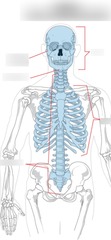
appendicular region
appendages (arms and legs)

The trunk consists of:
thorax, abdomen, pelvis
Superior
cranial
Toward the head
Inferior
caudal
Away from the head
Medial
toward the midline
Lateral
away from the midline
Proximal
Nearer to the trunk of the body
Distal
Farther from the trunk of the body
Ipsilateral
on the same side of the body
Contralateral
on the opposite side of the body
Anterior (ventral)
front of the body
Posterior (dorsal)
back of body
Superficial (external)
near the body surface
Deep (internal)
away from the body surface
Major body planes
-sagittal plane
-coronal plane
-transerse plane
saggital plane (median)
divides body into left and right
midsagittal plane
divides the body into equal right and left sides
parasagittal plane
Divides body into unequal right and left sides
frontal plane (coronal)
Divides the body into front and back portions.
transverse plane
horizontal division of the body into upper and lower portions
Human body characteristics
Tube-within-a-tube
Bilateral symmetry
Dorsal hollow nerve cord
Notochord and vertebrae
Segmentation
An
without
Ante
before
The two major body cavities are ________ and ________.
ventral and dorsal
cavities in the ventral cavity
thoracic (superior mediastinum, pleural cavities and pericardial cavity) and abdominal and pelvic cavities
cavities in dorsal cavity
cranial and vertebral
Serous Cavities
Pleaural, pericardial, peritoneal
Between the parietal and visceral layers
serous fluid
Bi
two
Chrom
color
Cyt
cell
Dys
bad
Endo
within
Exo
outside
Hyper
excessive
Inter
between
Lamina
layer
Lysis
breakdown
Contra
against
Dors
back
Epi
above
Infra
below
later
side
Morpho
shape
Para
beside, near
Pariet
wall
Peri
around
Post
Behind
Superior
above
trans
across
parietal membrane
membrane that lines the wall of a cavity
visceral membrane
membrane that covers organs directly
The opposite of superior is:
inferior
The opposite of inferior is:
superior
The opposite of anterior (ventral) is:
posterior (dorsal)
The opposite of posterior (dorsal) is:
Anterior (ventral)
The opposite of medial is:
lateral
The opposite of lateral is:
medial
The opposite of superficial is:
deep
The opposite of deep is:
superficial
Pinocytosis (cell drinking)
A type of endocytosis in which the cell ingests extracellular fluid and its dissolved solutes.
Phagocytosis (cell eating)
A type of endocytosis in which a cell engulfs large particles or whole cells
A cell can
1-obtain nutrients
2-use those nutrients to produce molecules needed for survival
3-dispose of wastes
4-maintain its shape and integrity
5-replicate itself
Organelle
"Little organs" that make up the cell working together for the survival and function of the cell.
cell three main parts
plasma membrane, cytoplasm, nucleus
plasma membrane
A selectively-permeable phospholipid bilayer forming the boundary of the cells