Introduction to Clinical Nutrition (Medical Nutrition Therapy)
0.0(0)
Studied by 8 people Call Kai
 Learn
Learn Practice Test
 Spaced Repetition
 Match
Match Flashcards
 Knowt Play
Card Sorting
1/57

Earn XP
Description and Tags
Last updated 1:52 PM on 2/15/23
Name | Mastery | Learn | Test | Matching | Spaced | Call with Kai | Chat |
|---|
No analytics yet
Send a link to your students to track their progress
58 Terms
1
New cards
Clinical Nutrition
\
\
Purpose
\
\
Purpose
To achieve or maintain good nutritional status
2
New cards
Patient Care
Team Approach (interdisciplinary)
3
New cards
Care Process
Patient-centered
4
New cards
Assessing Nutritional Status
Historical Information
Physical Examination
Anthropometric Data
Laboratory Analyses
Physical Examination
Anthropometric Data
Laboratory Analyses
5
New cards
Historical Information| Health History (Medical History)
risk factors for disease
food intake
conditions
emotional and mental health
food intake
conditions
emotional and mental health
6
New cards
Historical Information| Drug History
side effects of drugs to the patient
7
New cards
Historical Information| Socioeconomic History
purchasing power of the patient
8
New cards
Historical Information| Diet History
analyze amount of food taken
adequacy of intake
supplements that overlaps patient medication
adequacy of intake
supplements that overlaps patient medication
9
New cards
Tools for taking diet history
24 hour recall
usual intake
food frequency questionnaire/checklist
food records
observing food intake
usual intake
food frequency questionnaire/checklist
food records
observing food intake
10
New cards
Physical Examination
* weight status
* mobility
* sighns of nutrient deficienies/ malnutrition
* fluid balance
* mobility
* sighns of nutrient deficienies/ malnutrition
* fluid balance
11
New cards
Anthropometric Data
physical measurement of the body
indirect assessment of body composition and development
indirect assessment of body composition and development
12
New cards
anthropos; metric
human; measure
13
New cards
Ideal Body Weight
person’s body composition has a good balance of lean body mass and fat tissue
14
New cards
Body Mass Index (BMI)
Weight (kg)÷height (m^2)
* Underweight <18.5
* Normal 18.5-24.9
* Overweight 25.0-29.9
* Obese Class 1 30 to < 35
* Obese Class 2 35 to < 40
* Obese Class 3 40 or higher
* Underweight <18.5
* Normal 18.5-24.9
* Overweight 25.0-29.9
* Obese Class 1 30 to < 35
* Obese Class 2 35 to < 40
* Obese Class 3 40 or higher
15
New cards
Skin-fold Measurements
* not used to assess or monitor weight status
* half of total body fat is directly under the skin
* measure in multiple sites
* half of total body fat is directly under the skin
* measure in multiple sites
16
New cards
Skin-fold Measurement Sites
* Abdomen - next to the belly button (horizantal)
* Midaxilla - midline of the side of the torso (vertical)
* Pectoral - mid-chest, forward of the armpit (vertical)
* Quadriceps - middle of the upper thigh (vertical)
* Subscular - beneath the edge of the shouldder blade (vertical)
* Suprailiac - above the iliac crest of the hip bone (diagonal)
* Triceps - back of the upper arm (vertical)
* Midaxilla - midline of the side of the torso (vertical)
* Pectoral - mid-chest, forward of the armpit (vertical)
* Quadriceps - middle of the upper thigh (vertical)
* Subscular - beneath the edge of the shouldder blade (vertical)
* Suprailiac - above the iliac crest of the hip bone (diagonal)
* Triceps - back of the upper arm (vertical)
17
New cards
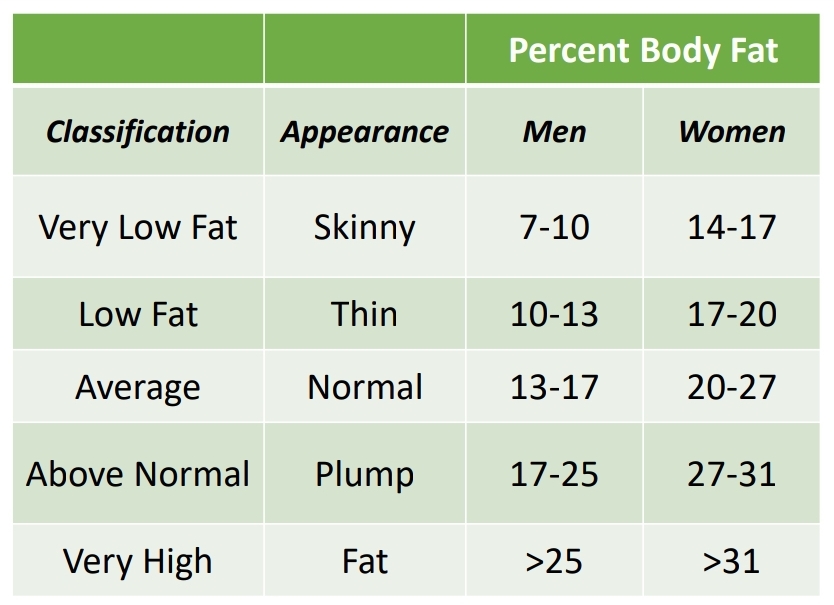
Percent Body Fat
* Very Low Fat (skinny) - Men (7-10); Women (14-17)
* Low Fat (Thin) - Men (10-13); Women (17-20)
* Average (normal) - Men (13-17); Women (20-27)
* Above Normal (Plump) - Men (17-25); Women (27-31)
* Very High (Fat) - Men (>25); Women (>31)
* Low Fat (Thin) - Men (10-13); Women (17-20)
* Average (normal) - Men (13-17); Women (20-27)
* Above Normal (Plump) - Men (17-25); Women (27-31)
* Very High (Fat) - Men (>25); Women (>31)
18
New cards
Waist to Hip Ratio
* Abdominal ratio
* Measure body fat distribution and adiposity
* Waist - measured at the narrowest point under the last rib (cm)
* Hip - measures at the widest point of the buttock (cm)
* Waist Circumference ÷ Hip Circumference
* >/= 1 in men = obese; >/= in women = obese
* Men >102 cm waist cicumference = obese
* Women >88 cm waist cicumference = obese
* Measure body fat distribution and adiposity
* Waist - measured at the narrowest point under the last rib (cm)
* Hip - measures at the widest point of the buttock (cm)
* Waist Circumference ÷ Hip Circumference
* >/= 1 in men = obese; >/= in women = obese
* Men >102 cm waist cicumference = obese
* Women >88 cm waist cicumference = obese
19
New cards
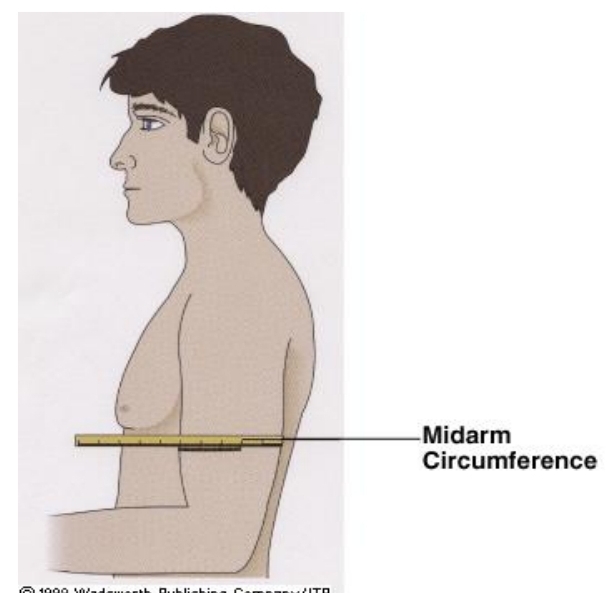
Mid Upper Arm Circumference (MUAC)
* evaluate fat stores
* measure the arm, muscle mass, subcutaneous fat and bone
* estimates wasting of an individual
* measure the arm, muscle mass, subcutaneous fat and bone
* estimates wasting of an individual
20
New cards
Mid Upper Arm Circumference (Children 1-5)
* Normal | >14
* Mild/moderate malnutrition | 12.5 - 14
* Severe malnutrition | <12.5
* Mild/moderate malnutrition | 12.5 - 14
* Severe malnutrition | <12.5
21
New cards
Mid Upper Arm Circumference (Adults)
* Normal | >/= 23 (male); >/= 22 (female)
* Malnourish | < 23 (male); < 22 (female)
* Malnourish | < 23 (male); < 22 (female)
22
New cards
Desirable Body Weight
* Infant: birth weight (gm) + age in mo. x 600
* 2 years and above (until 12): dbw (k) = age in years x 2 + 8
* Teens and adults: dbw (k) = height (cm) - 100 (if south asian or caucasian stop here)
* -10% (south east asian; + 3 tas -2)
* Amputees: dbw x % total weight of patient
* 2 years and above (until 12): dbw (k) = age in years x 2 + 8
* Teens and adults: dbw (k) = height (cm) - 100 (if south asian or caucasian stop here)
* -10% (south east asian; + 3 tas -2)
* Amputees: dbw x % total weight of patient
23
New cards
Nutritional Assessment | Biochemical Analysis
* Serum proteins
* Nitrogen balance
* Nitrogen balance
24
New cards
Serum Proteins
* Estimate visceral protein reserve
* overall poor reliability due to complex factors
* Overall markers include
* total serum protein, albumin, tansferrin and total lymphocyte count
* due to long half live refleccts chronic malnutrition
* More sensistive markers due to shorter half live
* pre-albumin, retinol binding prtein, ceruloplasmin
* reflects acute changes in nutritional status
* overall poor reliability due to complex factors
* Overall markers include
* total serum protein, albumin, tansferrin and total lymphocyte count
* due to long half live refleccts chronic malnutrition
* More sensistive markers due to shorter half live
* pre-albumin, retinol binding prtein, ceruloplasmin
* reflects acute changes in nutritional status
25
New cards
Nitrogen Balance
* Measure protein synthesis and breakdown
* protein intake is the sum of all nitrogen intake (enteral and peranteral)
* protein breakdown is measures by nitrogenexcretion in urine, feces, fistula etc.
* Calculations
* N intake = g protein / 6.25
* N output = (urine urea *urine volume/day(l)* 0.028) + losses (3-6g)
* Balance
* Positive = anabolism
* Negative = catabolism
* Mild 5-10 g
* moderate 10-15 g
* severe 15g
* protein intake is the sum of all nitrogen intake (enteral and peranteral)
* protein breakdown is measures by nitrogenexcretion in urine, feces, fistula etc.
* Calculations
* N intake = g protein / 6.25
* N output = (urine urea *urine volume/day(l)* 0.028) + losses (3-6g)
* Balance
* Positive = anabolism
* Negative = catabolism
* Mild 5-10 g
* moderate 10-15 g
* severe 15g
26
New cards
Metabolism
* sum energy expenditure of all bodily functions
* both voluntary and involuntary
* both voluntary and involuntary
27
New cards
Oxidation
part of the metabolic process in which your body processes food for fuel
28
New cards
Nutrition
science of how living organisms obtain and use food to support all the processes required for their existence
29
New cards
Nutrient
substance used by the body for growth, maintenance, and repair
30
New cards
Categories of Nutrients
* carbohydrates
* lipids
* proteins
* vitamins
* mineral
* water
* lipids
* proteins
* vitamins
* mineral
* water
31
New cards
Catabolism
* substances are broken down to simpler substances
* energy is released
* energy is released
32
New cards
Anabolism
larger molecules are built from smaller ones
33
New cards
Cellular Respiration
* oxygen using events take place within the cell to create atp from adp
* carbon leaves cells as carbon dioxide
* Hydrogen atoms are combined with oxygen to form water
* Energy produced by these reactions adds a phosphorus to ADP to produce ATP
* ATP can be broken down to release energy for cellular use
* carbon leaves cells as carbon dioxide
* Hydrogen atoms are combined with oxygen to form water
* Energy produced by these reactions adds a phosphorus to ADP to produce ATP
* ATP can be broken down to release energy for cellular use
34
New cards
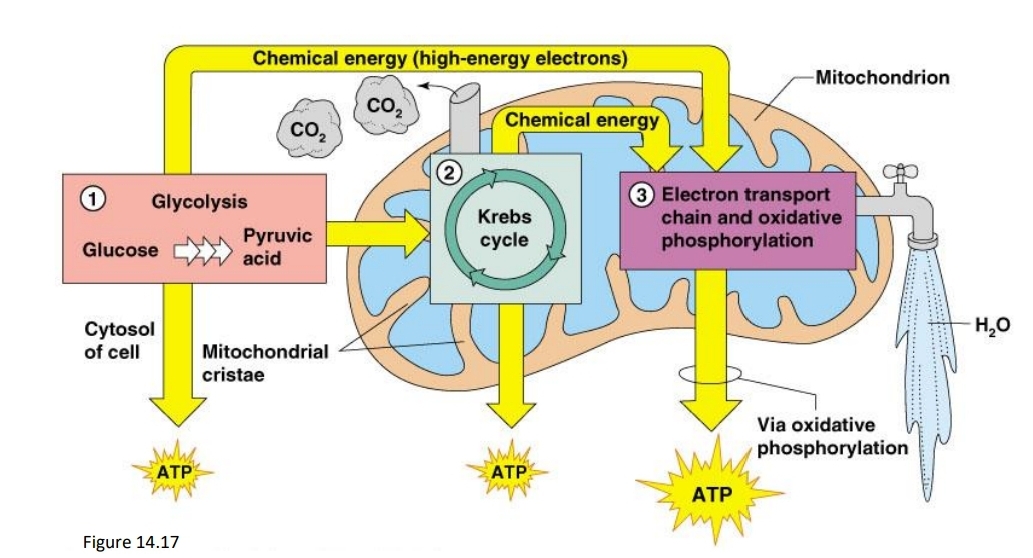
Metabolic Pathways
* Glycosis
* Krebs Cycle
* Electron Transport Chain
* Krebs Cycle
* Electron Transport Chain
35
New cards
Glycosis
energizes a glucose molecule so that it can be split into two pyruvic acid molecules and yield ATP
36
New cards
Krebs Cycle
* produces cirtually all the carbon dioxide and water resulting from cell respiration
* yields a small amount of ATP
* splits carbon, hydrogen, oxygen bond to create ATP again
* combines carbon and oxygen to produce carbon dioxide (by product of krebs cycle)
* yields a small amount of ATP
* splits carbon, hydrogen, oxygen bond to create ATP again
* combines carbon and oxygen to produce carbon dioxide (by product of krebs cycle)
37
New cards
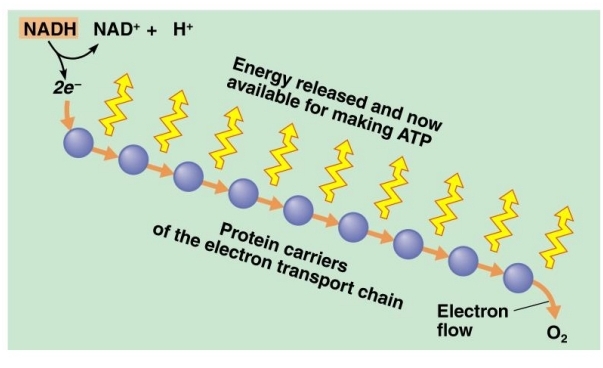
Electron Transport Chain
* hydrogen atoms removed during glycosis and the krebs cycle are delivered to protein carriers
* Hydrogen is split into hydrogen ions and electrons in the mitochondria
* Electrons give off energy in a series of steps to enable the production of ATP
* Hydrogen ions + oxygen = water (by product of ETC)
* Hydrogen is split into hydrogen ions and electrons in the mitochondria
* Electrons give off energy in a series of steps to enable the production of ATP
* Hydrogen ions + oxygen = water (by product of ETC)
38
New cards
Fat Metabolism
* handled mostly by the liver
* use fats to make ATP
* synthesize lipoproteins, thromboplastin, and choleterol
* release breakdown products to the blood
* body cells remove fat and cholesterol to buil membranes and steroid hormones
* use fats to make ATP
* synthesize lipoproteins, thromboplastin, and choleterol
* release breakdown products to the blood
* body cells remove fat and cholesterol to buil membranes and steroid hormones
39
New cards
Use of fats for ATP synthesis
* broken down acetic acid = ammonia = uric acid = produce carbon dioxide and ATP
40
New cards
Protein Metabolism
* used for most cellular structures
* use rarely for fuels; for starvation
* ingested broken down to amino acids
* Cells remove amino acids to build proteins
* Synthesized proteins are actively transported across cell membranes
* Amino acids are used to make ATP only when proteins are overabundant
* use rarely for fuels; for starvation
* ingested broken down to amino acids
* Cells remove amino acids to build proteins
* Synthesized proteins are actively transported across cell membranes
* Amino acids are used to make ATP only when proteins are overabundant
41
New cards
Production of ATP from protein
* Amine groups are removed from proteins as ammonia
* The rest of the protein molecule enters the Krebs cycle in mitochondria
* The liver converts harmful ammonia to urea which can be eliminated in urine
* The rest of the protein molecule enters the Krebs cycle in mitochondria
* The liver converts harmful ammonia to urea which can be eliminated in urine
42
New cards
Role of the liver in Metabolism
* Several roles in digestion
* Detoxifies drugs and alcohol
* Degrades hormones
* Produce cholesterol, blood proteins (albumin and clotting proteins)
* Plays a central role in metabolism
* Detoxifies drugs and alcohol
* Degrades hormones
* Produce cholesterol, blood proteins (albumin and clotting proteins)
* Plays a central role in metabolism
43
New cards
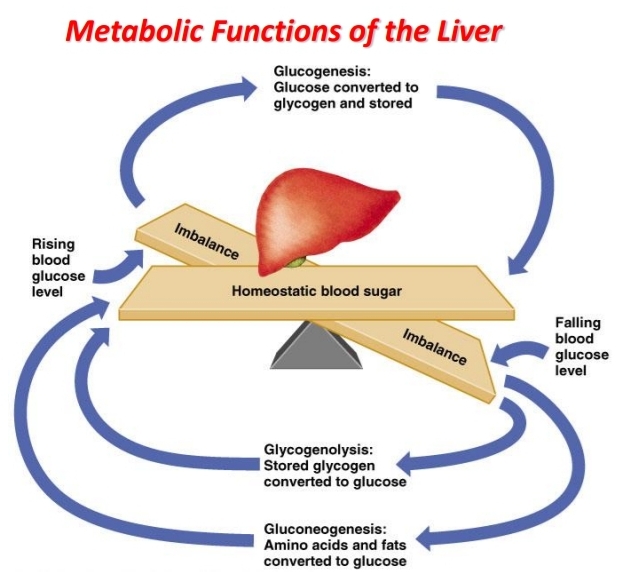
Metabolic functions of the liver
* glycogenesis
* glycogenolysis
* gluconeogenesis
* glycogenolysis
* gluconeogenesis
44
New cards
Glycogenesis
* glucose molecules are converted to glycogen
* glycogen molecules are stored in the liver
* glycogen molecules are stored in the liver
45
New cards
Glycogenolysis
Glucose is released from the liver after conversion grom glycogen
46
New cards
Gluconeogenesis
Glucose is produces from fats and proteins
47
New cards
Metabolic Functions of the Liver
* Fats and fatty acids are picked up by the liver
* Some are oxidized to provide energy for liver cells
* The rest are broken down into simpler compounds and released into the blood
* Some are oxidized to provide energy for liver cells
* The rest are broken down into simpler compounds and released into the blood
48
New cards
Cholesterol Metabolism
most cholestorol is produced in the liver and is not from diet
49
New cards
Cholesterol
\
\
Function
\
\
Function
* structural basis of steroid hormones and vitamin D
* major buliding block of plasma membrane
* major buliding block of plasma membrane
50
New cards
Cholesterol Transport
* cholesterol and fatty acids cannot freely circulate in the bloodstream
* they are transported by lipoproteins (lipid-protein complexes
* Low - density lipoproteins (LDLs)
* High - density lipoproteins (HDLs)
* they are transported by lipoproteins (lipid-protein complexes
* Low - density lipoproteins (LDLs)
* High - density lipoproteins (HDLs)
51
New cards
Low-density lipoproteins (LDLs)
* transport lipid towards body cells
* increase storage of fat in cells
* should be low
* increase storage of fat in cells
* should be low
52
New cards
High-density lipoproteins (HDLs)
* transport body cells to the liver
* fat from cell to be in liver to metabolize
* should be high
* fat from cell to be in liver to metabolize
* should be high
53
New cards
Body Energy Balance
* Energy intake = total energy output (heat + work + energy storage)
* most of our body fuel = create heat (60%)
* most of our body fuel = create heat (60%)
54
New cards
Regulation of Food Intake
* body weight is usually relatively stable
* Energy intake and output remain about equal
\
* Energy intake and output remain about equal
\
55
New cards
Mechanisms that may regulate food intake
* levels of nutrient in the blood - cravings = kulang vitamins
* hormones - pregnant = naglilihi
* body temperature - malamig = gutom
* psychological factors
* hormones - pregnant = naglilihi
* body temperature - malamig = gutom
* psychological factors
56
New cards
Basic Metabolic Rate
amount of heat produced by the body per unit of time at rest
57
New cards
Factors that influence BMR
* Surface area – small body usually has higher BMR
* Gender – males tend to have higher BMR
* Age – children and adolescents have a higher BMR
* The amount of thyroxine produced is the most important control factor
* More thyroxine means higher metabolic rate
* Gender – males tend to have higher BMR
* Age – children and adolescents have a higher BMR
* The amount of thyroxine produced is the most important control factor
* More thyroxine means higher metabolic rate
58
New cards
Total Metabolic Rate
* Total amount of kilocalories the body must consume to fuel ongoing activities
* increases with an increase in body activity
* must equal calories consumed to maintain homeostasis and maintain a constant weight
* increases with an increase in body activity
* must equal calories consumed to maintain homeostasis and maintain a constant weight