KNES 363 2
0.0(0)
Studied by 3 people Call Kai
 Learn
Learn Practice Test
 Spaced Repetition
 Match
Match Flashcards
 Knowt Play
Card Sorting
1/93

Earn XP
Last updated 3:30 AM on 12/10/22
Name | Mastery | Learn | Test | Matching | Spaced | Call with Kai | Chat |
|---|
No analytics yet
Send a link to your students to track their progress
94 Terms
1
New cards
What muscle structures are active & passive
Active - muscle
Passive - tendon, ligament, bone cartilage, etc.
Passive - tendon, ligament, bone cartilage, etc.
2
New cards
Functions of muscle
To produce force
To create movement
To provide joint stability
To act as a passive force transmitter
To create movement
To provide joint stability
To act as a passive force transmitter
3
New cards
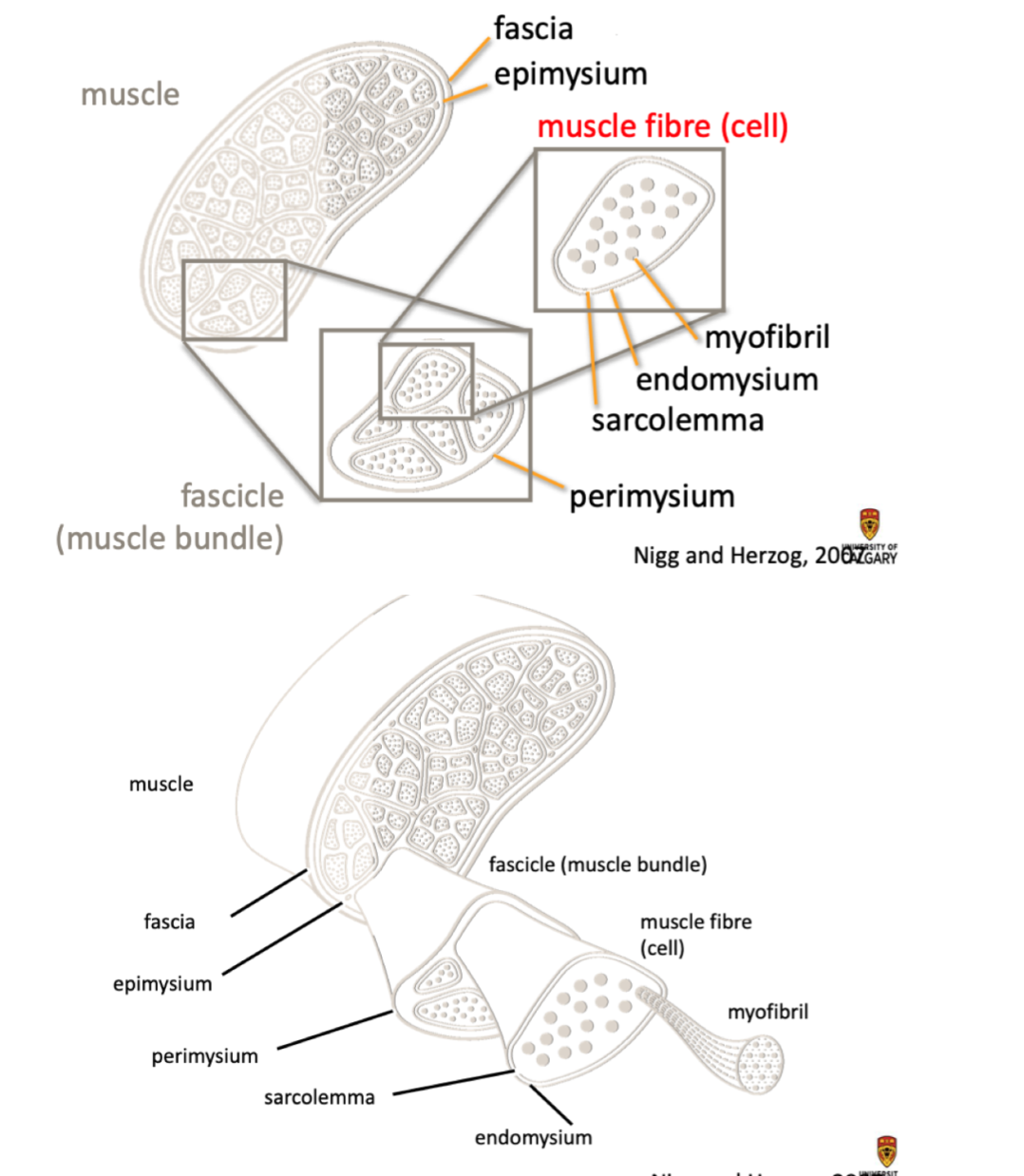
Define the parts of the muscle starting from the outside moving in
Muscle =
Fascia
Epimysium
Perimysium
Sarcolemma
Endomysium
Myofibril
Fascia
Epimysium
Perimysium
Sarcolemma
Endomysium
Myofibril
4
New cards
Muscle fasicles are surrounded by the
Perimysium
5
New cards
Myofibril, endomysium, & sarcolemma compose the
Muscle fibre (cell)
6
New cards
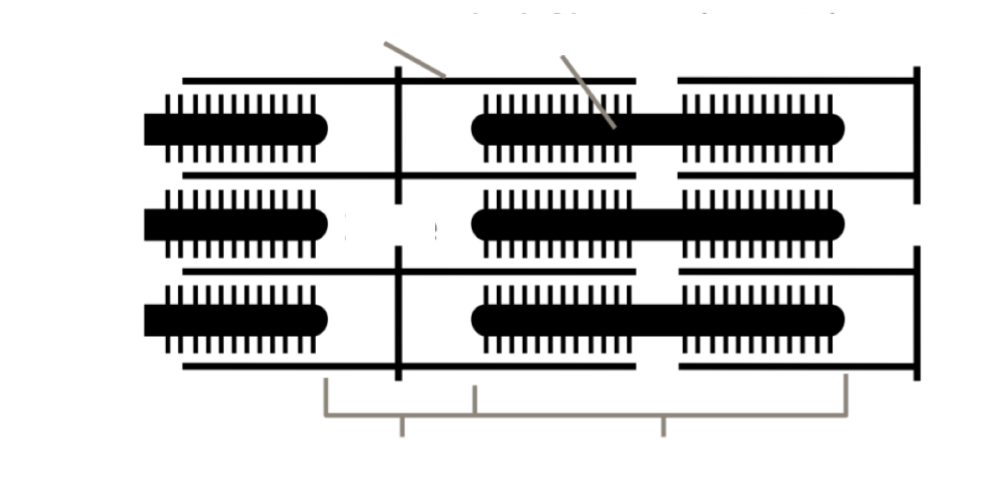
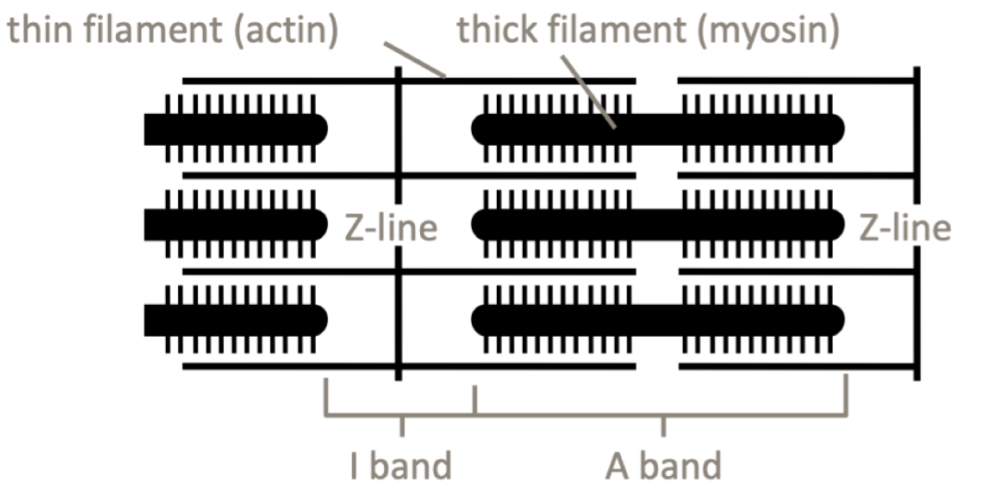
Name each section
7
New cards
Which band on the myofibril looks the same throughout?
Which does not?
Which does not?
I-band (isotropic band) - does look the same throughout
A-band (anistrotropic band) - does not look the same throughout
A-band (anistrotropic band) - does not look the same throughout
8
New cards
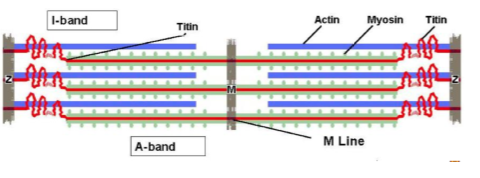
What is titin
Purpose?
Purpose?
Connects thick filament to Z line
Very large proteins
Very large proteins
9
New cards
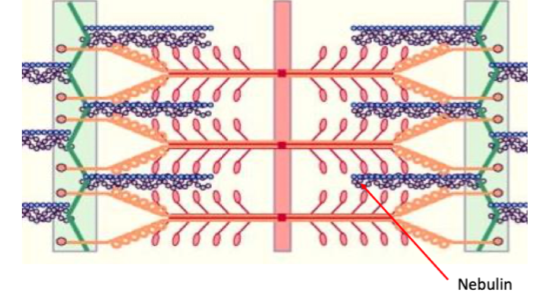
What is Nebulin
Purpose?
Purpose?
Actin-binding protein
Nebulin acts as a thin filament ruler that regulates the length during sarcomere assembly
Nebulin acts as a thin filament ruler that regulates the length during sarcomere assembly
10
New cards
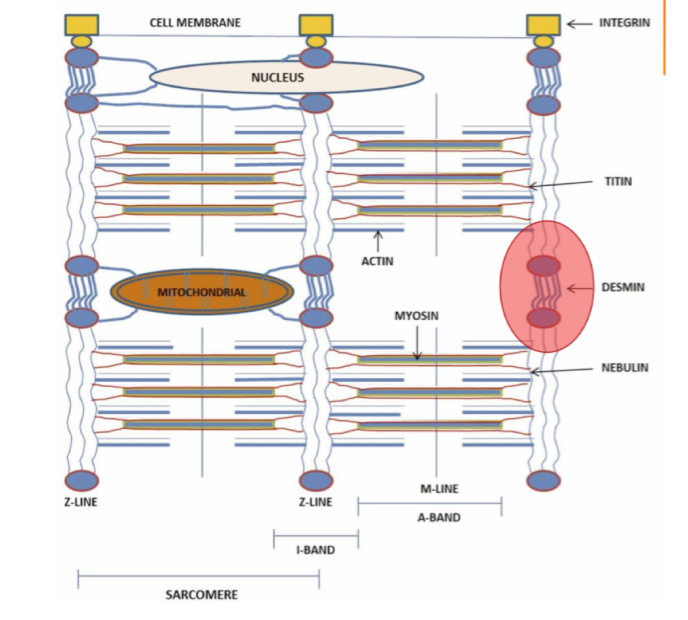
What is Desmin?
Purpose?
Purpose?
Intermediate filaments
Stabilizes the sarcomere
Stabilizes the sarcomere
11
New cards
What is a motor unit
A motor unit (MU) is a nerve cell (motor neuron) & all the muscle fibers innervated by this nerve cell
12
New cards
Afferent vs Efferent neurons
Afferent neurons - Arrive at the CNS
Efferent neurons - exit the CNS
Efferent neurons - exit the CNS
13
New cards
Define neuro-muscular junction / motor endplate
A neuro-muscular junction or motor endplate is the junction b/w the motor neuron & muscle fibre
14
New cards
What is the neuromuscular junction
It is separated by?
It is separated by?
Site where motor neuron meets the muscle fiber
Separated by a gap called neuromuscular cleft
Separated by a gap called neuromuscular cleft
15
New cards
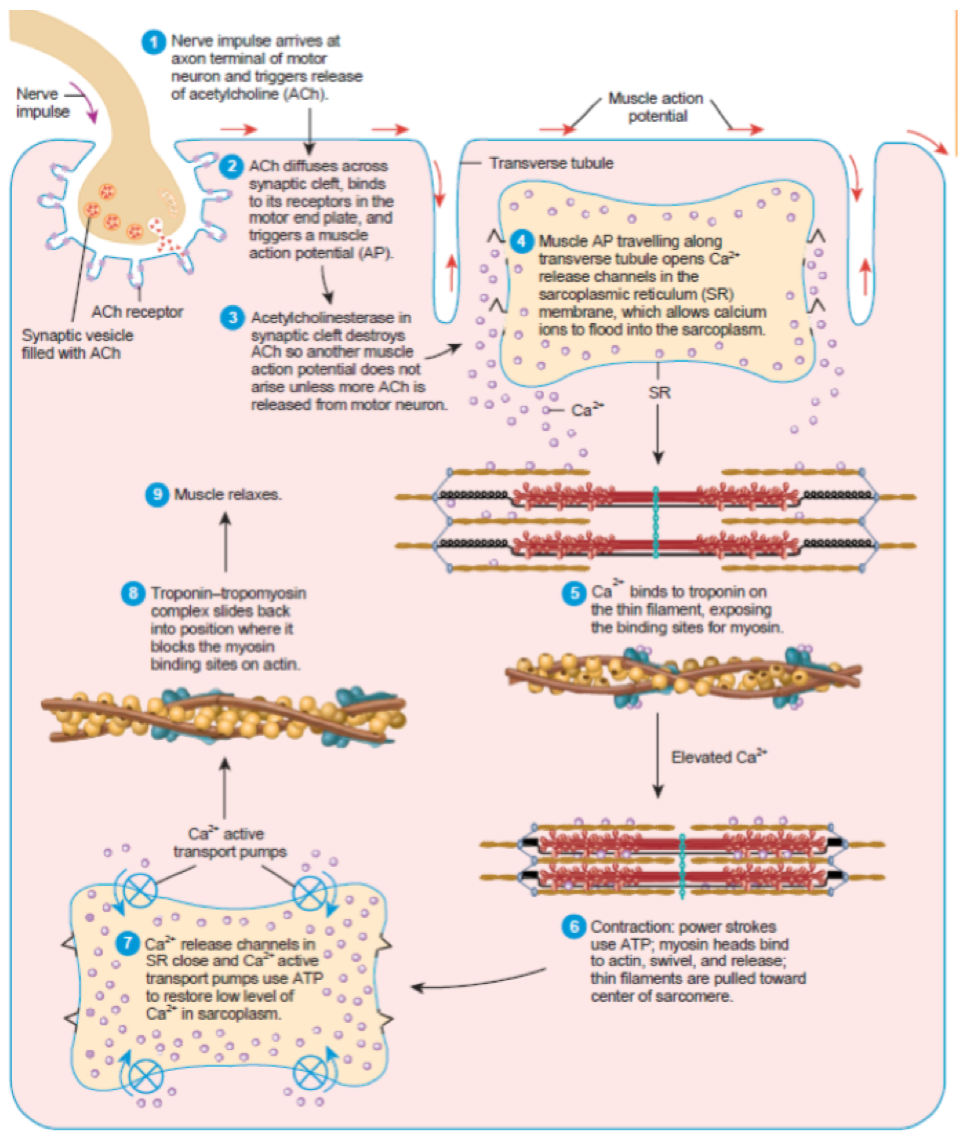
What are the 16 steps of a Muscular Contraction
1. An action potential (an electric signal) moves down the motor neuron (nerve)
○ via efferent neurons
2. Reaches the pre-synaptic terminal
3. A series of chemical reactions take place which culminate in the release of acetylcholine (ACh) from synaptic vesicles located in the pre-synaptic terminal
4. ACh diffuses across synaptic cleft
5. ACh binds to receptor molecules in membrane of post-synaptic terminal
6. Causes an increase in permeability of the membrane to sodium (Na+) ions
7. Due to diffusion of the sodium ions the membrane is depolarized
8. If that depolarization reaches a critical threshold an action potential will travel along the stimulated muscle fiber
9. A special chemical process (acetylcholine → acetic acid + choline) prevents continuous stimulation
10. The action potential travels along the fiber, depolarizing the membrane
Once threshold is reached, it travels alongside the muscle
11. The depolarization reaches the interior of the muscle fibres at invaginations of the cell membrane called T-tubules
12. This causes the release of calcium (Ca2+) ions from sarco-plasmic reticulum into the sarcoplasm surrounding the myofibrils
13. Calcium ions bind to special binding sites on the troponin molecules of the thin myofilament, removing an inhibitory mechanism preventing cross-bridge formation
○ Inhibitory mechanisms prevents crossbridge
○ If there's no calcium, thick filament can't attach to thin filament
14. Cross-bridges attach to the active sites of the thin filaments
15. A breakdown of ATP → ADP + a phosphate ion provides energy to move the cross-bridge heads pulling thin filaments past the thick filaments
An ATP molecule attaches to the myosin portion of the cross-bridge so that the cross-bridge can release from its attachment site, return to its original position, ready for a new cycle
○ via efferent neurons
2. Reaches the pre-synaptic terminal
3. A series of chemical reactions take place which culminate in the release of acetylcholine (ACh) from synaptic vesicles located in the pre-synaptic terminal
4. ACh diffuses across synaptic cleft
5. ACh binds to receptor molecules in membrane of post-synaptic terminal
6. Causes an increase in permeability of the membrane to sodium (Na+) ions
7. Due to diffusion of the sodium ions the membrane is depolarized
8. If that depolarization reaches a critical threshold an action potential will travel along the stimulated muscle fiber
9. A special chemical process (acetylcholine → acetic acid + choline) prevents continuous stimulation
10. The action potential travels along the fiber, depolarizing the membrane
Once threshold is reached, it travels alongside the muscle
11. The depolarization reaches the interior of the muscle fibres at invaginations of the cell membrane called T-tubules
12. This causes the release of calcium (Ca2+) ions from sarco-plasmic reticulum into the sarcoplasm surrounding the myofibrils
13. Calcium ions bind to special binding sites on the troponin molecules of the thin myofilament, removing an inhibitory mechanism preventing cross-bridge formation
○ Inhibitory mechanisms prevents crossbridge
○ If there's no calcium, thick filament can't attach to thin filament
14. Cross-bridges attach to the active sites of the thin filaments
15. A breakdown of ATP → ADP + a phosphate ion provides energy to move the cross-bridge heads pulling thin filaments past the thick filaments
An ATP molecule attaches to the myosin portion of the cross-bridge so that the cross-bridge can release from its attachment site, return to its original position, ready for a new cycle
16
New cards
A motor unit w/ a large number of muscle fibers
A motor unit w/ a small number of muscle fibers
A motor unit w/ a small number of muscle fibers
A motor unit w/ a large number of muscle fibers:
- Large increase in force for a given level of activation - Good for explosive or dynamics movements
A motor unit w/ a small number of muscle fibers:
- Small increase in force for a given level of activation
- Good for control of small or fine movements
- Large increase in force for a given level of activation - Good for explosive or dynamics movements
A motor unit w/ a small number of muscle fibers:
- Small increase in force for a given level of activation
- Good for control of small or fine movements
17
New cards
Muscle w/ large number of MUs
Muscle w/ a small number of MUs
Muscle w/ a small number of MUs
Muscle w/ large number of MUs:
- High resolution of control
- Finer control & adjustments
Muscle w/ a small number of MUs
- Sharper increase in force
- Less activation to get relatively more force production
- High resolution of control
- Finer control & adjustments
Muscle w/ a small number of MUs
- Sharper increase in force
- Less activation to get relatively more force production
18
New cards
Define Type I muscle fibers:
Speed
Fatigable?
Metabolism
Fiber size
Colour
Recruitment
Speed
Fatigable?
Metabolism
Fiber size
Colour
Recruitment
Slow twitch
No
Oxidative
Small
Dark Red
Recruited first
No
Oxidative
Small
Dark Red
Recruited first
19
New cards
Define type IIa muscle fibres
Speed
Fatigable?
Metabolism
Fiber size
Colour
Recruitment
Speed
Fatigable?
Metabolism
Fiber size
Colour
Recruitment
Fast twitch
Resistant
Oxidative-glycolytic
Medium
Red
Second
Resistant
Oxidative-glycolytic
Medium
Red
Second
20
New cards
Define type IIb muscle fibres
Speed
Fatigable?
Metabolism
Fiber size
Colour
Recruitment
Speed
Fatigable?
Metabolism
Fiber size
Colour
Recruitment
Fast twitch
Fatigable
Glycolytic
Large
White
Last
Fatigable
Glycolytic
Large
White
Last
21
New cards
What systems exist to help regulate our muscle contractions?
How do we know how much of our muscles have contracted or how far our muscles have been stretched?
How do we know how much of our muscles have contracted or how far our muscles have been stretched?
Muscle spindles & golgi tendon organs
Afferent signals from sensory receptors, specifically movement related sensory receptors known as proprioceptors
Afferent signals from sensory receptors, specifically movement related sensory receptors known as proprioceptors
22
New cards
What is muscle architecture?
The arrangement of muscle fibers relative to the axis of force production
23
New cards
Define longitudinal/fusiform muscle
Give an example
Give an example
Fibers extend parallel to the muscle force generating axis: parallel, longitudinal or fusiform muscle
Biceps, sartorius, psoas major
Biceps, sartorius, psoas major
24
New cards
Define unipennate muscle
Give an example
Give an example
Fibers oriented at a single angle relative to the force generating axis
- Muscle fibers that are at an angle (all muscle fibers in one direction)
- Extensor digitorum (in forearm)
- Vastus Lateralis, Flexor Pollicis Longus, Palmar Interosseous
- Muscle fibers that are at an angle (all muscle fibers in one direction)
- Extensor digitorum (in forearm)
- Vastus Lateralis, Flexor Pollicis Longus, Palmar Interosseous
25
New cards
Define multi-pennate muscle
Give an example
Give an example
Fibers oriented at several angles relative to the force generating axis: multipennate muscle
Gluteus Medius, Deltoid, Trapezius
Gluteus Medius, Deltoid, Trapezius
26
New cards
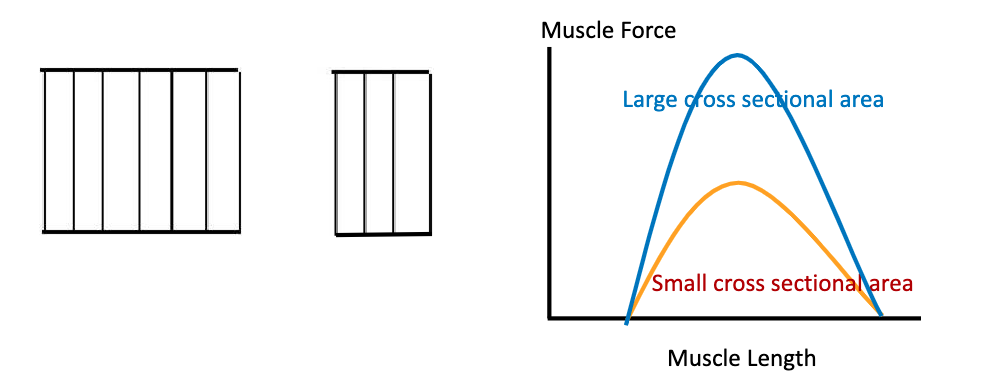
What is physiological cross-sectional area
Sum of the cross-sectional areas of all of the fibres w/in a muscle
27
New cards
# of parallel fibers determines maximum force → ________ → ________
# of parallel fibers determines maximum force → larger CSA → larger force production capability
28
New cards
What is pennation angle?
Angle b/w muscle fibers & line of action
Activation of more fibers w/ smaller geometric cross-section tradeoff: loss of force per fiber in line w/ tendon also amount of length change?
Activation of more fibers w/ smaller geometric cross-section tradeoff: loss of force per fiber in line w/ tendon also amount of length change?
29
New cards
Active force length relationship is established for ___________ __________
Active force length relationship is established for isometric contractions
30
New cards
Isometric
Isokinetic
Isotonic
Isokinetic
Isotonic
Isometric - constant length
Isokinetic - constant rate of movement / velocity
Isotonic - same load/weight
Isokinetic - constant rate of movement / velocity
Isotonic - same load/weight
31
New cards
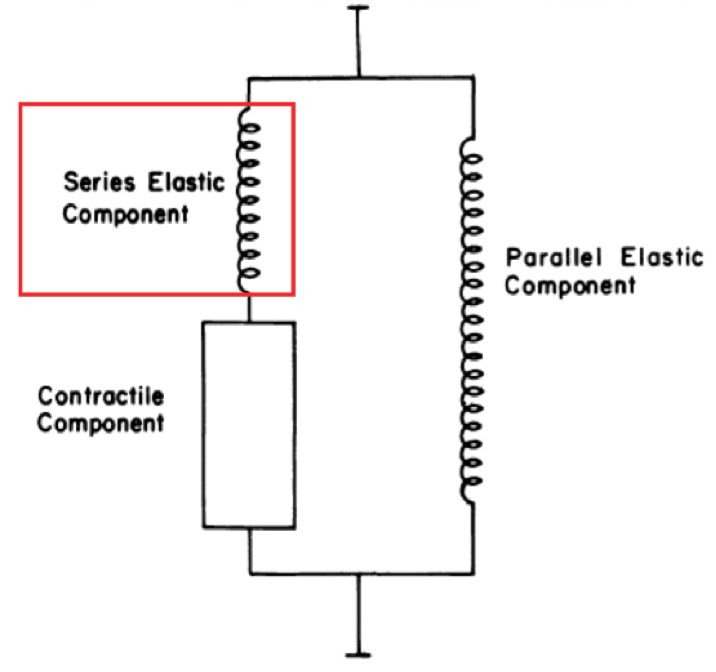
What are the 3 main components of a muscle?
Contractile component
Series Elastic component
Parallel Elastic Component
Series Elastic component
Parallel Elastic Component
32
New cards
What are Series Elastic Component
Structures in line w/ the contractile elements of the sarcomere
Structures like titin provide force when stretched as it acts like a spring in series w/ the CE
Tendon
Structures like titin provide force when stretched as it acts like a spring in series w/ the CE
Tendon
33
New cards
What are Parallel Elastic Component
The structures aligned alongside or parallel to the CE & SE that also provide passive tension when stretched
Fascia, epimysium, perimysium & endomysium
Fascia, epimysium, perimysium & endomysium
34
New cards
Alongside active force generation, muscles also have the capabilities to generate tension through:
passive means
35
New cards
What is the Hill Type Muscle Model
Describes the mechanism of force production.
It is composed by different elements that describe the behaviour of the muscle (contractile, series elastic and parallel elastic element) and tendon.
It is composed by different elements that describe the behaviour of the muscle (contractile, series elastic and parallel elastic element) and tendon.
36
New cards
Passive F-L: Hysteresis
Loss of energy
Damped system
Damped system
37
New cards
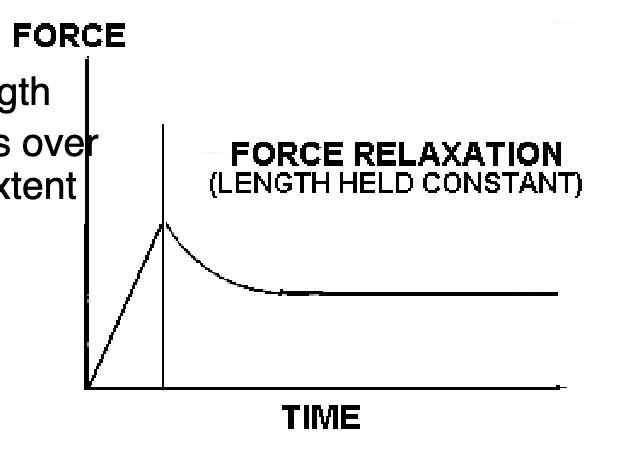
Passive F-L: Stress Relaxation
Tissue held at constant length
Force (or stress) decreases over time but only to a certain extent
Force (or stress) decreases over time but only to a certain extent
38
New cards
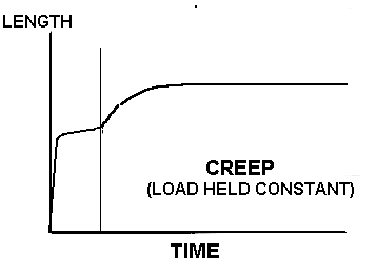
Passive F-L: Creep
Tissue held at constant stress
Tissue lengthens over time only to a certain extent
Tissue lengthens over time only to a certain extent
39
New cards
What structures are responsible for passive force?
Connective tissue:
- Fascia
- Endomysium
- Perimysium
Intra-fiber structures
- titin
- desmin
- Fascia
- Endomysium
- Perimysium
Intra-fiber structures
- titin
- desmin
40
New cards
Intermediate filaments: _______ filaments
- Form __________ connections b/w the peripheries of successive __ ______
- Form a three-dimensional ________ around the _ _____
- Connect the entire contractile apparatus to the ________ & its _______
- Form __________ connections b/w the peripheries of successive __ ______
- Form a three-dimensional ________ around the _ _____
- Connect the entire contractile apparatus to the ________ & its _______
Intermediate filaments: desmin filaments
- Form longitudinal connections b/w the peripheries of successive Z lines
- Form a three-dimensional scaffold around the Z lines
- Connect the entire contractile apparatus to the sarcolemma & its proteins
- Form longitudinal connections b/w the peripheries of successive Z lines
- Form a three-dimensional scaffold around the Z lines
- Connect the entire contractile apparatus to the sarcolemma & its proteins
41
New cards
The active force-length relationship describes muscle
behaviour at
behaviour at
The active force-length relationship describes muscle
behaviour at constant length (isometric contraction)
behaviour at constant length (isometric contraction)
42
New cards
Muscle force decreases as movement speed _______
Muscle force decreases as movement speed increases
43
New cards
Muscle Shortening:
- _______ relationship
-Fmax is obtained at "_____" shortening velocity (______ ________)
- As the velocity of shortening increases, force ______
- The force generated at a shortening velocity is always ______ than the muscle's ______ ______
- The maximal shortening velocity corresponds to "_____" muscle _____
- _______ relationship
-Fmax is obtained at "_____" shortening velocity (______ ________)
- As the velocity of shortening increases, force ______
- The force generated at a shortening velocity is always ______ than the muscle's ______ ______
- The maximal shortening velocity corresponds to "_____" muscle _____
Muscle shortening:
- Hyperbolic relationship
-Fmax is obtained at "zero" shortening velocity (isometric conditions)
- As the velocity of shortening increases, force decreases
- The force generated at a shortening velocity is always lower than the muscle's maximal force
- The maximal shortening velocity corresponds to "zero" muscle force
- Hyperbolic relationship
-Fmax is obtained at "zero" shortening velocity (isometric conditions)
- As the velocity of shortening increases, force decreases
- The force generated at a shortening velocity is always lower than the muscle's maximal force
- The maximal shortening velocity corresponds to "zero" muscle force
44
New cards
Muscle force drops _____ as the velocity _____ intially
Muscle force drops rapidly as the velocity increases initially
45
New cards
In hill's equation, what does a and b represent
a = force constant
b = speed constant
b = speed constant
46
New cards
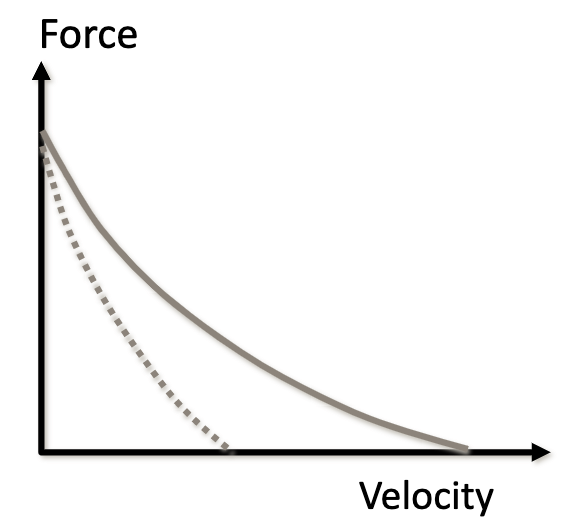
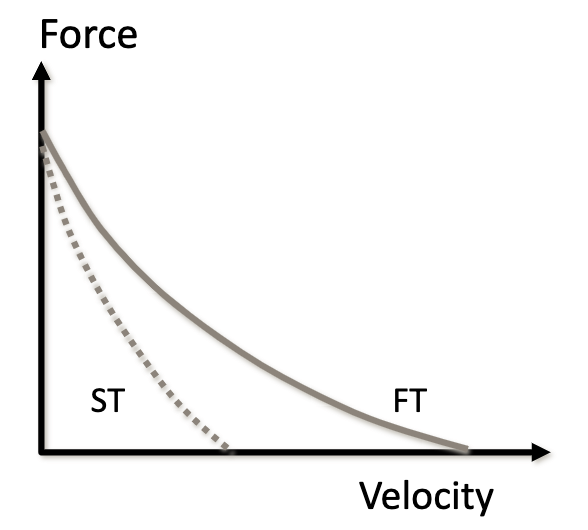
Which is fast twitch and which is slow
47
New cards
Lengthening: eccentric contractions
Muscle is forced to lengthen during _________
Muscle can achieve high forces relative to its...
Force becomes ________ of the ______
Muscle is forced to lengthen during _________
Muscle can achieve high forces relative to its...
Force becomes ________ of the ______
Lengthening: eccentric contractions
Muscle is forced to lengthen during contraction
Muscle can achieve high forces relative to its maximal isometric force
Force becomes independent of the velocity
Muscle is forced to lengthen during contraction
Muscle can achieve high forces relative to its maximal isometric force
Force becomes independent of the velocity
48
New cards
Lengthening:
Much of a muscle's normal activity occurs while it is actively lengthening; thus, eccentric contractions are ________ common
Muscle __________ thought to be associated more w/ eccentric contractions
Muscle _________ greater using eccentric training exercises
Much of a muscle's normal activity occurs while it is actively lengthening; thus, eccentric contractions are ________ common
Muscle __________ thought to be associated more w/ eccentric contractions
Muscle _________ greater using eccentric training exercises
Much of a muscle's normal activity occurs while it is actively lengthening; thus, eccentric contractions are physiologically common
Muscle injury/soreness thought to be associated more w/ eccentric contractions
Muscle strengthening greater using eccentric training
Muscle injury/soreness thought to be associated more w/ eccentric contractions
Muscle strengthening greater using eccentric training
49
New cards
The active force produced by a muscle depends on:
the number of attached cross bridges
the force produced per attached cross bridge
the force produced per attached cross bridge
50
New cards
when the velocity of shortening increases, the active force _______ because:
when the velocity of shortening increases, the active force decreases because:
- number of attached cross bridges decreases
- the force produced epr attached cross bridge decreases
- number of attached cross bridges decreases
- the force produced epr attached cross bridge decreases
51
New cards
Why/how does active force decrease as velocity of shortening increases?
As the shortening velocity increases, the speed at which the thin filament slides past the thick filament increases, & so fewer & fewer cross bridges have time to attach
When the speed of sliding reaches the speed of attachment of cycling cross bridges, the cross bridges have no time to attach & thus force becomes zero
When the speed of sliding reaches the speed of attachment of cycling cross bridges, the cross bridges have no time to attach & thus force becomes zero
52
New cards
Lengthening:
Attached cross bridges are pulled: the force produced per cross bridge ______
Cross bridges do not detach, force does not ______
Attached cross bridges are pulled: the force produced per cross bridge ______
Cross bridges do not detach, force does not ______
Lengthening:
Attached cross bridges are pulled: the force produced per cross bridge increases
Cross bridges do not detach, force does not decrease
Attached cross bridges are pulled: the force produced per cross bridge increases
Cross bridges do not detach, force does not decrease
53
New cards
Power is the...
Power = time rate of doing work
54
New cards
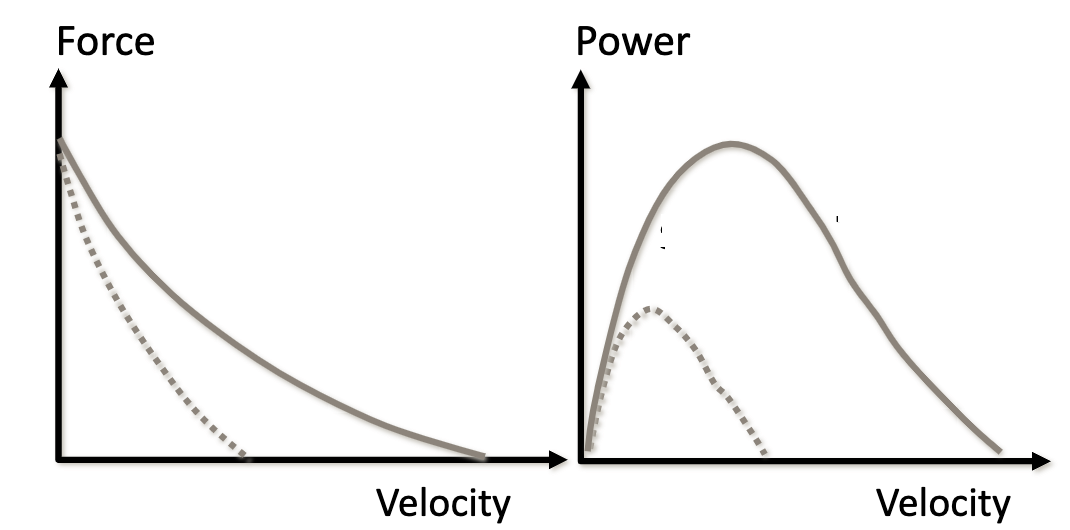
Which represents FT & ST fibers
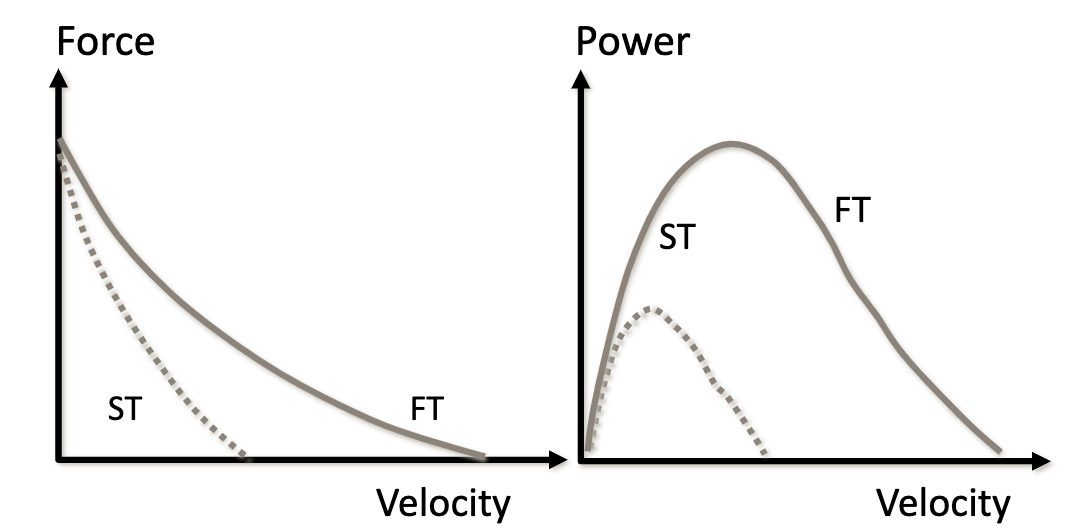
55
New cards
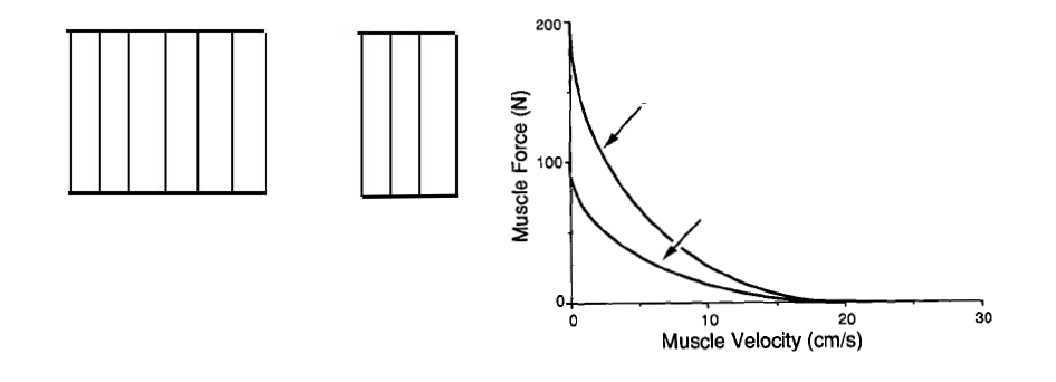
Force-Velocity
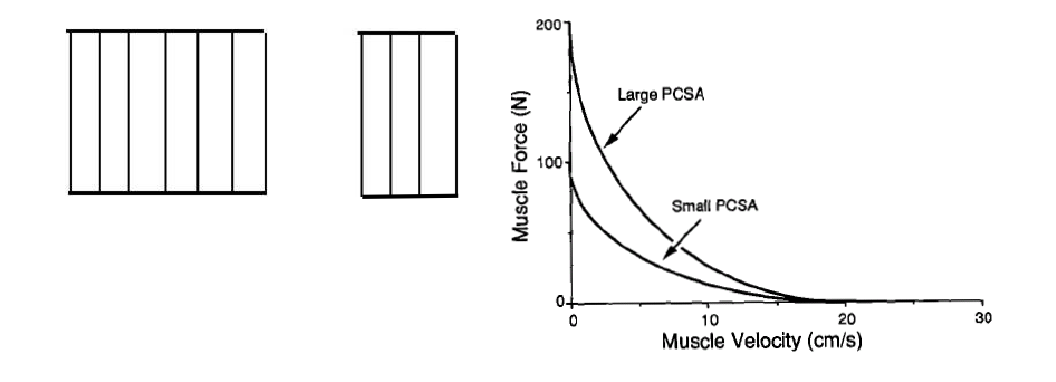
56
New cards
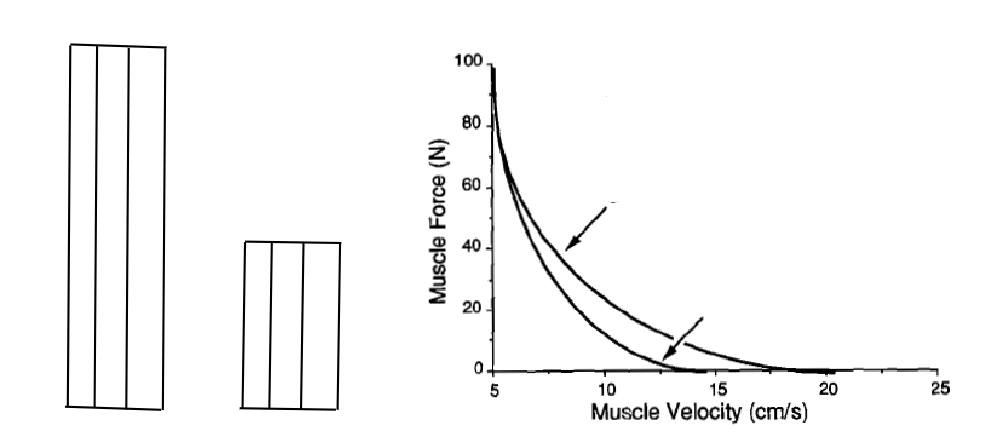
Force-Velocity
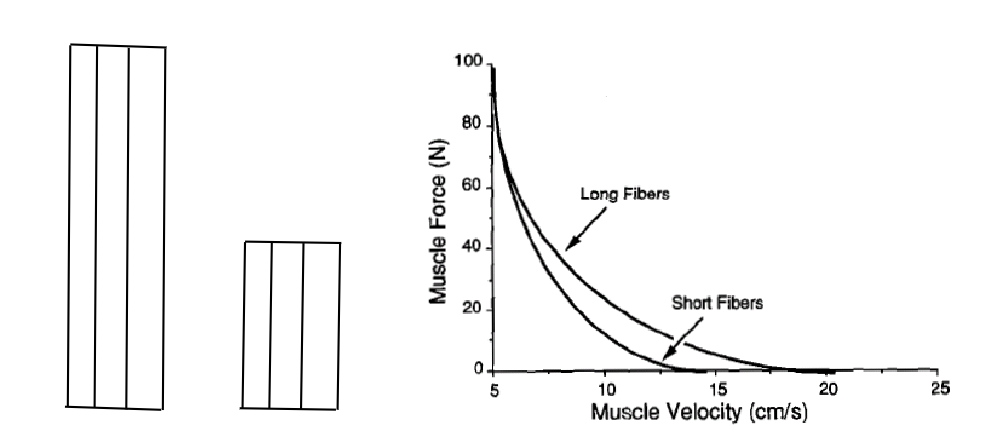
57
New cards
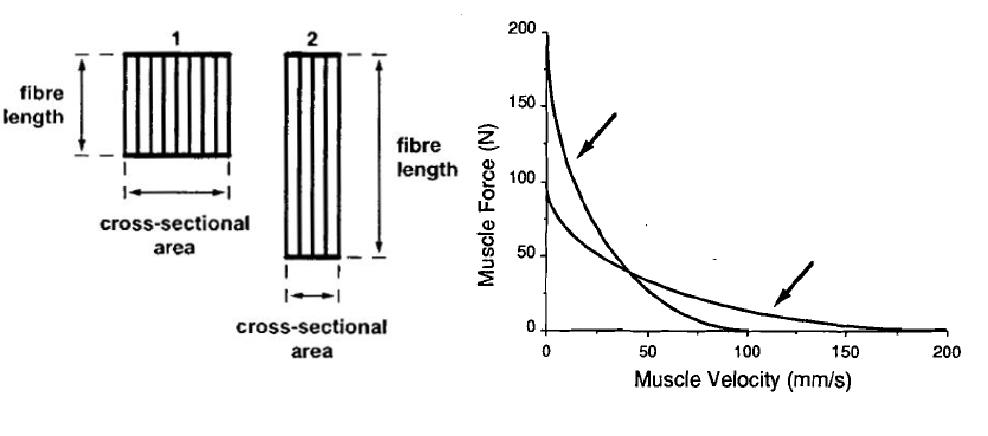
Force-Velocity
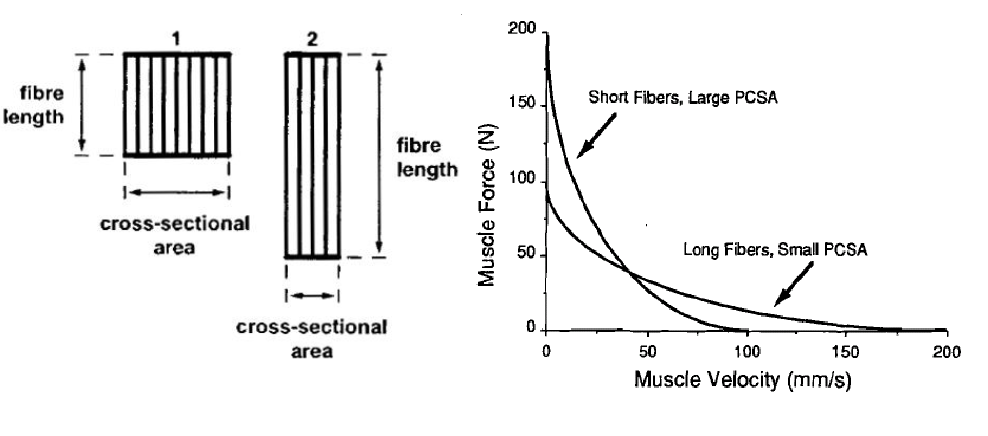
58
New cards
Active F-L
59
New cards
Active F-L
60
New cards
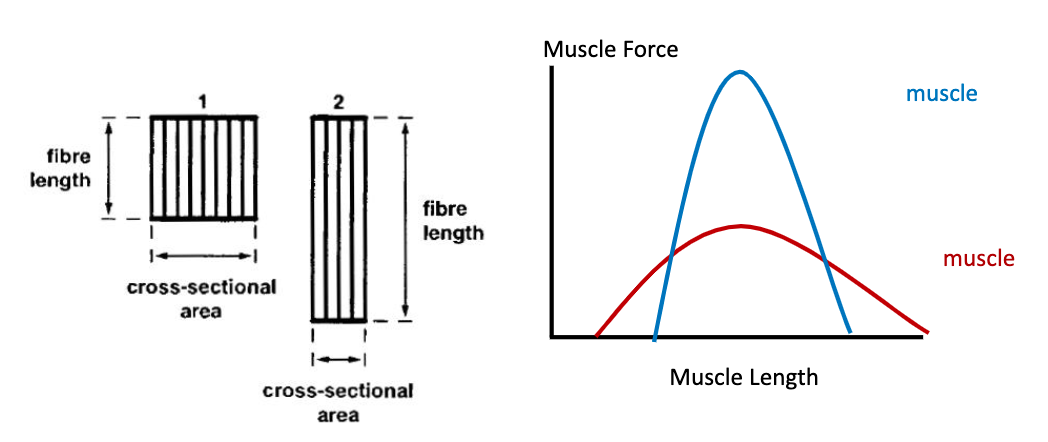
Active F-L
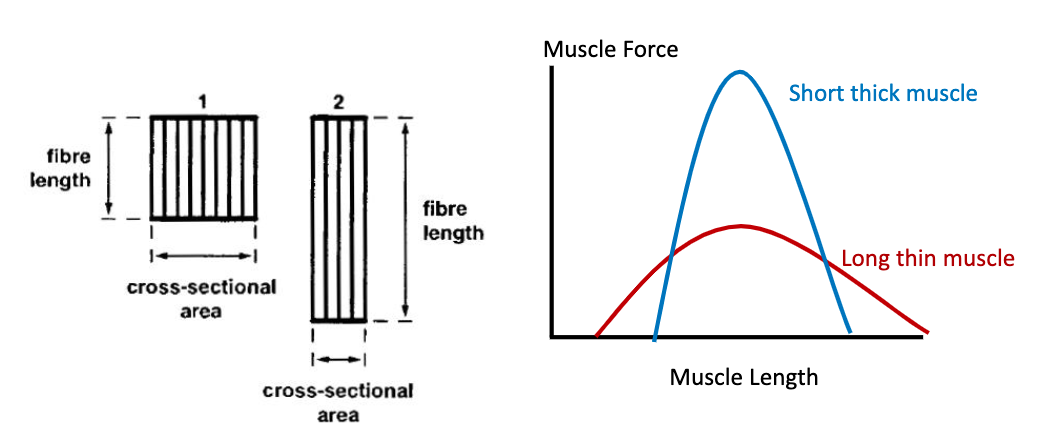
61
New cards
Torque
quantity that describes the capacity of a force to produce rotation
aka moment of force / moment
aka moment of force / moment
62
New cards
63
New cards
If muscles generate sufficient force, bones ____ about joint axes
If muscles generate sufficient force, bones rotate about joint axes
64
New cards
Torque depends on
Force
Moment arm
Angle
Moment arm
Angle
65
New cards
Does torque stay constant when joint angle varies?
No b/c the moment arm changes
66
New cards
Strength is equal to ________ ________ ________ at a specific _____
Strength is equal to maximal isometric torque at a specific angle
67
New cards
What 3 things happen when training for strength
1. Greater force per cross-sectional area
2. Neural adaptations
3. Changes in muscle architecture
2. Neural adaptations
3. Changes in muscle architecture
68
New cards
How does one obtain a greater cross-sectional area via strength training
Origin?
Origin?
Hypertrophy:
↑ in muscle size & ↑ in fiber/myofibril size
Satellite cells (SC): activation
↑ in muscle size & ↑ in fiber/myofibril size
Satellite cells (SC): activation
69
New cards
Satellite cell activation (2 processes)
Proliferation - division of satellite cells
Differentiation - formation of myoblasts to myofibrils
Differentiation - formation of myoblasts to myofibrils
70
New cards
Explain neural adaptations for strength training (2)
Frequency (firing rates): increased stimulation
Improvement in motor unit recruitment: synchronization
Improvement in motor unit recruitment: synchronization
71
New cards
Control of muscle force:
Temporal summation (frequency)
Spatial summation (recruitment)
Spatial summation (recruitment)
72
New cards
Temporal summation
Tetanus
higher firing rate leads to quicker force production
higher firing rate leads to quicker force production
73
New cards
Spatial summation
More motor units are recruited - syncrhonization
Larger force increments, quicker & larger force production
Larger force increments, quicker & larger force production
74
New cards
Changes in muscle architecture - what happens with pennation angle?
(during strength training)
(during strength training)
There will be an increase in pennation angle b/c you can fit more muscle fibers in parallel
• More cross-sectional area, more force
• More cross-sectional area, more force
75
New cards
What happens to fibers during strength training?
Increase in a type of fiber?
Increase in a type of fiber?
Increase in type IIb fibres in strength training
76
New cards
Strength training - time of improvement
first 1-2 weeks?
3-4 weeks?
4+?
first 1-2 weeks?
3-4 weeks?
4+?
Initial improvements (first 1-2 weeks)
learning effect – motor skill coordination
Subsequent improvements (3-4 weeks)
neural adaptations
Later improvements (4+ weeks)
muscle hypertrophy
learning effect – motor skill coordination
Subsequent improvements (3-4 weeks)
neural adaptations
Later improvements (4+ weeks)
muscle hypertrophy
77
New cards
What happens during endurance training?
Very small changes in muscle mass & fiber size
↑ Type I fibers
↑ number of mitochondria
Cardiovascular & respiratory adaptations:
- ↑ number of capillaries
- better supply of oxygen & nutrients
↑ Type I fibers
↑ number of mitochondria
Cardiovascular & respiratory adaptations:
- ↑ number of capillaries
- better supply of oxygen & nutrients
78
New cards
What is Specificity?
A muscle (fibre) adapts if it is recruited during exercise
Adaptations are therefore specific to the muscle trained
Adaptations are specific to the trained position
Adaptations are therefore specific to the muscle trained
Adaptations are specific to the trained position
79
New cards
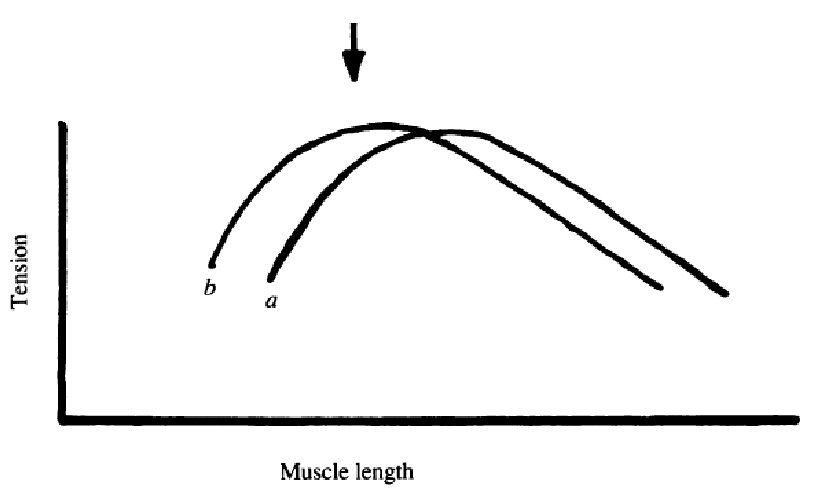
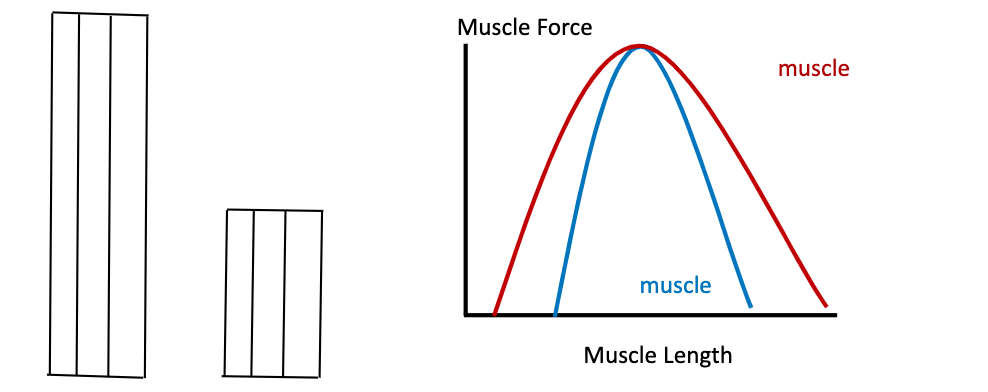
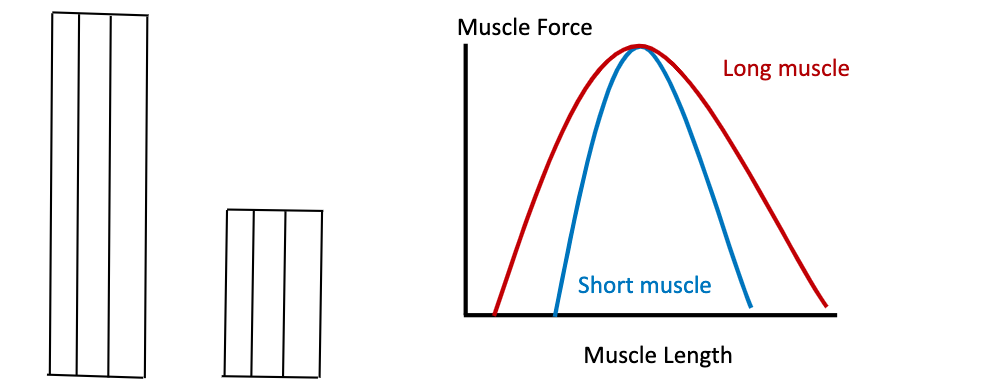
What causes the left shift in this graph?
If training has higher functional demands at a shorter muscle lengths, the tissue can and will adapt to ultimately produce more force over the range that is required by that training, resulting in a shifted curve like b in the graph above.
80
New cards
Increased functional demand
Strength & endurance training
81
New cards
Decreased functional demand
Reduction in the electrical & mechanical activities
- Neuromuscular diseases
- Spinal cord injury
- Denervation
- Immobilization
- ↘ weight bearing
- Neuromuscular diseases
- Spinal cord injury
- Denervation
- Immobilization
- ↘ weight bearing
82
New cards
Sarcopenia
Leads to decreased...
Leads to decreased...
age related involuntary loss of muscle mass and
strength
decreased:
muscle cross sectional area
fiber size
fiber number
(greater loss in fast twitch fibers)
strength
decreased:
muscle cross sectional area
fiber size
fiber number
(greater loss in fast twitch fibers)
83
New cards
What is a joint
junction b/w 2 or more bones of the skeleton
84
New cards
Functions of joints
to permit & inhibit movement
to transfer forces b/w bones
to absorb shock through movement
to transfer forces b/w bones
to absorb shock through movement
85
New cards
Cartilaginous joint
Example
Where does it connect
Movement
Example
Where does it connect
Movement
Spinal vertebrae
cartilage
Small
cartilage
Small
86
New cards
Fibrous joint
Example
Where does it connect
Movement
Example
Where does it connect
Movement
distal/inferior tibiofibular joint
Fibrous tissue
small
Fibrous tissue
small
87
New cards
Synovial joint
Example
Where does it connect
Movement
Example
Where does it connect
Movement
knee, hip
ligaments
small translation, large rotation
ligaments
small translation, large rotation
88
New cards
Synarthrosis joint - movement?
Immovable
89
New cards
amphiarthrosis joint - movement?
slightly movable
90
New cards
Diarthrosis joint - movement?
freely movable
91
New cards
What are degrees of freedom?
Number of variables (coordinates) needed to describe the movement of a body
92
New cards
A rigid body in 2-D space can
How many DOF?
How many DOF?
translate in x direction
translate in y direction
rotate around z axis
3 DOF in 2-D space
translate in y direction
rotate around z axis
3 DOF in 2-D space
93
New cards
A rigid body in 3-d space can
translate in x direction
translate in y direction
translate in z direction
rotate around x axis
rotate around y axis
rotate around z axis
6 DOF in 3-D space
translate in y direction
translate in z direction
rotate around x axis
rotate around y axis
rotate around z axis
6 DOF in 3-D space
94
New cards
Joints are often considered as ______
why?
why?
Organs
changes in one structure affect all other structures:
- mechanically
- biochemically
- morphologically
changes in one structure affect all other structures:
- mechanically
- biochemically
- morphologically