A&P Lab 1 Tissue Histology
 Call Kai
 Learn
Learn Practice Test
 Spaced Repetition
 Match
Match Flashcards
 Knowt Play
1/85

There's no tags or description
Looks like no tags are added yet.
Name | Mastery | Learn | Test | Matching | Spaced | Call with Kai | Chat |
|---|
No analytics yet
Send a link to your students to track their progress
86 Terms
What are the four basic tissue types?
Epithelial, connective, muscular, and nervous tissue
What is the general function of epithelial tissue?
It covers surfaces, lines body cavities/organs, and forms glands
What is the general function of connective tissue?
Supports, protects, and binds organs
What is the general function of muscular tissue?
Contraction and movement
What is the general function of nervous tissue?
Communication/signaling and coordination through electrical and chemical signals.
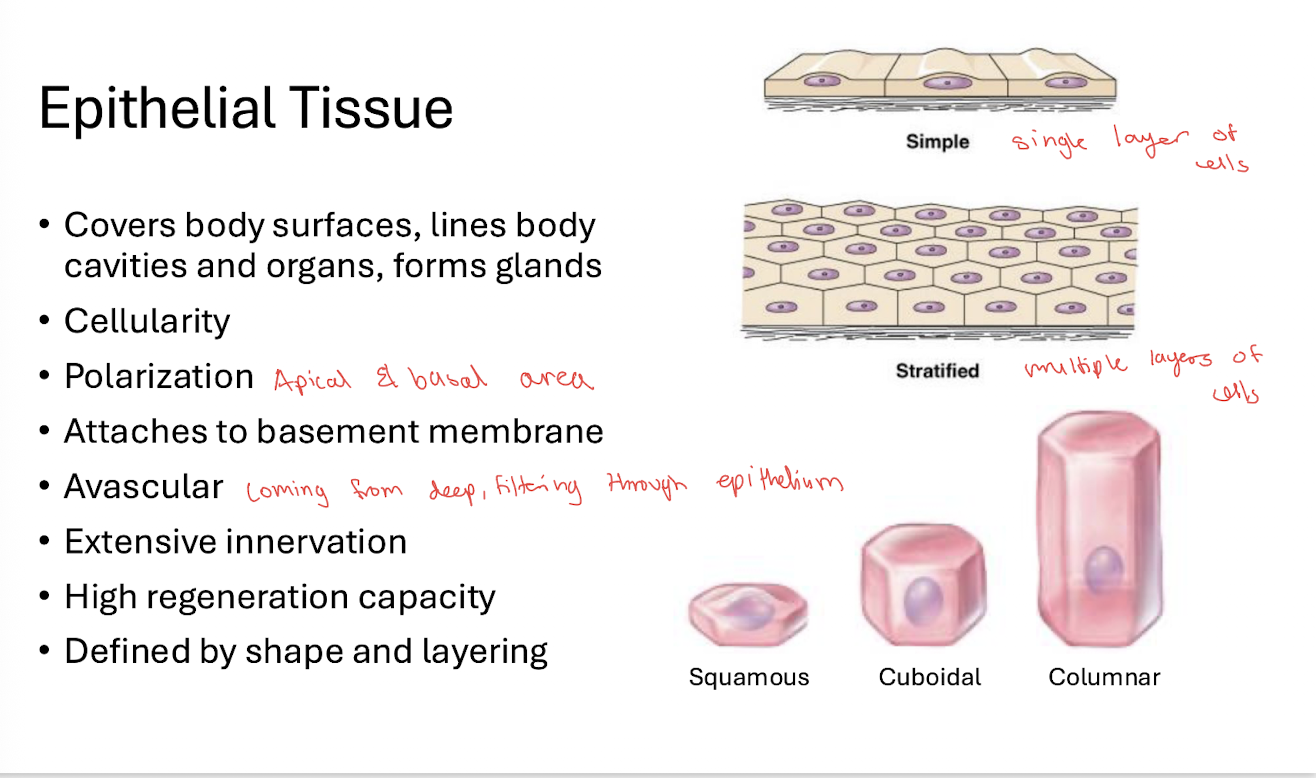
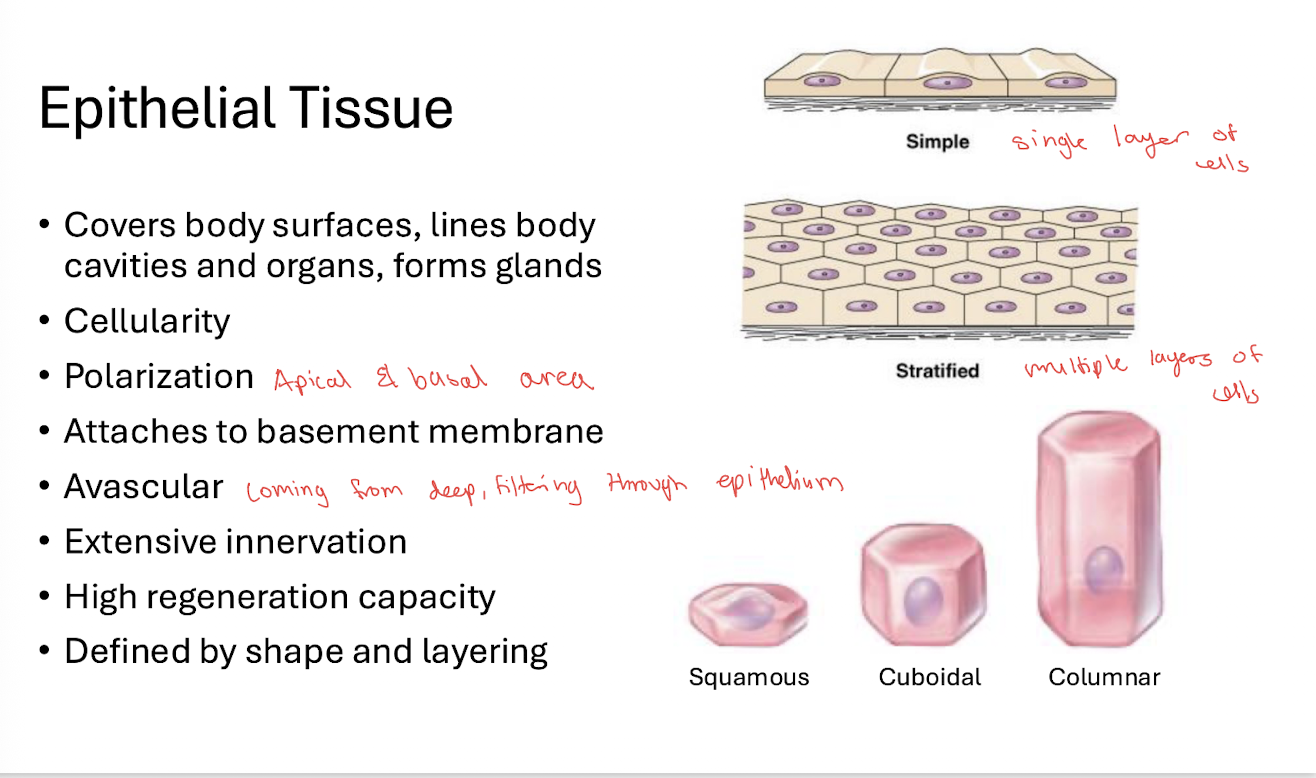
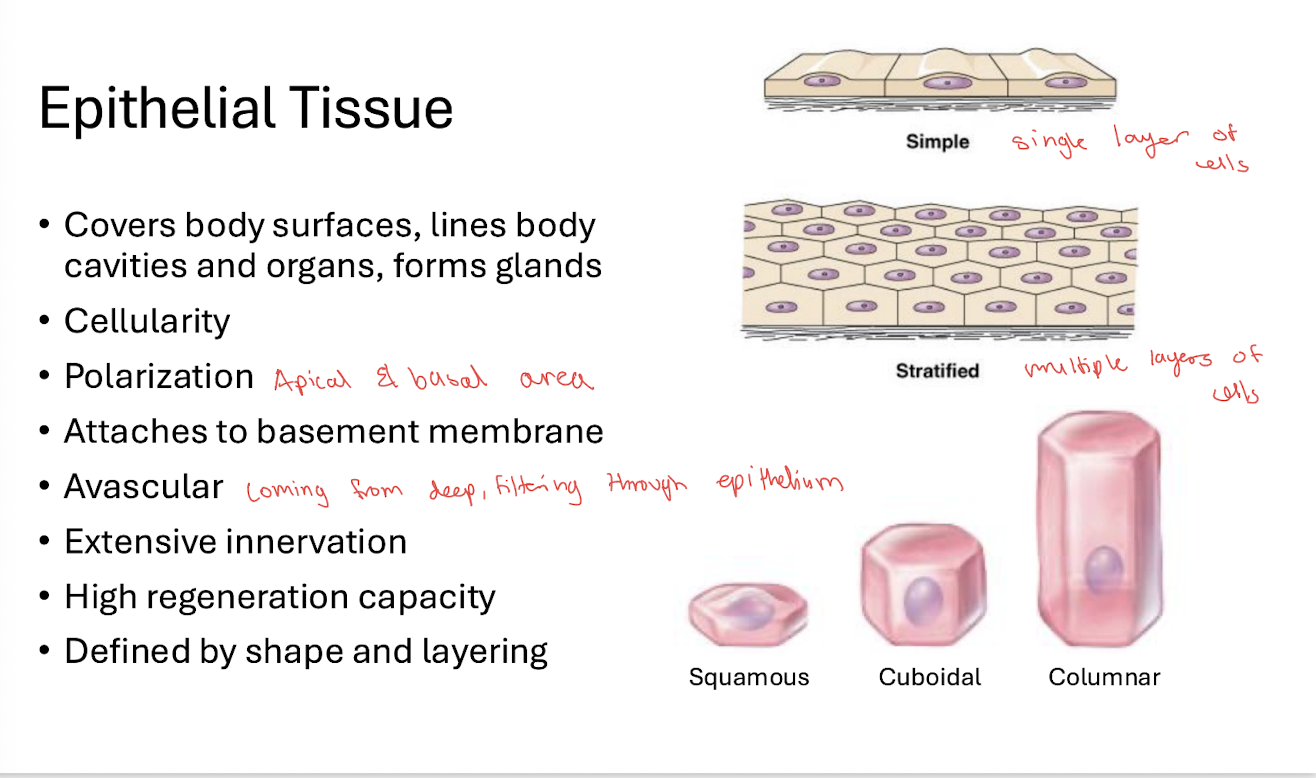
What does cellularity mean in epithelial tissue?
Epithelial tissue has closely packed cells with little extracellular material between them.
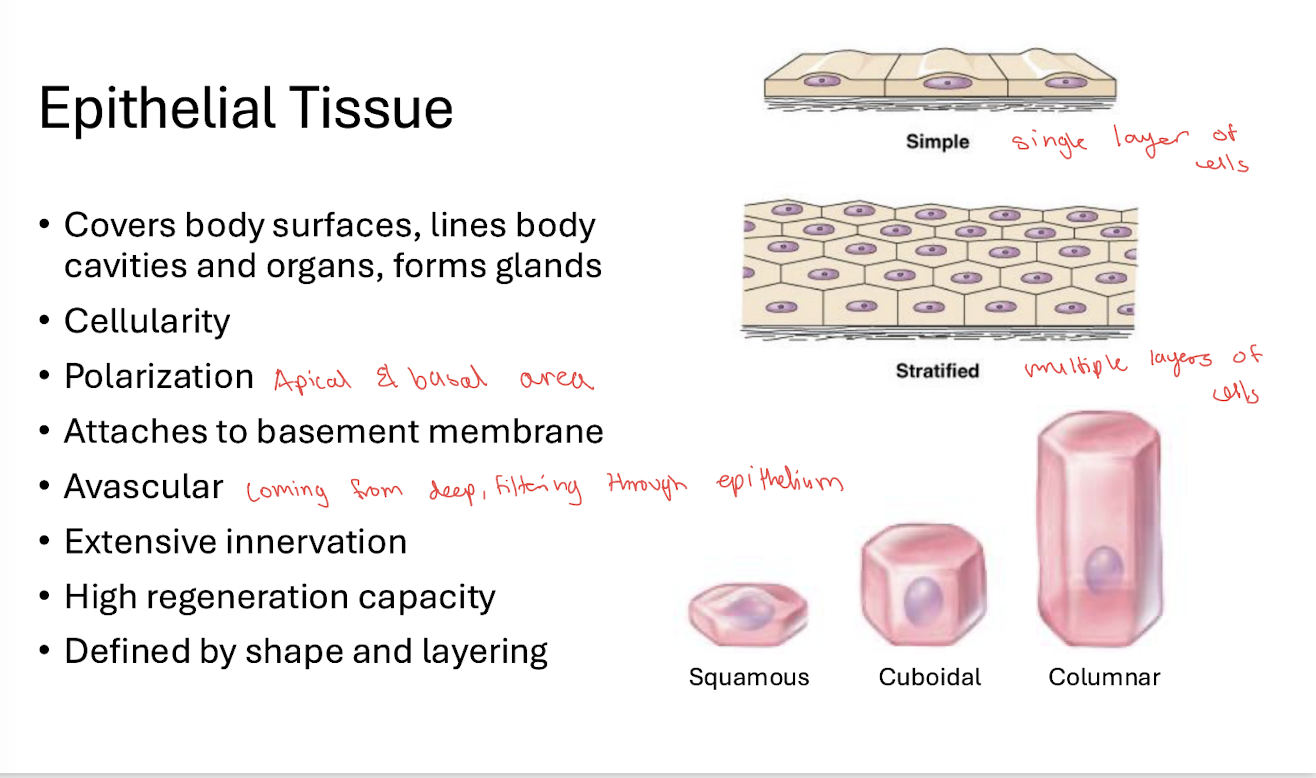
What does epithelial polarization mean?
Epithelial cells have distinct apical and basal surfaces.
What does epithelial tissue attach to?
A basement membrane
Is epithelial tissue vascular or avascular?
Avascular
Does epithelial tissue have extensive innervation?
yes!, extensive

Does epithelial tissue regenerate quickly?
Yes, it has a high regeneration capacity.

What two characteristics are used to classify epithelial tissue?
Number of cell layers and cell shape
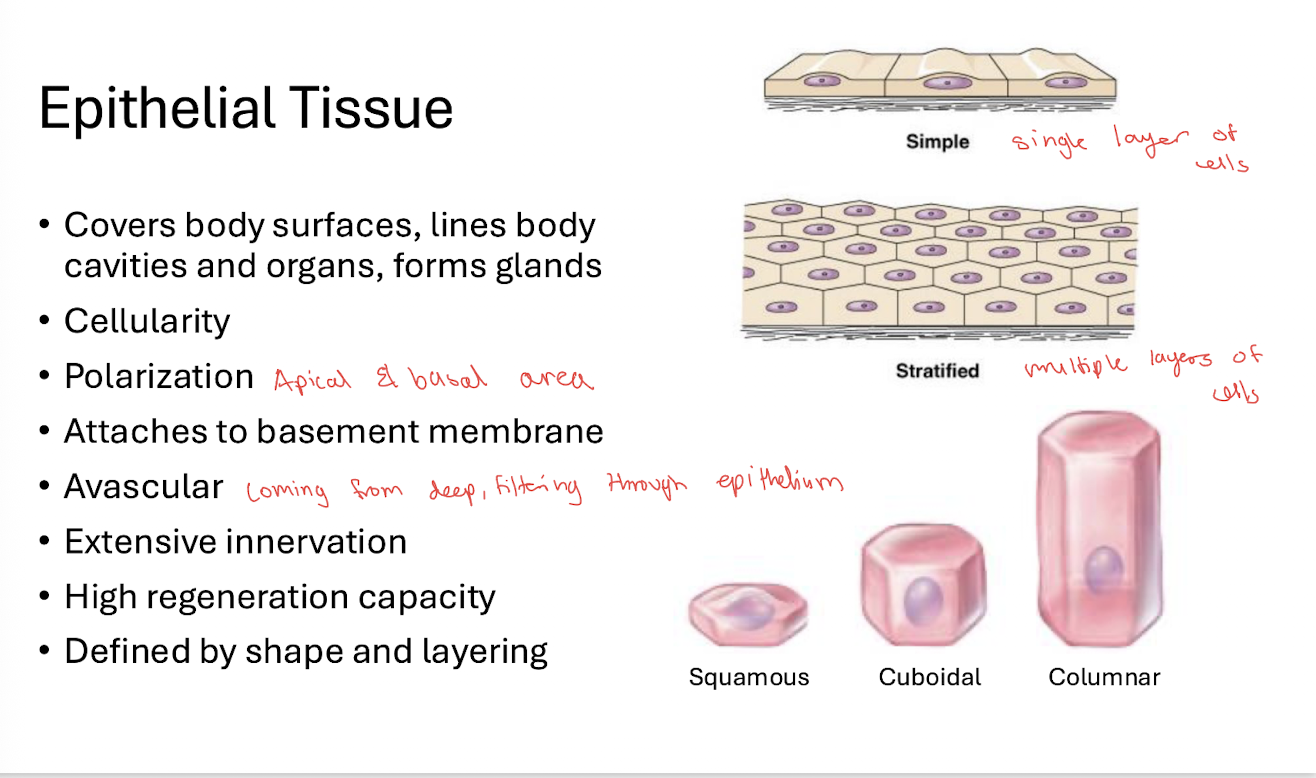
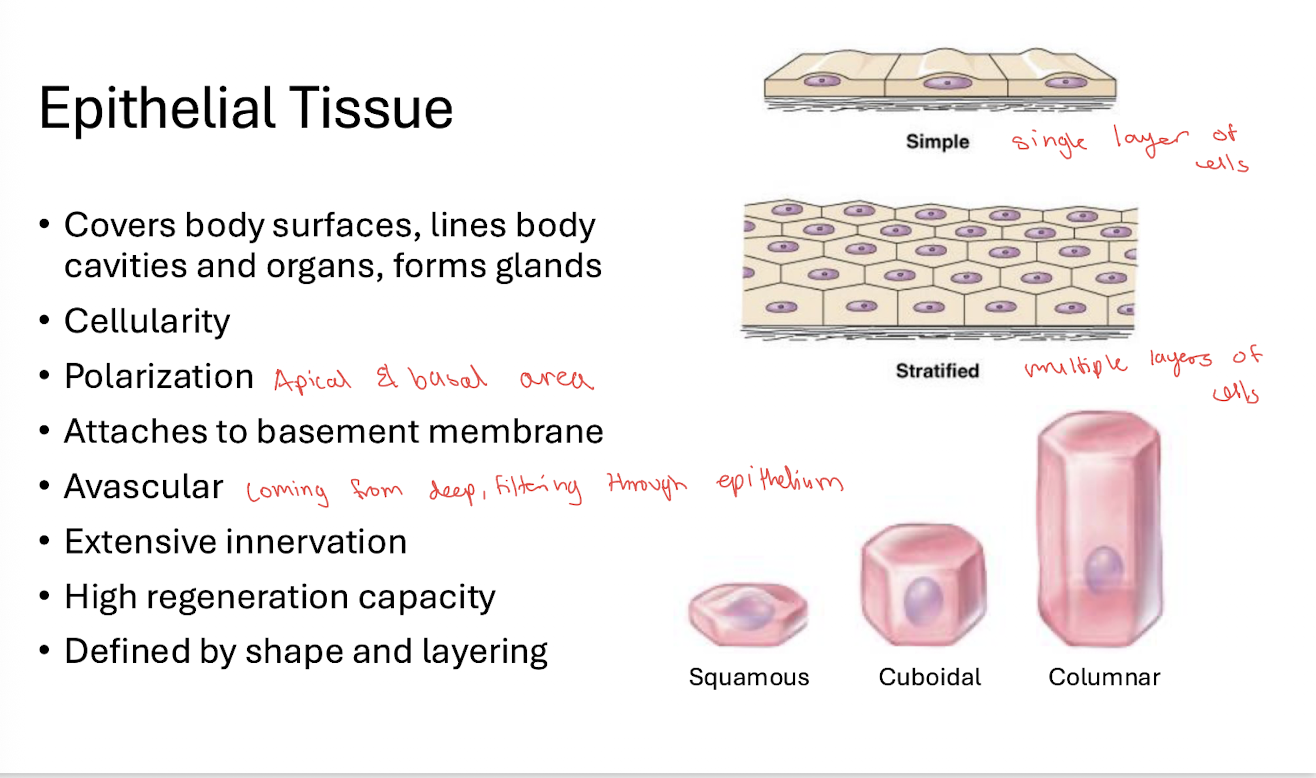
What does "simple" mean in epithelial tissue?
One layer of cells.

What does "stratified" mean?
Multiple layers of cells.

What does "pseudostratified" mean?
The tissue appears multilayered, but every cell contacts the basement membrane.
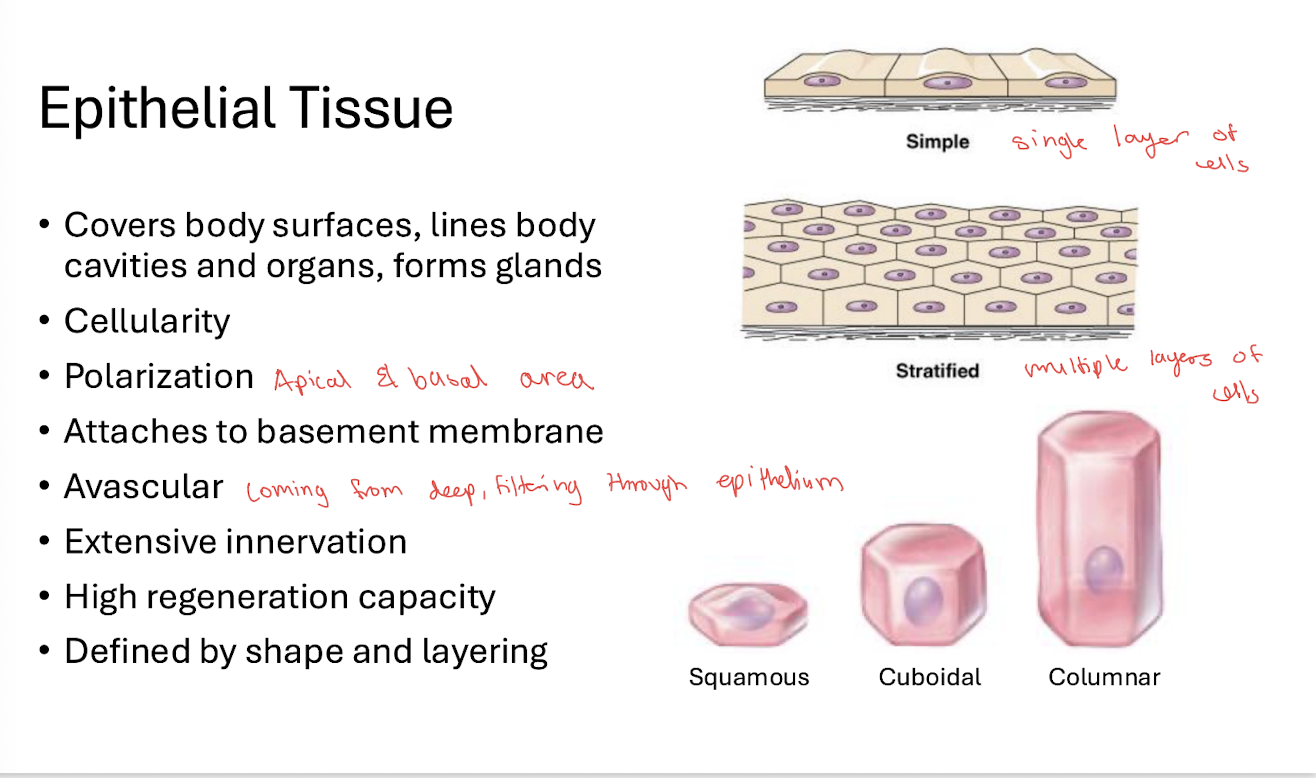
What does squamous mean?
Flat/thin cells.
like a fried egg

What does cuboidal mean?
Cells that are approximately as tall as they are wide.
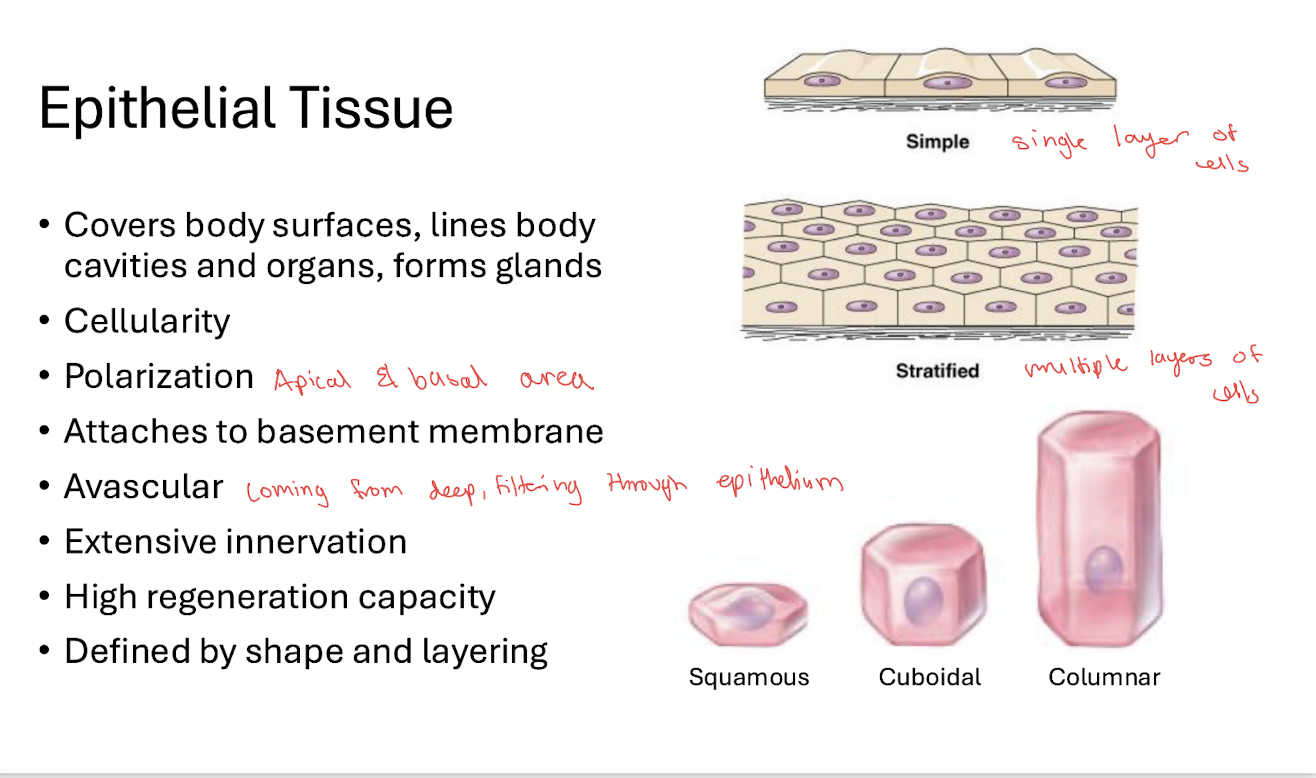
What does columnar mean?
Tall cells, taller than they are wide.
What is the key naming rule your instructor emphasized for epithelial tissue?
The test answer should contain four words: the number of layers, cell type, and "epithelial tissue" — with the required terminology included for the specific tissue.
Example = Pseudostratified ciliated columnar epithelial tissue

What kind of tissue is this?
Simple Squamous Epithelial Tissue
one layer of very thin, flat cells
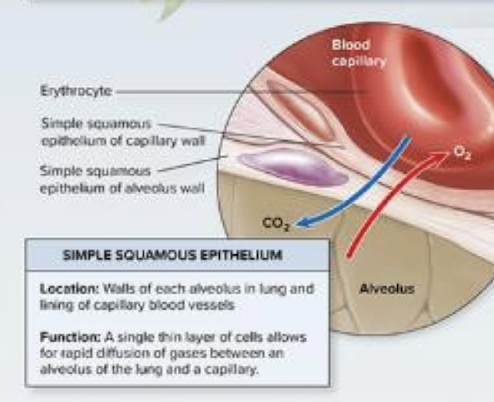
What are the major functions of simple squamous epithelium?
Diffusion and exchange; it also forms thin flexible surfaces.

Where is simple squamous epithelium found?
Capillaries, alveoli, and serous membranes
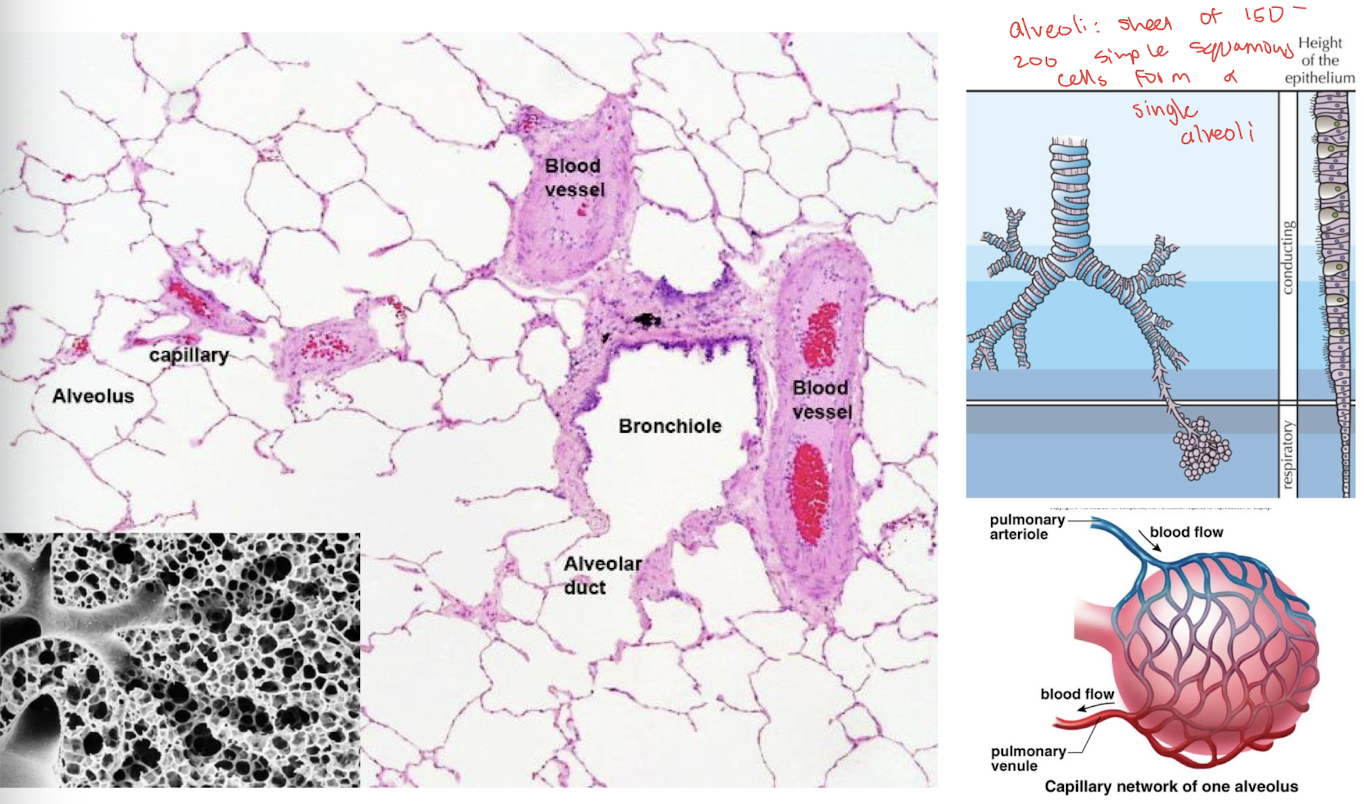
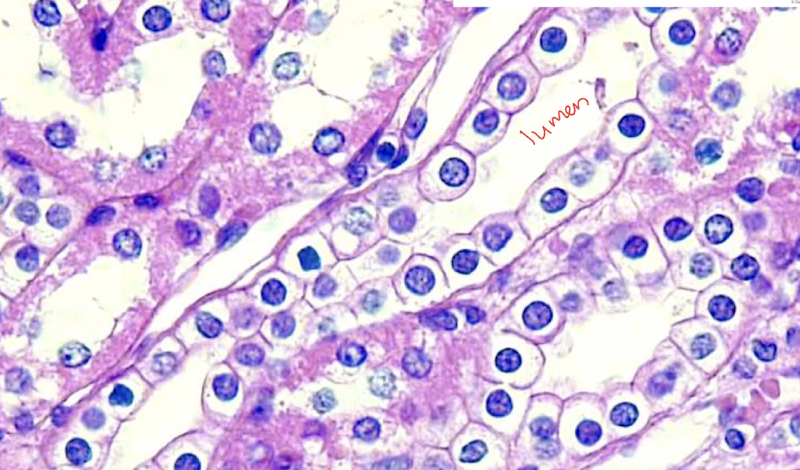
What kind of tissue is this?
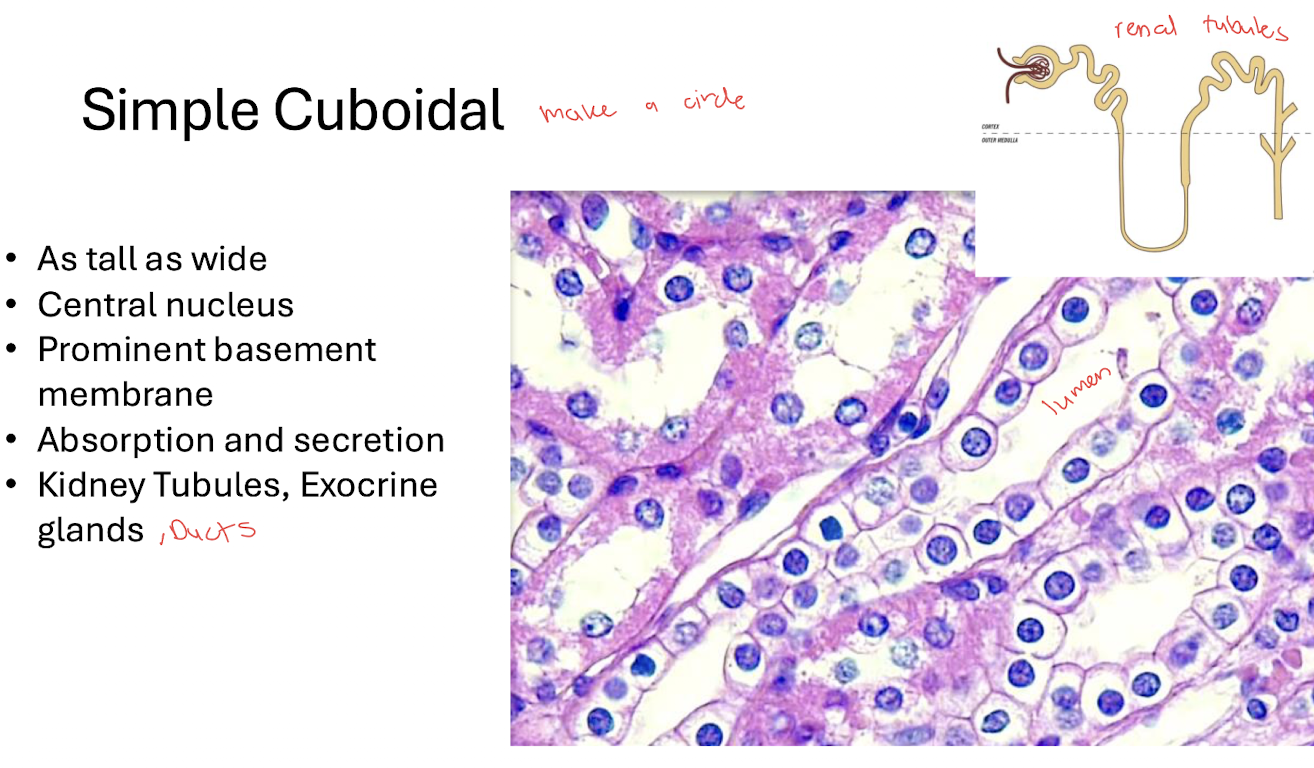
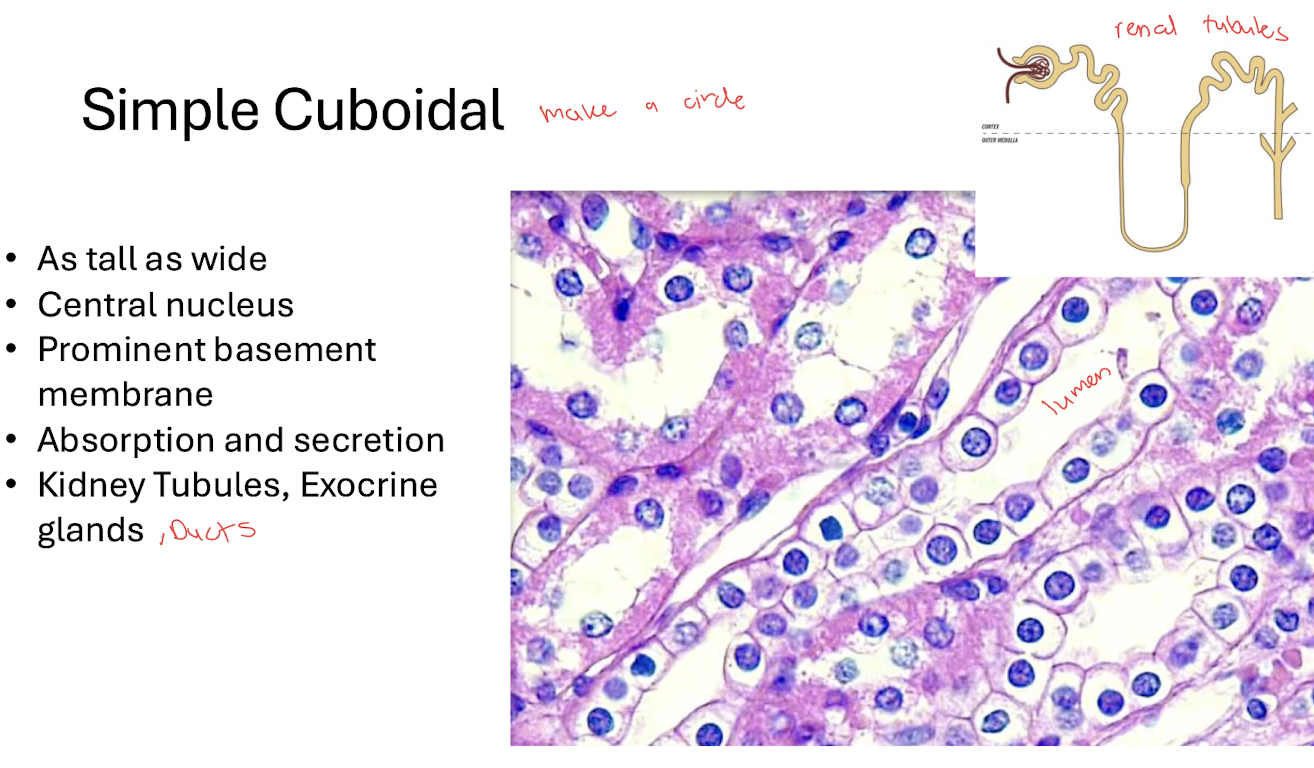
Simple Cuboidal Epithelial Tissue
as tall as wide, central nucleus, prominent basement membrane
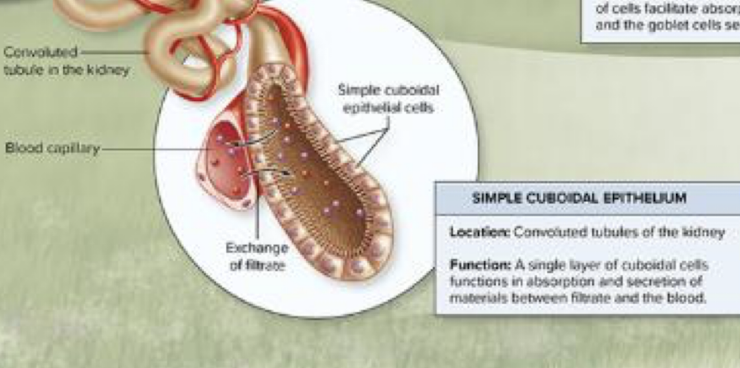
What are the major functions of simple cuboidal epithelium?
Absorption & Secretion
Where is simple cuboidal epithelial tissue found?
Kidney tubules and exocrine glands & ducts

What kind of tissue is this?
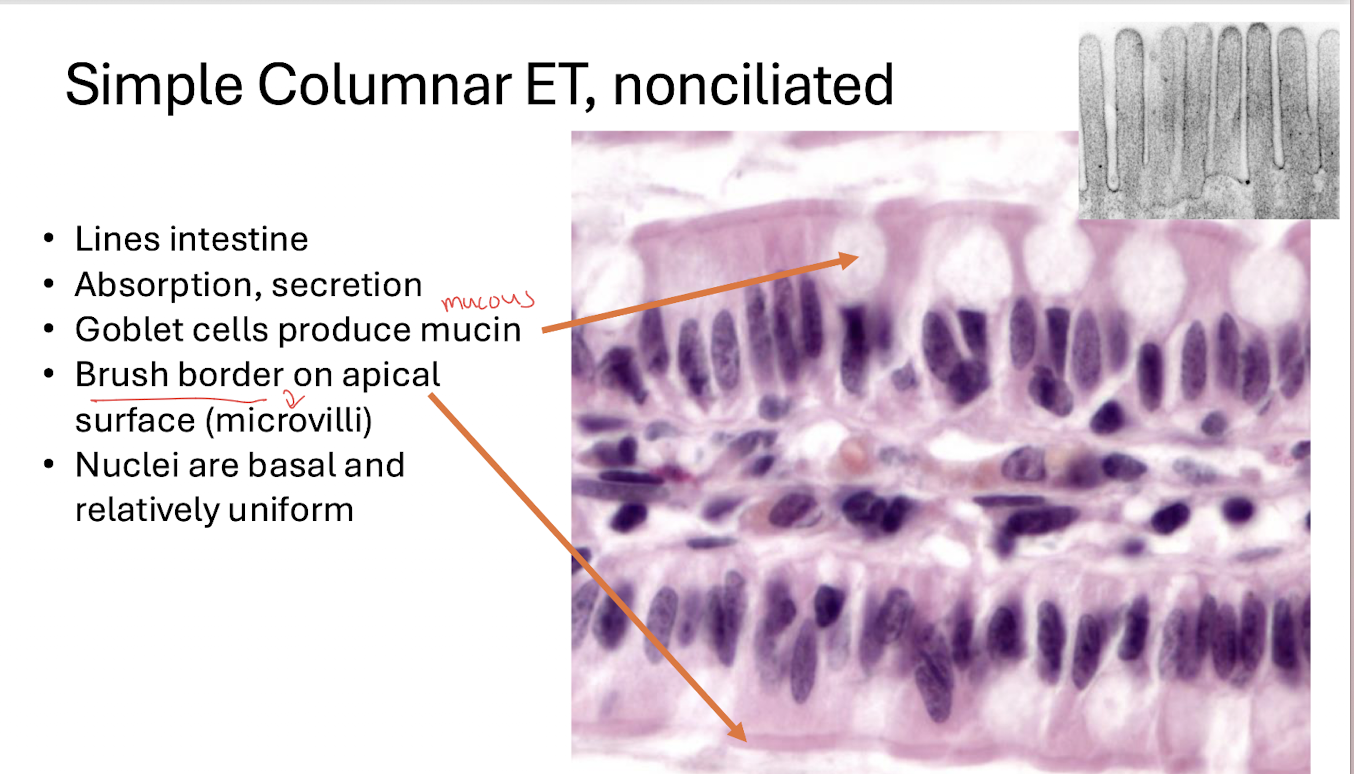
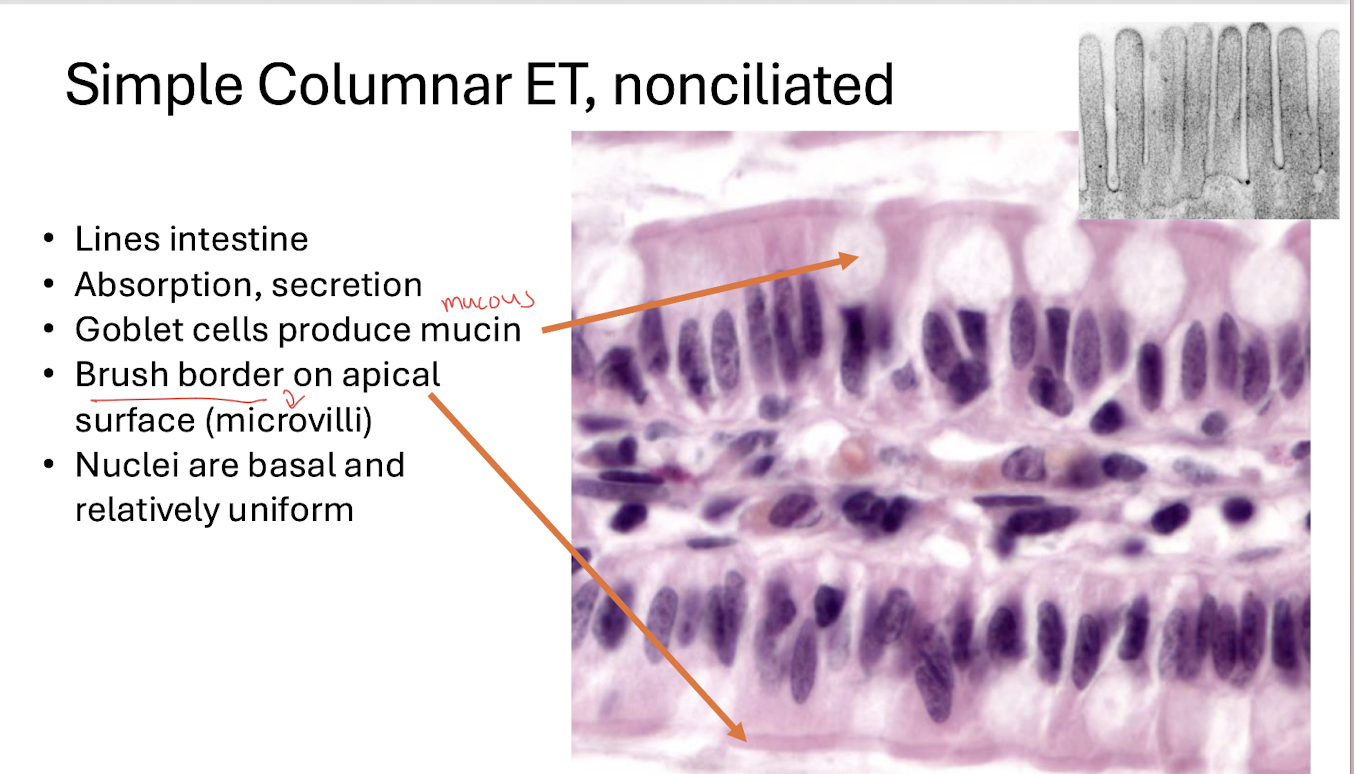
Simple (Nonciliated) Columnar Epithelial Tissue
nuclei are basal & relatively uniform
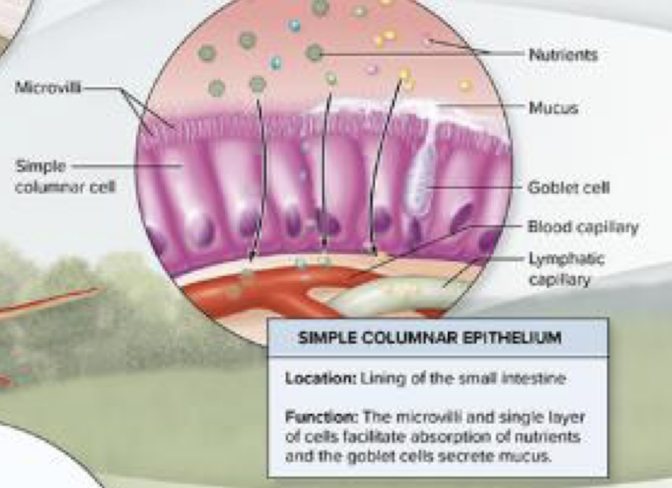
What are the major functions of simple columnar epithelium?*
Absorption & Secretion*
Where is simple columnar epithelium found?
the intestine

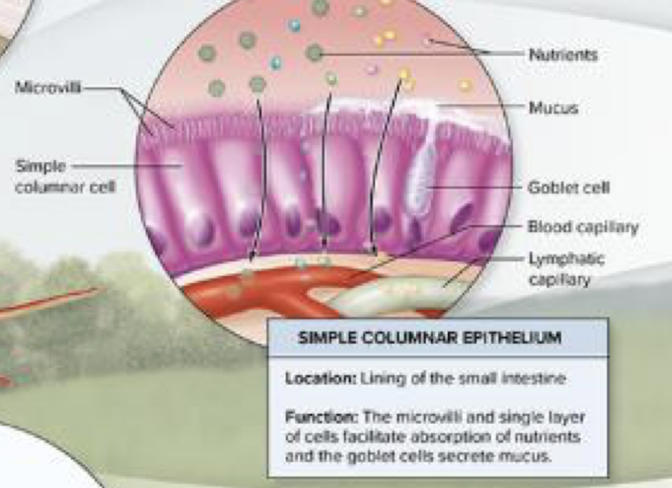
What are goblet cells?
Cells that produce mucin, which contributes to mucus.
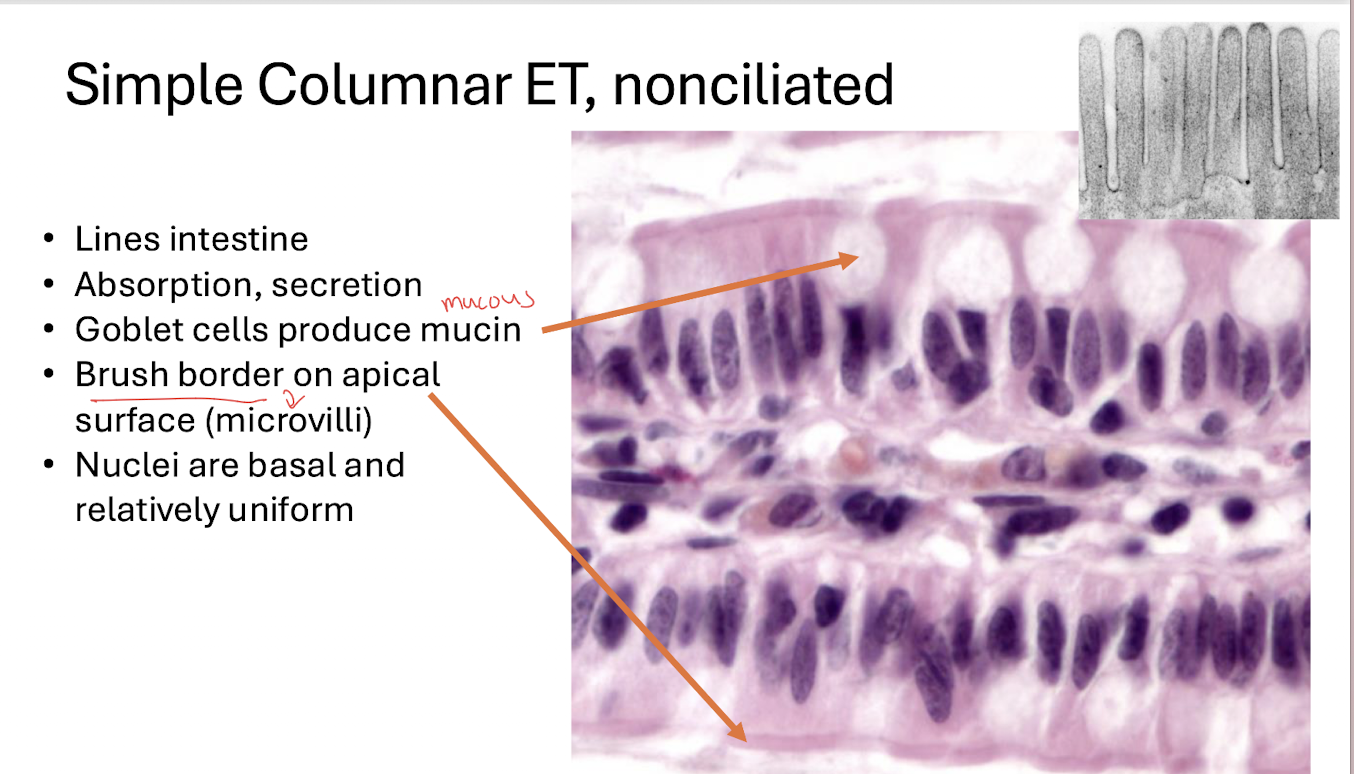
What is the function of mucin/mucus in the intestine?
It helps protect and lubricate the epithelial surface.

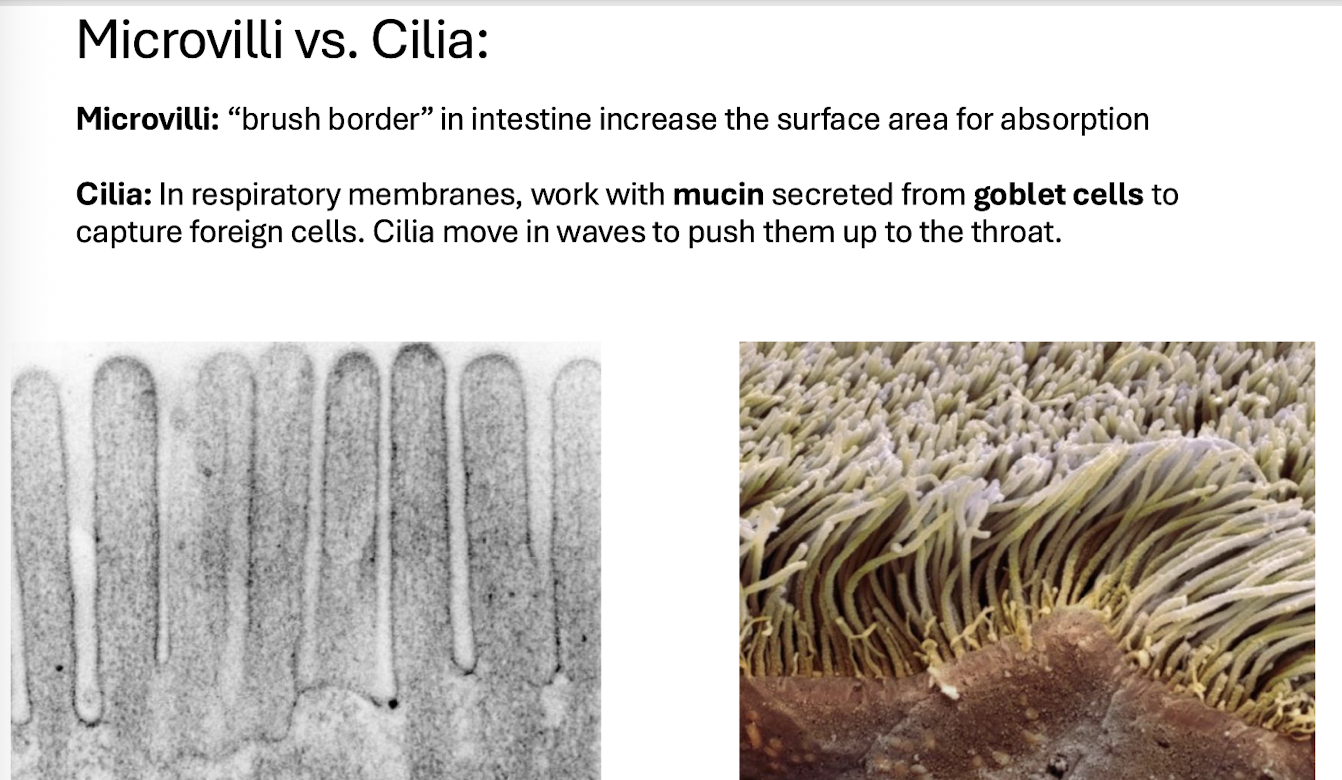
What is a brush border?
A layer of microvilli on the apical surface.
increase surface area for absorption
3,000-500 microvilli per cell
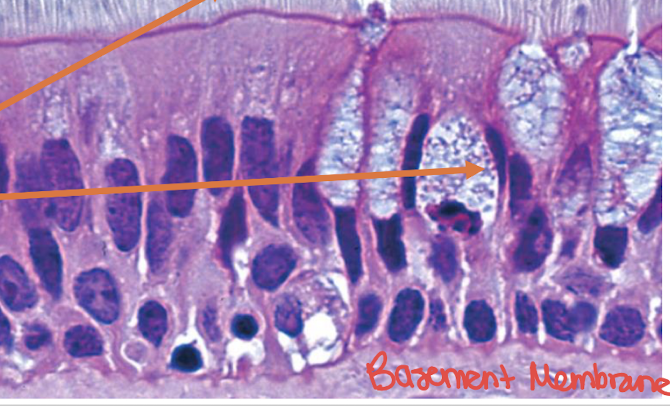
What kind of tissue is this?
Pseudostratified Ciliated Columnar Epithelial Tissue
nuclei not uniform → pseudostratification
lots of goblet cells

Are all cells of pseudostratified epithelium attached to the basement membrane?
Yes, EVERY cell attached at basement membrane
NOT EVERY cell reaches apical surface

What are cilia? Function in PCCE?
Hair-like projections that move material along the epithelial surface
move foreign material/mucus toward the throat.
Where is pseudostratified ciliated columnar epithelium found?
The upper airways/respiratory tract.
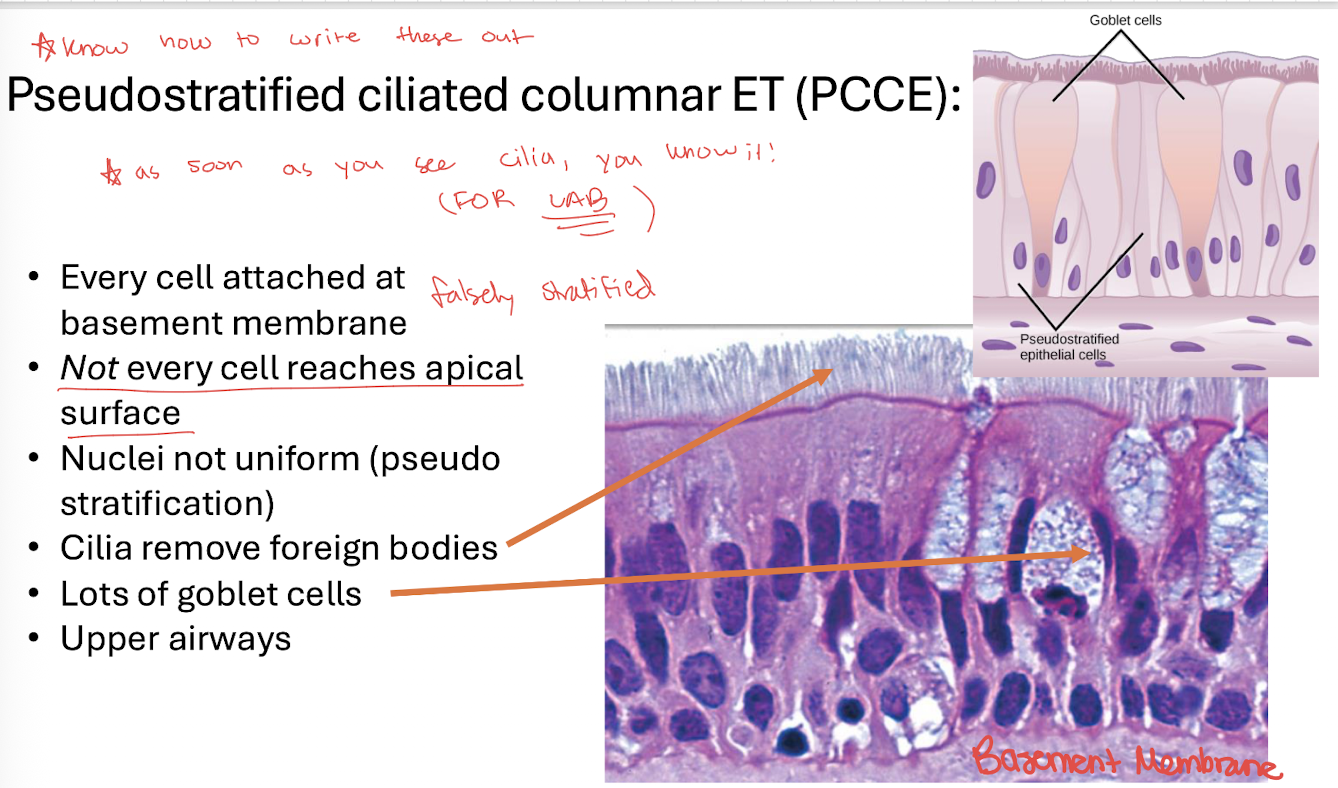
How do cilia and mucus work together in the respiratory tract?
Goblet cells produce mucin → mucus captures foreign material → cilia move the mucus toward the throat
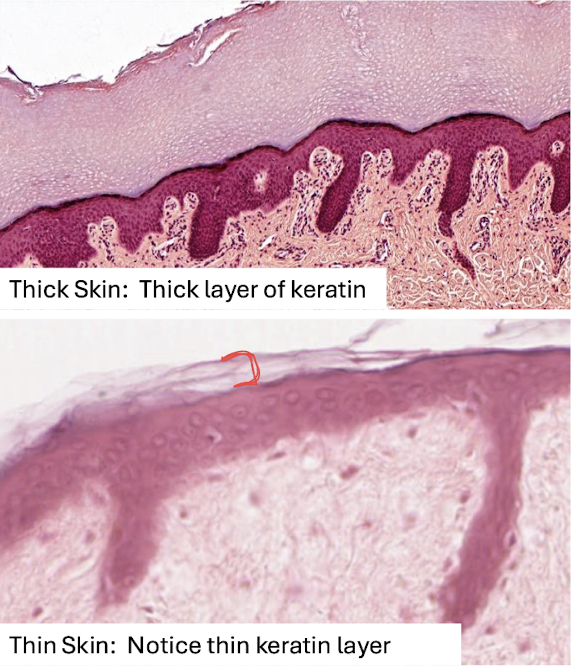
What kind of tissue is this?
Keratinized Stratified Squamous Epithelial Tissue
multiple cell layers
named w/TOP layer of cells = surface cells are squamous

What is the main function of stratified squamous epithelium?
Protection
FOUND IN SKIN
Multiple layers → cells can be shed/replaced → underlying tissues remain protected.
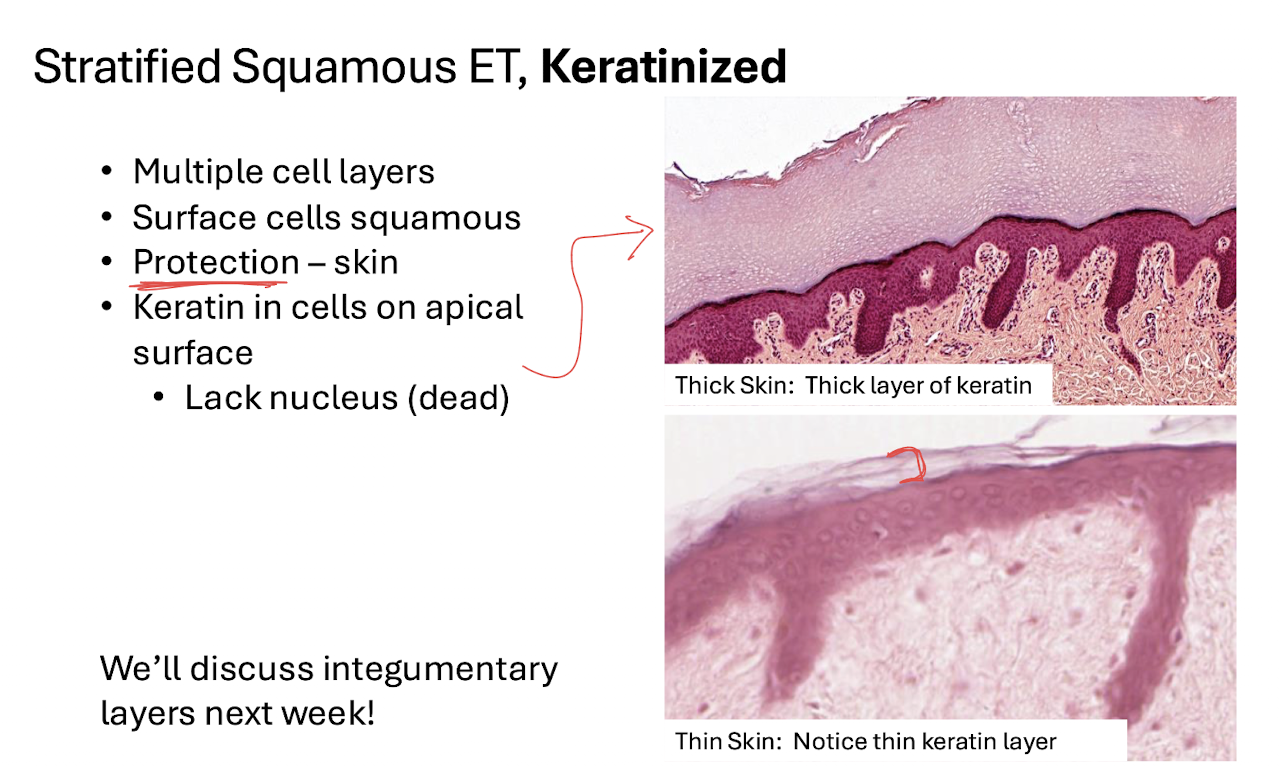
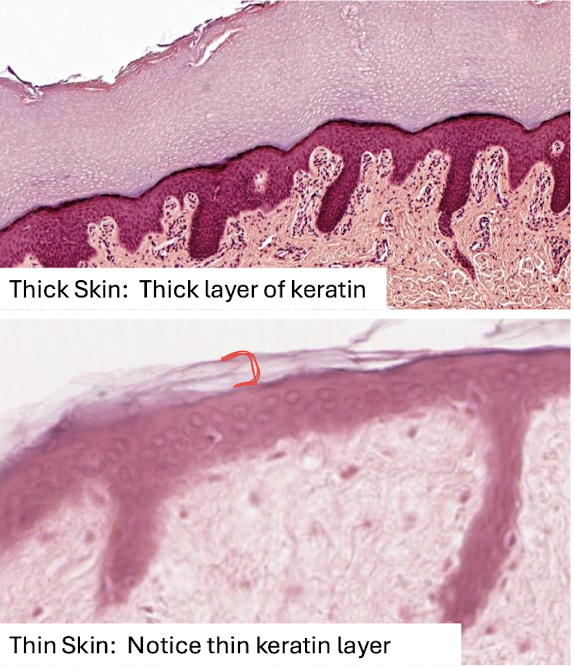
What happens to the nuclei of the surface cells in keratinized stratified squamous epithelium?
The surface cells lack nuclei because they are dead.
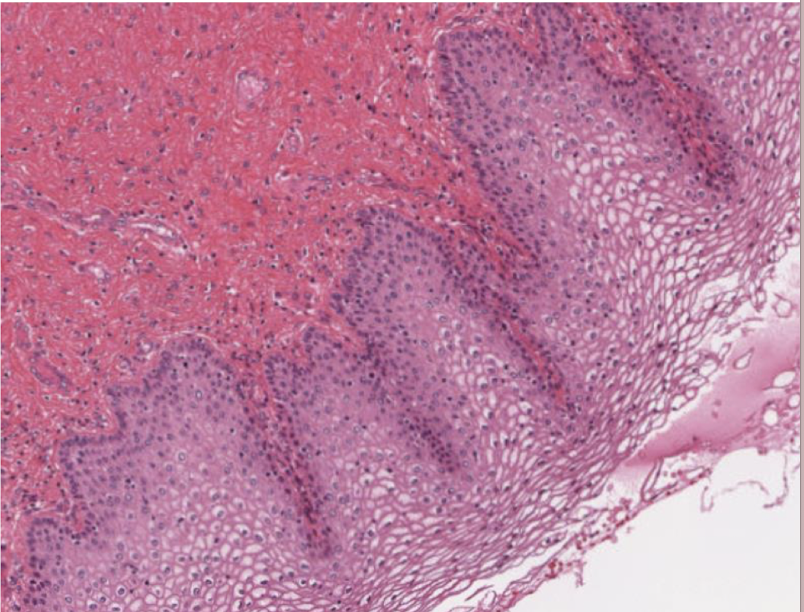
What kind of tissue is this?
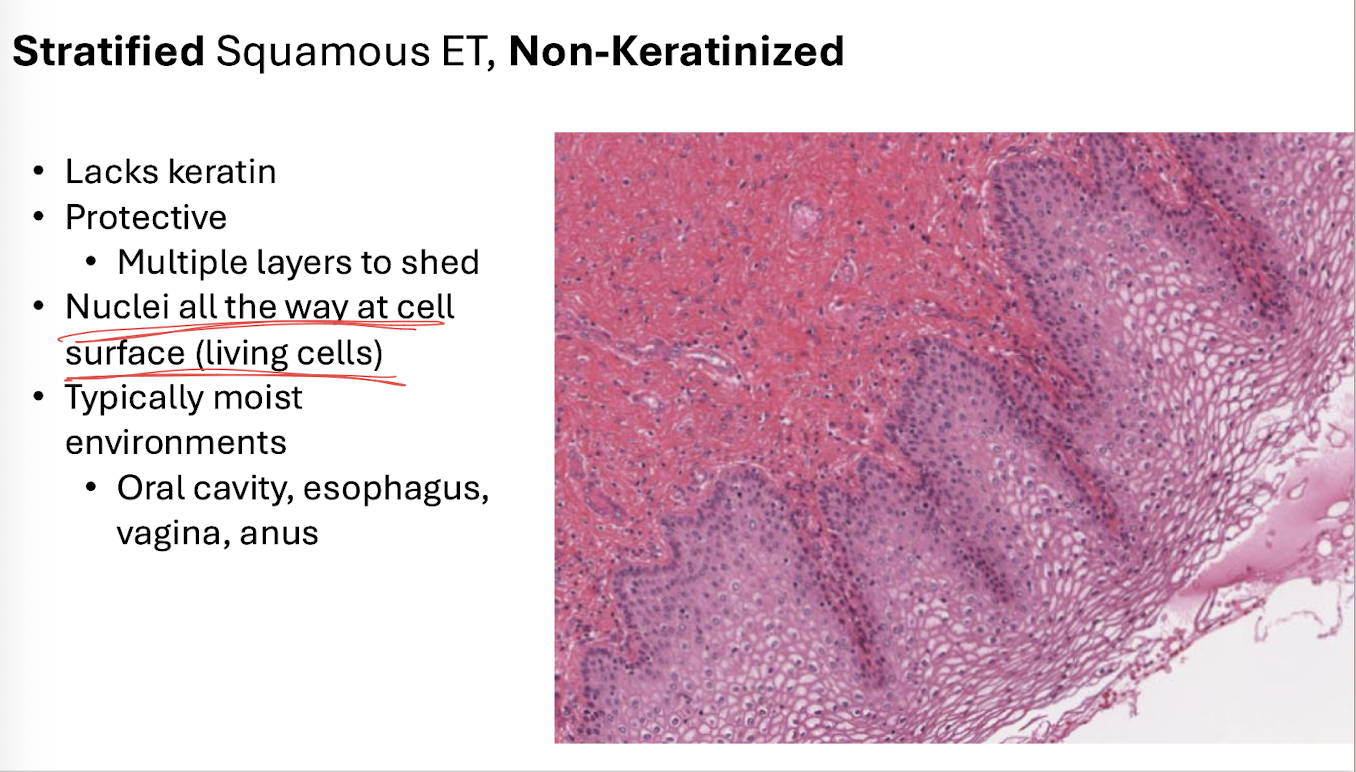
Non-Keratinized Stratified Squamous Epithelial Tissue
lacks keratin at the apical surface
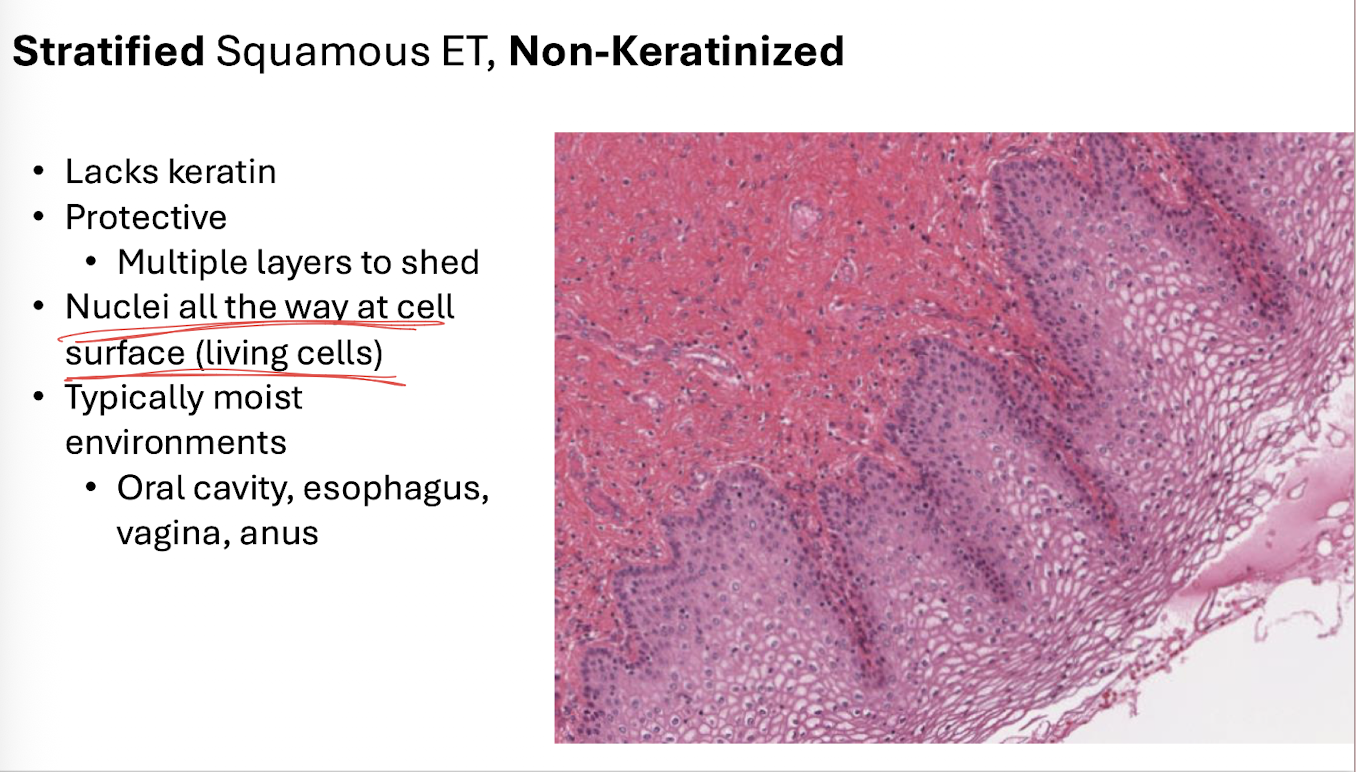
Do the surface cells of non-keratinized stratified squamous epithelium have nuclei?
Yes. The surface cells are living.
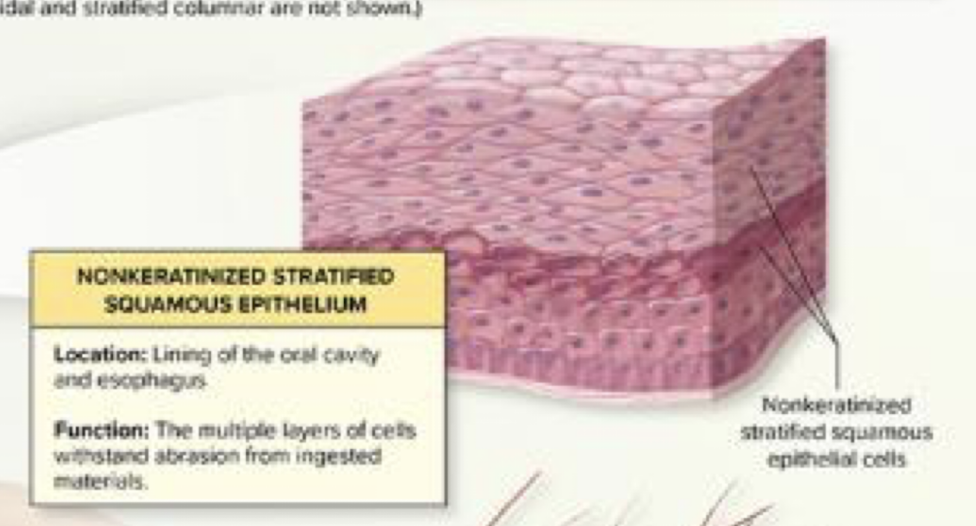
What is the main function of non-keratinized stratified squamous epithelium?
Protection
Multiple layers → protection from abrasion/wear.

Where is non-keratinized stratified squamous epithelium found?
Typically moist environments
Oral cavity, esophagus, vagina, anus
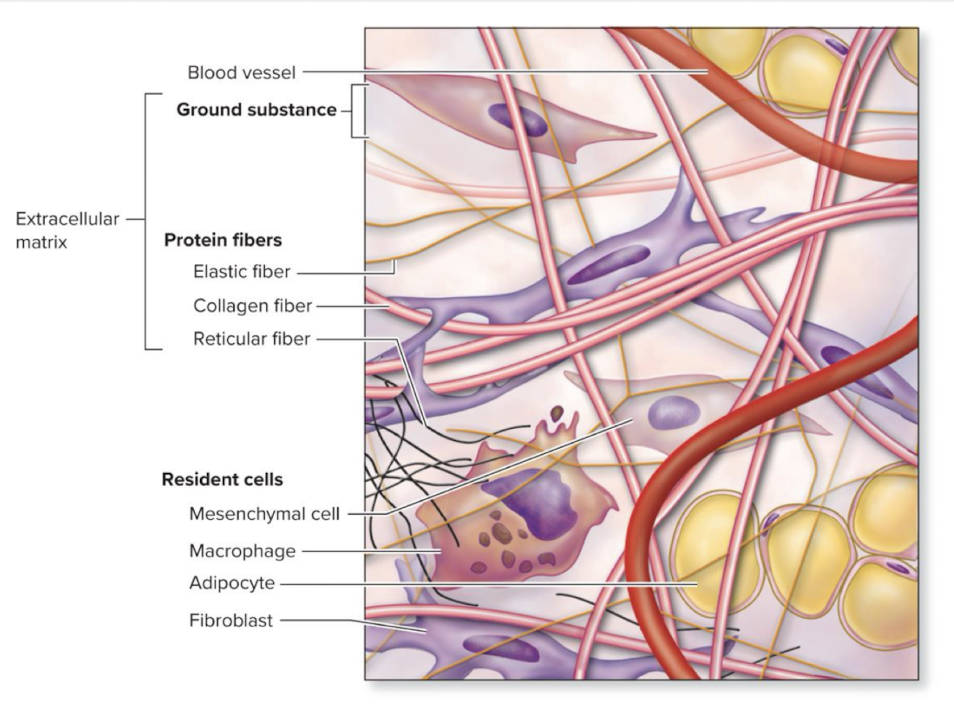
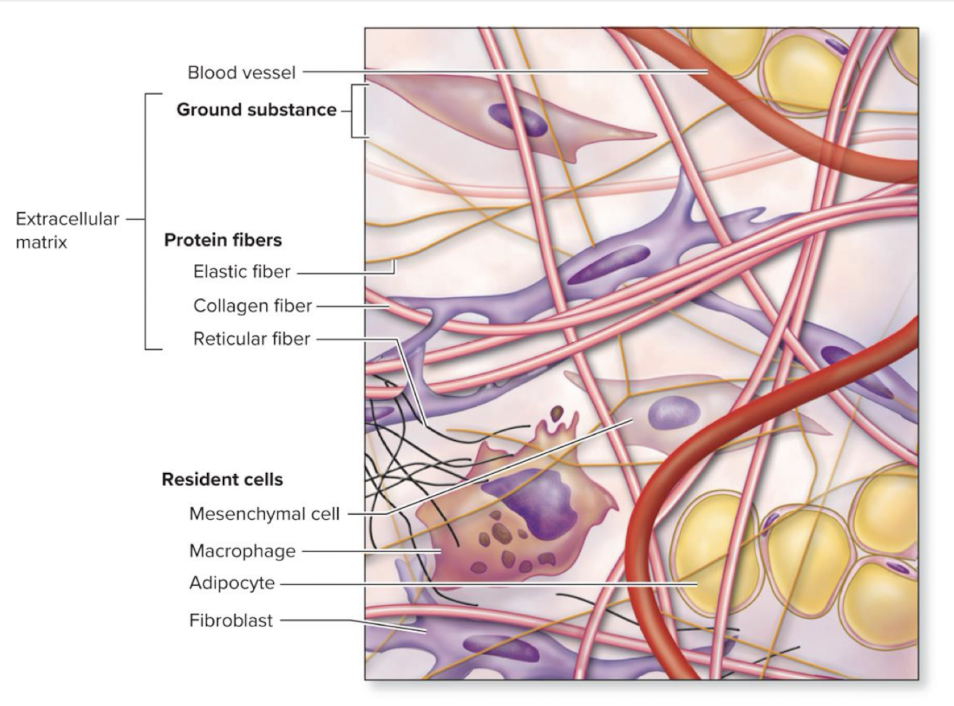
What are the three major components of connective tissue?
Cells, protein fibers, and ground substance.

What components make up the extraceullar matrix?
Protein fibers + ground substance
Material outside the cells consisting of fibers and ground substance

What are the three types of protein fibers in connective tissue?
Collagen Fiber
Elastin Fiber
Reticular Fiber

What are examples of connective tissue cells?
Fibroblasts, adipocytes, mesenchymal cells, and macrophages
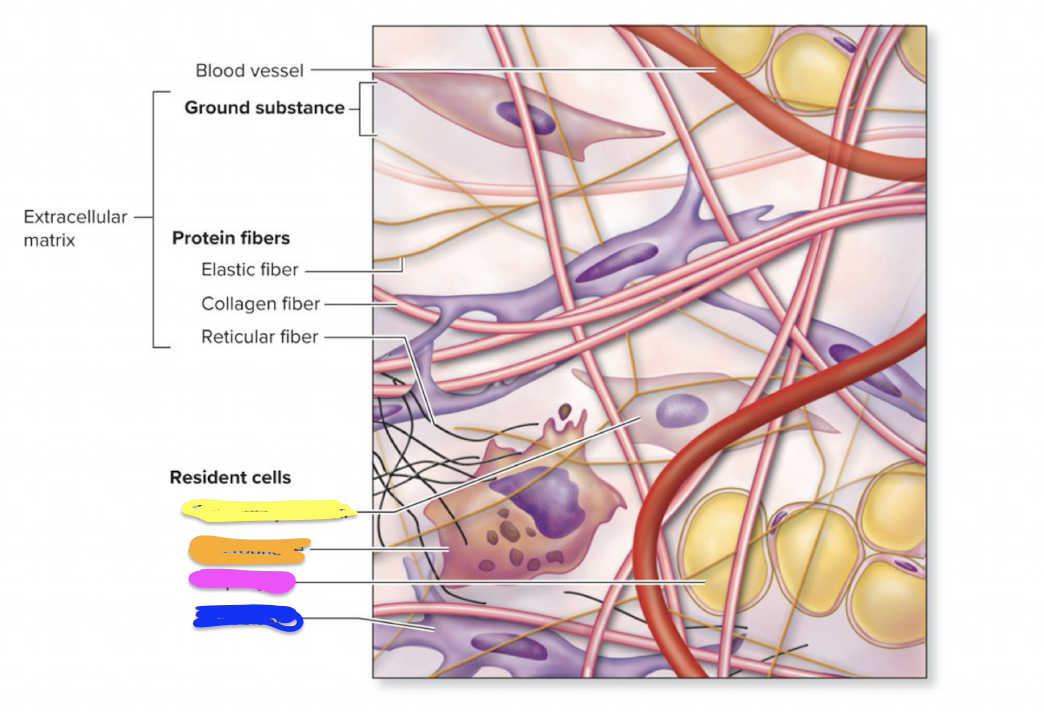
What is blue?
Fibroblast
Connective tissue cells associated with producing/maintaining the ECM and fibers
most prominent
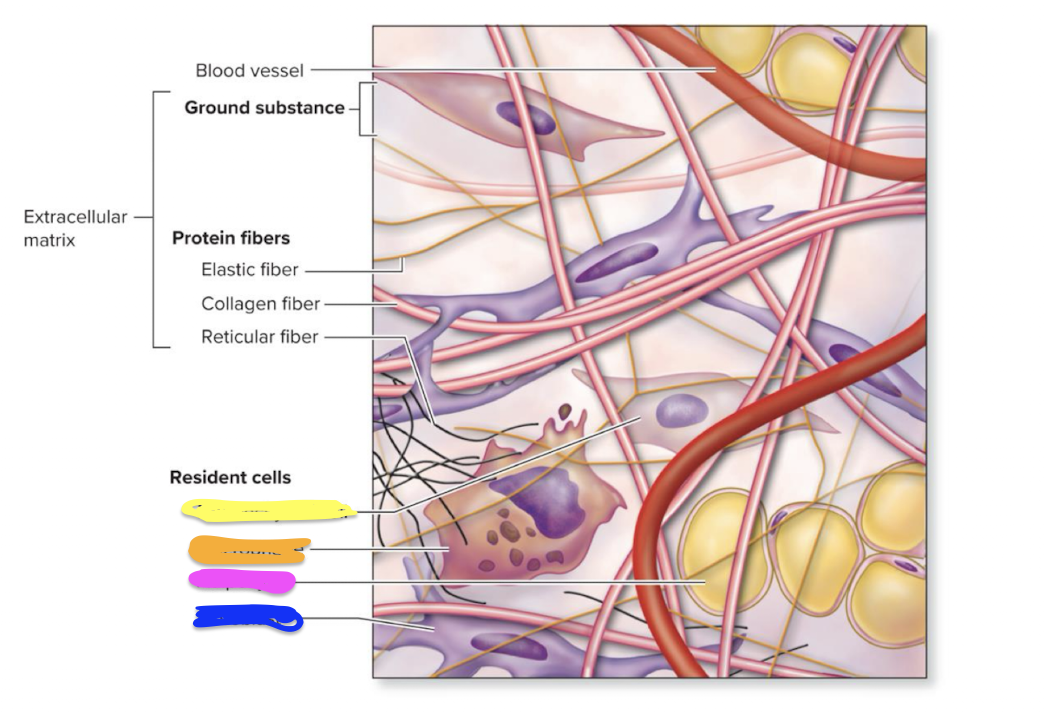
What is pink?
Adipocyte
fat cell

What is orange?
Macrophage
Connective tissue cells involved in engulfing foreign material/debris
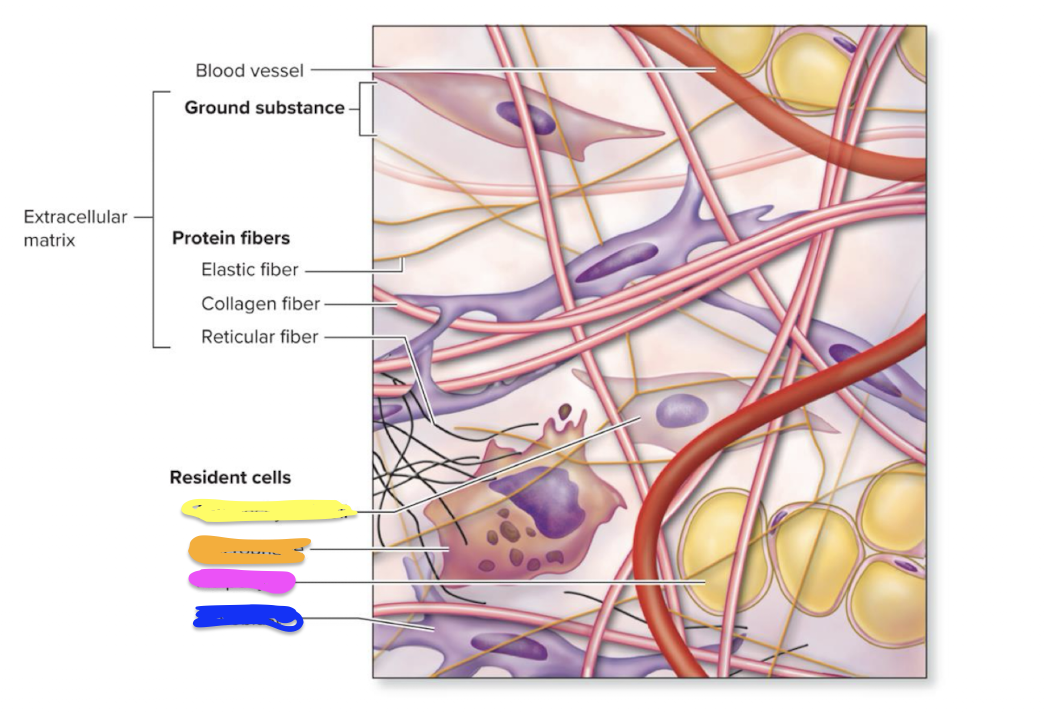
What is yellow?
Mesenchymal cell
multipotent stem cells that can develop into various types of connective tissues, including bone, cartilage, muscle, and fat
What is ground substance?
non-fibrous component of the extracellular matrix surrounding connective tissue cells and fibers.
Glycosaminoglycans, proteoglycans, and glycoproteins
What is collagen's general structural role? (protein fiber)
provide strength
especially strong
What is elastin's general structural role?
Provides elasticity/stretch and recoil
What are reticular fibers associated with?
Forming a supportive network/framework
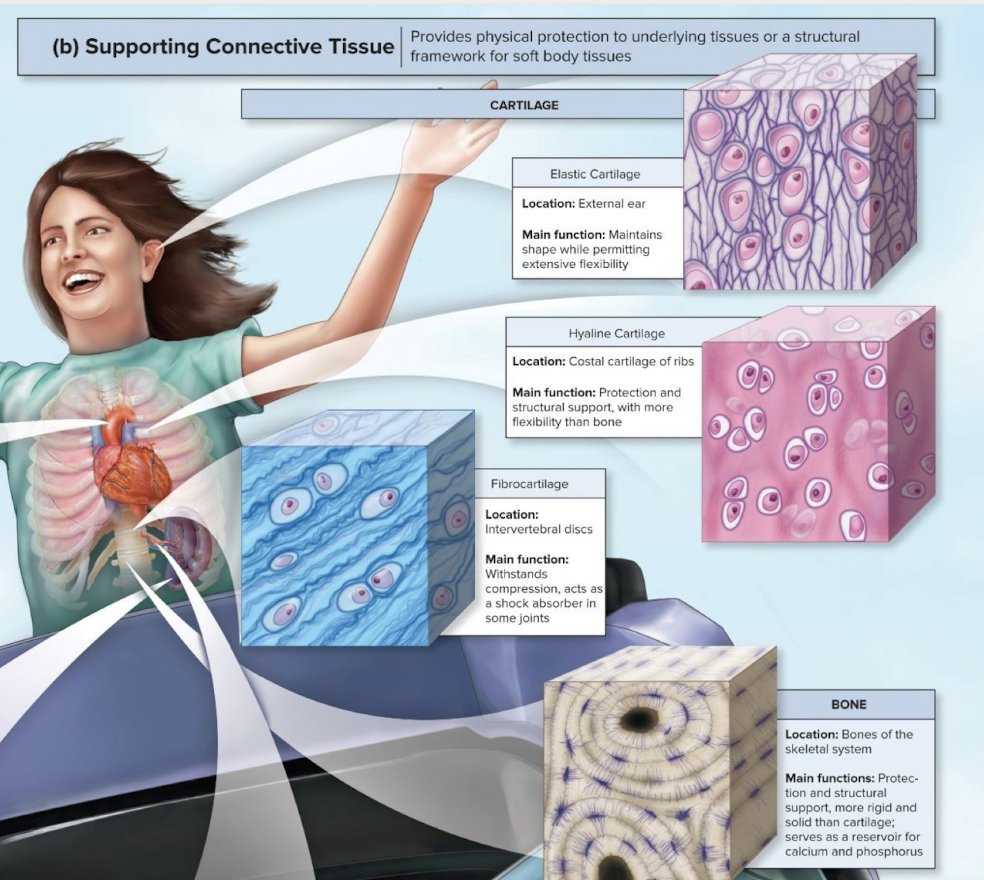
What are the three broad categories of connective tissue?
Connective tissue proper, supporting connective tissue, and fluid connective tissue

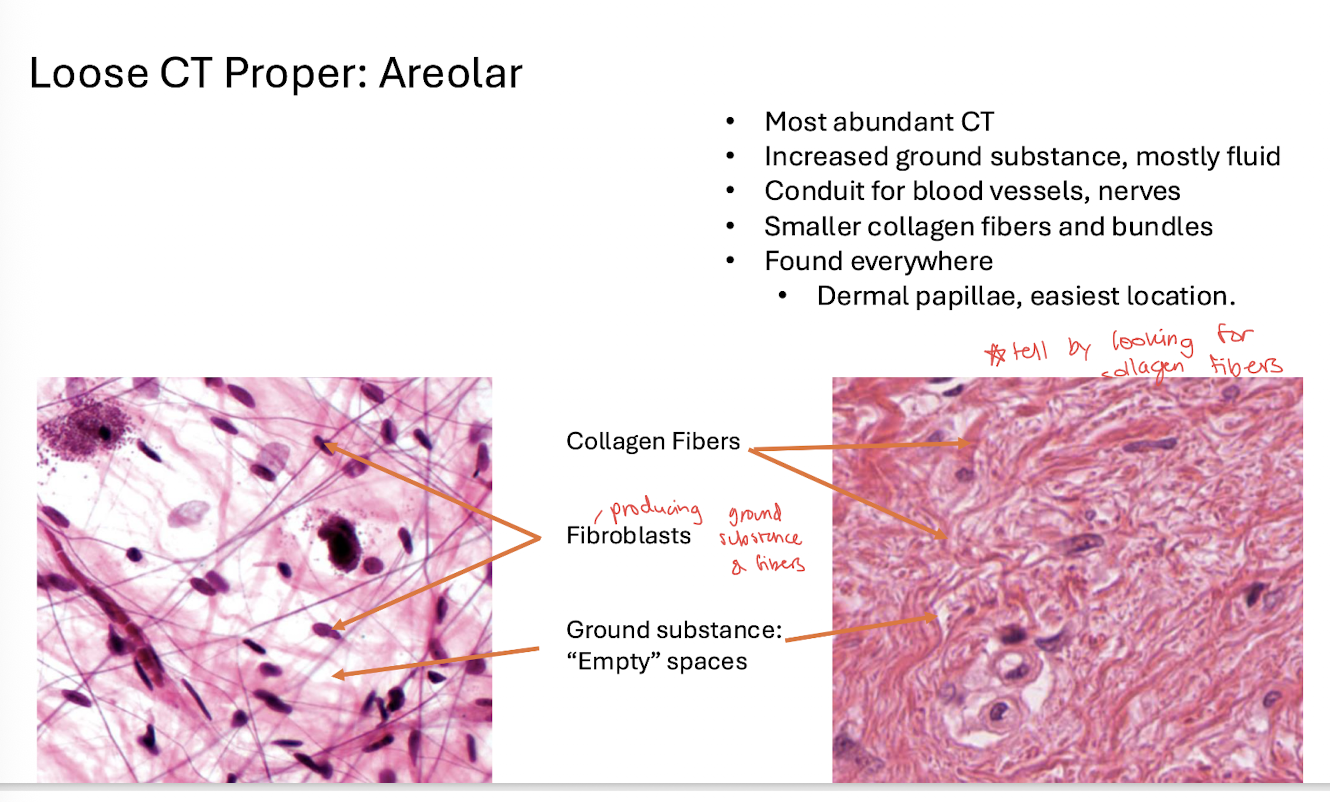
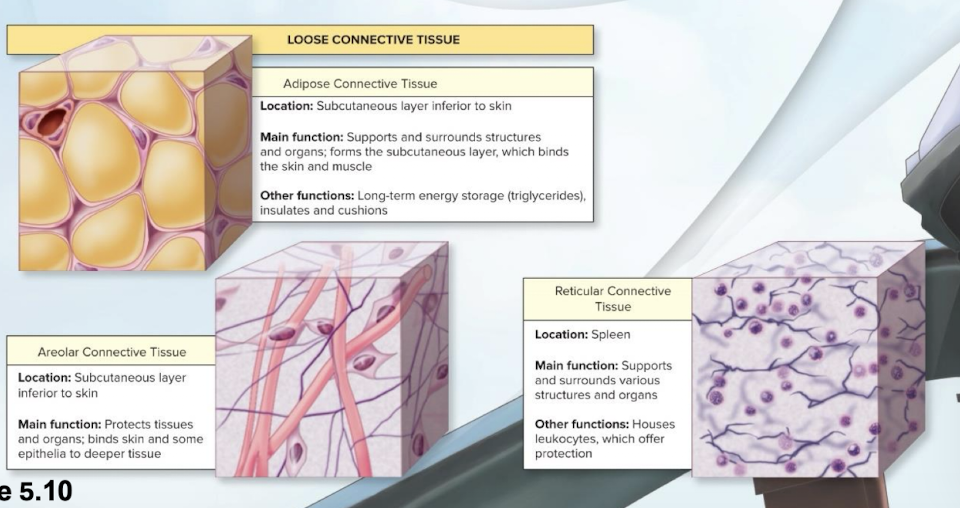
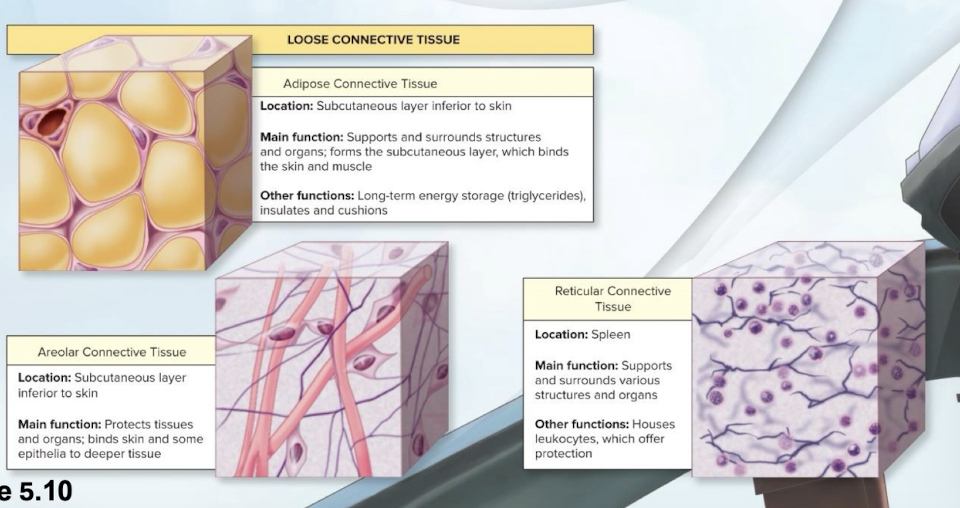
What type of connective tissue is areolar CT?
Loose connective tissue proper
Key = increased ground substance, which is mostly fluid
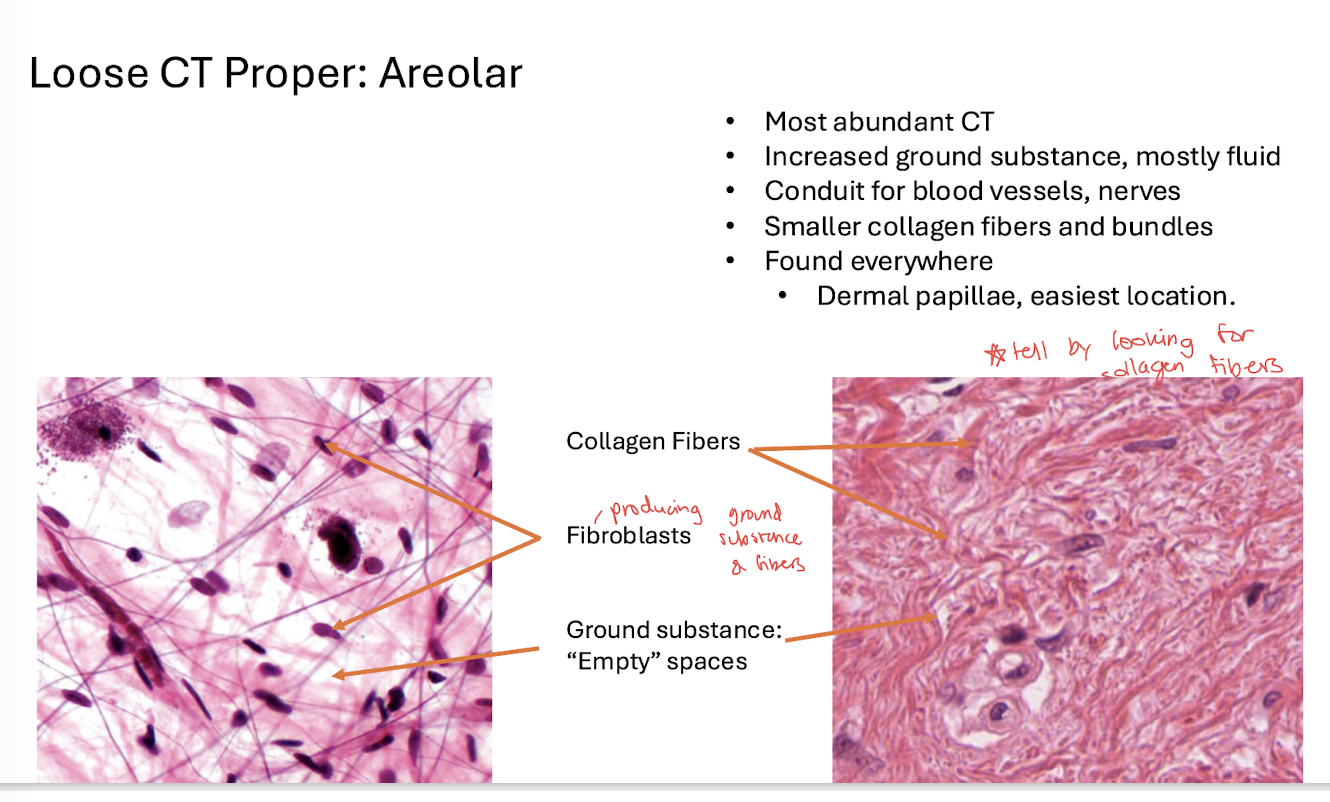
What is the function of areolar connective tissue?
It acts as a conduit for blood vessels and nerves and provides support/binding
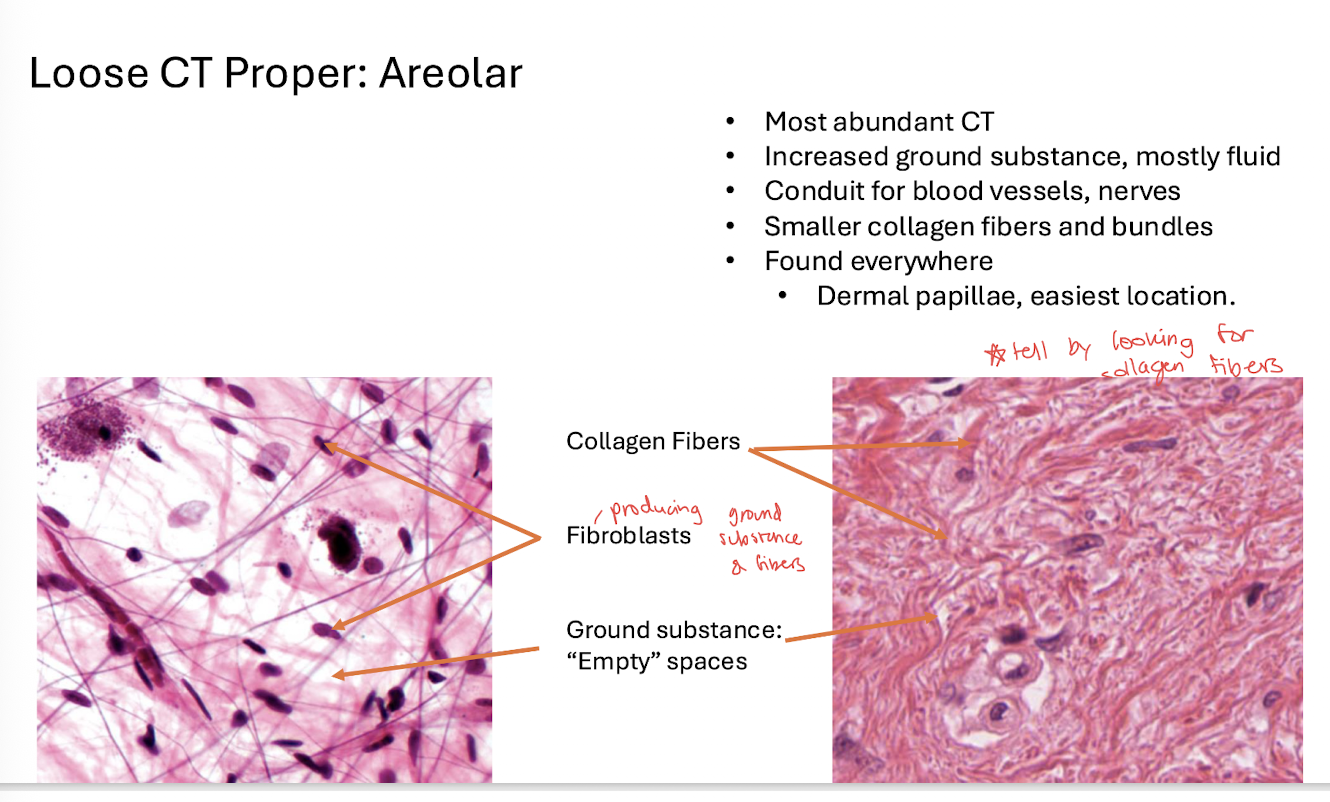
Where is areolar connective tissue found?
Throughout the body; dermal papillae are an easy location to identify.
the most abundant connective tissue
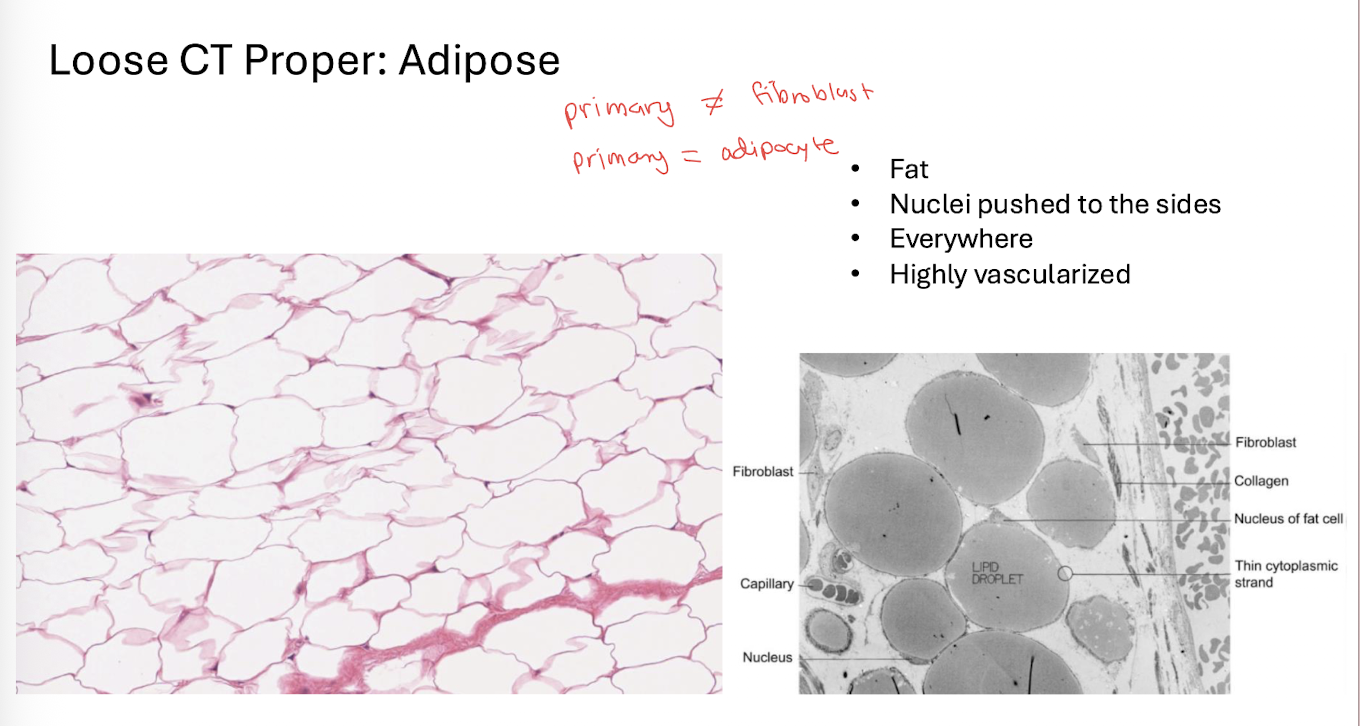
What type of connective tissue is adipose?*
Loose connective tissue proper

What is the primary characteristic of adipose tissue?
contains adipocytes/fat cells → fat storage
Highly vascularized, found everywhere (especially subcutaneous layer)
What type of connective tissue is reticular CT?
Loose Connective tissue proper

Where is reticular connective tissue found?
Lymph nodes & spleen

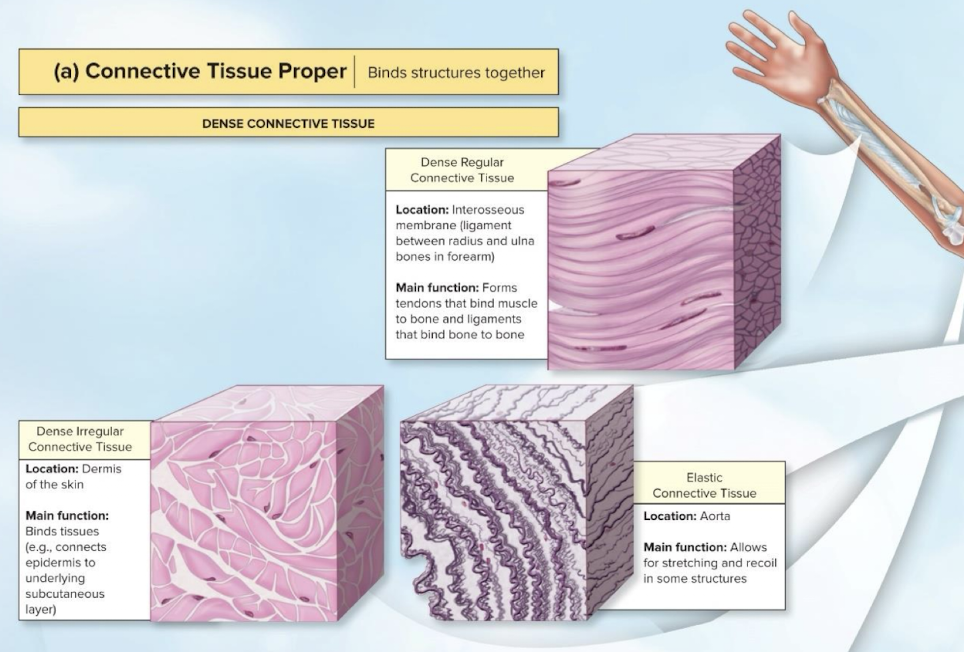
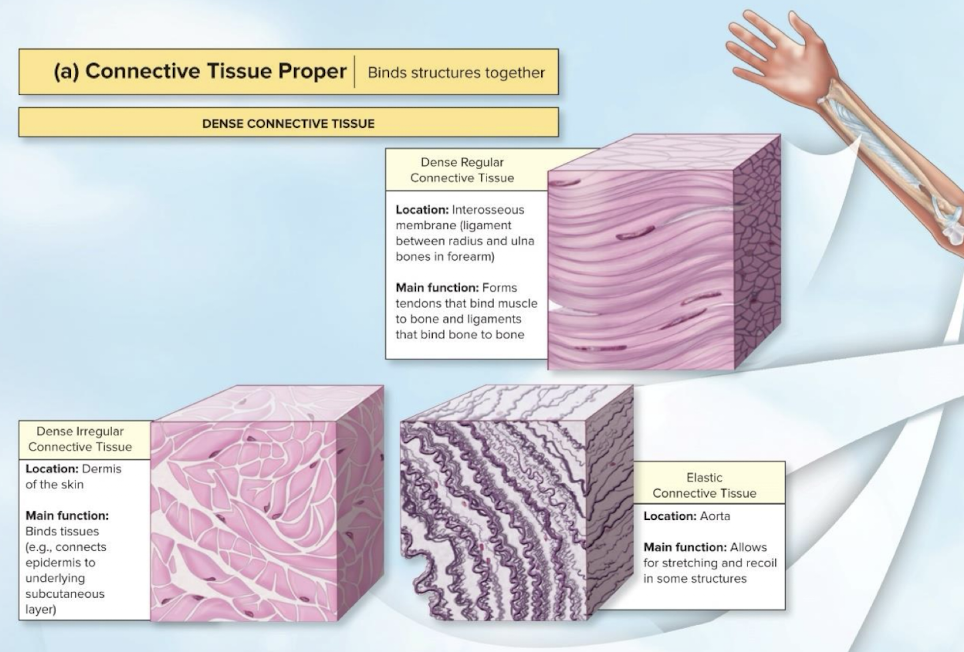
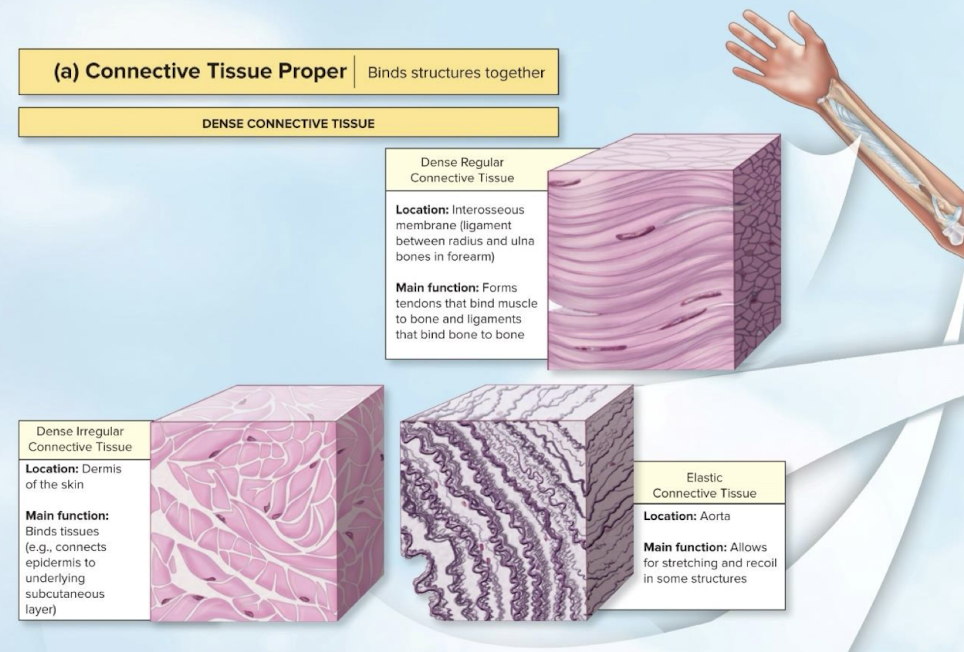
What type of connective tissue is dense regular CT?
Dense connective tissue proper.
large collagen fibers running parallel with little ground matrix
occasional fibroblast

What is the main function of dense regular CT?
Provides strong tensile strength in one primary direction.
Tendons and ligaments
parallel arrangement provides strong resistance to pulling forces along the direction of the fibers.

What type of connective tissue is dense irregular CT?
Dense connective tissue proper.
decreased ground matrix
Large collagen bundles
NOT parallel → strong in multiple direction
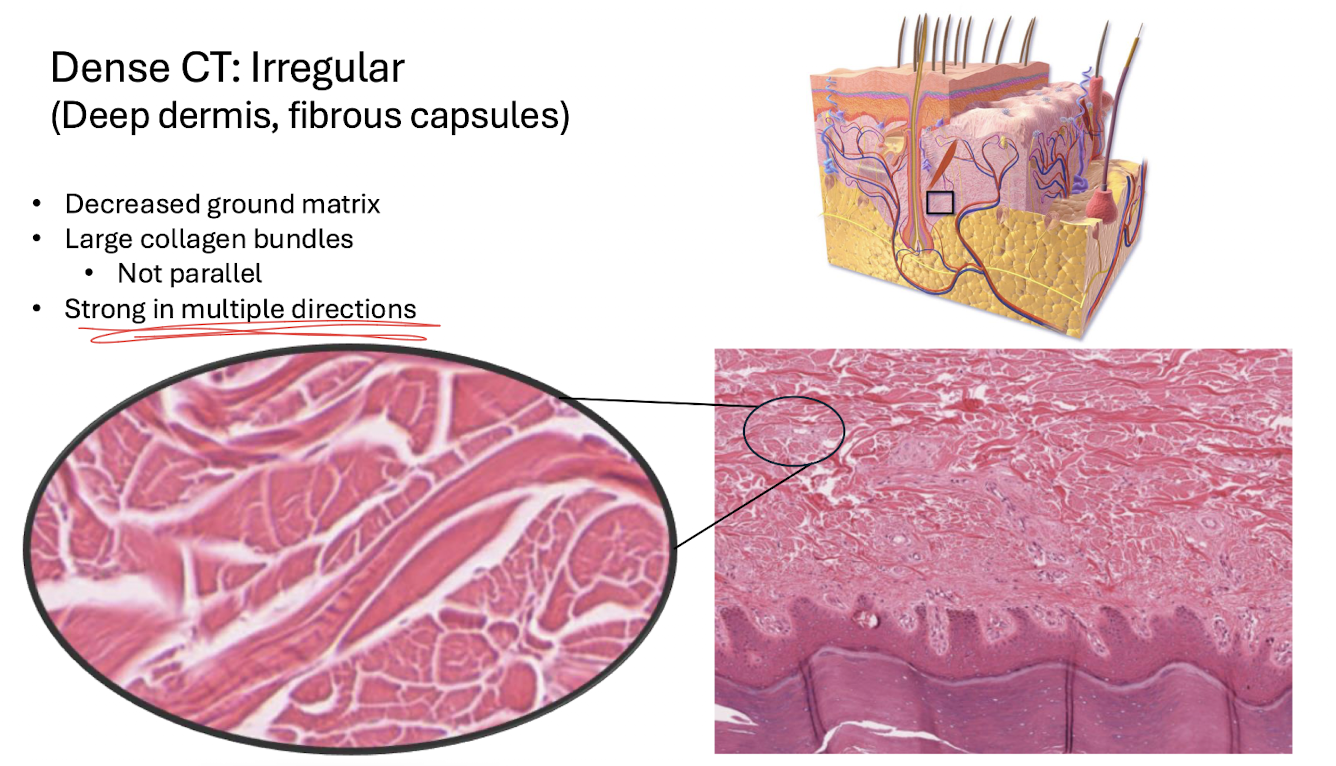
What is the function of dense irregular CT?
Provides strength in multiple directions.
Found in Deep dermis and fibrous capsules

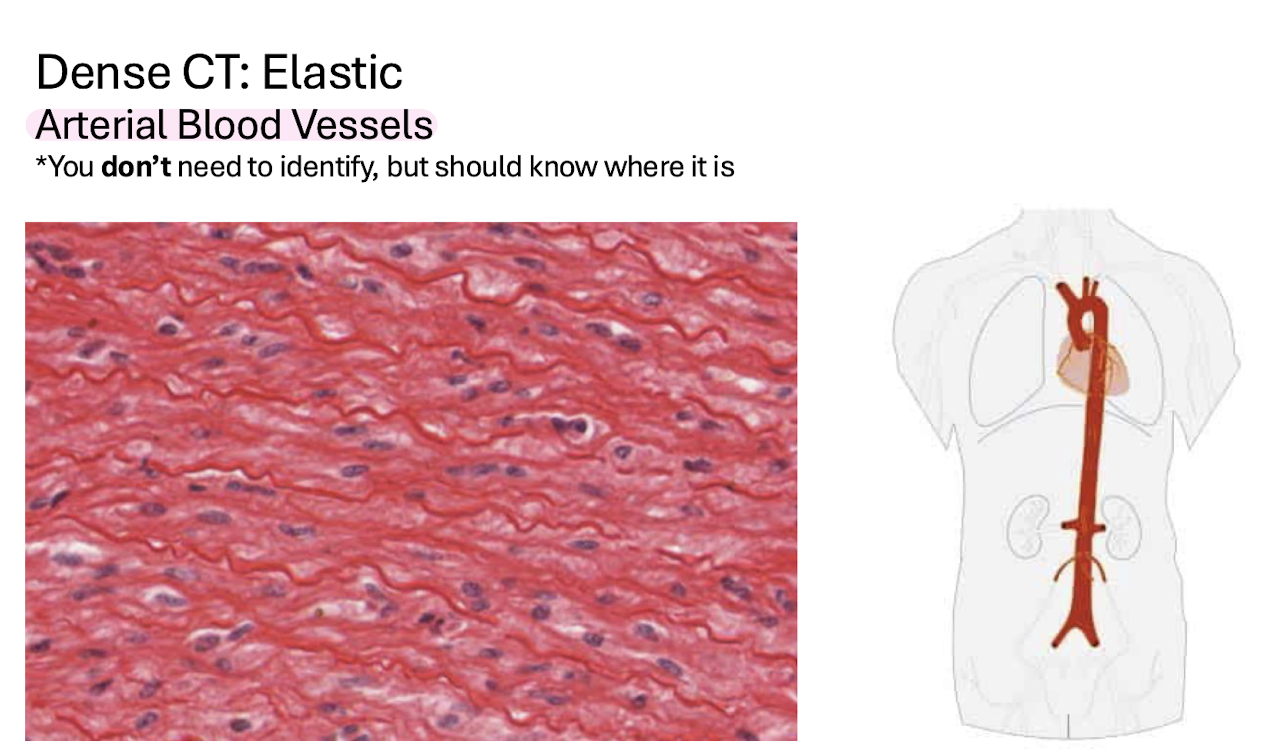
What type of connective tissue is elastic CT?***
Dense connective tissue proper***

Where is elastic connective tissue found?
Arterial Blood Vessels
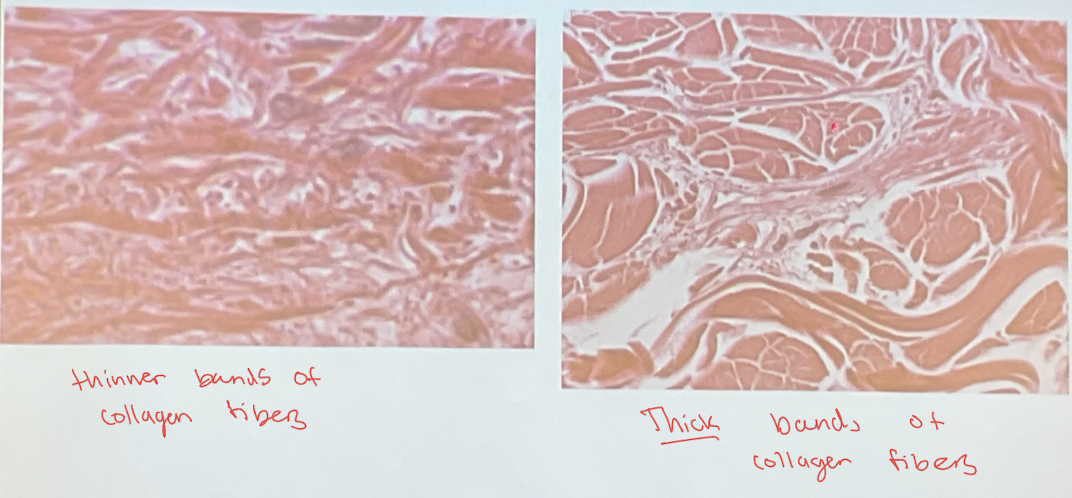
Which is loose aerolar CT and which is dense irregular CT ?
left = aerolar
right = dense irregular
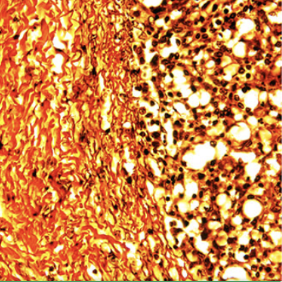
Tissue?
Proper Loose Reticular Connective Tissue
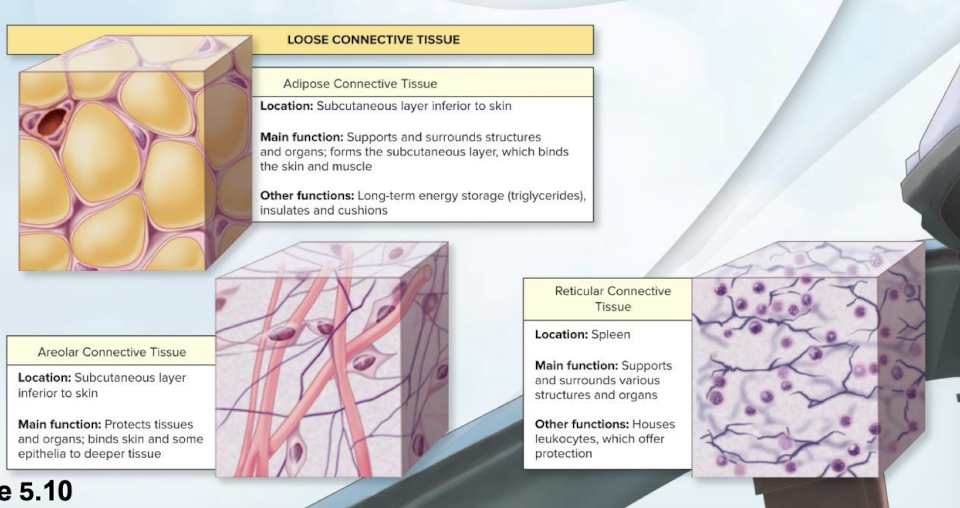
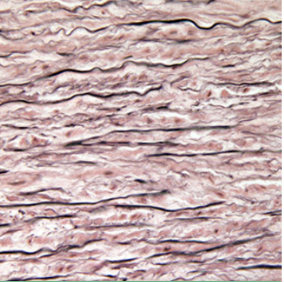
Tissue?
Proper Dense Elastic Connective Tissue
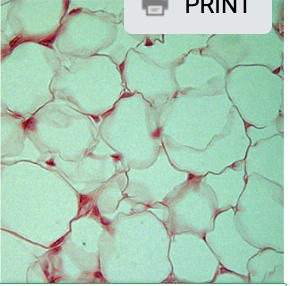
Tissue?
Proper loose adipose connective tissue

Tissue?
Proper loose areolar connective tissue.

Tissue?
Proper dense irregular connective tissue.
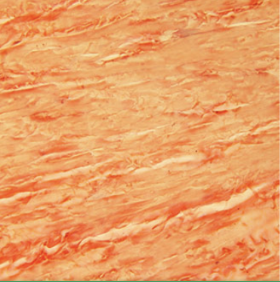
Tissue?
Proper dense regular connective tissue.
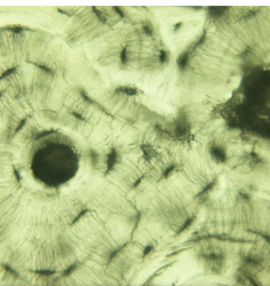
Tissue?
Bone CT
Osteocytes
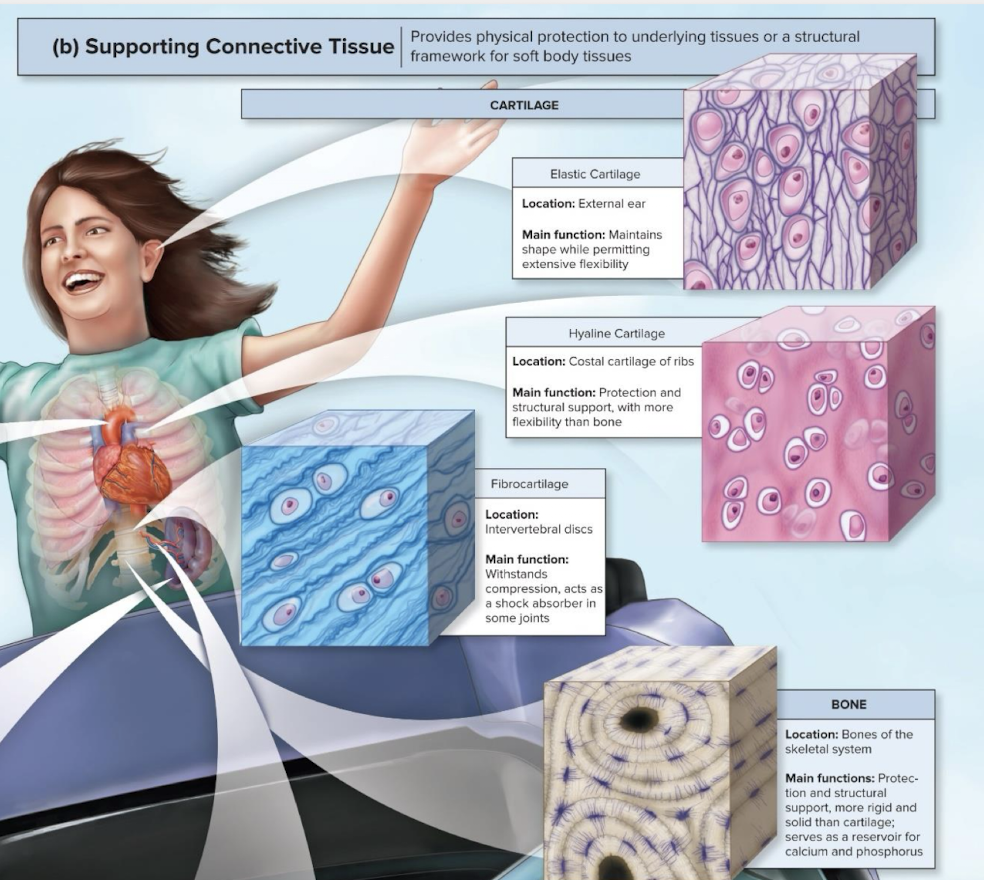
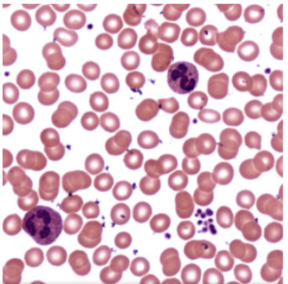
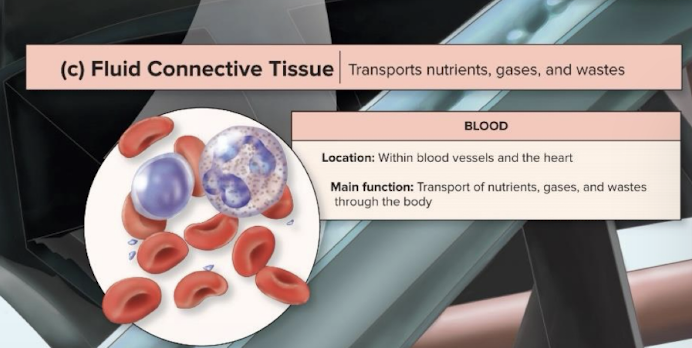
Tissue?
Blood CT
Fluid Ct

Tissue?
Hyaline Cartilage
Supporting Connective Tissue


Tissue?
Elastic Cartilage
Supporting Connective Tissue
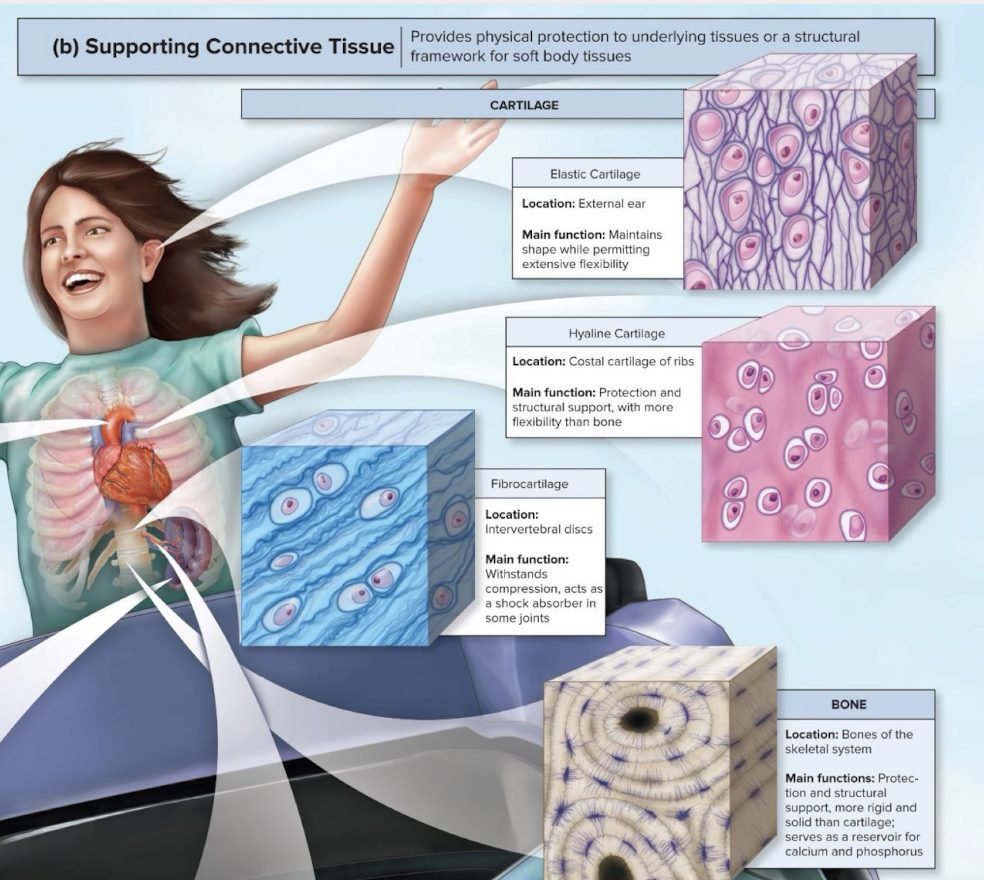

Tissue?
Fibrocartilage
Supporting Connective Tissue
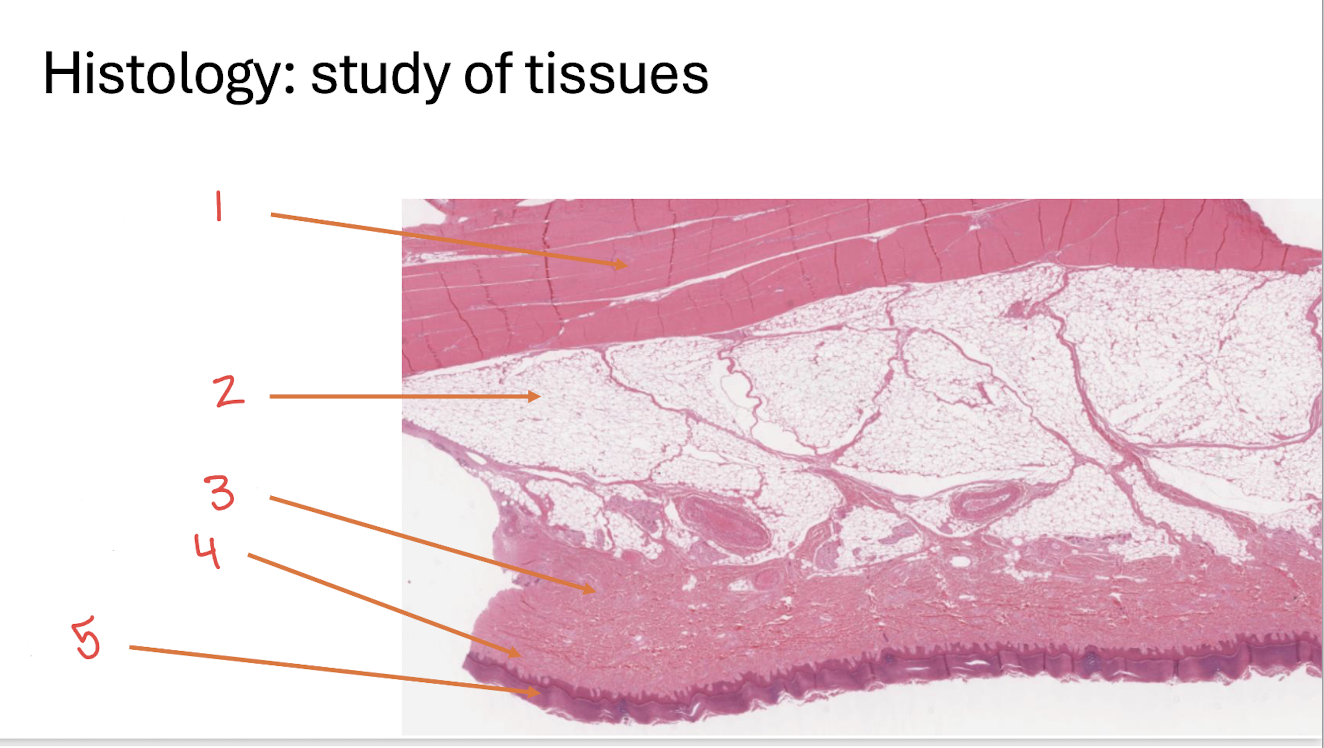
What is 1? #
Dense Regular CT proper #
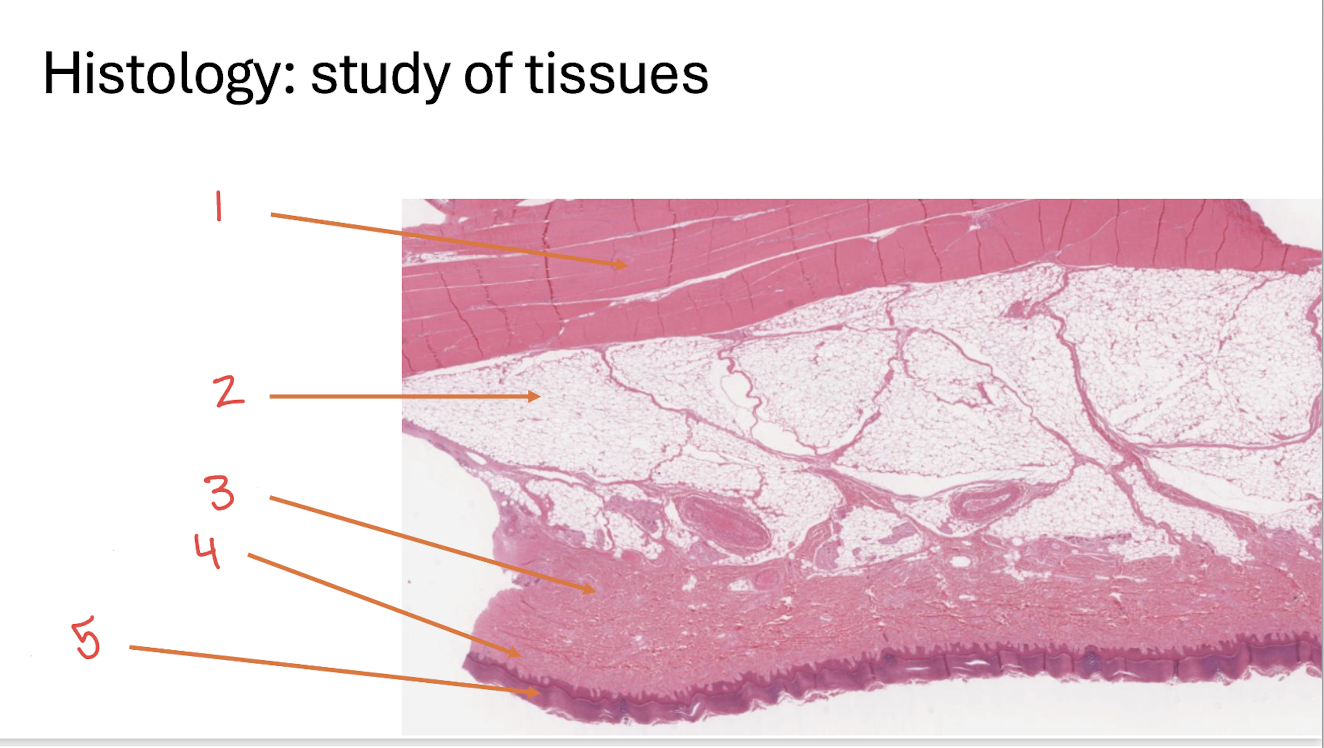
What is 2? #
Adipose Loose CT Proper #
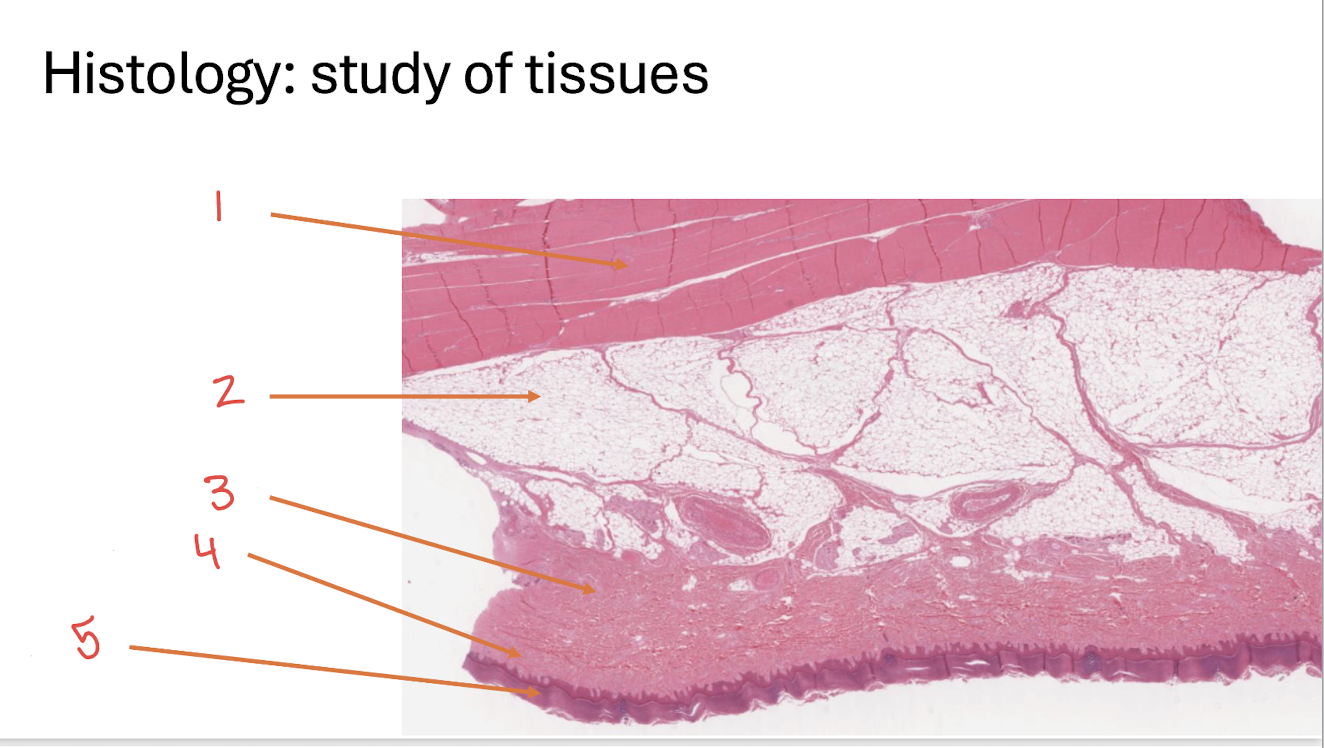
What is 3? #
Dense Irregular loose CT proper #
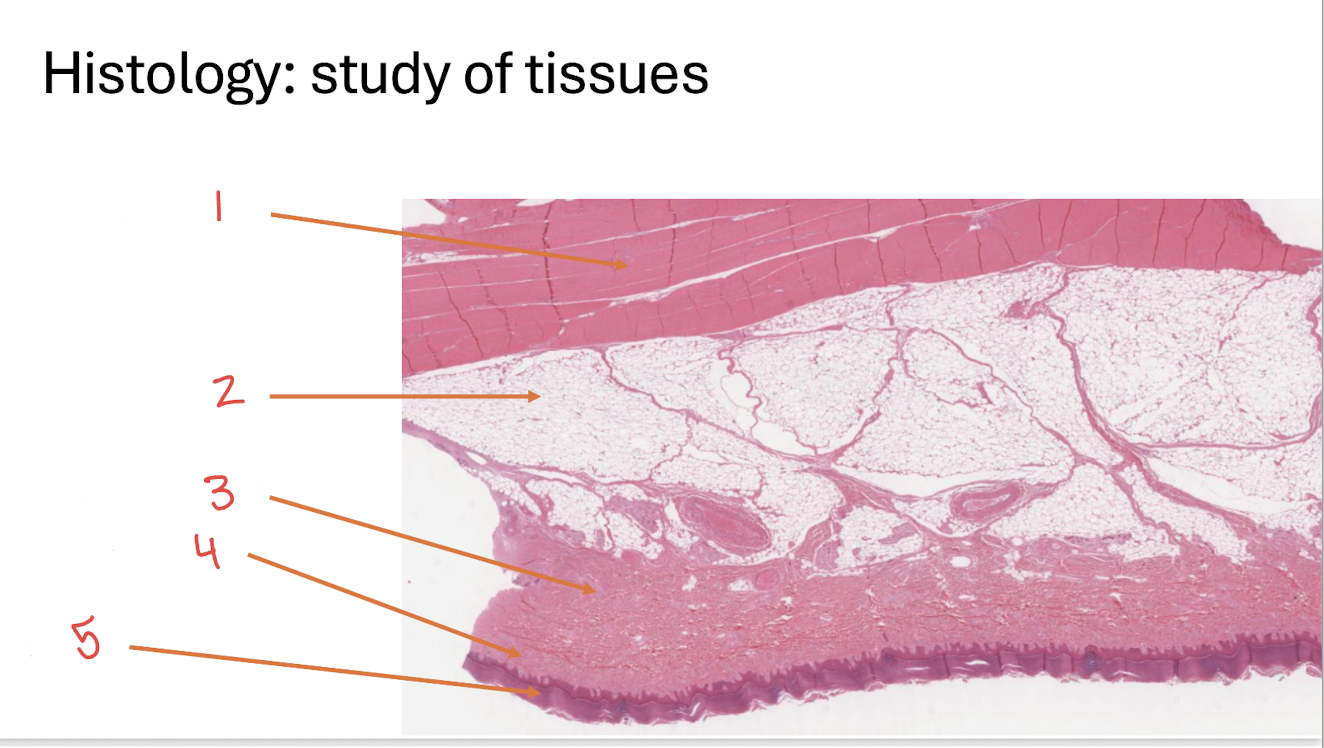
What is number 4? #
Areolar loose CT proper #

What is number 5? #
Stratified Squamous ET, keratinized #