KIN 1600 Chapter 3: Social Connections
 Call Kai
 Learn
Learn Practice Test
 Spaced Repetition
 Match
Match Flashcards
 Knowt Play
1/48

There's no tags or description
Looks like no tags are added yet.
Name | Mastery | Learn | Test | Matching | Spaced | Call with Kai | Chat |
|---|
No analytics yet
Send a link to your students to track their progress
49 Terms
healthy personal relationship
Relationships are at the heart of the human experience.
•Family.
•Community.
•Classmates, teammates, and colleagues.
•Acquaintances and friends.
what are some difficultuies and challenges with relationships
•Divorce.
•Single-parent and blended families.
•Living alone.
Electronic connections.
attributes that make successful relationships possible
•Healthy sense of self.
•Reasonably high self-esteem.
•Capacity for empathy.
•Ability both to be alone and to be with others.
friendship
a reciprocal relationship based on mutual liking and caring, respect and trust, interest and companionship.
•Considered longer-lasting and more stable when compared with romantic partnerships.
•Offers a psychological and emotional buffer against stress, anxiety, and depression.
Intimate relationships with a partner have similarities to friendships, but also other qualities…
•More exclusive.
•Deeper levels of connection and caring.
•Sexual component.
characteristics of successful partnership
•Independence and maturity.
•Self-esteem and mutual respect.
•Understanding of the importance of good communication.
•Open expression of sexual affection and respect.
•Enjoyment of time spent with each other, and time spent alone.
•Acknowledgment of strengths and failings.
•Assertive and flexible in wants and needs.
•Handle conflict constructively.
•Friends as well as lovers, with a focus on unselfish caring.
•Good relationships with family and friends.
•Shared spiritual values.
attraction
people seem to use a systematic screening process when deciding if someone could be a potential partner.
factors that promote attraction
•Proximity—or, sometimes determined by proximity, familiarity.
•Physical attractiveness.
•Similar characteristics, including values and attitudes.
The process of finding a partner: dating and more
Indirectness is not an effective strategy.
•People who are straightforward and respectful in developing a relationship are more likely to get a positive response.
Partners are often found through social connections.
Social Media has expanded our social networks.
similarity theory
suggests that we fall in love with people who are similar to us in important ways.
social exchange theory
suggests that falling in love and choosing a partner are based on the exchange of “commodities.”; Love, status, property, and services.
the course of love
The beginning stages of falling in love can feel like a roller-coaster ride.
•“Lovesick.”
The experience of love likely involves increased levels of dopamine
•Causes arousal of the sympathetic nervous system.
•Intense passion may subside as lovers become habituated to each other.
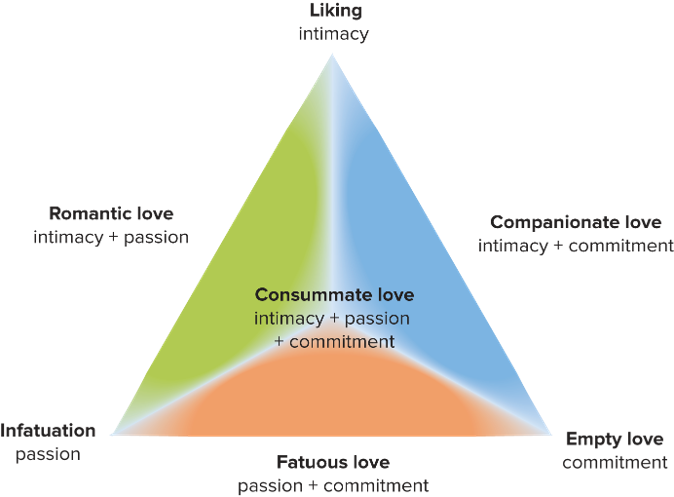
Sternberg’s Triangular theory of love
•Intimacy, the emotional component.
•Passion, the sexual component.
•Commitment, the decision aspect.
you don’t need all of them to love
nonverbal communication
takes place through facial expressions, eye contact, gestures, body position and movement, and spatial behavior
metamessage
the unspoken message in communication; the meaning behind the message is conveyed by nonverbal behavior and situational factors such as how, when, and where the message is delivered.
good communication skills…
help make conflict constructive
•Before you speak, know what you want to say.
•Use “I” statements: “I feel . . . when you . . .” versus “You make me feel . . .”
•As a listener, give the other person time and space.
•Assertiveness: speaking up for yourself without violating someone else’s rights.
T/F: there is a pattern that men are more likely to use communication to compete, and women are more likely to use communication to connect.
true
sex
is a person’s biological status as a male or a female, usually established at birth by the appearance of the external genitals.
intersex
is a condition in which the genitals are ambiguous at birth
gender
refers to the behaviors and characteristics considered appropriate for a male or a female in a particular culture.
cisgender
an individual whose gender matches an assigned sex
gender role
a set of behaviors and activities a person engages in to conform to society’s expectations.
gender identity
is an internal sense of being male or female
transgender
those whose gender identity differs from the sex they are assigned at birth.
sexual orientation
refers to a person’s emotional, romantic, and sexual attraction to a member of the same sex, the other sex, or both.
heterosexuality
emotional and sexual attraction to members of the other sex.
homosexuality
emotional and sexual attraction to members of the same sex.
bisexuality
emotional and sexual attraction to members of both sexes.
T/F: Marriage is not only the legal union of two people, but also a contract between the couple and the state.
true
T/F: The average age at first marriage has risen.
true
what are some characteristics of successful or unsuccessful marriages
•One predictor of a successful marriage: positive reasons for getting married.
•Infidelity mars some marriages but does not necessarily end them.
•Open marriage is being explored more as a new structure to marriage.
homophobia
irrational fear of homosexuality and homosexuals.
T/F: LGBTQ+ people are twice as likely to cite legal rights and benefits as being important.
true
cohabitation
a relationship in which two people of the opposite sex live together as unmarried partners.
More than 60 percent of marriages are preceded by a cohabiting relationship.
T/F: second marriages have a 40 to 50 percent probability of ending in divorce.
False. First marriages have a 40 to 50 percent probability of ending in divorce.
T/F: Divorce is a leading cause of poverty, leaving many children in impoverished homes headed by a single mother, often the parent with the lower income.
true
blended families
one or both partners bring a child or children from a previous marriage.
how many years does it take for children to build relationships with their stepparents
It can take two years or more for stepparents and stepchildren to build relationships.
cohesion
is the dynamic balance between separateness and togetherness in both couple and family relationships; Relationships are strongest when there is a balance between intimacy and autonomy.
flexibility
the dynamic balance between stability and change.
community
a group of people connected in a way that transcends casual attachment;
•Typically, as an association of like-minded people or people with common goals.
•Being active in a community usually has a positive impact on health.
values
the criteria for judging what is good and bad that underlies moral principles and behavior
purpose
•why am I here? What gives my life meaning? These questions have been asked by people all over the world. Searching for the answers is part of life's journey.
goals
when you identify and pursue your personal goals, you are taking responsibility for yourself.
spirituality
a person’s connection to self, significant others, and the community at large providing a sense of purpose and meaning.
dragonfly effect
how social media has been used to facilitate social change.
what are other ways to find community
volunteering, service learning, the arts, social media connections
service learning
a form of education that combines coursework with community service.