Logistics & Supply Chain Management
 Call Kai
 Learn
Learn Practice Test
 Spaced Repetition
 Match
Match Flashcards
 Knowt Play
1/79

There's no tags or description
Looks like no tags are added yet.
Name | Mastery | Learn | Test | Matching | Spaced | Call with Kai | Chat |
|---|
No analytics yet
Send a link to your students to track their progress
80 Terms
What is logistics?
studies activities determining the flow of materials in a company from their origin at the supplier to delivery of the finished products to the customer & post-sales service
ensures delivery of the right good in the right quantity in the right condition at the right time on the right place with the highest possible economic efficiency
DMAIC: define, measure, analyze, improve, control
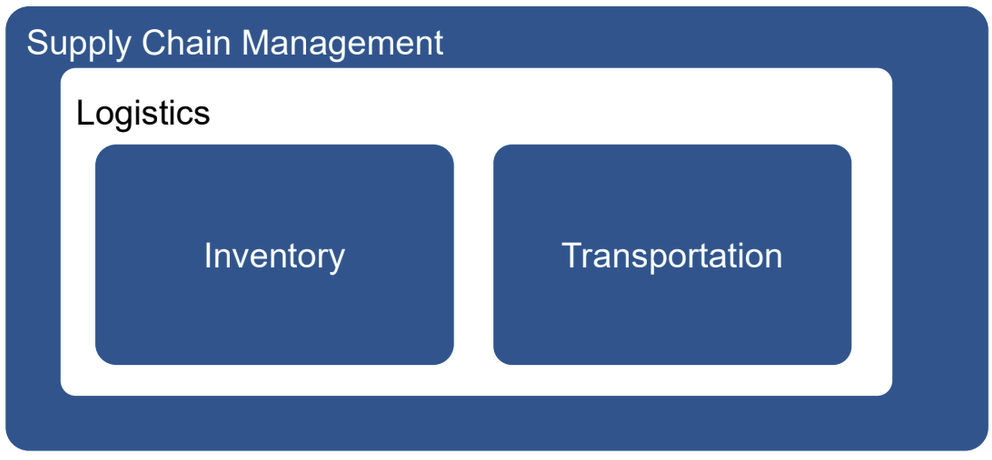
What is the hierarchy of supply chain management?
What aspects does logistics deal with?
location of facilities
transportation modes & routes
supplier selection, strategy & coordination
inventory management
urban logistics, last-mile deliveries
humanitarian logistics
What are the goals of urban logistics?
determine which parcels should be delivered on which route and in which order → route planning
forecast delivery time → synchronization
how parcels are packed in a vehicle
what happens if delivery is unsuccessful
time windows of customers
unattended delivery (e.x. packaging stations, mobile delivery boxes)
drove delivery
robot delivery
crowd-logistics (e.x. car sharing, Amazon logistics)
What is sustainable supply chain management?
include all sustainability criteria
ensure responsibility of suppliers
lower emissions in transportation & production
recycling
What are the 3 levels of logistics?
micro-logistics
business logistics
procurement, production, distribution, reverse, spare parts
supply chain management
production management
transportation logistics
macro-logistics
macroeconomic aspects: infastructure & traffic (e.x. roads, harbor capacity, bridges)
modes of transport (air, rail, ship, trict)
meta-logictics
cooperations
What are the 3 main logistics strategies?
cost leadership: economies of scale
fix cost degression, technology choice
learning curve
centralization
product differentiation: economies of scope
service orientation
diversity (color, design)
decentralization
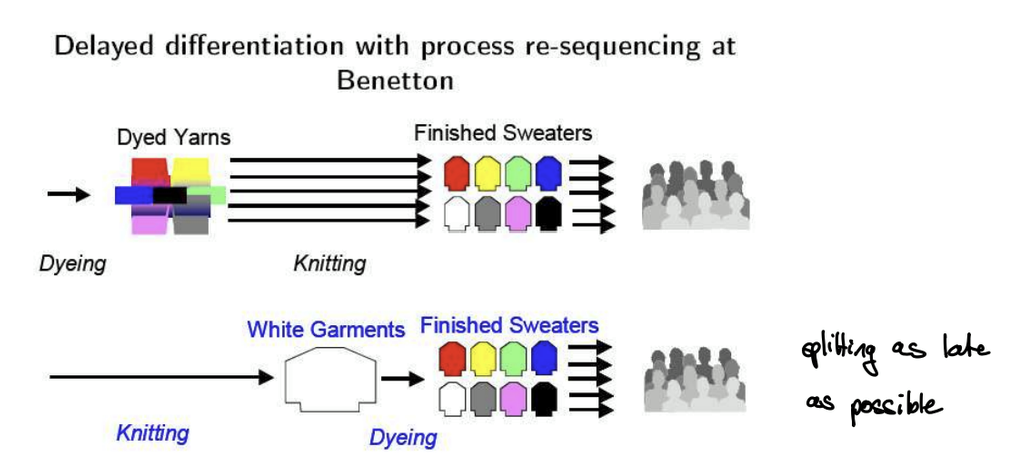
mass-customization: combination, postponement
What are the common costs of logistics?
control & system costs: design, planning & monitoring of the material flow
inventory costs: cost of capital, insurance, devaluation
storage costs: holding & operating warehouse capacity
transportation costs: internal, external, inbound, outbound
handling costs: packaging, transshipment, picking
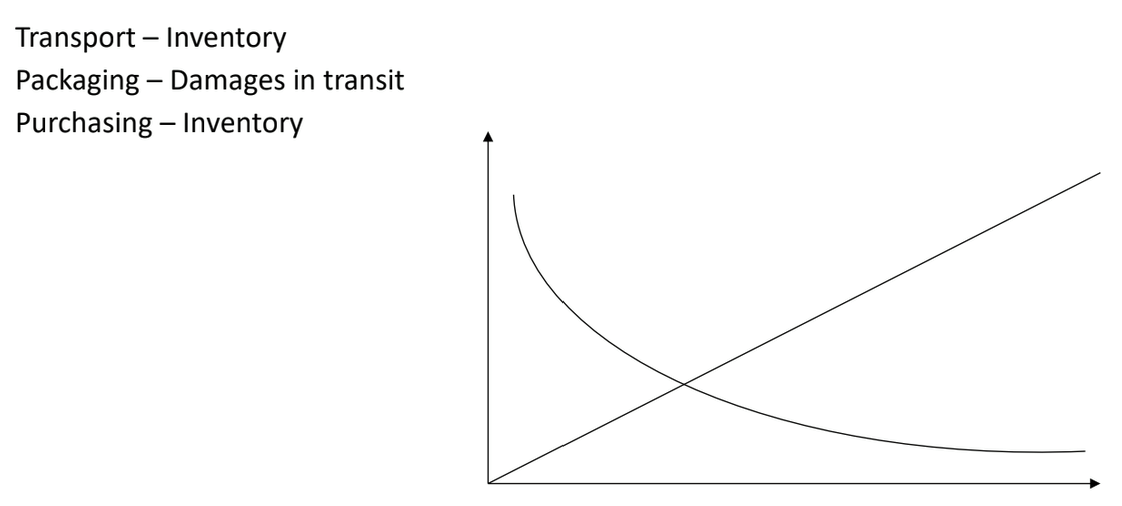
What is the function of cost trade-offs?
What do nodes and edges represent in a logistics problem?
nodes: warehouse, hub, container terminal, airport, seaport
edges: transport routes (symmetric, asymmetric)
evaluation
distances (linear, real)
travel times (depending on daytime)
costs
capacities (e.x. pipeline, truck size)
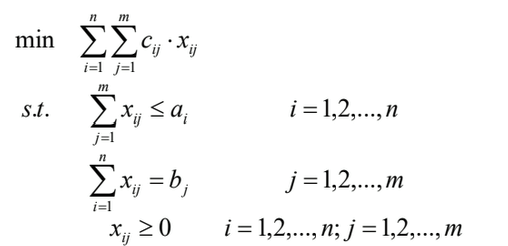
What is the transportation optimization model?
Data
n sources with capacity ai
m sinks with demand bj
Transportation costs cij per unit from source i to sink j
Decision variables
Transportation quantity xij from source i to sink j
Constraints
Ensure capacities
Satisfy demands
Objective
Minimizing total transportation costs
Solution methods
Simplex
Heuristics: NWCR, matrix minimum
What are the applications of the transport optimization model?
supply network planning
decentralized production planning
supplier selection
selection of modes of transportation
production smoothing (average out volume and mix of items manufactured over time → eliminate peaks)
cross-docking and transshipment
container logistics (redistribution of empty containers → rebalancing problem)
shared mobility (bike & car repositioning)
What are the applications of the travelling salesman problem?
delivery of goods
sequence of delivery/pickup
sub-problem of vehicle routing
order picking in warehouses
vehicle deployment problems
avoidance of idle times
production control
sequence dependent set-up costs
cutting stock problems
How is the optimization of the travelling salesman problem expressed mathematically?
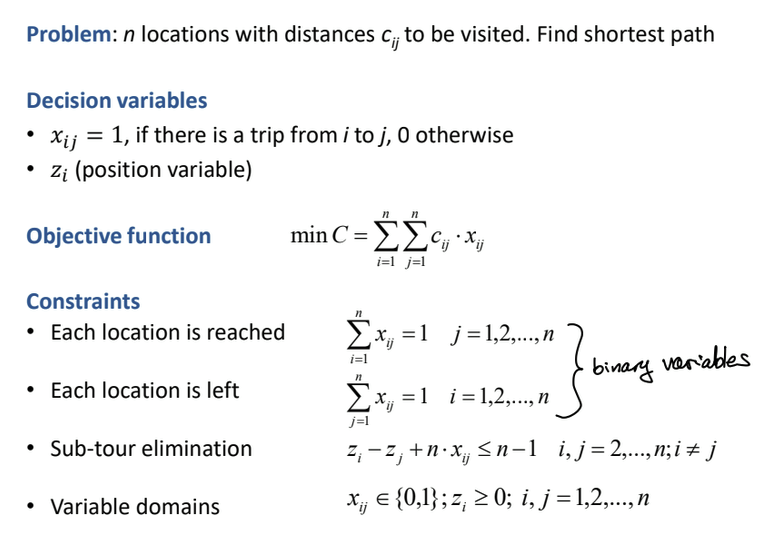
What is the difference between the nearest neighbor and successive insertion heuristics?
Construction procedures
Nearest neighbor
Start at an arbitrary node
Go from the current node to the closest node, which has not yet been visited
Successive insertion
Insert any node, which has not yet been visited, in the best possible way into the so far constructed tour
What is the 2-opt procedure?
Improvement of a tour through removing two edges and replacing these with two different edges
Iteration, until no further improvement is possible
What is the difference between the travelling salesman and the vehicle routing problem?
TSP: find one tour containing all locations
VRP: assign location to tours and then determine optimal order
What are the traits of the vehicle routing problem?
depot: start & end of delivery trips
tour: set of all customers who are supplied by one vehicle in one tour
route: sequence of customers of one tour
standard problem
one depot
single planning period
no time windows
methods
route first, cluster second
determine giant tour without capacity constraints (TSP) → go back to depot if next customer cannot be visited with given capacity
cluster first, route second → sweep method
parallel clustering & routing → savings method
sij = d0i + d0j - dij
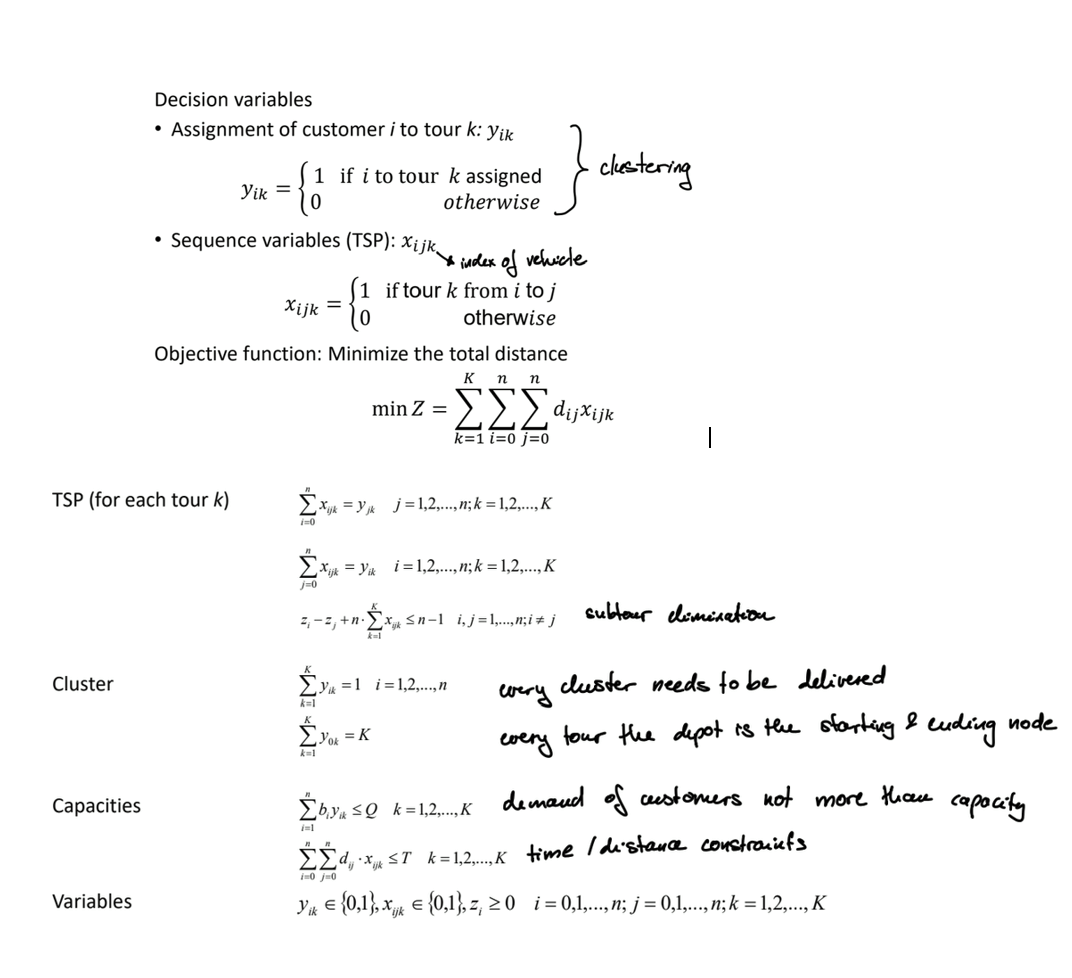
How is the vehicle routing problem expressed mathematically?
One depot (without loss of generality) with index 0
n customers (i=1,2,...,n) with demand bi
Complete deliveries in one tour (no split deliveries)
Distances between customers or depot and customers dij, i=0,1,...,n; j=0,1,...,n (for simplification: symmetric)
K identical vehicles
Capacity Q (volume, customers)
Time restriction T
What are the packaging levels?
good (loose goods, fluids, mass product)
article (package, bag, can)
outer packaging (pallet, carton, box)
delivery (parcel, pallet, container)
load (freight)
transport (truck, ship, wagon)
What are the packaging tasks?
package design
volume, weight, bulkiness, fragility
legal conditions
packaging type, packaging material
packaging process
automation
closed-loop economy processes
returns
disposal
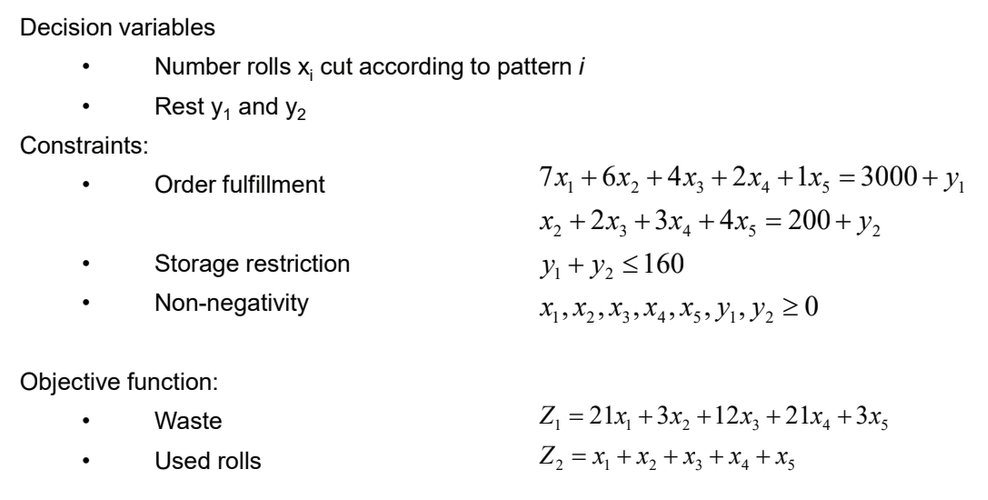
How do you model the cutting stock problem?
Data
Order data
Technology, specification of cutting patterns
Storage capacity
Decision: Choice of cutting pattern and the respective quantity
Objective: Minimization of waste
Constraints
Fulfillment of orders
Compliance with technology
Storage capacity
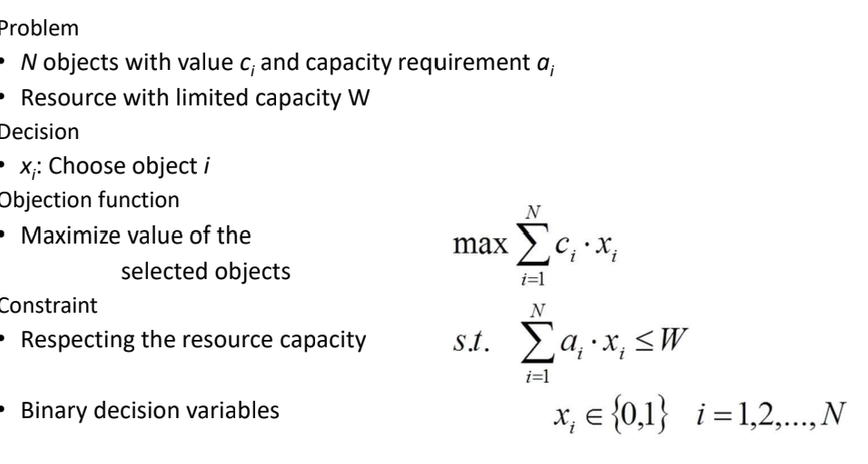
What is the Knapsack problem?
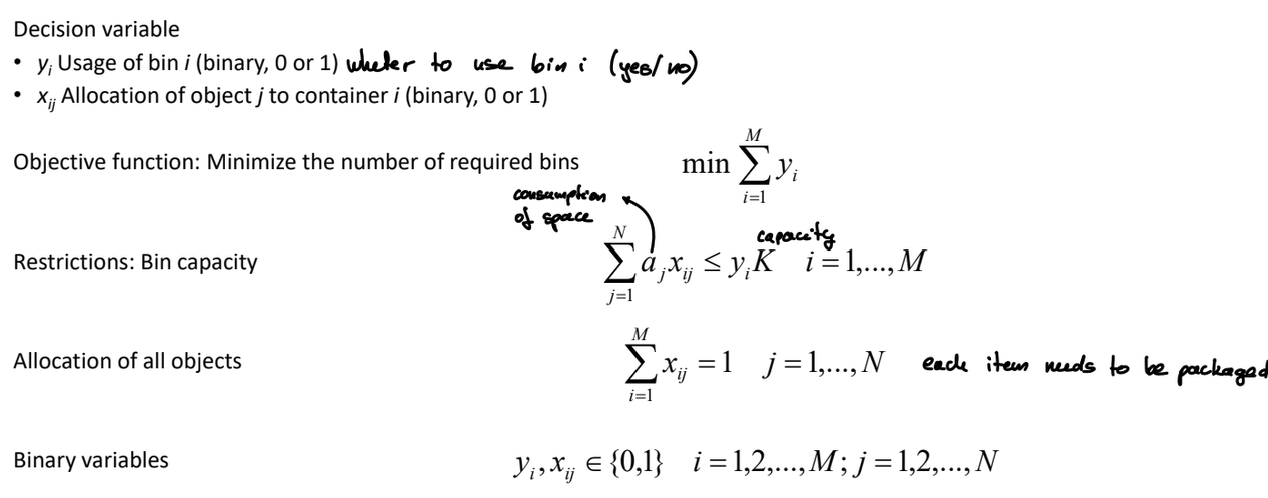
What is the bin-packaging problem?
Problem definition
• Allocation of N objects to M bins, whose number shall be minimized
Binary optimization problem
• Allocation problem
• Capacity constraint
Objective
• Minimizing the number of required bins
Constraint
• All objects included
• Capacity K of the container, objects require aj units of capacity
What is the goal of inventory management?
Providing the required quantities of intermediate products, assemblies, and purchased parts on time for the production of the end-products.end products
stochastic inventory control → replenishment policies (e.x. AI inventory management, take out & refill)
material requirements planning (forecast, replenish what is expected to be sold)
What are the key performance indicators of inventory control?
Total costs
Costs per order
Inventory holding costs
Costs of capital commitment (opportunity costs)
Inventory costs inducing payments (insurance, service providers)
Shortage penalty costs (e.x. shipping goods to customers, penalty, long-term losing customers)
Service level (in percent)
Non-stockout probability: Number of periods without shortages/Number of total periods (α) → doesn’t tell how many of the products are missing
Fill-rate: Fraction of (total) demand immediately satisfied from stock (β)
What is ABC and XYZ analysis?
ABC analysis: high, middle & low consumption value (importance)
XYZ analysis: categorization with regard to regularity of demand (regular, irregular, erratic)
How is net inventory and inventory position calculated?
Net inventory = physical inventory - backlog
Inventory position = Net inventory + outstanding orders
What are the 3 inventory control policies?
(R,S): Base-stock policy
When: all R periods
Quantity: Order-up-to level S minus inventory position
(s,Q): Reorder point - order quantity policy
When: Inventory position reaching / falling below reorder point s
Quantity : Lot size Q
(s,S): Reorder point – order-up-to policy
When: Inventory position reaching / falling below reorder point s
Quantity : Order-up-to level S minus inventory position
What are the objectives of the planning problem?
how to set inventory control parameters
minimize costs
ordering cost
inventory holding cost
stockout penalty cost
constraints
service levels
What are the set parameters for the inventory control policies?
(R,S)
R fix (periodic order R=1)
R = classic order interval (EOI)
Base-stock level S = expected demand during replenishment lead time (including review period) plus safety stock
(s,Q)
Q = Economic order quantity (EOQ)
Reorder point s = expected demand during replenishment lead time (including review period) plus safety stock
(s,S)
S-s = Economic order quantity (EOQ)
Reorder point s = expected demand during replenishment lead time (including review period) plus safety stock
What is the lot size?
quantity which
produced without interruption in exactly one production order
produced in one common replenishment order
transported together
What are the trade-offs of fixed costs per order?
order handling, transportation costs
setup costs (e.x. change of tools, opportunity cost for capacity loss)
costs of storage/retrieval
impact: few orders with high quantity
consequence: high inventory holding costs
What are the trade-offs of inventory holding costs?
opportunity costs of capital commitment
payment inducing cost of warehouse rent, insurance
impact: procurement synchronous with demand (just in time)
consequence: many orders
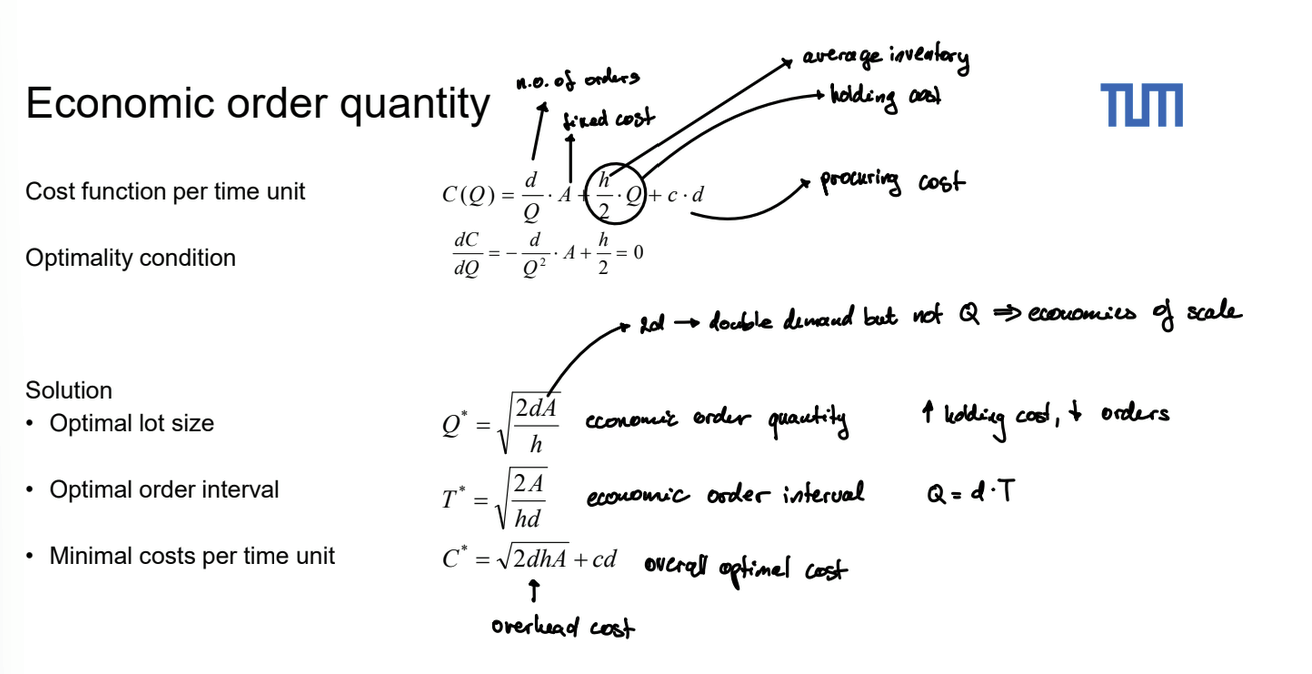
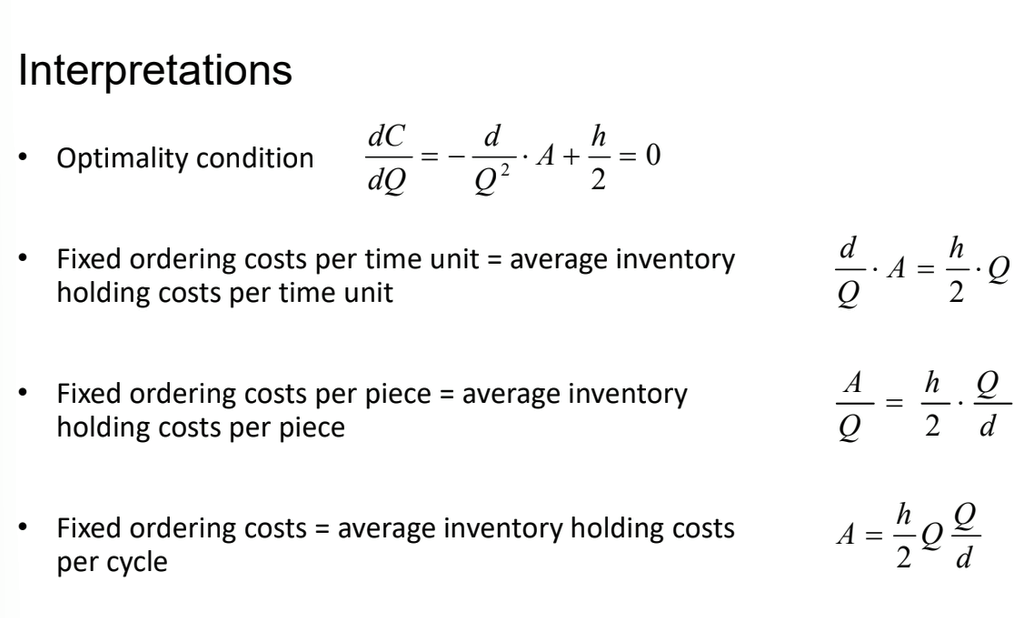
What are the assumptions for the economic order quantity model?
Continuous time, infinite planning horizon
Constant demand rate d (units per time unit)
Procurement of material in lots of size Q (units)
No lead time, i.e. immediately affecting inventory
Fixed ordering costs per order A
Constant procurement costs c per unit (purchase price, production costs per unit)
No shortage permitted (non-negative net inventory)
Storage
Unlimited storage capacity
Inventory holding costs h for inventory (per unit and time unit)
What are the interpretations of the EOQ model?
What is the newsvendor model?
Safety stock : expected inventory before the next delivery arrives
Goal of holding inventory: Safety motive
Sources of uncertainty
Demand
Time, Quantity
Delivery
Time, Quantity, Quality/Yield
Inventory control rules
When is inventory ordered?
How much is ordered?
Demand model
Random variable, probability distribution f(d)=P(D=d),
F(d) = P(D≤d)e.x. binomial distribution
Order quantity: y
Costs
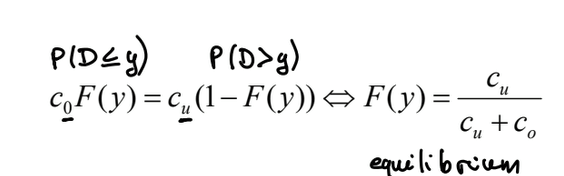
underage costs: cu = p - c (selling-purchase price)
overage costs: co = c - s (purchase price-salvage value)
Equilibrium condition
increase the order quantity up to the point where the reduction of underage costs is smaller than the rise in overage costs
What are the applications of the newsvendor problem?
Products with short lifetime
No transfer through storage, e.g. newspaper, seasonal products
Trade-offs
Excess inventory: Destruction, clearance sale
Lost profits: lost customers, additional costs through express deliveries
Capacity planning
Holding / standby costs, no transfer possibility
External procurement of additional capacity
Opportunities of alternative usage
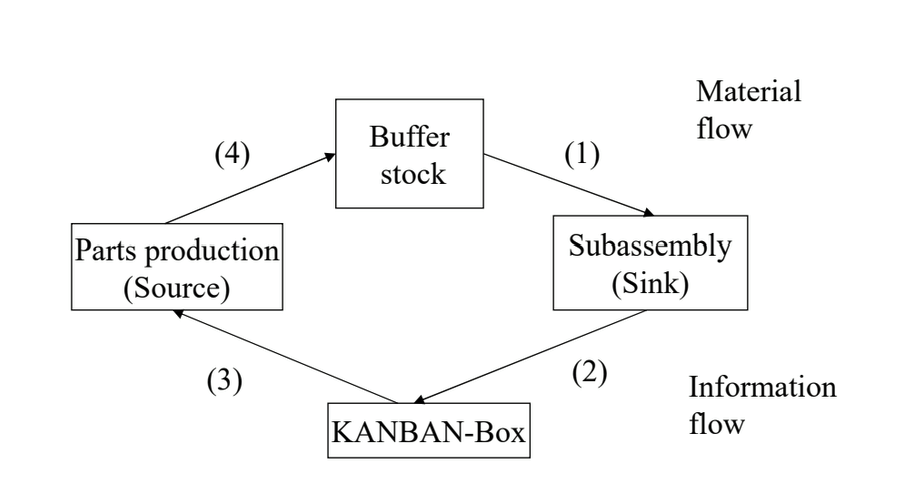
What is KANBAN?
Production on demand (just-in-time), pull approach, decentralized control, supermarket approach
Application
Limited fluctuation of demand, short transport distance
Mass and large-scale production
Procedure
Specification of the production plan for end-products
Removal of a full container from the storage
Kanban (Card) is removed from the container and put in a box; this represents the source of a production order
Produced parts are put in the container and Kanban is attached; the storage is filled with the full container.
Structure of the total process in single loops
Source (producing node) → buffer stock → sink (consuming node)
What are the elements of a supply chain?
Value chain
Integration of business activities (Porter)
Interface view
Business process management
Internal Supply Chain
Procurement– Production – Distribution – Disposal
External Supply Chain
External partners: suppliers, customer
Flows
Information, material, payments
What are the instruments of supply chain management?
Cooperation
Alliances, networks
Centralization, decentralization, integration (e.x. how you pack a Euro pallet)
Standardization (e.x. tailoring phones to your needs, customized goods, mass customization → cars)
Modularization, postponement
Customer orientation
Service, incentives, contracts
Optimization
→ Vertical integration
What decisions have to be made in the supply chain management process?
delivery: central warehouse, regional warehouse, direct delivery
planning problems
distribution steps
centralization, decentralization
sizing & distribution of safety stocks (have to consider shelf life)
part production & assembly
standardization (e.x. languages of manual)
spare part strategy
warehousing: on site, central, regional
international locations
diversity, postponement
purchased parts → assemble at location?
order strategies
information flow
materials flow: standard/express transportation
transshipment: intermediate delivery, avoidance of inability of delivery
high frequency product → store everywhere, scarce sales → specific location or uniform and sell later at discount
manufacturer: price planning, contracts
recycling economy
reuse of old products
remanufacturing, refurbishing
material recycling
organization
in-house production, external service
integrated system, decentralized system
What are the 5 supply chain structures?
serial
supplier-purchaser reelationship
convergent
assembly production
divergent
distribution systems (warehouse, distribution center, store)
standardization
general
network, link of assembly and distribution aspects
closed loop
recycling, bidirectional material flow
What is reverse logistics?
„The process of planning, implementing, and controlling the efficient, cost effective flow of raw materials, in-process inventory, finished goods and related information from the point of consumption to the point of origin for the purpose of recapturing value or proper disposal“
Reverse activities
• Product acquisition
• Transportation
• Testing, sorting
Returning of products
• Commercial returns
• Warranties
• Repairs
• End-of-use (EOU)
• End-of-life (EOL)
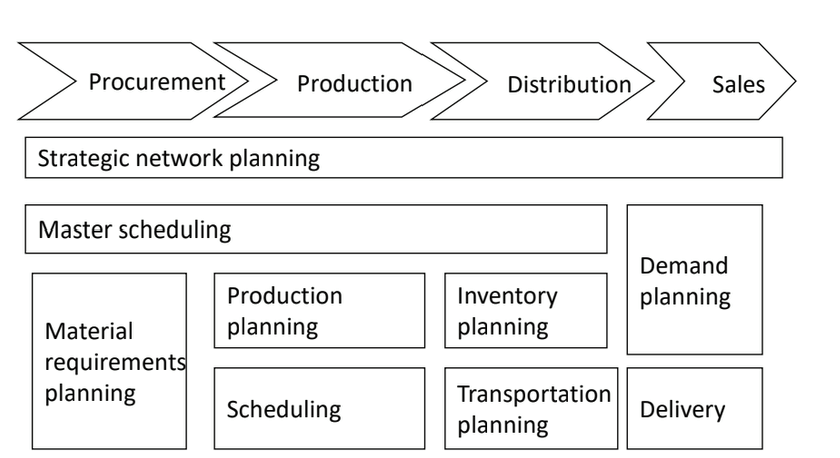
What are the stages of supply chain planning?
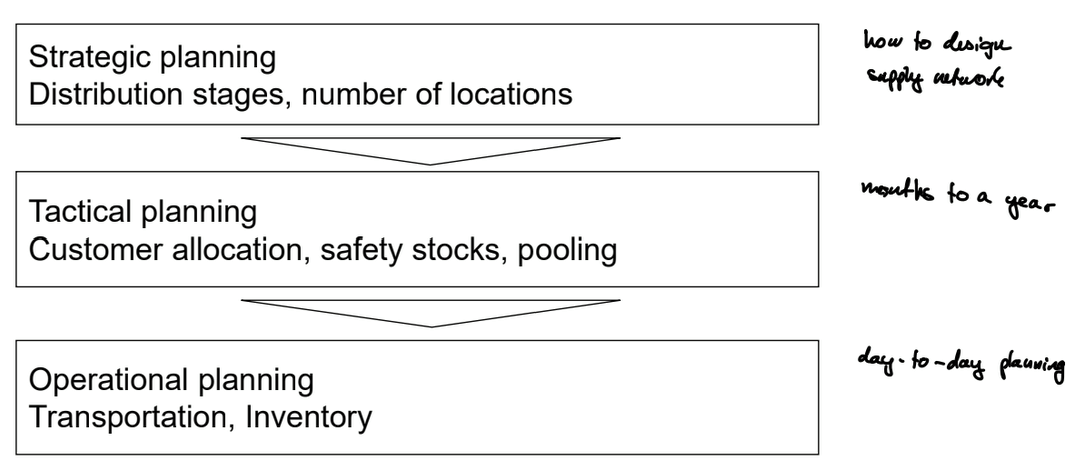
What are the hierarchies of planning?
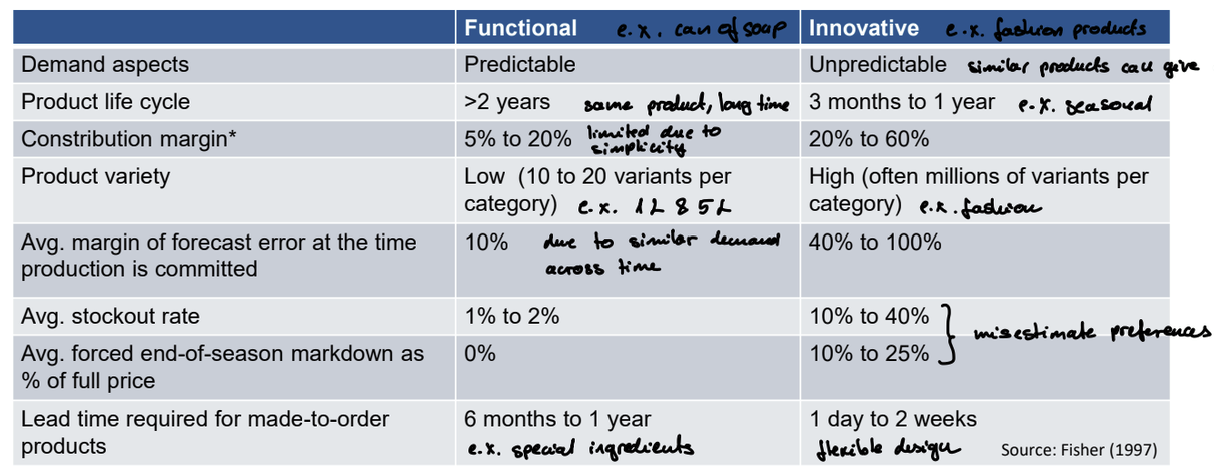
What is the difference between a functional and an innovative product?
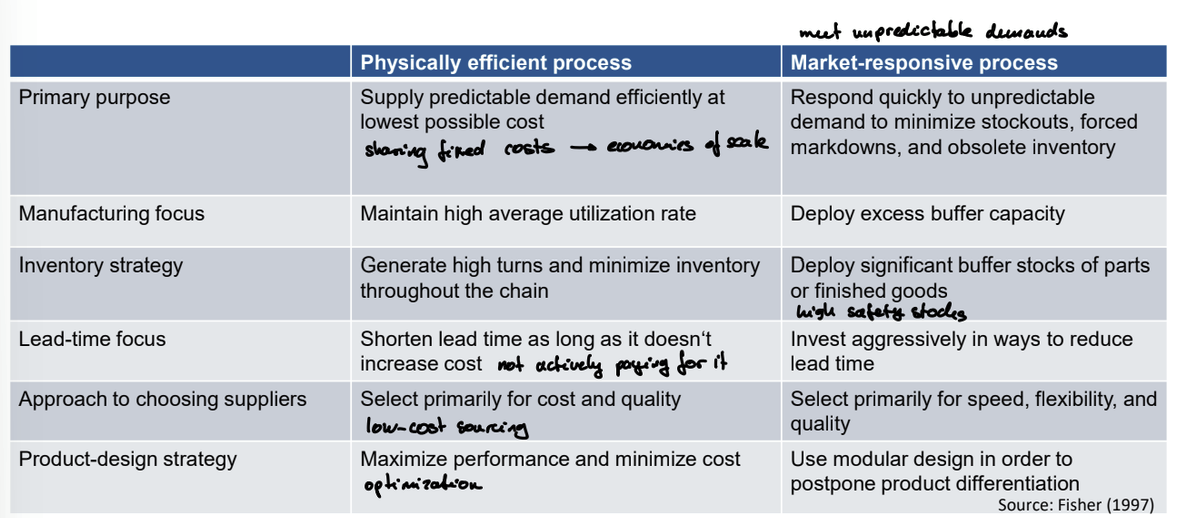
What is the difference between a physically efficient and a market-responsive process?
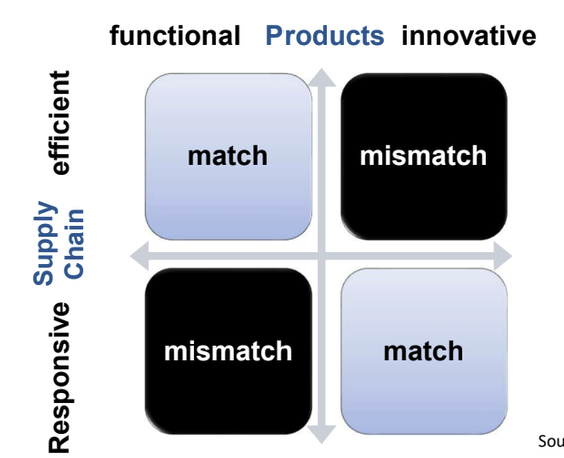
Which product and supply chain fits are possible?
What are the possible weaknesses of the supply chain process?
inaccurate knowledge
insufficient information systems
neglect of uncertainty
insufficient coordination
wrong evaluation of stocks
separation of production & supply chain decisions
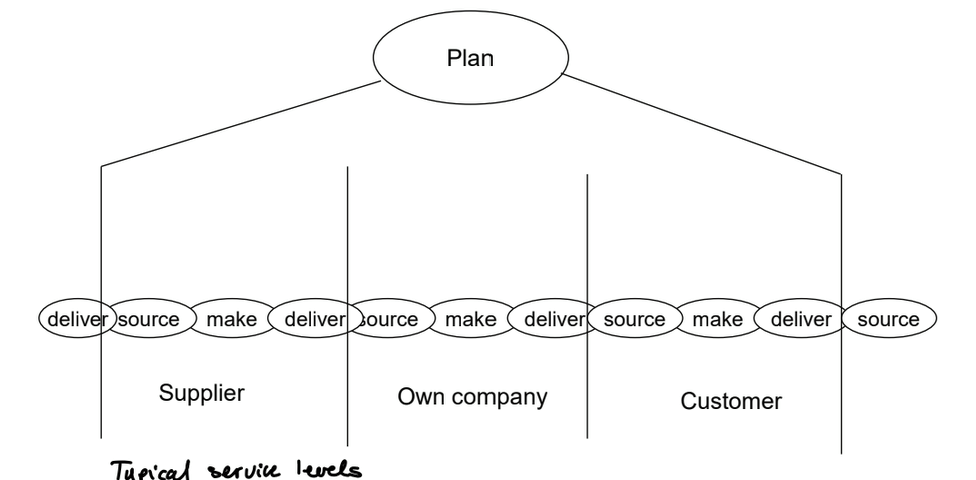
What is the SCOR model?
Objectives: ideal-typical, cross-sector reference models
• Definition and visualization of processes, key performance indicator (KPI)
• Benchmarking, Best-Practice
Standardized process description, configurability
Hierarchical structure
• Top-level, configuration level, process level, implementation level
What are the stages of planning?
What is the bullwhip-effect?
Increasing variability of demand / orders when moving upstream the supply chain
reasons
forecasting
delivery time: errors during replenishment time
lot sizing: accumulation of demands
fluctuating prices
anticipation of shortages
What are the possible countermeasures against the bullwhip-effect?
reduction of uncertainty → ERP-systems
reduction of variability
permanent low prices
reduction of lot sizes
reduction of lead times
strategic alliances → vendor-managed inventories
collaborative planning, forecasting & replenishment
What are the possible decoupling points of production?
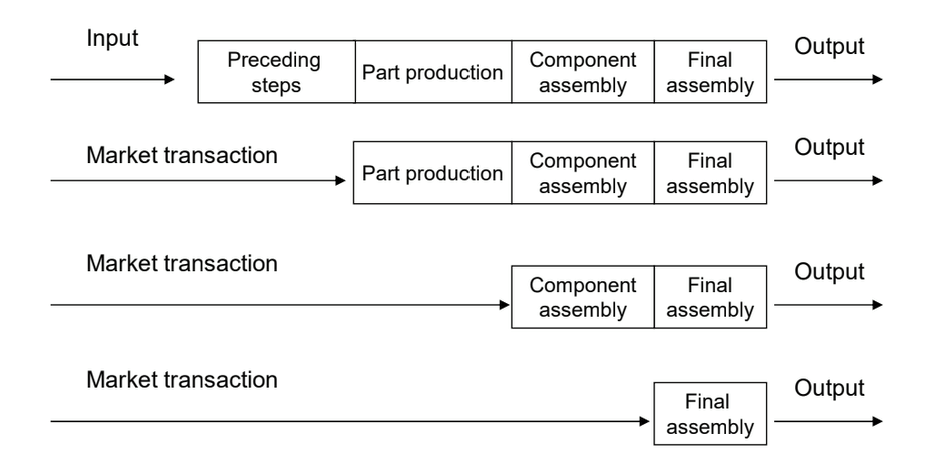
What are the 4 possible scenarios for outsourcing?
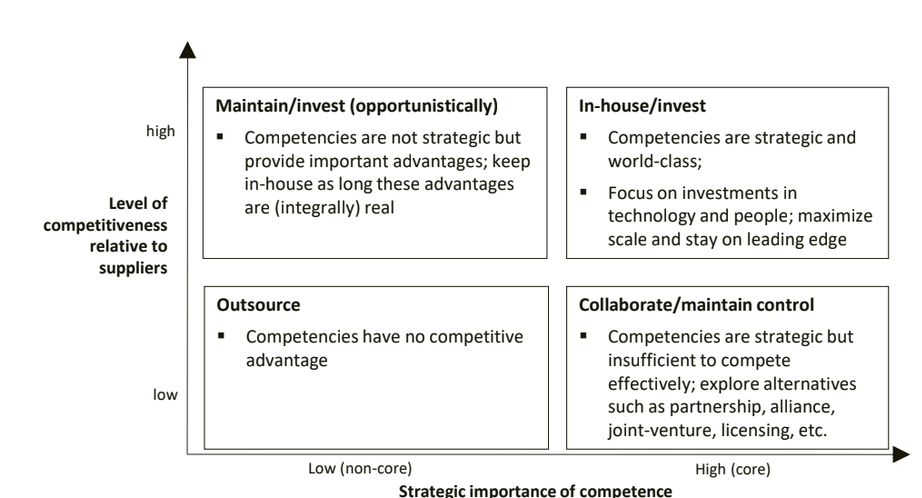
What are the 4 components of transaction costs?
Components
Search and information costs
Research about potential transaction partners
Bargaining costs
Negotiations, contract formulation
Enforcement costs
Compliance of target dates, quality, quantities and prices
Adjustment costs
Adjustment of agreements during the runtime
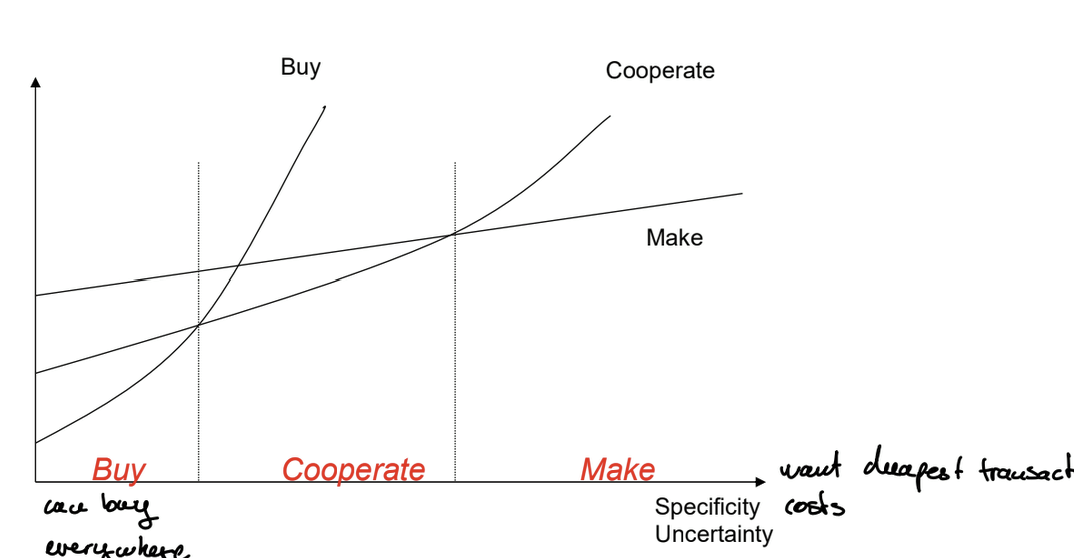
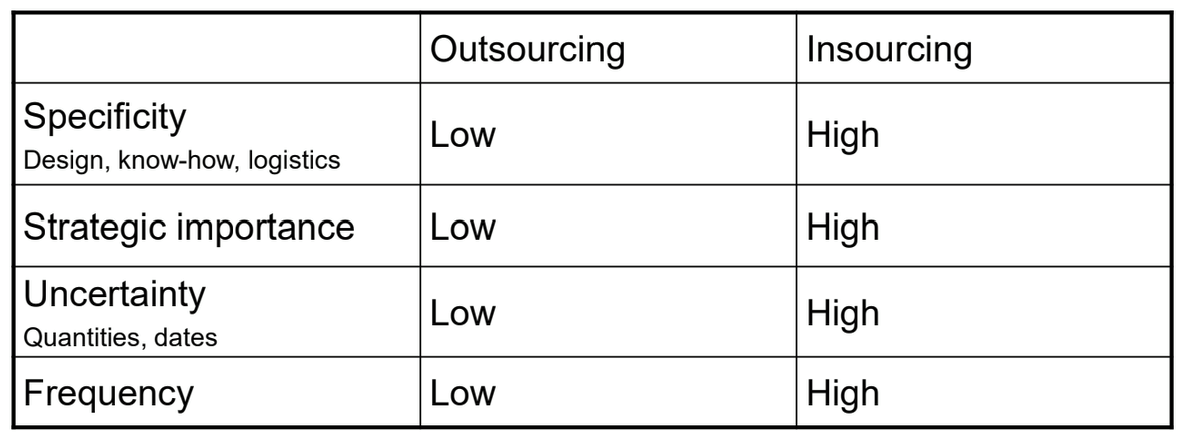
In which cases is outsourcing vs. insourcing better (specificity, strategic importance, uncertainty, frequency)?
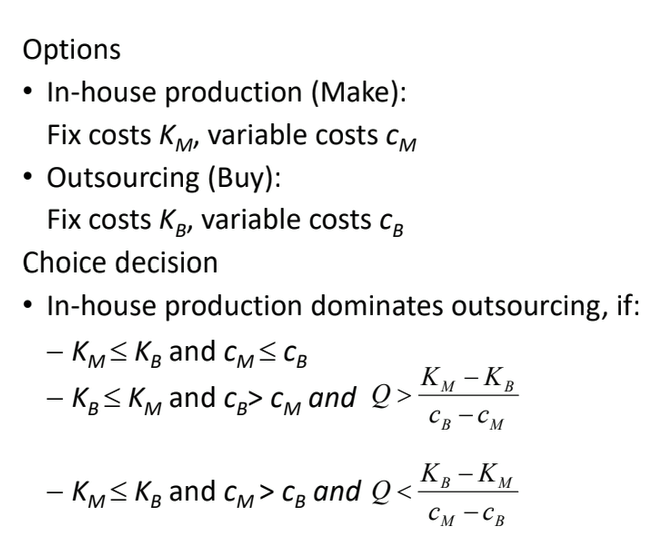
How do you conduct a break-even analysis?
What is green supply chain management?
“integrating environmental thinking into supply chain management, including product design, material sourcing and selection, manufacturing processes, delivery of the final product to the consumers as well as end-of-life management of the product after its useful life.”
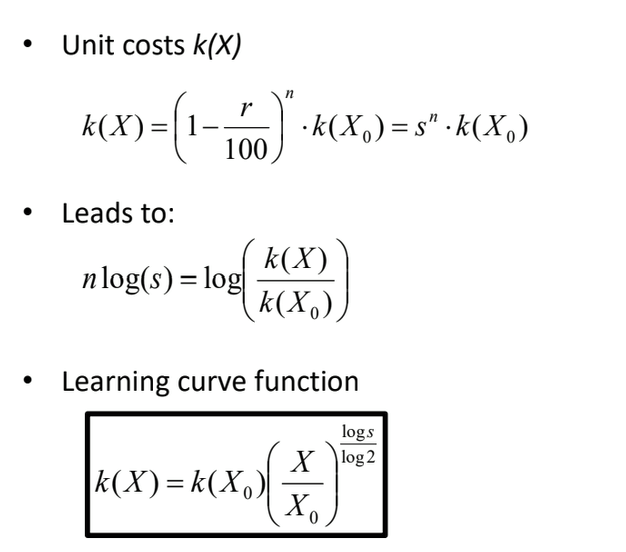
How are learning curves expressed mathematically?
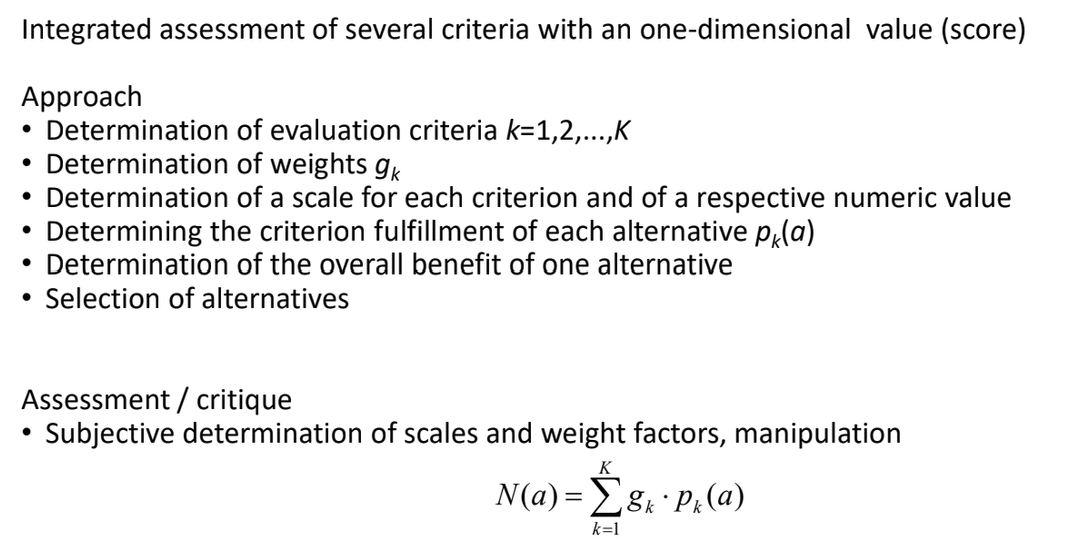
What is the scoring method?
What are the benefits of single sourcing?
• Bargaining power of supplier
• Quantity discounts
• Economies of scale
• Shared research and development
• Advantages of a long-term partnership
• Reduction of complexity through joint process optimization
• Incentivize sustainability through regular audits and investments in supplier development
What are the benefits of multi-sourcing?
Sourcing the same product / material from different suppliers
Supplier competition leads to decreasing cost
Risk diversification
• Lead time
• Reliability of shipments
• Flexibility
• Capacity constraints
• Local-content-regulations
What is resilience?
“... supply chain resilience aims to help companies cope with different types of disruptions in a rapid way, enabling operations to be restored to the previous performance level or even to a new and better one”
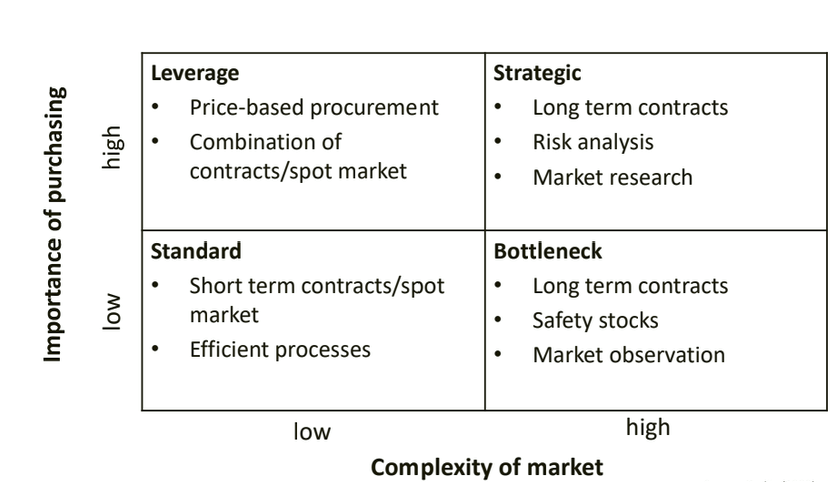
What are the 4 possible procurement portfolios?
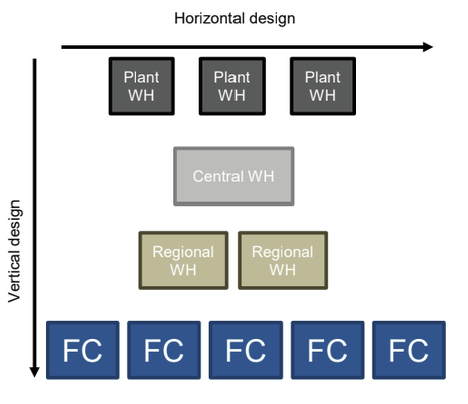
What is the difference between vertical and horizontal distribution system design?
• Vertical: Number of distribution stages (plant warehouse, central warehouse, regional warehouse, fulfillment center (FC))
• Horizontal: Number of warehouses per stage
What are the 6 criteria for location decisions?
Quantitative
Transportation cost
Capacity cost
Property
Buildings
Workers
Energy
Taxes, subsidies
Qualitative
Infrastructure
Property
Transportation
Human resources
Political stability
Economic stability
What is the location theory of Weber?
Sales market for product A
2 materials with sourcing locations B1 and B2
Case 1: both materials are ubiquities → Production near sales market
Case 2: two net weight materials → Production near sales market
Case 3: two weight loss materials → Tendency to the sourcing locations
Case 4: one ubiquity, one weight loss material B2 → Line between A and B2
What is the Steiner-Weber model?
Continuous location planning
Single location, no consideration of investment costs (only transportation costs)
Distance measurement: Euclidean or Manhattan
Decision: Location (coordinates) that minimizes transportation costs
Customer data
j=1,2,...,n customers
Locations (xj, yj)
Customer demand per time unit: bj
Transportation costs
c per quantity and distance unit
Model properties
Exclusively considering transportation costs
All locations are feasible, no cost differences in the investment or operation of the location
Fixed customer locations
Linear transportation costs
Static approach: single facility, one-time snapshot
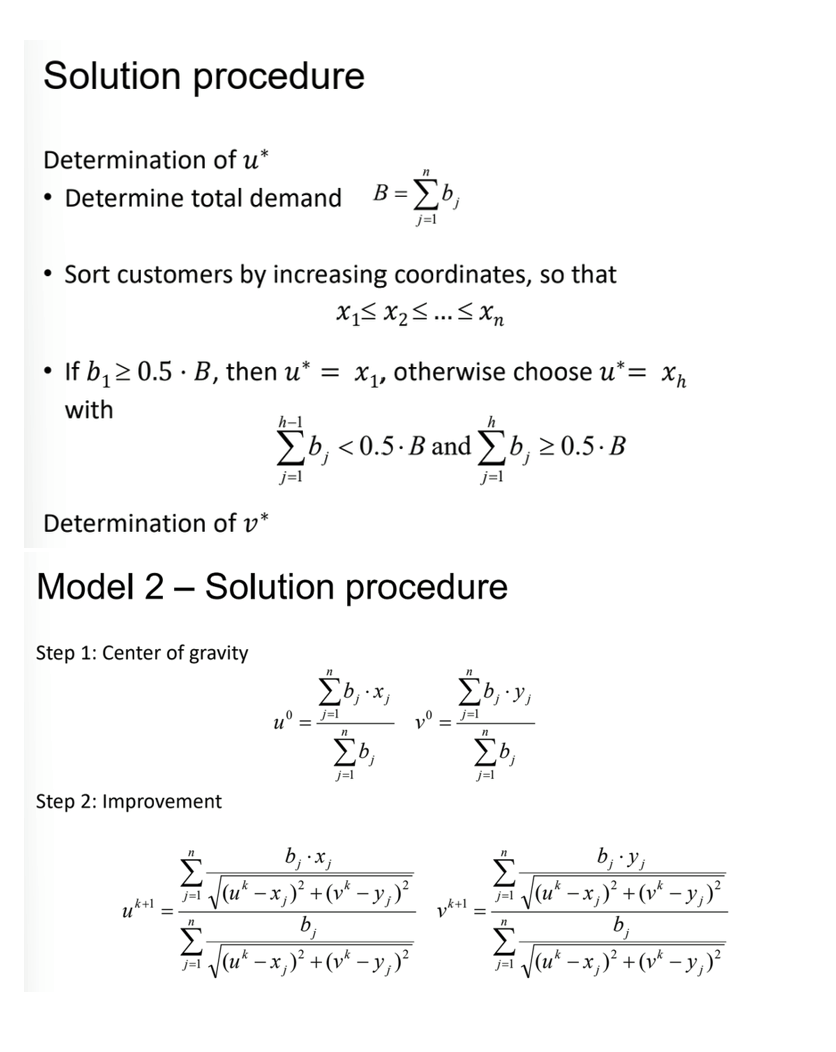
How is the warehouse location problem modeled mathematically?
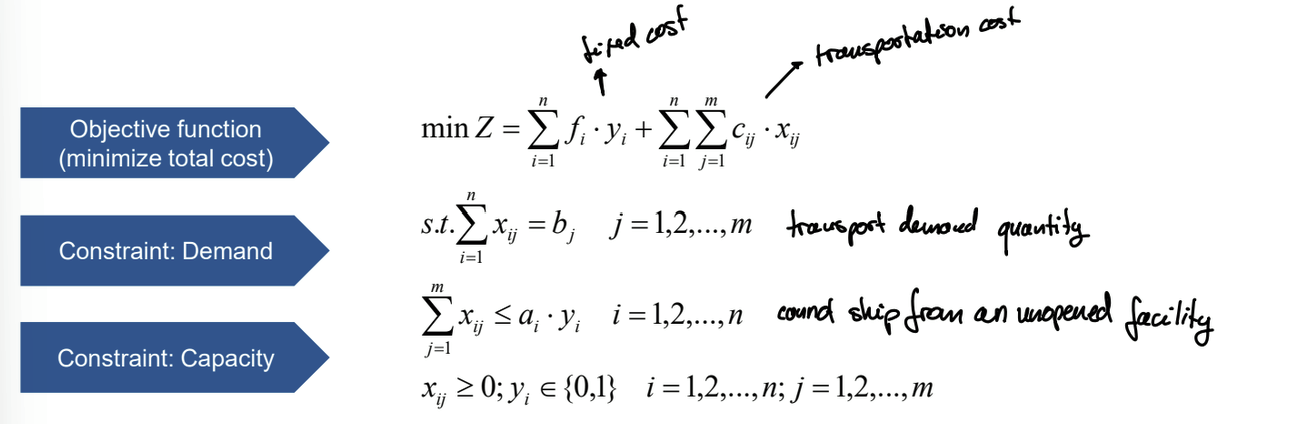
What is the add heuristic?
Start solution
Find the (one) location which minimizes the sum of investment and transportation costs (to all customers) and open it
Improvement (iteration)
For each undecided location:
Calculate the improvement in transportation costs (compared to the current solution) if opening this location
Compare to required investment costs
Open the location with the highest positive saving
Forbid all locations with negative savings
Repeat improvement until all potential locations are either opened or forbidden
What is the goal of time-focused models?
Problem setting:
• Customers who should be delivered within a certain time window (24, 48h)
• Location configuration, so that x% of the customers can be delivered within time t
Competition:
• Time competition instead of cost competition
Center problems:
• Network, plane
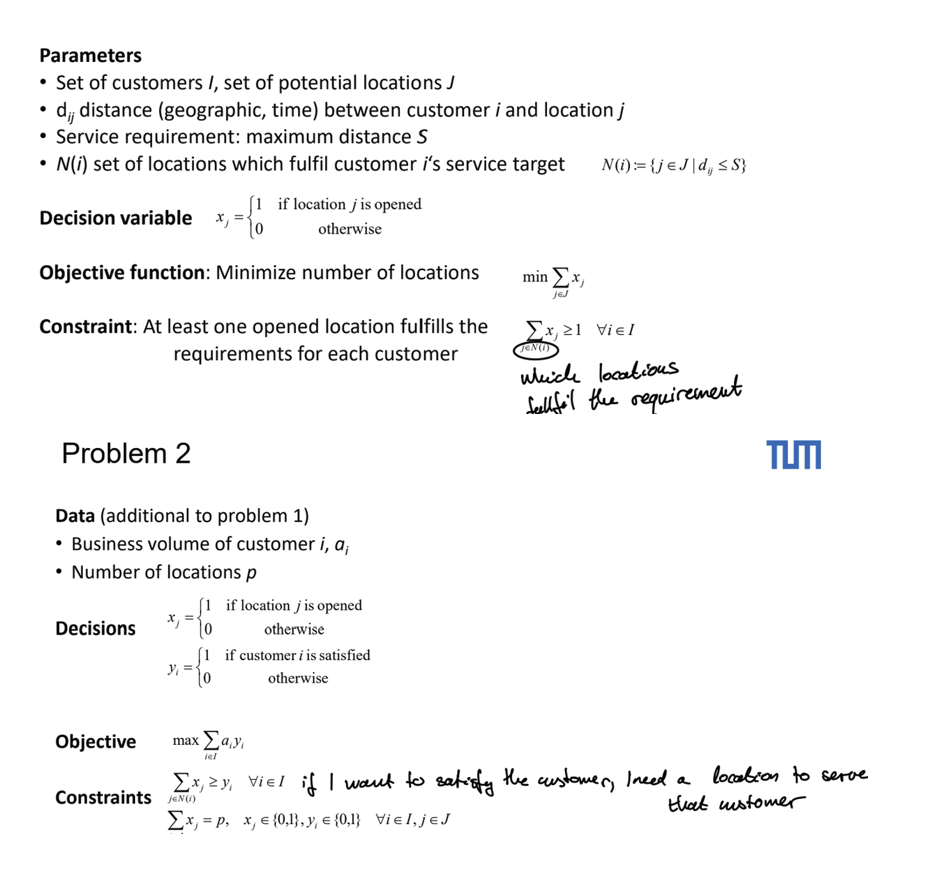
What is the set covering problem?
Problem 1
Minimize the number of required locations
Constraint: all customers can only be delivered within a given time window (alternative: maximal distance)
Problem 2
Maximize the number of customers that can be attracted with a given number of locations
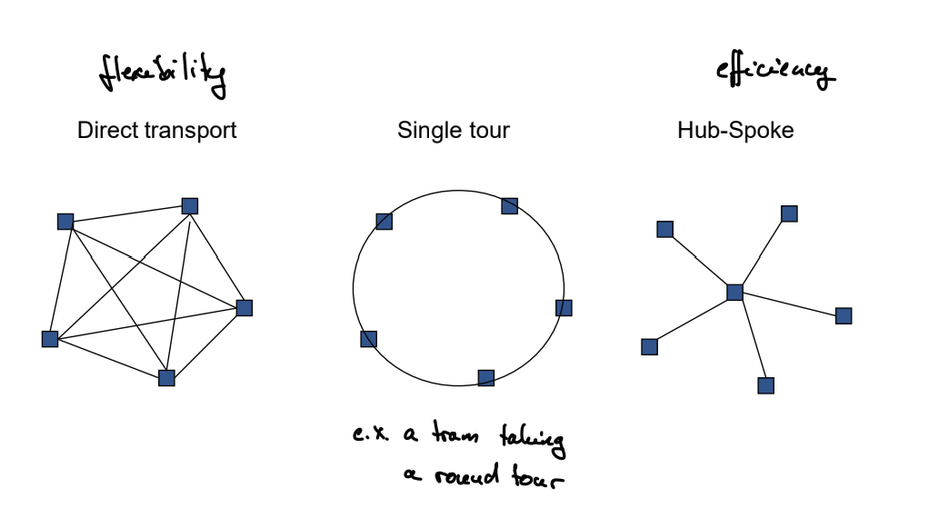
What are the 3 Hub-Spoke systems?
How is the Hub-Spoke system expressed mathematically?
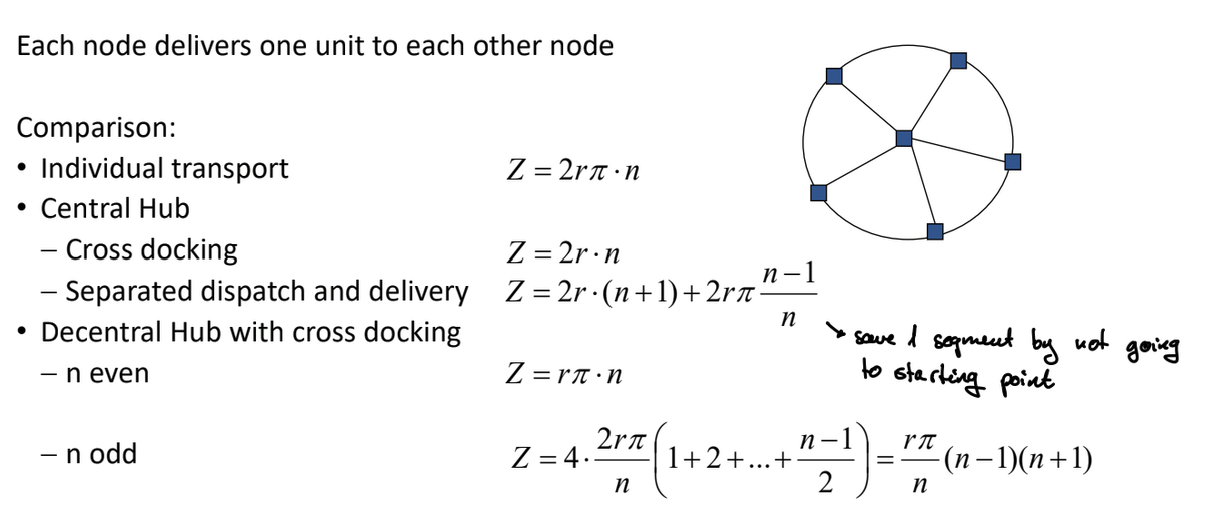
What is cross docking?
(Almost) no inventories
Only reallocation of incoming and outgoing goods
Objectives
• Transport consolidation or service improvement by more frequent deliveries
• Effective sorting
• Lowering inventory at certain nodes in the supply chain
• Shorter lead time for products
What is postponement?
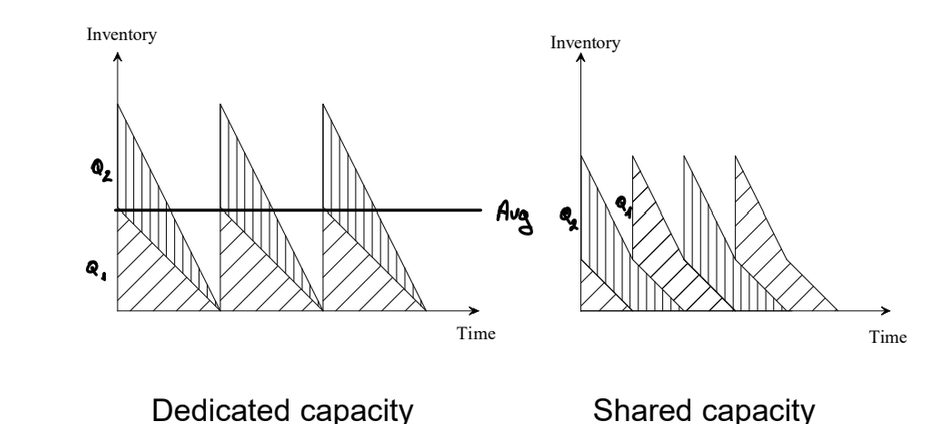
What is the difference between dedicated capacity and shared capacity storage?
dedicated capacity: need to split warehouse space → on average warehouse is only 50% full
shared capacity: stagger orders → maximum capacity needed is reduced → utilization is around 66% (more orders lead to more utilization)
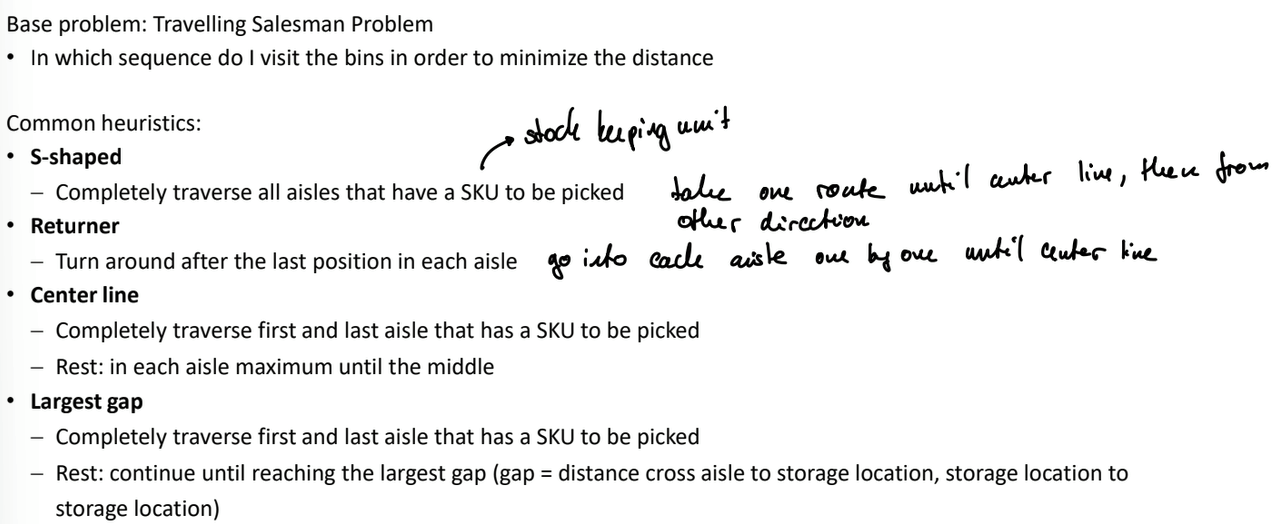
What are the 4 possible picking sequences?