Stoichionetry (C3)
 Call Kai
 Learn
Learn Practice Test
 Spaced Repetition
 Match
Match Flashcards
 Knowt Play
1/16

Earn XP
Description and Tags
IGCSE Chemistry: C3.2: Relative masses of atoms and molecules C3.3: The mole and Avogadro constant
Name | Mastery | Learn | Test | Matching | Spaced | Call with Kai | Chat |
|---|
No analytics yet
Send a link to your students to track their progress
17 Terms
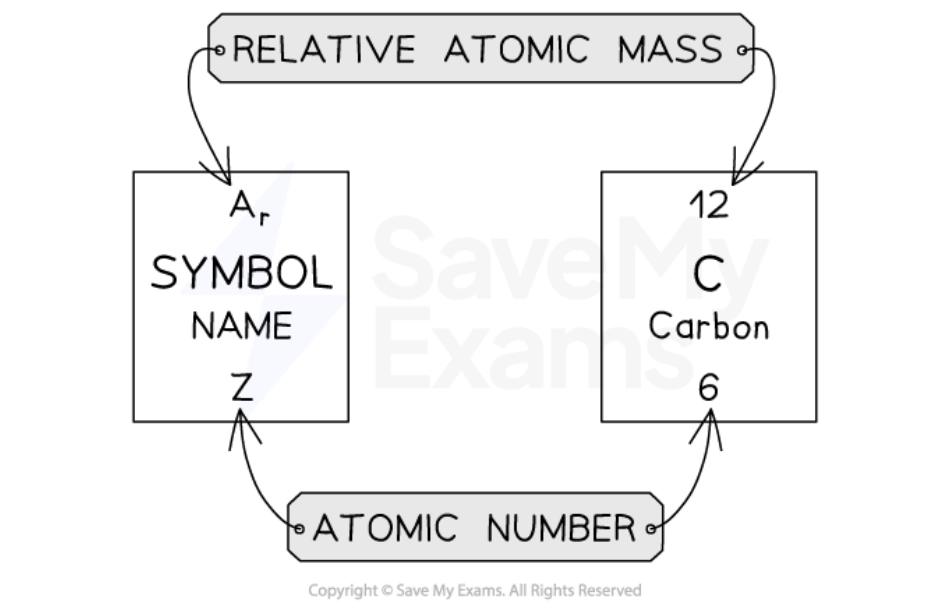
What is relative atomic mass (Ar)?
The average mass of the isotopes of an element compared to 1/12th of the mass of an atom of ¹²C, it’s shown on the atomic symbol, and it’s always bigger than the atomic number
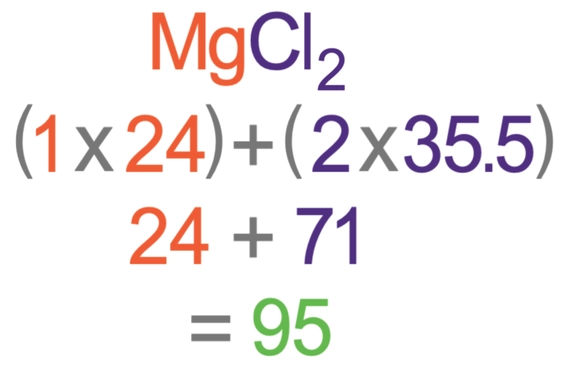
What is relative molecular mass (Mᵣ)?
The sum of the relative atomic masses of all atoms in a molecule
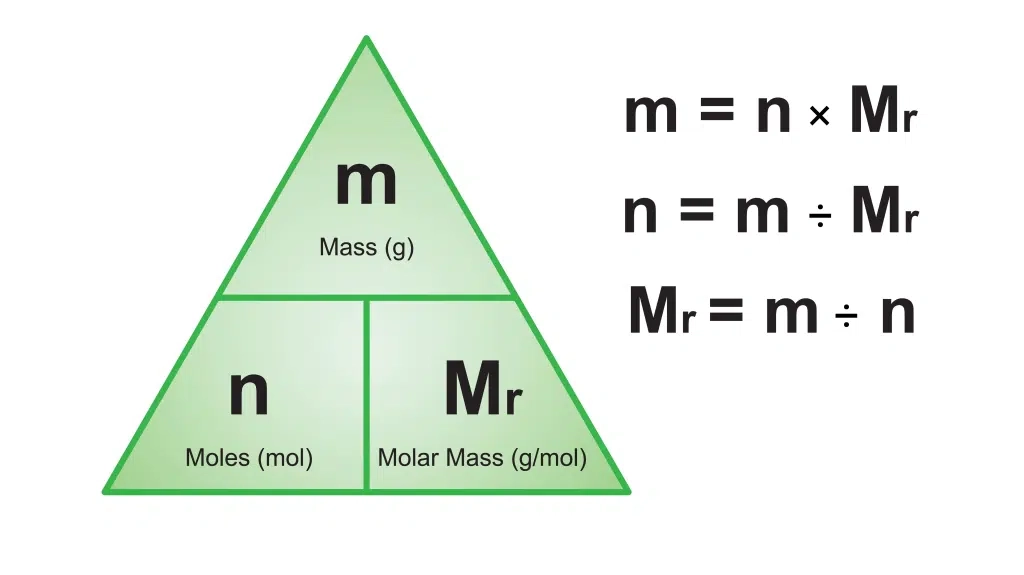
What are the calculations needed?
What is the concentration of a substance, and what can it be measured in?
The amount of solute dissolved in a measured volume of solution. It can be measured in g/dm³ or mol/dm³
What is a mole?
A unit that can be used to measure the amount of substance
What is Avogadro’s number?
6.02 x 10²³
How many particles does a mole have?
One mole contains 6.02 x 10²³ particles
What is the molar mass for an element and for a compound?
For an element: the same as relative atomic mass (Aᵣ) but in grams
For a compound: the same as relative molecular mass (Mᵣ) but in grams
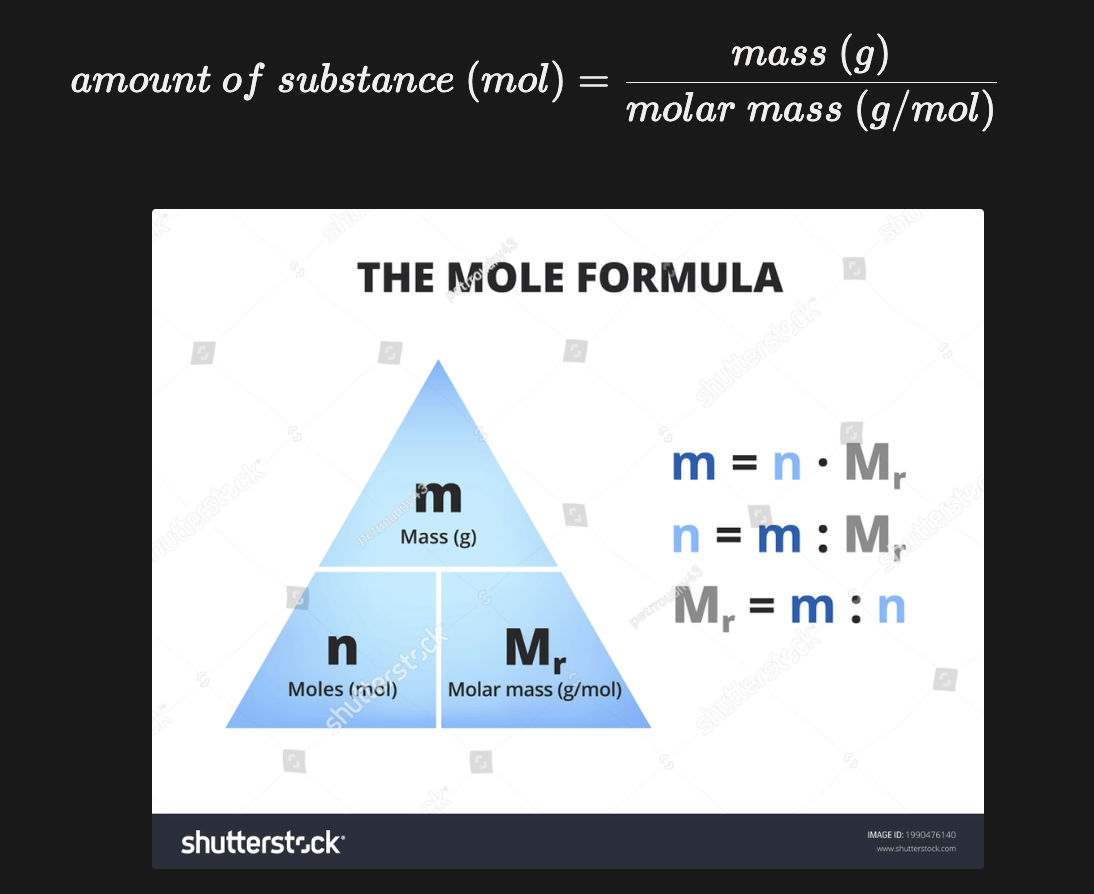
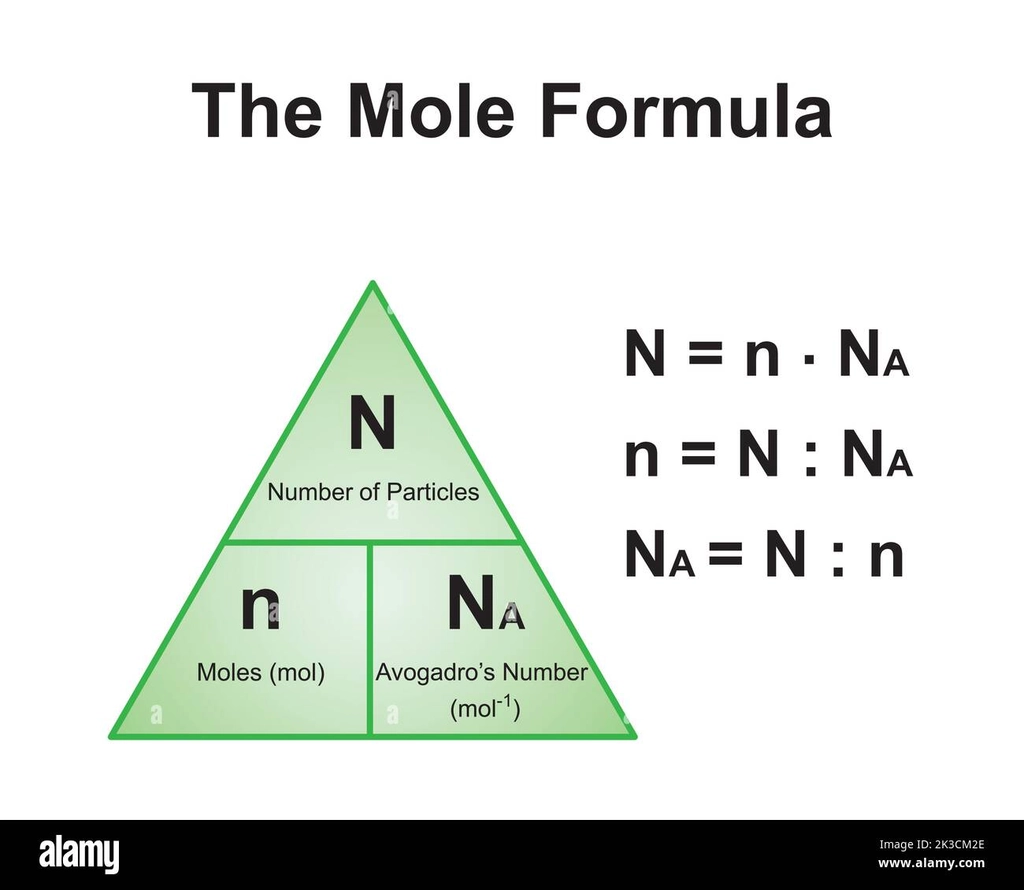
What is the equation for moles?
How do you calculate the number of particles?
number of particles = moles (n) × Avogadro's number (6.02 × 10²³)
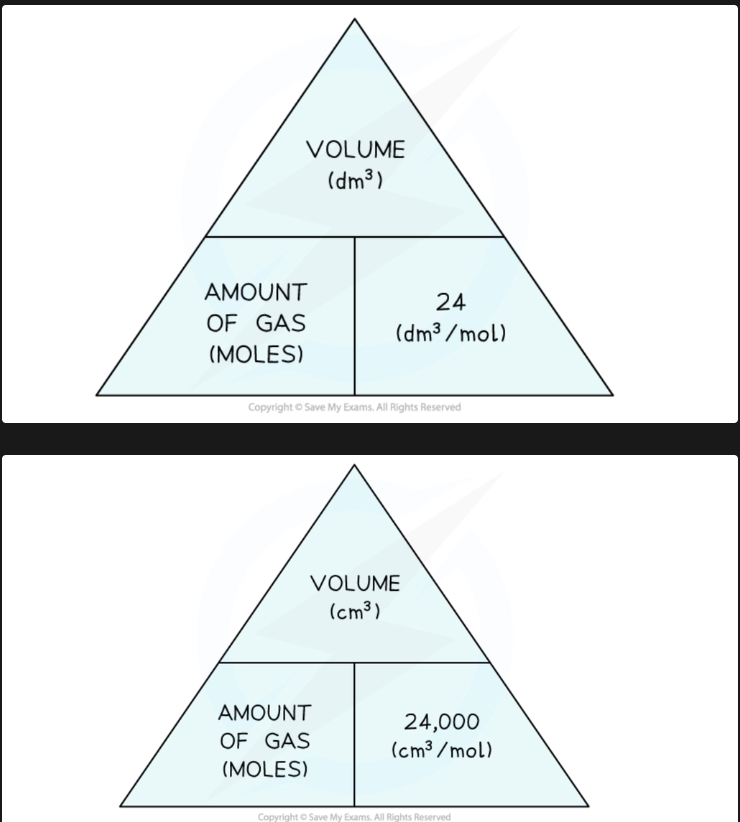
What is the volume of 1 mol of gas at room temperature?
24dm³
How do you convert cm³ to dm³
Divide by 1000
How do you convert dm³ to cm³?
Multiply by 1000
What are the calculations in a gas?
What is a limiting reactant?
The reactant in a chemical reaction that is used up first and determines the amount of product that is formed
By working out the mass of the limiting reactant, what else can we work out?
The moles
What is the process to calculate liming reactants?
Balance the chemical equation
Calculate the number of moles of each reactant
Divide the number of moles of each reactant by the coefficients from the balanced equation
The smaller result is the limiting reactant
(If there is no coefficient, the smaller amount of moles is the limiting reactant)