Other High Yield PNLE Concepts (DOH Programs and Laws Governing Nursing)
 Call Kai
 Learn
Learn Practice Test
 Spaced Repetition
 Match
Match Flashcards
 Knowt Play
1/71

There's no tags or description
Looks like no tags are added yet.
Name | Mastery | Learn | Test | Matching | Spaced | Call with Kai | Chat |
|---|
No analytics yet
Send a link to your students to track their progress
72 Terms
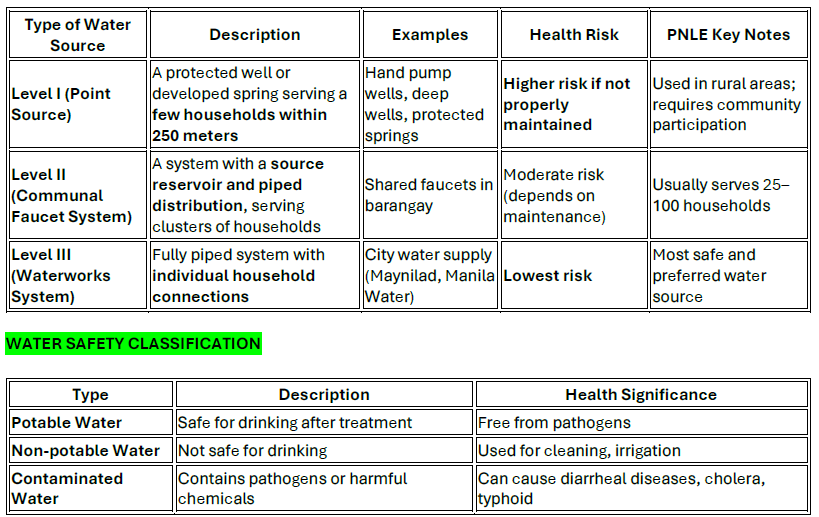
Water Types / Water Supply Classification
Cholera
Typhoid fever
Dysentery
Hepatitis A
Diarrheal diseases
Most Common Waterborne Diseases
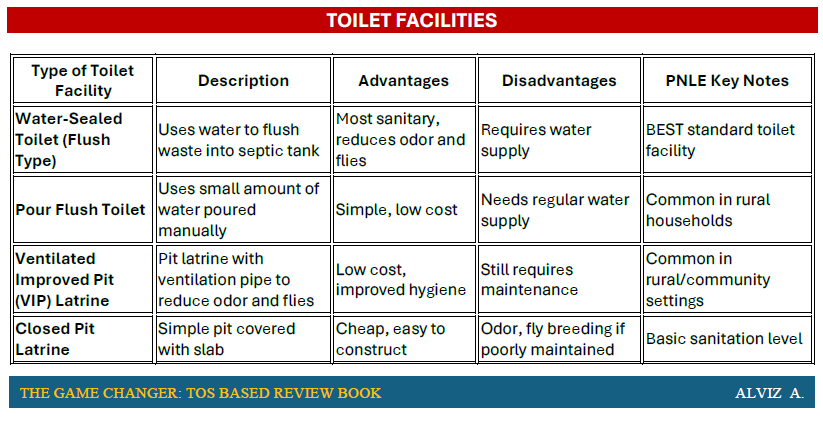
Toilet Facilities (1) review

Toilet Facilities (2) review
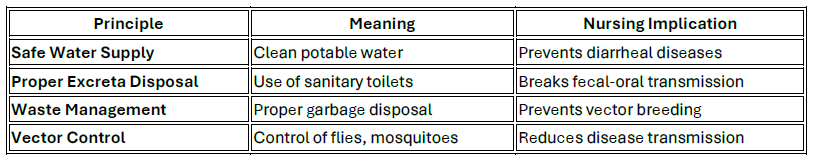
Sanitation principles
Fecal-Oral Transmission
Game Changer:
This route is a major transmission mode in foodborne illness. Disease spread pathway (Feces → Flies → Food/Water → Mouth → Disease)
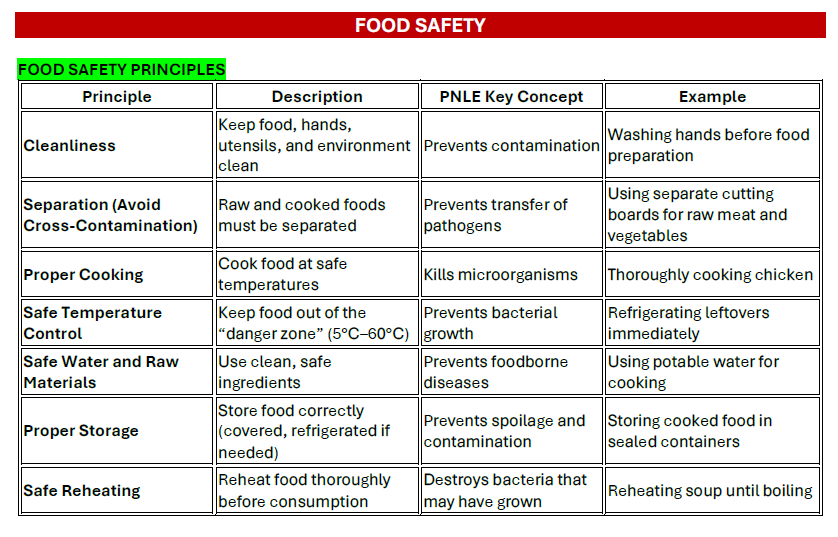
Food safety principles (1)

Food safety principles (2)
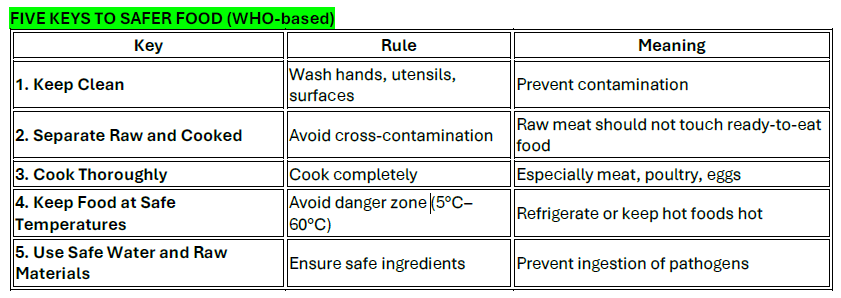
Five Keys to Safer Food (WHO Based)
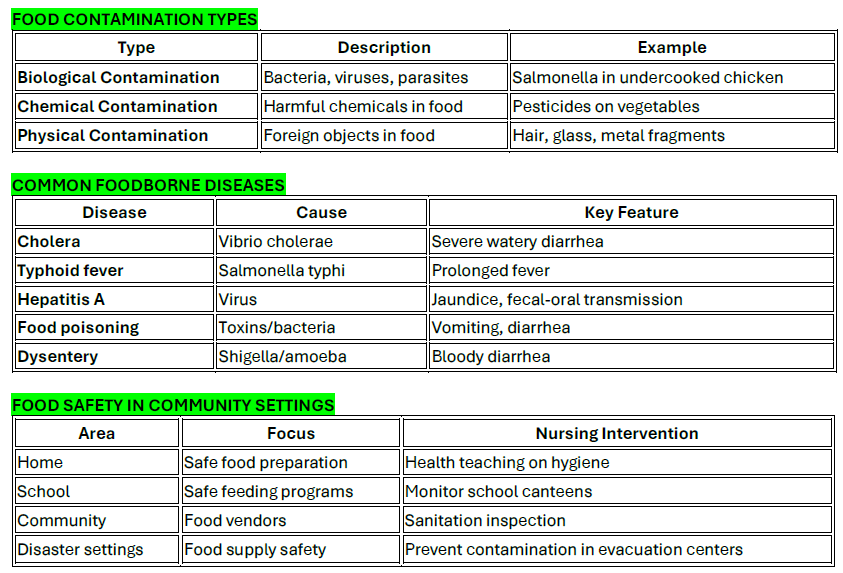
Food contamination types, diseases, and safety
Cleanliness prevents infection
Game Changer:
Most important principle in food safety is ___
Cross-contamination
Game Changer:
___ is a major cause of foodborne disease
5°C to 60°C
Game Changer:
Danger zone temperature
(Proper cooking kills pathogens)
Color Coding For Healthcare Waste
Proper healthcare waste segregation prevents infection transmission, occupational exposure, and environmental contamination. Waste should be segregated at the point of generation (where it is produced).
Black
Color Coding: ___
General / Non-infectious waste
Paper, cartons, food waste, office waste, packaging materials
Regular municipal waste disposal
Yellow
Color Coding: ___
Infectious / Pathological waste
Blood-soaked materials, tissues, organs, body parts, laboratory waste, contaminated dressings
Requires special treatment and safe disposal
Red
Color Coding: ___
Sharps waste
Needles, syringes, blades, scalpels, broken contaminated glass
Place in puncture-resistant sharps container
Brown
Color Coding: ___
Chemical and pharmaceutical waste
Expired medicines, chemicals, disinfectants, laboratory reagents
Requires specialized disposal
Blue
Color Coding: ___
Radioactive waste
Materials contaminated with radioactive substances
Managed according to radiation safety protocols
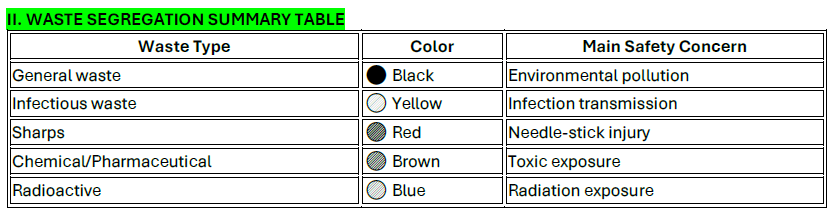
Waste segregation summary table review
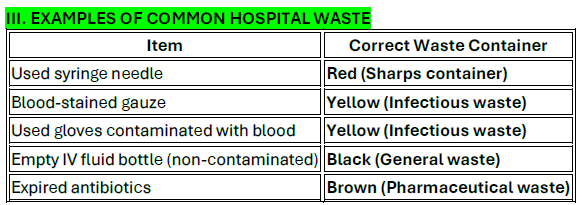
Examples of hospital wastes and their container review
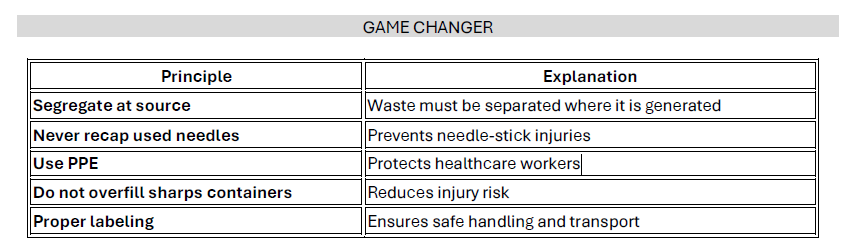
Game Changer:
Principles of Waste Management
Expanded Program on Immunization (EPI)
The ___ is a national program that aims to reduce illness, disability, and deaths caused by vaccine-preventable diseases by providing routine immunization services to infants, children, pregnant women, and other eligible groups.
It is a primary prevention strategy because it prevents disease before it occurs.
Republic Act No. 10152
Mandatory Infants and Children Health Immunization Act of 2011
RA 10152
A Philippine law that provides for mandatory basic immunization services for infants and children as part of the government’s public health program.
It supports the Expanded Program on Immunization (EPI) by ensuring that children receive essential vaccines against vaccine-preventable diseases.

Goals of EPI
Tuberculosis
BCG
Hepatitis B
Hepatitis B vaccine
Poliomyelitis
OPV/IPV
Diphtheria
Pertussis
Tetanus (Tetanus-containing vaccines)
Haemophilus influenzae type b (Hib)
Pentavalent vaccine
Pneumococcal disease
PCV
Measles
Measles-containing vaccine (MCV)
Rubella
Measles-Rubella (MR) vaccine

Routine Immunization Schedule (Infants and Children) Review
Active and Passive
Types of immunization
Active Immunity
Body produces its own antibodies after exposure to antigen
Ex: Vaccination
Passive Immunity
Ready-made antibodies are given
Ex: Immunoglobulin administration
Cold chain
The ___ is the system used to maintain vaccines at the correct temperature from manufacture until administration. Maintaining this preserves vaccine potency.
+2°C to +8°C
Most vaccines storage temperature
Frozen vaccines (depending on type)
Vaccine stored according to manufacturer recommendation
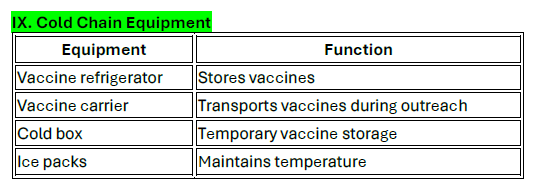
Cold Chain Equipment
Hepatitis B birth dose
Game Changer:
___ should be given as early as possible after birth.
Correct vaccine
Correct dose
Correct route
Correct site
Correct schedule
5 C’s of vaccine administration
Immunization
Game Changer:
___ is considered one of the most cost-effective public health interventions.
Mild illness
Game Changer:
A ___ is generally not a contraindication to vaccination.
Do not repeat same vaccine
What is the nursing action before vaccination to severe allergic reaction to previous dose?
Evaluate specific vaccine safety
What is the nursing action for immunocompromised client before vaccination?
Adverse Events Following Immunization (AEFI)
Any unexpected health event occurring after vaccination.
Examples:
Fever
Pain/swelling at injection site
Allergic reaction
Nursing management:
Observe client
Provide appropriate care
Report serious events
R – Right vaccine
D – Right dose/date
S – Right site
Game Changer:
What do nurses check before giving vaccine? (RDS)

Vaccine Timing Review

DEPARTMENT OF HEALTH PUBLIC HEALTH PROGRAMS (1)

DEPARTMENT OF HEALTH PUBLIC HEALTH PROGRAMS (2)
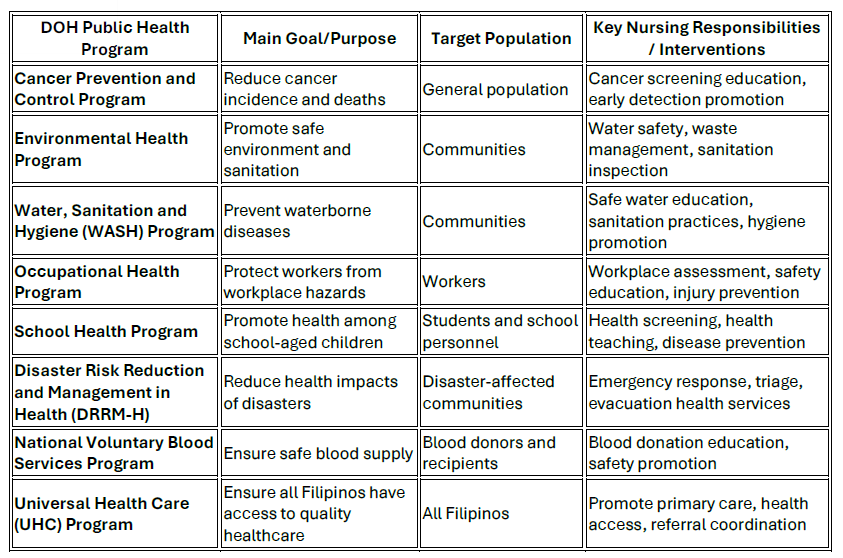
DEPARTMENT OF HEALTH PUBLIC HEALTH PROGRAMS (3)
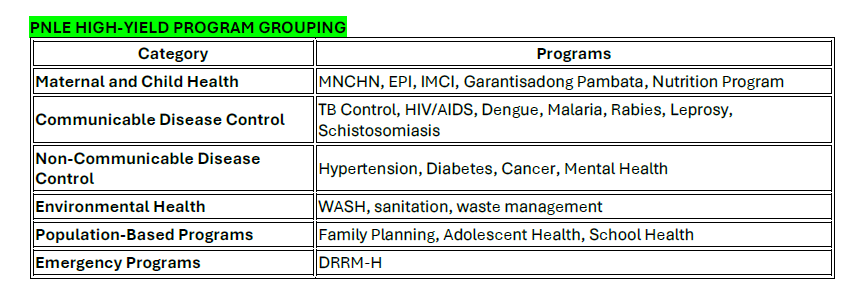
PNLE High Yield DOH Program Grouping
National Tuberculosis Control Program (NTP)
Game Changer:
Program that uses DOT for TB treatment?
IMCI
Game Changer:
Program for children below 5 with assessment and classification?
EPI
Game Changer:
Program responsible for routine vaccines?
Dengue Prevention and Control Program
Game Changer:
Program preventing mosquito breeding sites?
Universal Health Care (UHC)
Game Changer:
Program promoting access to healthcare for all Filipinos?
Environmental Health/WASH Program
Game Changer:
Program focusing on safe water and sanitation?
RA 9173 – Philippine Nursing Act
Governing Law for Nursing practice
RA 7305 – Magna Carta of Public Health Workers
Governing Law for Public health workers' rights
RA 10152 – Mandatory Immunization Act
Governing Law for Immunization
RA 11223 – Universal Health Care Act
Governing Law for Universal healthcare
RA 11036 – Mental Health Act
Governing Law for Mental health
RA 11166 – Philippine HIV and AIDS Policy Act
Governing Law for HIV/AIDS
RA 10028 + EO 51 – Milk Code
Governing Law for Breastfeeding
RA 10354 – RH Law
Governing Law for Family planning
RA 9003 – Ecological Solid Waste Management Act
Governing Law for Waste management
RA 10121 – DRRM Act
Governing Law for Disaster management
RA 7610 – Child Abuse Law
Governing Law for Child protection
RA 9482 – Anti-Rabies Act
Governing Law for Rabies prevention