CH 01 - Cells & Origins
 Call Kai
 Learn
Learn Practice Test
 Spaced Repetition
 Match
Match Flashcards
 Knowt Play
1/23

Earn XP
Description and Tags
EXAM 1: homework problems
Name | Mastery | Learn | Test | Matching | Spaced | Call with Kai | Chat |
|---|
No analytics yet
Send a link to your students to track their progress
24 Terms
The function of a(n) _________ cell, which has a long, branched structure, requires many connections to be made with neighboring cells
NERVE
Nerve cells have long, branched protrusions that form many contacts with other cells. This allows communication between the nerve cells and the sending of signals
All living cells
SHARE THE SAME BASIC CHEMISTRY
Living cells are remarkably diverse in size and shape but are governed by the same chemical principles.
Self-replication of living cells occurs through the catalytic action of
PROTEINS
To self-replicate, cells must first replicate their DNA, followed by division in two. DNA replication is performed by enzymes, which are proteins
Mistakes in replicating the DNA of a cell before division can have ___ effects
POSITIVE, NEGATIVE, OR NEUTRAL
Mistakes in the DNA sequence, depending on where they occur, can have positive, negative, or neutral effects on cell growth and survival. Changes that have positive effects on survival and reproduction can lead to the enrichment, called selection, of cells with that change in the population.
The genes in the genome of an adult organism are
EXPRESSED/SILENCED DEPENDING ON CELL TYPE + ENVIRONMENT
The cells of an adult organism can be quite varied in their structure and function despite having the same information in their genome. Not all genes in the genome are expressed at all times, or in all cell types; some genes are expressed for specific purposes and might be unique for a particular type of cell or situation.
Which of the following microscopy techniques would allow the most detailed image showing the 3-D structure of a flagellum?
SCANNING ELECTRON MICROSCOPY
Of all the microscopy techniques listed, electron microscopy provides the most high-resolution and detailed images. Scanning electron microscopy examines the outer surface of cell structures and gives a 3-D image.
Which of the following microscopy techniques allows the observation of living cells (i.e., NOT fixed cells)?
FLOURENSCE MICROSCOPY
Light microscopy, which also includes fluorescence microscopy, can be used to view living cells. Electron microscopy requires cell fixation and extensive preparation of the samples, which kills the cells.
The defining property that differentiates prokaryotic cells from eukaryotic cells is their
LACK OF NUCLEUS
Prokaryotes are small, single-celled organisms with a simple cell structure and no membrane-bound organelles. There is no nucleus surrounding the DNA of prokaryotic cells.
Compared to eukaryotes, prokaryotic organisms are ___ on earth
MORE ABUNTANT + WIDESPREAD
Prokaryotic organisms are everywhere, and they live in a very wide range of habitats on Earth, including some of the harshest environments on the planet.
Archaea and bacteria are two separate domains of prokaryotes that were distinguished by examining
DNA SEQUENCES
Archaea and bacteria are similar in size and cell appearance under a microscope, but they differ significantly in their genome sequences. Because they are both prokaryotes, they lack a nucleus and any organelles.
The main function of the nucleus is to
HOUSE DNA
DNA, in the form of chromosomes, is stored in the nucleus. Keeping the DNA separate from other cell components helps eukaryotic cells regulate access to the genetic information.
The inner membrane of the mitochondrion appears ___________ because it provides___________.
FOLDED, LARGE SURFACE AREA FOR ENERGY PRODUCTION
In mitochondria, the outer membrane is smooth, while the inner membrane is highly folded and convoluted. The proteins that are responsible for energy production via respiration are found in the inner membrane.
One piece of evidence indicating that chloroplasts evolved from engulfed photosynthetic bacteria is
CONTAIN THEIR OWN DNA
Chloroplasts, like mitochondria, contain their own DNA and reproduce by dividing in two. Both are thought to have evolved by symbiotic engulfed bacterial cells, but in two separate engulfment events.
Lysosomes and peroxisomes both perform a series of reactions to break down molecules, but one difference between them is that
PEROXISOMES CONTAIN HYDROGEN PEROXIDE
Both peroxisomes and lysosomes are small organelles that break down materials, but lysosomes generally digest biomolecules like proteins so that the building blocks can be reused. Peroxisomes deactivate toxic materials, often using hydrogen peroxide.
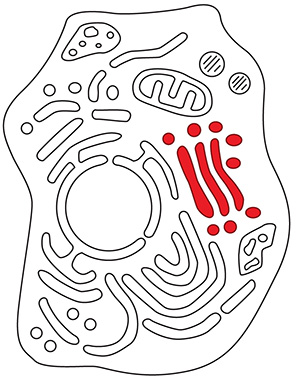
The organelle shown in the figure is the ___________ and one of its main functions is to ___________.
GOLGI APPARATUS, PACKAGE + MODIFY PROTEINS FOR SECRETION
The Golgi apparatus is a series of flattened sacs that receives proteins from the ER. It modifies and prepares these proteins for secretion outside of the cell.
The cell components that move materials from one organelle to another are called
TRANSPORT VESICLES
Transport vesicles are small membrane-bound compartments that bud off of one organelle, move to another organelle and fuse with it to release its contents into the interior.
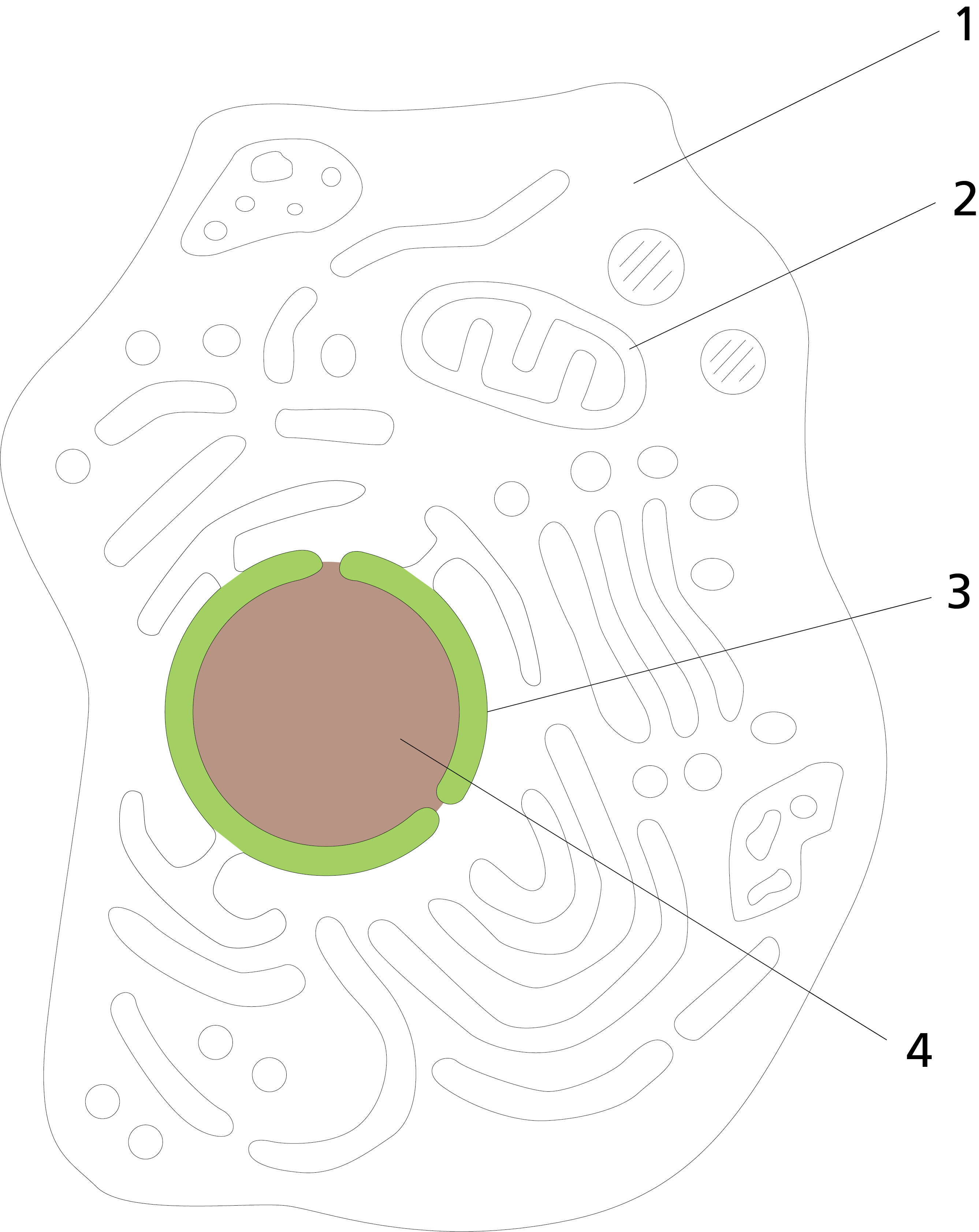
Which cell component is indicated in the figure below by the line labeled "1"?
CYTOSOL
The cytosol is an aqueous solution of soluble proteins and other macromolecules. It is the part of the cytoplasm that is not contained within organelles.
Which of the following accurately matches the types of filaments in the cytoskeleton with their cellular function?
microtubules-
intermediate filaments-
actin filaments-
CHROMOSOME SEGREGATION, STRENGTH/SUPPORT, CELL MOVEMENT
Microtubules form the mitotic spindle that functions in accurate chromosome segregation, intermediate filaments have a primary function of providing strength and support to the cell, and actin filaments are involved in dynamic processes such as cell motility.
Which of the following is a role of the cytoskeleton in plant cells?
ACTIN FILAMENTS GUIDE CELL MOVEMENT
XX
The rules of which fundamental process were elucidated in the bacterium Escherichia coli (E. coli)?
Correct answer:
DNA REPLICATION
The rules behind the process of DNA replication (as well as transcription and translation) were determined by experiments with the bacterial model organism E. coli. These simple prokaryotes are single-celled and do not have a cell cycle or mitosis, thus are best for studies of the most evolutionarily conserved cell processes.
The fruit fly, Drosophila melanogaster (D. melanogaster) is an excellent model for studying fundamentals of development because
DEVELOPMENT GENES IN FRUIT FLY ALSO FOUND IN HUMANS
Fruit flies have been studied for over a century, and their complex body plan can be manipulated genetically to uncover which genes govern development of which parts. Many of these genes have direct counterparts in the human genome.
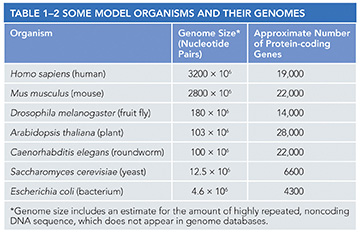
Genome size does not precisely determine gene number, as illustrated in the table below. What is a plausible explanation as to why A. thaliana, a plant, has a similarly sized genome as the fruit fly, but twice the number of protein-coding genes?
MORE GENES DUPLICATED DURING EVOLUTION
Plants have genes that were duplicated during evolution, and thus their protein-coding gene number is higher. Repeated noncoding sequences cannot explain this observation, since these do not get counted in the number of protein-coding genes.
If a gene sequence in one organism is highly similar to the sequence of another gene in another organism it is called
HOMOLOGOUS
Gene sequences from one organism can be compared to another organism to see if they are homologous. Homology between genes (and thus also their protein products) strongly suggests that they evolved from a common ancestral gene
A segment of DNA in the genome that is not a protein-coding gene can be
USED TO REGULATE GENE ACTIVITY
The genome of a complex organism is made up of protein-coding genes, sequences that encode functional RNAs, and regulatory sequences used to finely tune gene activity. Other DNA noncoding sequences seem to be unimportant to the cell, but we might just not understand their function yet.