Muscle Tissue Review Flashcards
 Call Kai
 Learn
Learn Practice Test
 Spaced Repetition
 Match
Match Flashcards
 Knowt Play
1/42

Earn XP
Description and Tags
Comprehensive vocabulary flashcards covering skeletal muscle anatomy, cellular physiology, contraction mechanisms, energy metabolism, and major muscle actions based on the lecture slides.
Name | Mastery | Learn | Test | Matching | Spaced | Call with Kai | Chat |
|---|
No analytics yet
Send a link to your students to track their progress
43 Terms
Sarcomere
The functional unit of a skeletal muscle. They make up muscle cells
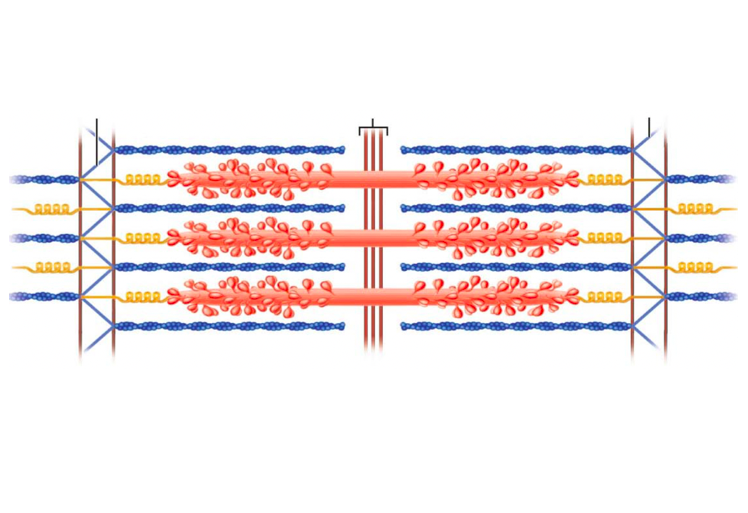
A band
The region of the sarcomere where thick filaments are found.
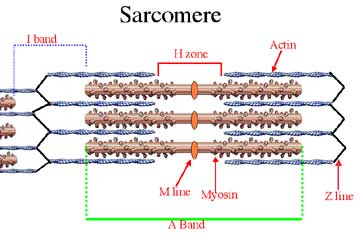
Titin
The elastic filament whose function is to connect myosin to the Z disc.
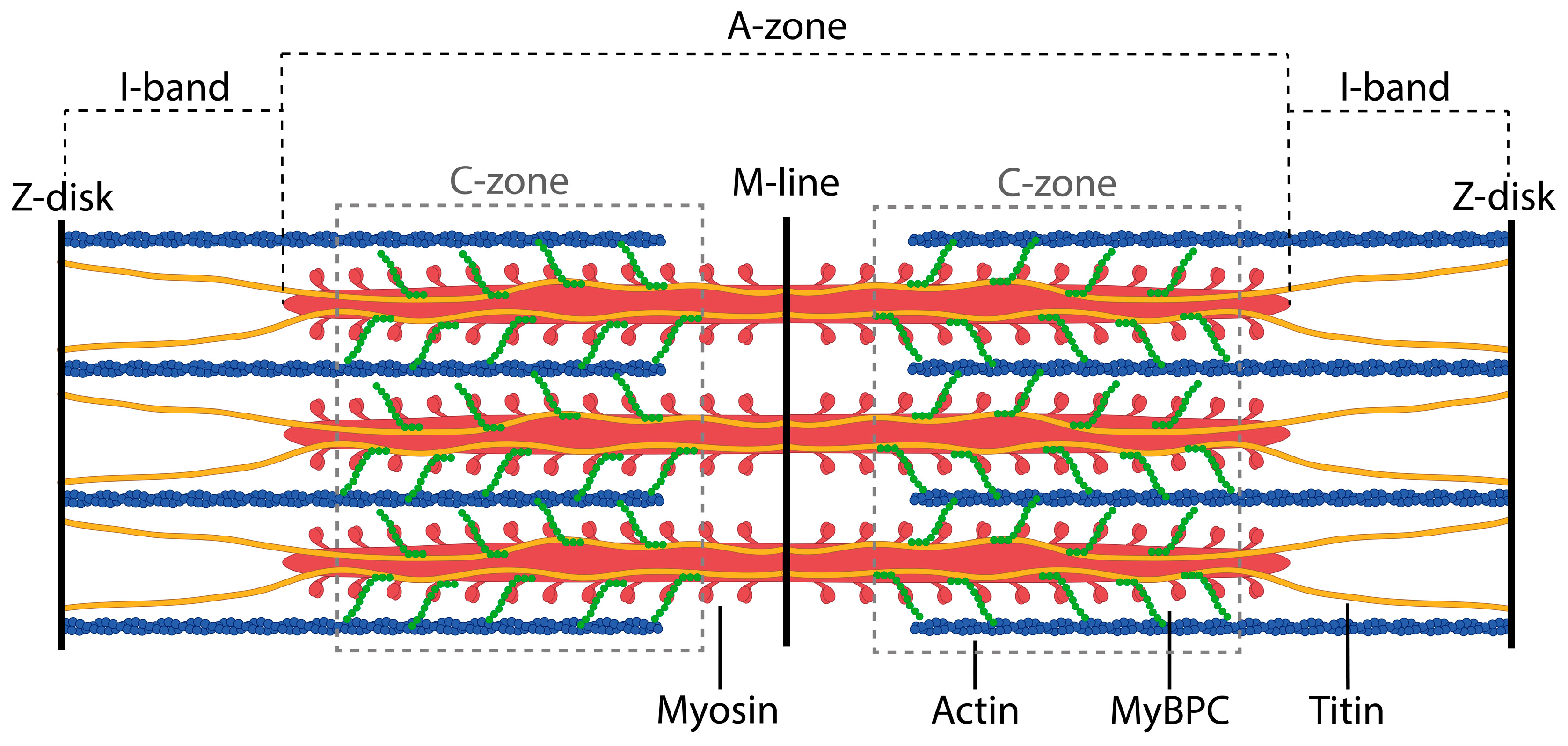
Tropomyosin
The regulatory protein that blocks myosin-binding sites in a resting muscle cell.
T tubules
The invaginations or infoldings of the sarcolemma that conduct electrical impulses into the interior of the myofiber.
Sarcoplasmic reticulum
The complex membrane structure where calcium is stored inside the muscle cell.
Troponin
The protein that calcium binds to in the sarcoplasm, causing tropomyosin to move and expose myosin-binding sites.
Terminal cisternae
Specific regions of the sarcoplasmic reticulum where calcium is stored and released in response to an action potential.
Epimysium
The connective tissue sheath that surrounds the entire muscle.
Endomysium
The connective tissue sheath that surrounds an individual muscle fiber.
Perimysium
The connective tissue sheath that surrounds a fascicle.
Tendon
A thick, ropelike structure that attaches the muscle to a bone, formed by the continuation of connective tissue sheaths.
Sarcolemma
The cell membrane of a muscle fiber.
Myofibrils
Long, cylindrical structures filling the myofiber, composed of back-to-back sarcomeres.
Z discs
Structures that anchor and stabilize the thin filaments and mark the boundaries of a sarcomere.
Actin and Myosin
The two contractile filaments found within a sarcomere.
Striations
The striped appearance of myofibers caused by alternating I and A bands.
I band
The region of the sarcomere containing only thin filaments.
H zone
The region of the sarcomere containing only thick filaments.
Triad
A functional unit formed by one T tubule and two terminal cisternae.
Cross bridge formation
The process that occurs when the myosin head binds to actin.
ATP
The substance that must bind to myosin heads to allow them to detach from thin filaments, and the first energy source used during intense activity.
Active transport
The process by which calcium reenters the terminal cisterns after muscle contraction is finished.
Neuromuscular junction
The site of communication between a motor neuron and a muscle, consisting of the motor endplate, axon terminal, and synaptic cleft.
Synaptic vesicles
The structures from which acetylcholine is released.
Acetylcholinesterase
The enzyme responsible for breaking down acetylcholine in the synaptic cleft.
Acetylcholine receptors
Ligand-gated sodium channels found on the motor endplate.
Action potential
An electrical impulse or current that spreads across the sarcolemma and down T-tubules to open voltage-gated Ca++ channels.
Creatine phosphate
The molecule in the muscle cell that regenerates ATP from ADP, acting as the second source of energy.
Glycolysis
An anaerobic process in the cytoplasm that produces a net of 2ATP and two pyruvate molecules; it is the third energy source used.
Aerobic respiration
A process occurring in the mitochondria that requires oxygen and produces about 36−28ATP through the Kreb's cycle and electron transport chain.
Sternocleidomastoid
The muscle responsible for flexing the neck.
Trapezius
The muscle responsible for extending the neck.
Deltoid
The muscle whose primary action is abducting the arm.
Pectoralis major
A muscle that acts as an arm adductor.
Triceps brachii
The muscle responsible for extending the elbow.
Biceps brachii
The muscle responsible for flexing the elbow.
Anterior tibialis
The muscle that causes dorsiflexion.
Gastrocnemius
The muscle that causes plantar flexion.
Hamstrings
The muscle group responsible for causing knee flexion.
Rectus femoris
The muscle responsible for causing knee extension.
Muscle Action Terms
Terms describing what a muscle does, including flexor, extensor, abductor, adductor, and pronator.
Muscle Size/Length Terms
Terms used in muscle naming including vastus, maximus, and longus.