Reading Vocabulary Volume 7 Test 1
 Call Kai
 Learn
Learn Practice Test
 Spaced Repetition
 Match
Match Flashcards
 Knowt Play
1/19

Earn XP
Description and Tags
A set of vocabulary flashcards derived from Reading Volume 7 Test 1, focusing on academic terminology, word families, and contextual usage.
Name | Mastery | Learn | Test | Matching | Spaced | Call with Kai | Chat |
|---|
No analytics yet
Send a link to your students to track their progress
20 Terms
Adaptation
A structural characteristic that enables certain plant species to survive in nutrient-poor environments.
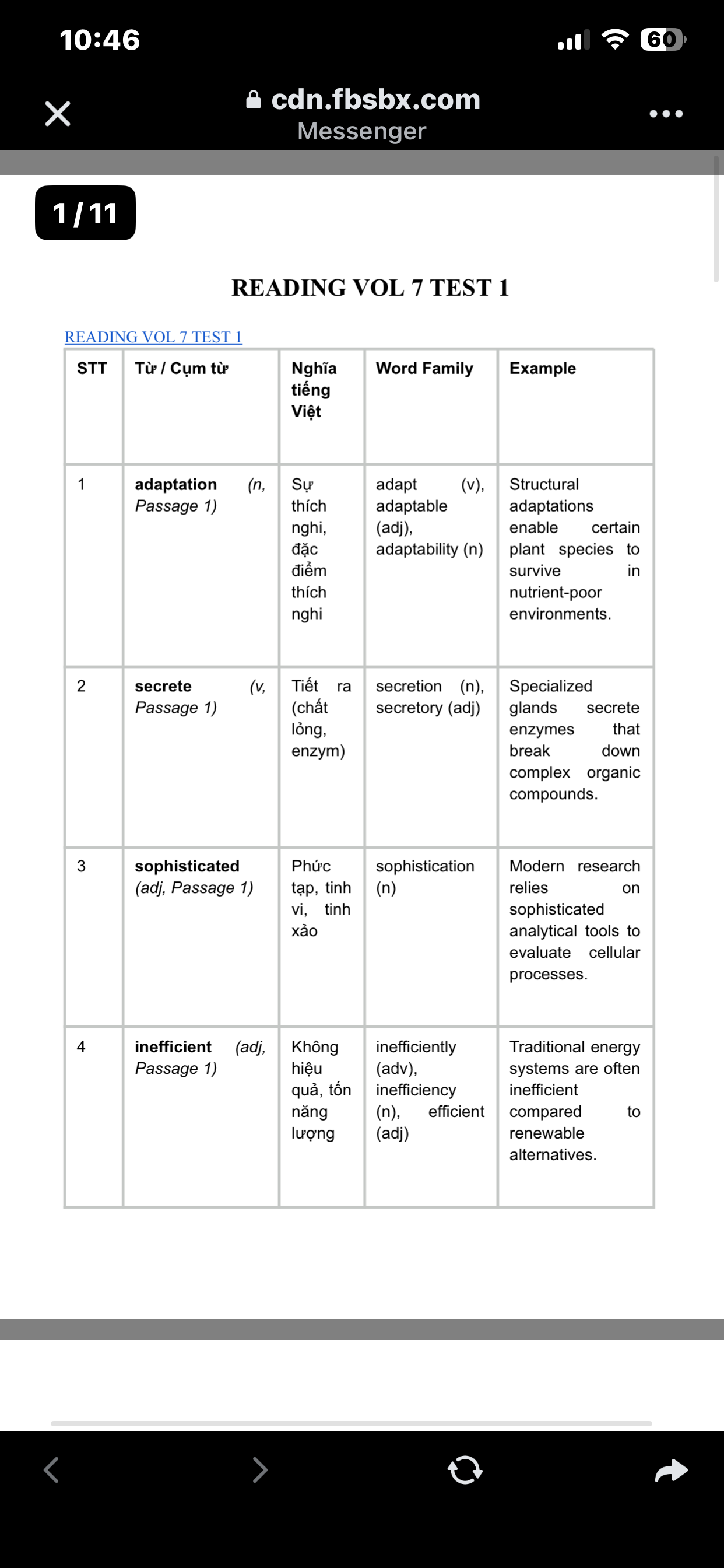
Secrete
To produce and release a liquid or enzyme, such as specialized glands releasing enzymes to break down complex organic compounds.
Sophisticated
Complex, fine, or advanced, often describing analytical tools used to evaluate cellular processes.
Inefficient
Not achieving maximum productivity or wasting energy; often used to describe traditional energy systems compared to renewable alternatives.
Harsh
Severe or cruel, specifically regarding climatic conditions like those in a desert that organisms must evolve traits to endure.
Overcompete
To compete more successfully than others, such as invasive species rapidly surpassing native flora for light and soil nutrients.
Inventiveness
The quality of being creative or ingenious, as seen in the complex defense mechanisms of flora through natural selection.
Reminiscent
Tending to remind one of something, such as architectural designs that evoke classical civilisations.
Complexity
The state or quality of being intricate or complicated; for example, the growing intricacy of urban infrastructure.
Captivate
To attract and hold the interest and attention of, as ancient monuments do for researchers and tourists.
Remnant
A remaining part or trace of something, such as the remains of an ancient settlement discovered beneath a city center.
Substantiate
To provide evidence to support or prove the truth of a claim, such as using empirical evidence for historical claims regarding social collapse.
Categorise
To place in a particular class or group; for instance, environmental stressors can be grouped into human-induced and natural factors.
Degradation
The process of wearing down or the state of being deteriorated, such as land degradation threatening agricultural productivity and food security.
Depletion
The reduction in the number or quantity of something, such as the rapid reduction of natural resources posing a threat to economic stability.
Inaccurate
Not correct or exact; relying on historical myths often leads to incorrect conclusions about past events.
Demise
The end or failure of an enterprise or institution, such as unchecked political corruption contributing to the fall of an empire.
Vulnerability
The state of being exposed to the possibility of being attacked or harmed, such as coastal cities facing economic risk due to rising sea levels.
Contingent on
Subject to chance or dependent on something else.
Encompass
To include comprehensively or contain.