Ecology & Behavior
 Call Kai
 Learn
Learn Practice Test
 Spaced Repetition
 Match
Match Flashcards
 Knowt Play
1/9

There's no tags or description
Looks like no tags are added yet.
Name | Mastery | Learn | Test | Matching | Spaced | Call with Kai |
|---|
No analytics yet
Send a link to your students to track their progress
10 Terms
Ways to study Ecology & Behavior
Direct observations- often short notes based on limited observations, diffuse to do in field
Baited Longlines & Drumlines
Acoustic tagging
Study done on South Farallon Islands, CA: describe, what patterns observed from big map & other graph about shark behavior?
Used tower at top of islands to observe and record white shark attacks on prey
see concentrated areas closely associated w/isand of where attacks occurs and also in lines→ prey is associated with beach, colonies of seals & sealions, they also take the same routes off & too land that the sharks know
Found attacks to be the most in the middle of the day- more observations during the day but divided # of attacks recorded by observation effort to compensate, still found the same thing
White shark eyes tapetum lucidum not oriented for max reflectiveness so probably hunt better during the day (guanine covers tapetum lucidum in white sharks so theyre more light than dark adapted)
Baited Longines & drumlines
Long line: on surface or benthos, long line that has many baited hooks coming down from it
Drum line: has a waited base and line with hook that can swivel so shark can keep swimming and stay alive
useful for monitoring trends in relative abundance (catch per unit effort) → comparing one area to another or over time, not for population estimates
Data from researchers and bycatch from fishermen
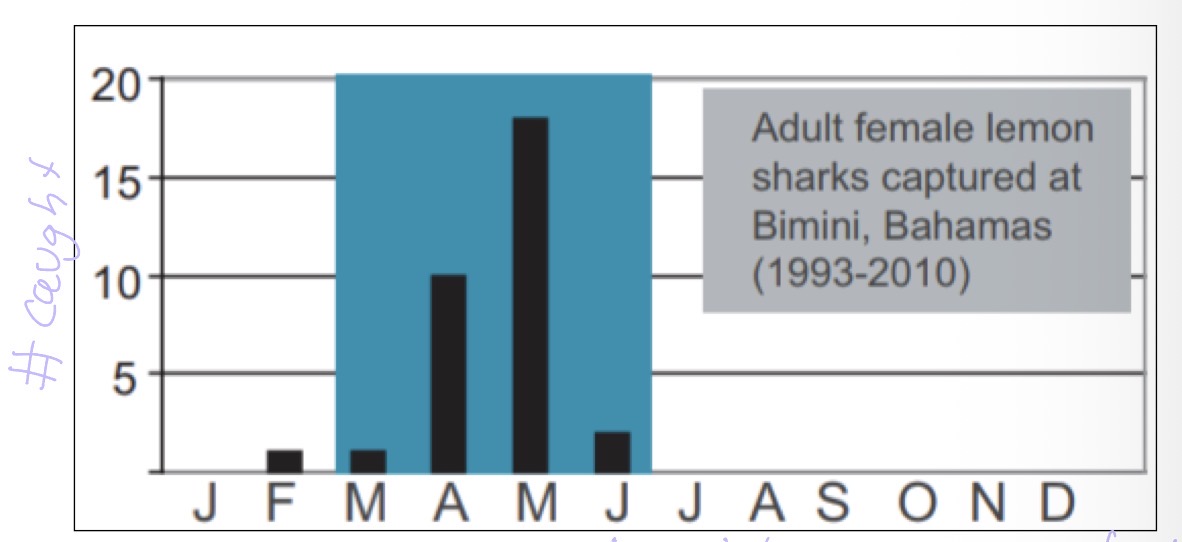
Implications?
Using long line to catch females tells us when the females are in the area, which can tell us about migratory habitats, and area residence
blue coincides with newborn pups being present→ tells us that theyre their to pup
Stupid paper about shark abundance based on longline data
reported that coastal (hammer head, white, tiger, coastal) & offshore pelagic (thresher, blue, mako, oceanic whitetip) species relative abundance was all decline from 1986-2000
Rebuttal saying maybe going down but really not as much as other paper
Stupid Cascading paper
Cascade- one change in a level affects a level 2 steps away
Figures of big coastal shark abundance all declining starting in 1970, fig of small meso predator species all increasing from 1970, figure of Bay scallop pop increasing and then crashing
Claimed that all the cownose rays were eating the bay scallops causing their pop to crash bc the great shark pops were declining so they weren’t preying on the cownose rays and other meso predators
This was actually harmful and wrong→ caused eat a ray, save the bay campaign, cownose rays overfished and killed their pops can’t even recover that fast bc they have low # of offspring
Bay scallop pop also crashed in Maine and cownose rays don’t even migrate that far, said data was left out too
Dolphin & tiger shark study- what they found, how they did it?

