Glycolysis
 Call Kai
 Learn
Learn Practice Test
 Spaced Repetition
 Match
Match Flashcards
 Knowt Play
1/16

Earn XP
Name | Mastery | Learn | Test | Matching | Spaced | Call with Kai | Chat |
|---|
No analytics yet
Send a link to your students to track their progress
17 Terms
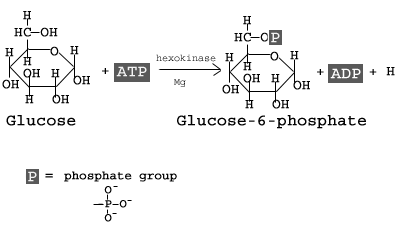
Hexokinase
Step 1
Conversion of glucose to glucose-6-phosphate
glucose is phosphorylated using 1 ATP molecule
ATP → ADP (tri- to di-)
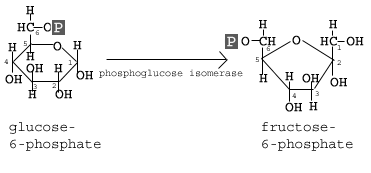
Phosphogluco-isomerase
Step 2
Rearrangement of glucose 6-phosphate (G6P) into fructose 6-phosphate (F6P) (fructose is an isomer of glucose)
6-member ring to 5-member ring
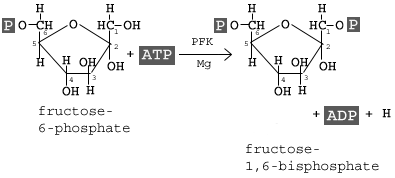
Phosphofructokinase
Step 3
Fructose-6-phosphate is converted to fructose- 1,6-bisphosphate (FBP)
uses 1 additional ATP molecule for second phosphate
ATP → ADP
Aldolase
Step 4
cleavage of FBP to yield two 3-carbon molecules
Yields glyceraldehyde-3-phosphate (GAP) dihydroxyacetone phosphate (DHAP) (isomers)
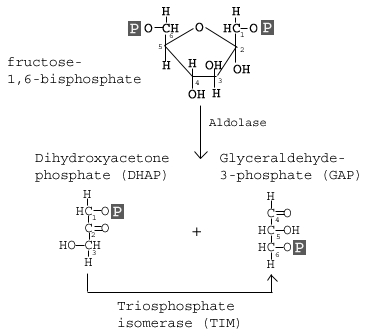
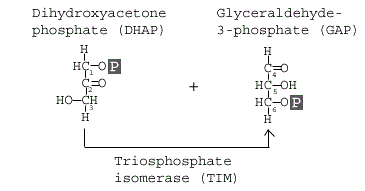
Triosephosphate isomerase
Step 5
Converts DHAP molecules into GAP to continue onto the next step
Should have two GAP molecules at the end
Glyceraldehyde-3-phosphate
dehydrogenase
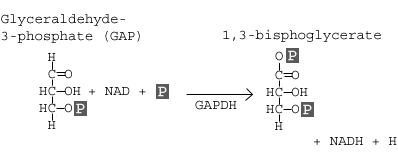
Step 6
Glyceraldehyde-3-phosphate (GAP) is oxidized by the coenzyme nicotinamide adenine dinucleotide (NAD)
The molecule is phosphorylated by the addition of a free phosphate group yielding 1,3-bisphosphoglycerate and NADH
Phosphoglycerokinase
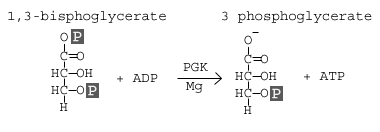
Step 7
1,3 bisphoglycerate is converted to 3-phosphoglycerate
Phosphate is transferred to a molecule of ADP yielding ATP
happens x2 with both 1,3 bisphoglycerate molecules, yielding a total of 2 ATP
Phosphoglyceromutase
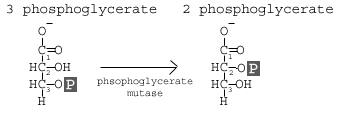
Step 8
Rearrangement of the position of the phosphate group on the 3-phosphoglycerate molecule, making it 2-phosphoglycerate
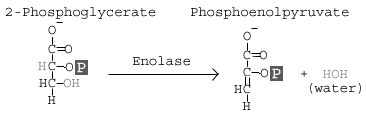
Enolase
Step 9
Conversion of 2-phosphoglycerate to phosphoenolpyruvate (PEP)
Dehydration yielding H2O
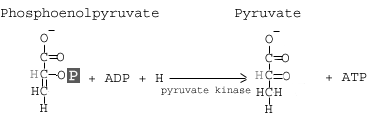
Pyruvate kinase
transfers a P from phosphoenolpyruvate (PEP) to ADP to form pyruvic acid and ATP
happens x2 with both phosphoenolpyruvate molecules, yielding 2 ATP and 2 pyruvate molecules
Glycolysis Equation

Energy Generating Steps
Steps 7 & 10 = +4 ATP
Energy Consuming Steps
Steps 1 & 3 = -2 ATP
Reaction Coupling
Endergonic (unfavorable) reactions are paired with exergonic (favorable) reactions to proceed
Steps 1 & 3 utilize this by coupling phosphorylation with ATP hydrolysis
Aerobic Conditions
Pyruvate is converted into Acetyl CoA, enters the TCA cycle
NADH transfers its electrons into the ETC
Anaerobic Conditions
Fermentation
Pyruvate is reduced into either lactate (animals/bacteria) or ethanol and CO2 (fungi/plants)
NADH transfers electrons to pyruvate, oxidizes back to NAD to restart glycolysis
Redox Reactions
An oxidation-reduction (redox) reaction is a type of chemical reaction that involves a transfer of electrons between two molecules
Glycolysis: Step 6 GAP is oxidized by NAD, NAD is reduced to NADH