Traffic Signals
 Call Kai
 Learn
Learn Practice Test
 Spaced Repetition
 Match
Match Flashcards
 Knowt Play
1/13

Earn XP
Description and Tags
Official Florida Driver License Handbook.
Name | Mastery | Learn | Test | Matching | Spaced | Call with Kai | Chat |
|---|
No analytics yet
Send a link to your students to track their progress
14 Terms

Red Light:
Come to a complete stop at the stop line. Remain stopped until the light turns green.
Don’t stop too far away from the stop line. Some signals change only when sensors detect vehicles at the stop line.
After stopping, you may turn right if there is not a NO TURN ON RED sign and the way is clear.
You may turn left from a one-way street onto a one-way street that has traffic moving to the left.
Before turning, you must yield the right-of-way to pedestrians in the crosswalk and oncoming traffic.
Running (driving through) a red light is against the law and is extremely dangerous!

Yellow Light:
Warning—the light is changing to red.
Stop if you can safely do so. It is extremely dangerous to be in an intersection when the light turns red.
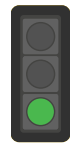
Green light:
Go, but only if the intersection is clear.
Yield to pedestrians in the crosswalk and vehicles in the intersection.
Approach at a speed that will allow you to slow down if the light changes.
When turning left, you must yield to oncoming traffic and pedestrians.

Red Arrow:
Do not make the movement shown by the arrow until the green light appears.
After stopping, you may turn right if there is not a NO TURN ON RED sign and the way is clear.
You may turn left from a one-way street onto a one-way street that has traffic moving to the left.
You must yield the right-of-way to pedestrians in the crosswalk and oncoming traffic.

Yellow Arrow:
◆ The green arrow is ending or the light is about to turn red.
◆ Stop if you can safely do so.

Green Arrow:
You may make a turn in the direction of the arrow.
If the red light is illuminated at the same time, you must be in the proper lane for such a turn.
You must yield the right-of-way to vehicles and pedestrians in the intersection.

Flashing Yellow Arrow:
The green arrow is ending or the light is about to turn red.
Stop if you can safely do so.

Flashing Red Light:
Used at dangerous intersections. Treat it like a stop sign; stop and
proceed when safe.

Flashing Yellow Light:
Used at, or just before, dangerous intersections.
Also used to alert you to a warning sign such as a school crossing or sharp curve. Proceed with caution.
Lane Signals:
Lane signals are used:
when the direction of the flow of traffic changes during the day;
to show that a toll booth is open or closed; or
to show which lanes are opened or closed.

Red X:
Never drive in a lane under the red X.

Yellow X:
The lane signal is about to turn red.

Green Arrow:
You may use this lane and you must also obey all other signs and signals.
Ramp signals:
Ramp signals:
control the rate of vehicles entering an expressway; and
alternate between red and green. You must wait for the green signal before entering the expressway.