L6 DNA Methylation II: Demethylation and Reprogramming Learning Objectives
 Call Kai
 Learn
Learn Practice Test
 Spaced Repetition
 Match
Match Flashcards
 Knowt Play
1/10

There's no tags or description
Looks like no tags are added yet.
Name | Mastery | Learn | Test | Matching | Spaced | Call with Kai | Chat |
|---|
No analytics yet
Send a link to your students to track their progress
11 Terms
Distinguish passive from active demethylation, and say which of the two requires DNA replication
Passive demethylation:
Loss of methylation due to lack of maintenance of DNA methylation
Two rounds without DNMT1: hemimethylated, then unmethylated
Requires DNA replication
Active demethylation:
Removal of existing methyl marks
Deamination of 5mC to thymidine by activation-induced deaminase (AID)
Creates T:G mismatches – T replaced by C by TDG or MBD4
Discovered when 5-hydroxy-methylcytosine (5hmC) was identified
Follow a fully methylated CpG through two rounds of replication without DNMT1, and name the intermediate state
The Starting Point
You start with 1 DNA molecule that is fully methylated (methyl groups on both strands).
Round 1 of Replication (No DNMT1)
The 2 strands separate to make 2 new DNA molecules.
Since DNMT1 is missing, the new partner strands are built completely unmethylated.
Result: 2 DNA molecules that are half-methylated.
Intermediate State Name: Hemi-methylated DNA (or semimethylated DNA).
Round 2 of Replication (No DNMT1)
The 2 hemi-methylated molecules separate to make 4 total DNA molecules:
The 2 methylated strands pair with new unmethylated strands —> 2 Hemi-methylated DNA molecules (50%)
The 2 unmethylated strands pair with new unmethylated strands —> 2 Fully unmethylated DNA molecules (50%)
Summary:
Missing DNMT1 causes the original methyl marks to get diluted by half with every cell division until unmethylated DNA is produced
Trace active demethylation: AID deamination of 5mC giving T:G mismatches repaired by TDG or MBD4, and TET oxidation of 5mC to 5hmC, 5fC and 5caC, returned to C by base excision repair
Deamination of 5mC to thymidine by activation-induced deaminase (AID)
Creates T:G mismatches – T replaced by C by TDG or MBD4
Discovered when 5-hydroxy-methylcytosine (5hmC) was identified
5hmC is produced via action of Ten-eleven translocation methylcytosine dioxygenase (TET)
5hmC can not act as a substrate for DNMT1 (maintenance DNA methyltransferase) – this leads to passive demethylation
5hmC, 5fC (5-formylcytosine), 5caC (5-carboxylcytosine) can be converted to C through base excision repair via glycosylase
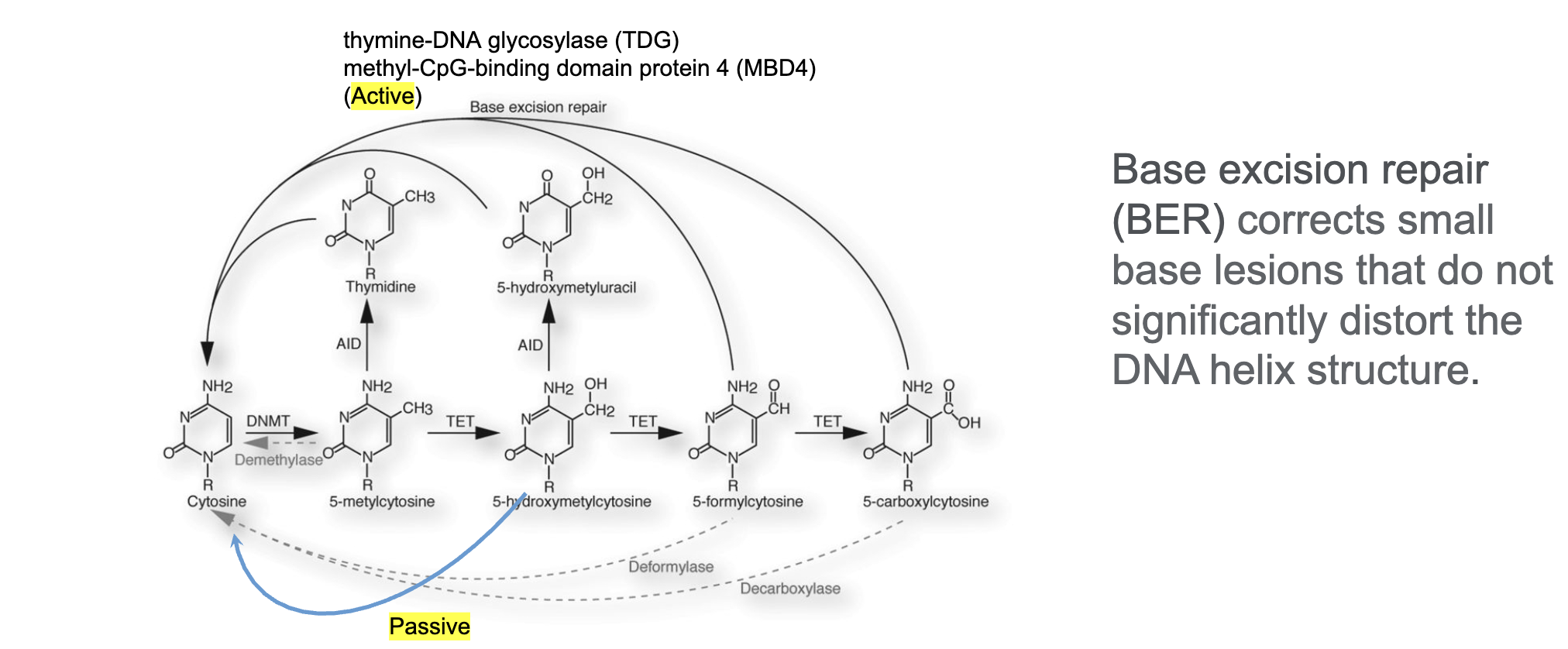
Explain why TET feeds both routes — 5hmC is a poor substrate for DNMT1, so oxidation also causes passive loss
TET feeds both routes: BER removal and dilution
5hmC is a poor substrate for DNMT1, so oxidation also causes passive loss
Describe early mammalian development from zygote to blastocyst, and say which lineage makes the embryo proper, and which makes the placenta
Cells are totipotent between zygote and morula stage. Morula = 16 cells
Transition from morula to blastocyst produces inner cell mass (ICM)
ICM produces pluripotent embryonic stem (ES) cells and makes all body organs
Trophectoderm (TE) cells make placenta

Name the two genome-wide demethylation cycles in the mammalian life cycle, say when each occurs, and give what each accomplishes
Two distinct cycles of large-scale demethylation and remethylation
Differentiation of primordial germ cells:
Allows sex-specific imprinting
After fertilization and before implantation:
Crucial for establishing pluripotency

Place PGC demethylation on a developmental timeline (specification ~E6.0, migration ~E8.0, complete by ~E11.5) and give the levels reached: under 10%, against over 70% in surrounding somatic cells
Primordial germ cells (PGC) are precursors of germ cells
PGC originate from embryonic cells that start to acquire somatic fate
At their origin, PGC have methylation levels similar to their parental somatic cells
Chromatin structure and transcription profiles are also similar to parental somatic cells
As the PGC start migrating to genital ridge, their methylation is mostly removed such that total methylation is <10% compared to >70% methylation in other cells in the embryo
Parental imprints are removed
X chromosome in females is reactivated

Distinguish the two waves of PGC demethylation
There are two waves of PGC demethylation. First is passive and second is active demethylation
First stage – passive demethylation:
De novo DNA methyltransferases DNMT3a/b are suppressed
DNMT1 present but its cofactor NP95 is absent
Replication dependent demethylation causes higher amount of hemi-methylated DNA
X chromosome and imprinted genes retain some methylation during this phase
Second stage – active demethylation:
Involves conversion of 5-methylcytosine (5mC) to 5-hydroxymethylcytosine (5hmC)
Involves TET and AID proteins
X chromosome and imprinted genes are demethylated
Most of DNA methylation is removed in PGC
Except some retroelements
Explain sex-specific remethylation of PGCs and say why the male germline accumulates more maintenance errors
In males, PGC methylation levels are fully established by birth:
DNA methylation levels are maintained during life leading to adulthood – several rounds of mitosis
Chances of errors in maintaining methylation are higher in males
Male germline keeps dividing; female stays in meiotic arrest
In females, re-methylation occurs after birth during oocyte growth:
De novo DNA methylation is required to put sex-specific imprints
Loss of de novo DNA methylation causes sperm apoptosis
Such loss in oocytes causes death of embryo

Contrast paternal and maternal demethylation after fertilization: Tet3 translocation to the paternal pronucleus against replication-dependent dilution of the maternal genome; say when remethylation begins and give one hypothesis for why the paternal genome is actively demethylated
Starts after zygote formation – before implantation to uterus
Imprinted genes are not demethylated
Maternal and paternal chromosomes show different kinetics of demethylation
Remethylation begins at the blastocyst, as the ICM methylation goes high while trophectoderm methylation stays low
Tet3 expressed in oocyte and zygote
After fertilization, Tet3 protein moves from cytoplasm to male paternal nucleus
Converts 5mC to 5hmC/5fC/5caC
Paternal genome undergoes rapid and almost complete demethylation:
This is very dramatic as 90% of the sperm genome is methylated!
Demethylation of paternal genome is active
5hmC is then diluted as the embryo divides toward the morula
Maternal genome under passive demethylation:
Oocytes have lower (~40%) levels to begin with
Maternal genome appears resistant to active demethylation (e.g., TET)
Why is paternal genome actively demethylated:
One hypothesis is that it allows maternal control by removing any distinguishing paternal epigenetic marks
Removes any marks that may favor a specific embryo
Allows equal distribution of resources to embryos
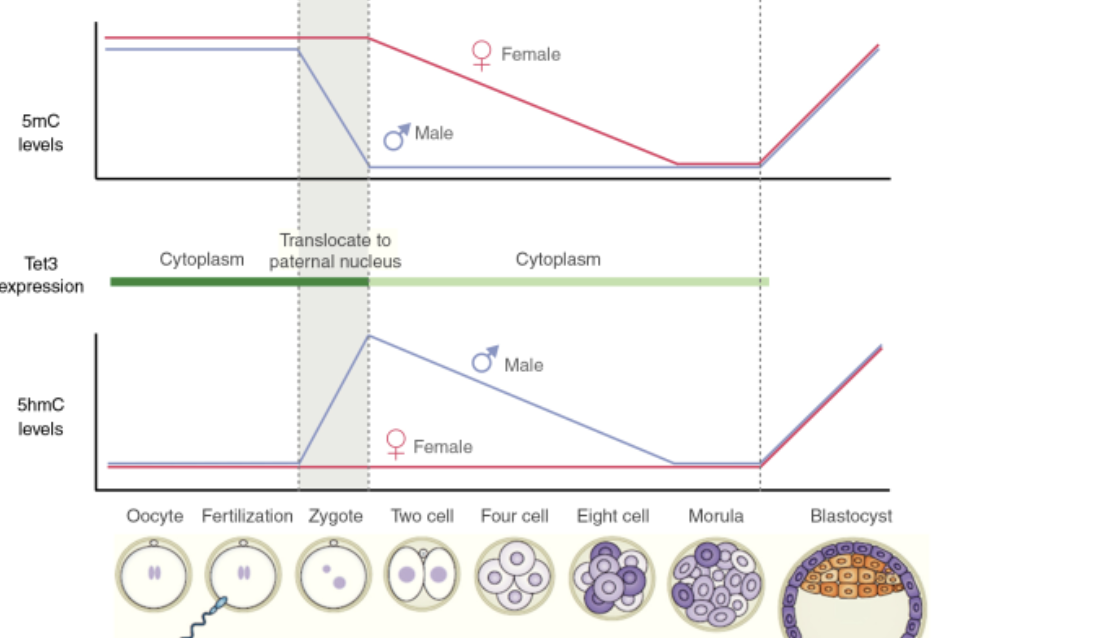
The two reprogramming cycles (not part of the learning objectives)
