Chapter 2 - Plasma Membranes
 Call Kai
 Learn
Learn Practice Test
 Spaced Repetition
 Match
Match Flashcards
 Knowt Play
1/128

Earn XP
Description and Tags
Name | Mastery | Learn | Test | Matching | Spaced | Call with Kai | Chat |
|---|
No analytics yet
Send a link to your students to track their progress
129 Terms
What is a plasma membrane?
a cell surface membrane
What are some of the functions of membranes?
partially permeable
involved in cell signalling
provide attachment sites for enzymes and other molecules involved in metabolism
allow electrical signals to be passed
allow compartmentalisation
Why is it important that membranes allow compartmentalisation?
It allows cellular compartments to have different conditions required for optimum reaction rates, as the membrane acts as a barrier
Explain why phospholipids form a bilayer in plasma membranes
phospholipids have a polar phosphate group head, which is hydrophilic and will face the aqueous solution
the fatty acid tails are non-polar and hydrophobic so will move away from the aqueous solution
as both the tissue fluid and the cytoplasm are aqueous, phospholipids form 2 layers with the hydrophilic tails facing inwards and the hydrophobic phosphate groups facing outwards
Which part of a phospholipid is polar and hydrophilic?
phosphate heads
Which part of a phospholipid is non-polar and hydrophobic?
fatty acid tails
True or false? Phospholipids act as a barrier to most water-soluble substances, such as dissolved glucose and amino acids
True
Why is the structure of the plasma membrane often called the “fluid mosaic model”?
‘fluid’ as the phospholipids are free to move laterally within the layer
‘mosaic’ due to the scattered pattern of intrinsic and extrinsic proteins in the membrane
‘model’ as the agreed structure is based on experimental and chemical evidence
True or false? Proteins (both intrinsic and extrinsic) cannot move through the phospholipid bilayer
false - they can move depending on the number of phospholipids with unsaturated fatty acids in their tails
What is an intrinsic or integral protein?
a protein that is embedded in both layers of the phospholipid bilayer
What is an extrinsic or peripheral protein?
a protein that is present in only one layer of the phospholipid bilayer
How are intrinsic proteins fixed in position in the phospholipid bilayer?
The hydrophobic R-groups in their amino acids interact with the hydrophobic core of the membrane
How are extrinsic proteins held in place?
The hydrophilic R-groups interact with the polar heads of the phospholipids or with intrinsic proteins?
True or false? All extrinsic proteins can move between the layers of the phospholipid bilayer
false - only some can
What type of molecules can diffuse directly through a membrane?
small, non-polar, fat soluble molecules
Give 2 examples of transport proteins?
channel and carrier proteins
What characteristic of molecules means they need a transport protein to transport them through a membrane?
polar
Fill in the blanks and choose the correct words: channel proteins are (p)____ in the membrane that provide a hydrophilic/hydrophobic channel to allow the passive/active of small/large or polar/non-polar molecules through membranes down a ___ ___. Some may be (g)____ to control movement by opening and closing.
pores, hydrophilic, passive, large, polar, concentration gradient, gated
What are carrier proteins?
proteins that change shape to carry molecules across a membrane
True or false? Carrier proteins always require energy
false - some are passive
Are glycoproteins intrinsic or extrinsic proteins?
intrinsic
What are the carbohydrates chains (of varying lengths) that protrude from glycoproteins and glycolipids called?
glycolax
On a diagram, how can you tell the difference between a glycolipid and a glycoprotein?
the glycolax (carbohydrate chain) of a glycoproteins is usually more highly branched
How do glycoproteins help to stabilise the cell membrane?
they form hydrogen bonds with the water molecules surrounding the cell
Give 3 functions of glycoproteins
help stabilise the membrane
involved in cell adhesion (for building cell tissues)
act as cell receptors for cell signalling, neurone transmission, hormones, and drugs
What is the function of glycolipids?
immune recognition - act as cell identity markers for antigens allowing the immune system to recognise its own cells and distinguish them from pathogens, preventing self destruction
receipts for drugs and hormones
What does amphiphilic mean?
a molecule is both hydrophobic and hydrophilic
Is cholesterol an amphiphilic molecule?
yes
How is cholesterol positioned within a membrane?
it is found in small amounts positioned in between the phospholipids with the hydrophilic end interacting with the phospholipid heads and hydrophobic end with tails, pulling them together
Choose the correct word: cholesterol - at a high temperature membranes becomes more/less fluid, so more/less stable, as cholesterol releases/binds/modifies the phospholipids together, so they are packed more loosely/tightly.
less, more, binds, tightly
How does cholesterol affect membrane fluidity at low temperatures?
cholesterol maintains the membranes fluidity by preventing the phospholipid molecules from grouping too closely together.
What are the 2 functions of cholesterol in cell membranes?
regulate fluidity
increase mechanical strength (less likely to burst)
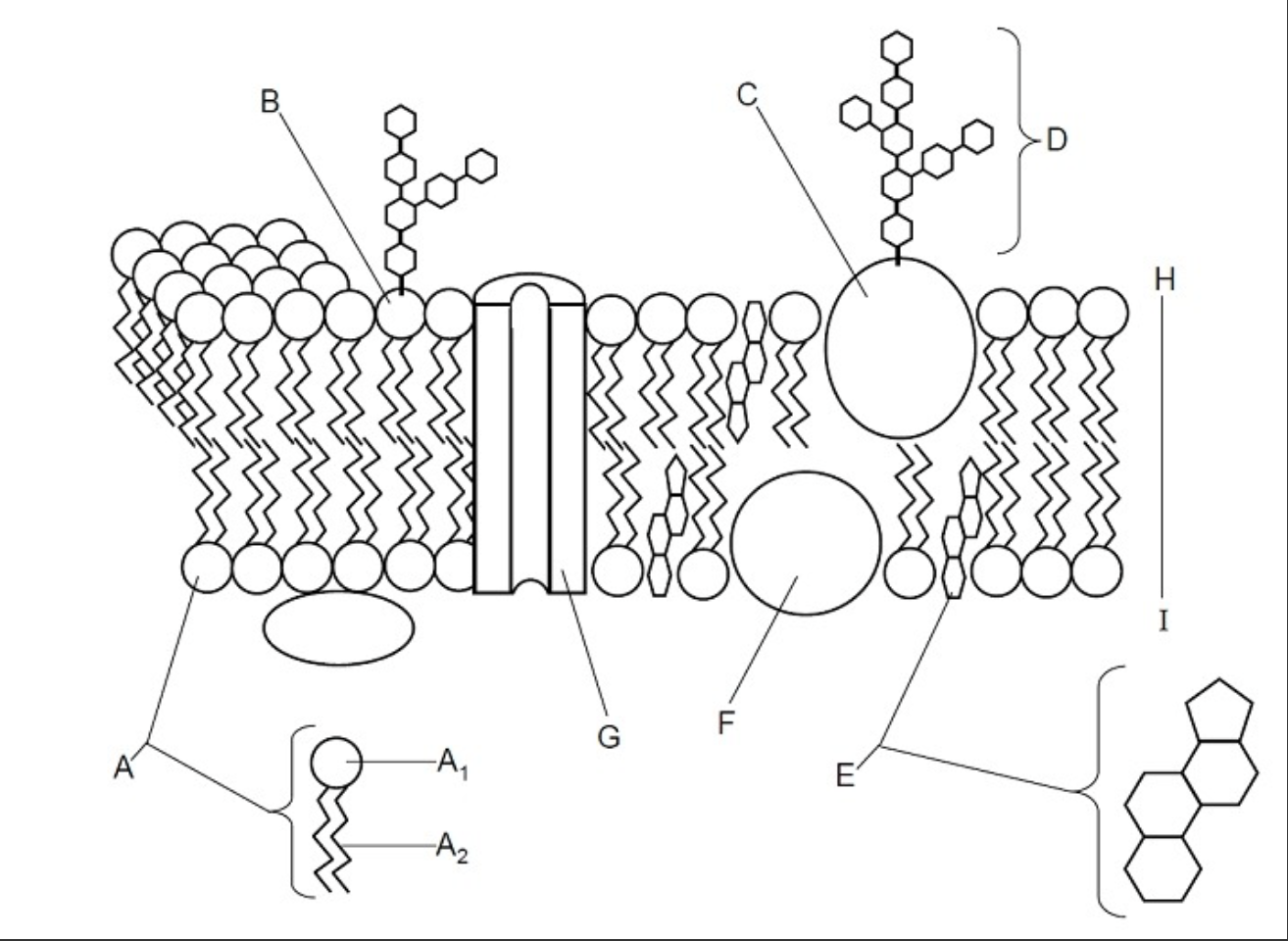
Label parts A, G and F
A - phospholipid head, fatty acid tail, G - intrinsic channel protein, F - extrinsic protein
Label the parts B, C and D
B - glycolipid, C - protein component of glycoprotein, D - carbohydrate chain of glycoprotein
Label Part E
cholesterol
What 2 factors can affect membrane permeability?
temperature and solvents
How does a temperature below 0ºC affect membrane permeability?
the phospholipids don’t move as they have little energy, so they are packed closely together causing the membrane to become rigid increasing permeability
proteins denature increasing permeability
ice crystals may pierce the membrane, making it very permeable when it thaws
How does a temperature between 0-45ºC affect membrane permeability?
phospholipids have increasing kinetic energy so move around more, meaning they are less tightly packed together so permeability increases
How does a temperature above 45ºC affect membrane permeability?
Fill in the blanks: the bilayer starts to ___, ____ permeability. Water inside the cell ___ putting more ___ on the cell surface membrane. Proteins begin to ___, disrupting the membrane (s)___ so it is no longer an effective (b)___ and allows substances pass through freely. This process is (i)___
break down, increasing, expands, pressure, denature, structure, barrier, irreversible
How do organic solvents affect the permeability of the phospholipid bilayer?
they increase the permeability by dissolving the phospholipids in the membrane
Give an example of an organic solvent
alcohols
Even though water is a solvent, why does it benefit the phospholipid bilayer?
it has hydrophilic interactions with the phospholipid heads of the phospholipids which help to keep the membrane intact
Describe the method that a student could use to investigate the affect of temperature on membrane permeability of beetroot cubes/cylinders, which contain a red pigment called betalain
cut 5 equal sized beetroot cubes/cylinders using a scalpel or cork borer
place 5 (labelled) test tubes containing distilled water in thermostatically electronic water baths from 20-60ºC and allow to equilibrate to temperature
rinse the cylinders under a tap and pat them dry
take the temperature of the water in the test tubes and add a beetroot cylinder/cube
leave for 15 mins
remove the tubes from the water bath and decant the liquid into cuvettes
measure the absorption of each cuvette on a colorimeter
A student uses this method to investigate the affect of temperature on membrane permeability of beetroot cylinders:
cut 5 equal sized beetroot cylinders using a scalpel or cork borer
place 5 (labelled) test tubes containing distilled water in thermostatically electronic water baths from 20-60ºC and allow to equilibrate to temperature
rinse the cylinders under a tap and pat them dry
take the temperature of the water in the test tubes and add a beetroot cylinder
leave for 15 mins
remove the tubes from the water bath and decant the liquid into cuvettes
measure the absorption of each cuvette on a colorimeter
Explain the importance of step 3.
it removes excess betalain pigment from the outer damaged cells
A student uses this method to investigate the affect of temperature on membrane permeability of beetroot cylinders:
cut 5 equal sized beetroot cylinders using a scalpel or cork borer
place 5 (labelled) test tubes containing distilled water in thermostatically electronic water baths from 20-60ºC and allow to equilibrate to temperature
rinse the cylinders under a tap and pat them dry
take the temperature of the water in the test tubes and add a beetroot cylinder
leave for 15 mins
remove the tubes from the water bath and decant the liquid into cuvettes
measure the absorption of each cuvette on a colorimeter
Describe and explain the results that the student would expect to find.
Higher absorbance at higher temperatures, as the denaturation of proteins in the membrane and increased kinetic energy of the phospholipids increases membrane permeability, so more red betalain pigment leaks out of the beetroot cells
Why is cell signalling important?
allows cells to detect and respond to changes in their internal and external environments
What are the 3 cell signalling pathways? Briefly explain them
endocrine signalling - cells overs large distances using signalling molecules
paracrine signalling - local scale
autocrine signalling - within a cell or to cells of the same type
What is the name of the ‘message molecule’ sent in cell signalling, and give an example?
signals e.g. hormones
How can cells detect signals?
cells must have receptors with complementary shapes to the signal
True or false? cell signalling molecules can be intracellular or extracellular (inside or outside the cell)
true
Describe the process of cell signalling (hint: there are 5 stages)
stimuli
receptors - usually found on plasma membranes and receive signal
transducers - convert the stimulus into a signal (chemical) that can be passed from the outside to inside of the cells through transduction
amplifiers - increase intensity of cell signal
intracellular response
What cells produce insulin and where are they found?
beta cells in the pancreas
Fill in the blanks: when the ____ detects high blood glucose levels, ___ ___ in the pancreas secrete the hormone ___ into the blood, which binds to liver, fat and muscle cells. This causes the cells to open more glucose channels in the plasma membranes so more glucose enters the cell and is converted to ___, reducing blood sugar levels.
pancreas, beta cells, insulin, glycogen
Fill in the blanks: many drugs have been developed so they are complementary to certain cell signalling receptors such as beta-blockers, which block ____ so signalling molecules cannot instigate a ___. Other drugs mimic natural signalling molecules, which the patient’s body cannot produce
receptors, response
What is diffusion?
the net movement of molecules or ions from a region of higher concentration to a region of lower concentration, down a concentration gradient until there is a concentration equilibrium (they are evenly distributed)
Fill in the blank: (B)_____ (m)____ causes particles to randomly move around due to kinetic energy and bump into each other
Brownian motion
Why is diffusion a passive process?
it doesn’t require energy
True or false? when diffusion reaches equilibrium across a membrane the particles no longer move across it
False - the particles still move, just equally in both directions, so there is no net movement
What characteristics of molecules mean they can diffuse straight through a membrane?
small and non-polar
Give an example of a molecule that can diffuse straight across a membrane?
water, oxygen, carbon dioxide, steroid hormones, small ions
How do larger, charged particles diffuse through membranes? (just the name of the process)
facilitated diffusion
Give an example of a molecule that diffuses across membranes by facilitated diffusion
glucose and amino acids
What is facilitated diffusion?
the diffusion of large, polar molecules and ions across cell membranes with the help of certain proteins, which are highly specific
Is facilitated diffusion an active or a passive process?
passive - molecules are moving down a concentration gradient
What are the two types of protein that carry out facilitated diffusion?
channel and carrier proteins
Fill in the blanks and choose the correct words: Channel proteins are intrinsic/extrinsic proteins which contain a ____ (a hydrophilic/hydrophobic channel) which has a ___ shape. They may be (g)___ - ___ cause the proteins to change shape closing one side and opening the other
intrinsic, pore, hydrophilic, specific, gated, ions
Fill in the blanks: carrier proteins are intrinsic/extrinsic ___proteins with a ___ shape. The molecule binding to the protein causes a ___ shape change in the protein which delivers the molecule to the other side of the membrane.
intrinsic, glyco-, specific, conformational
Rank in terms of speed for diffusion (slowest to fastest): diffusion, facilitated diffusion by a carrier protein and facilitated diffusion by a channel protein
diffusion, channel, carrier
List the factors that affect the rate of diffusion
temperature, concentration gradient, surface area, size of molecule, distance/thickness, stirring/moving
How does the size of the molecule affect the rate of diffusion?
smaller molecules require less kinetic energy to move, so move and therefore diffuse faster. They are also move likely to be able to diffuse straight through the membrane, which is faster than larger molecules diffusing by facilitated diffusion
Fill in the blanks to compare active and passive transport:
in passive transport ___ isn’t needed but it active transport it is needed in the form of ___
passive transport transports molecules from a ___ to ___ concentration ___ a concentration gradient
active transport carries molecules ___ a concentration gradient, and requires ____ ____
energy, ATP, high, low, down, against, carrier proteins
True or false? active transport can occur if diffusion isn’t quick enough and cannot meet the needs of the cell
true
What is active transport?
the movement of molecules and ions through a cell from a region of lower concentration to a region of higher concentration, against a concentration gradient using energy from respiration/in the form of ATP
True or false? active transport for a specific molecule can happen both ways across a cell membrane
false - it only allows a one-way flow
In active transport, what do the molecules or ions bind to inside the carrier proteins and why is this possible?
bind to receptors due to their complementary shape
Fill in the blanks to describe the process of active transport:
the molecule/ion binds to the ____ of the carrier protein
ATP also binds and is ___ into ___ and a ___
the binding of the ____ causes the carrier protein to ___ ____
the molecule/ion is ___
the phosphate molecule is ____ and recombines with ___ to form ___
the carrier proteins return to its ___ ___
receptors
hydrolysed, ADP, phosphate
phosphate, change shape
released
released, ADP, ATP
original shape
Give an example of a use of active transport
reabsorption of useful molecules and ions into blood after filtration into kidney tubules
absorption of glucose and amino acids from digestion into the blood
absorption of mineral ions by the roots of plants
exchange of sodium and potassium ions in nerve impulses
What is bulk transport?
the movement of large quantities of materials into and out of cells
True or false? Bulk transport is a type of diffusion
false - it is a type of active transport
Do diffusion, osmosis and active transport transport large amounts of molecule or ions?
no - they only transport individual molecules or ions
Give an example of a substance that is moved by bulk transport?
hormones, enzymes, phagocytes
What is endocytosis?
the bulk transport of materials into cells
Compare the 2 types of endocytosis
phagocytosis is the bulk intake of solids by a cell whereas pinocytosis is the bulk intake of liquids
What type of cell specialises in phagocytosis?
phagocytes
When phagocytes intake a substance, what are the vacuoles formed?
phagocytic vacuoles
What is the term for the pinocytosis of a very small amount of a substance?
micropinocytosis
True or false? both phagocytosis and pinocytosis work in the same way
true
Fill in the blanks for the process of endocytosis: The cell surface ____ and the membrane ___ the material until the membrane ____, forming a ___. The vesicle ____ ___ and moved into the cytoplasm where it is further ____ by the cell
invaginates, enfolds, vesicle, pinches off, processed
What is exocytosis?
the process by which materials are removed from/transported away from the cell
Fill in the blanks for the process of exocytosis: (s)___ vesicles are transported from the ___ ___ along (m)____ in the ____. The vesicle becomes linked and pulled into contact with the ___ ___ _____, with which the (p)___ ___ begin to merge. In (c)___ (f)___ the vesicle membrane fully ___ with the cell surface membrane, which creates a (f)___ (p)____ allowing the contents of the vesicle to leave the cell
secretory, Golgi apparatus, microtubules, cytoskeleton, cell surface membrane, phospholipid bilayers, complete fusion, fuses, fusion pore
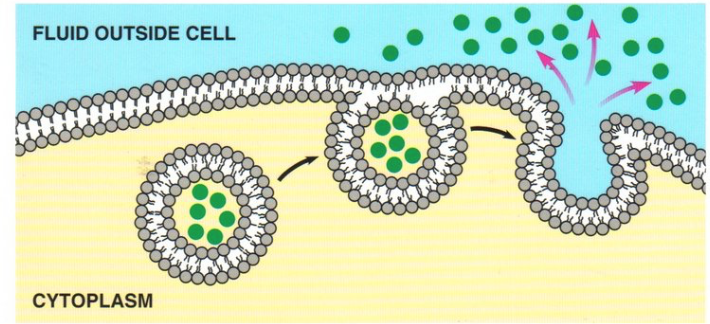
exocytosis
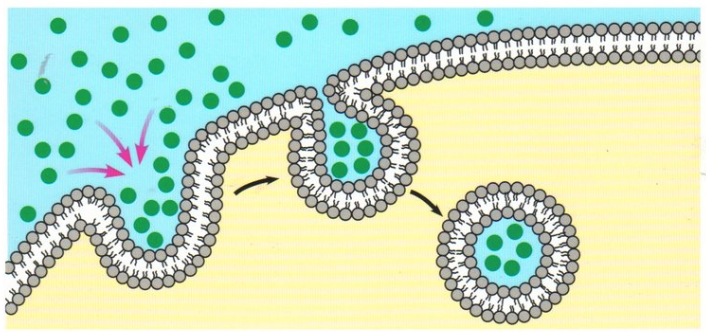
endocytosis
What is osmosis?
The net movement of water molecules from a region of higher water potential to a region of lower water potential through a selectively permeable membrane until the water potential is in equilibrium
What is water potential?
the pressure exerted by water molecules as they collide with a membrane or container
Fill in the blanks: water potential is a measure of the water molecule potential for ___ in a solution and the ___ created by water molecules.
movement, pressure
What is the symbol for water potential?
Ψ (Greek letter psi)
What are the units of water potential?
pascals (Pa)
What is the water potential of pure water under standard conditions of temperature and pressure?
0
What are the standard conditions of temperature and pressure?
25ºC and 100kPa
What happens to the water potential in the presence of a solute?
it lowers as water molecules cluster around the solute particles, so are no longer free to move