Chapter 9 The U.s in WW1
 Studied by 2 people
 Call Kai
 Learn
Learn Practice Test
 Spaced Repetition
 Match
Match Flashcards
 Knowt Play
1/18

There's no tags or description
Looks like no tags are added yet.
Name | Mastery | Learn | Test | Matching | Spaced | Call with Kai |
|---|
No study sessions yet.
19 Terms

The diagram below provides details about the origins of World War I. Which phrase completes the diagram?
A. Alliance System
B. Social Revolution
C. Drought and Famine
D. Worldwide Economic Depression
A. Alliance System
Which group of adult males, ages 21 to 30, was NOT required to serve in the
U.S. military during World War I?
A. African Americans
B. Conscientious objectors
C. People who opposed the war
D. American Indians with U.S. citizenship
B. Conscientious objectors
Which event was responsible for the changes in trade shown on the table?
A. The United States boycotted Germany after it invaded neutral Belgium.
B. Submarine warfare made it difficult to ship goods safely to the Central
Powers.
C. The convoy system helped protect American ships carrying supplies to
Germany.
D. The British naval blockade of the North Sea cut off American trade to
the Central Powers.
D. The British naval blockade of the North Sea cut off American trade to the Central Powers.
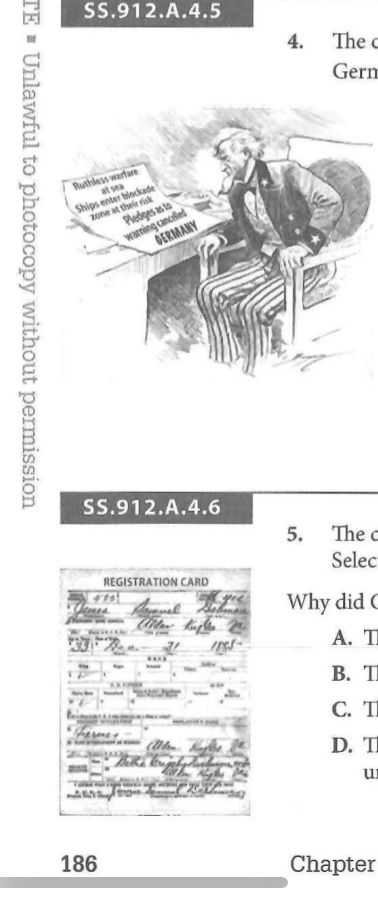
The cartoon on the left was published on February 1, 1917. The letter from
Germany to Uncle Sam reads:
5.
"Ruthless warfare at sea. Ships enter blockade zone at their risk.
Pledges as to warnings cancelled:'
What was the effect of the message shown in this cartoon?
A. The United States declared war after the US.S. Maine was blown
up in Havana Harbor.
B. The United States declared war after Germany sank American
ships in the blockaded zone.
C. The Zimmerman telegram offered Texas and California to
Mexico in exchange for an alliance.
D. Germany announced it would not attack passenger ships or
merchant ships without warning.
B. The United States declared war after Germany sank American ships in the blockade zone
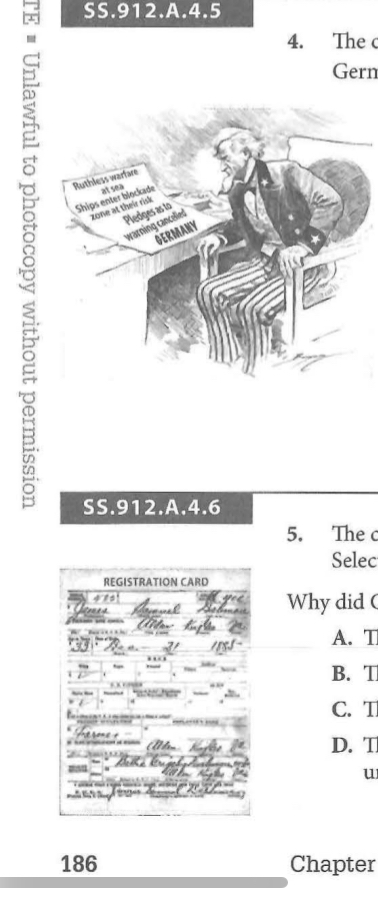
The card on the left was used by a 33 year-old man to register with the
Selective Service in 1917.
Why did Congress feel this registration was necessary?
A. The United States needed to raise troops to fight overseas.
B. The United States needed to increase its agricultural production.
C. The United States needed laborers to replace men in the armed services.
D. The United States needed to produce war goods, such as ships and
uniforms.
The United States needed to increase its agricultural production.
The message below was sent in secret code by the Foreign Minister of
Germany to the German Ambassador to Mexico in January 1917. It was
discovered and deciphered by the British government.
We intend to begin on the first of February unrestricted submarine warfare. We shall try in spite of this to keep
the United States of America neutral. If this does not succeed, we will make a proposal of alliance to Mexico on
the following terms: we make war together, we make peace together, we give generous financial support and an
understanding that Mexico is to regain the lost territory in Texas, New Mexico, and Arizona. . . . Please call the
attention of the President [of Mexico] to the fact that the ruthless employment of our submarines now offers the
prospect of compelling England to make peace in a few months.
W}i)ff;jl:ll
What was the impact of the publication of this letter?
A. Mexico allied with Germany in World War I.
B. American public opinion was outraged against Germany.
C. The United States Senate immediately declared war on Germany.
D. The United States paid Mexico compensation for its lost territories .
B. American public opinion was outraged against Germany.
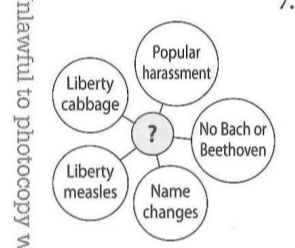
The graphic organizer on the left gives details about American society, April
1917-November 1918.
What would be an appropriate title for the graphic organizer?
A. The Impact ofWorld War I on Women
B. The Impact of World War I on Food Production
C. The Impact of World War I on German Americans
D. The Impact of World War I on the Federal Government
C. The Impact of WW1 on German Americans
What caused African-American demographic patterns in the United States
to shift during World War I?
A. the closing of factories in the South
B. effects of the Civil Rights movement
C. more job opportunities in Northern cities
D. the availability of cheap farmland in the North
C. More job opportunities in Northern cities
Which sentence describes the experiences of African-American soldiers
during World War I?
A. They were unable to engage in combat because of racial prejudice.
B. They successfully persuaded the government to desegregate the army.
C. They were segregated but many engaged in combat under French
command.
D. They were treated as equals with ample opportunity for advancement
through the ranks.
C. They were segregated but many engaged in combat under French comand.
Which step was taken by Herbert Hoover as head of the U.S. Food
Administration during World War I?
A. persuading Americans to eat less wheat and meat
B. rationing food on the home front with ration coupons
C. prohibiting the migration of farm workers to jobs in cities
D. directing farmers to grow fewer crops to maintain food prices
A. Persuading Americans to eat less wheat and meat
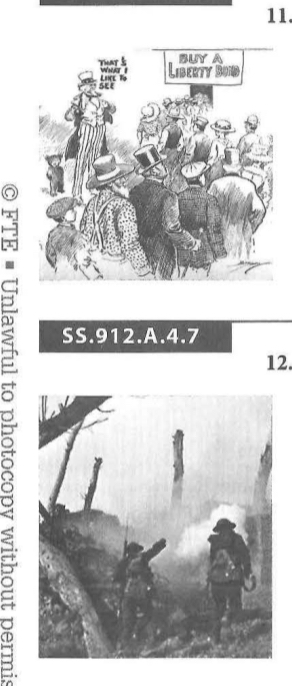
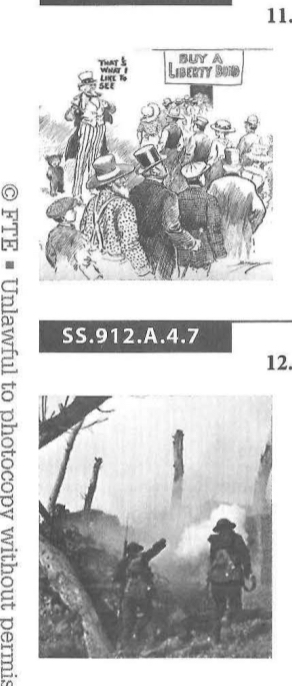
The cartoon on the left was published on May 16, 1917.
What was the purpose of the bonds being sold in the cartoon?
A. To avoid an economic depression
B. To keep the United States out of war
C. To help finance the American war effort
D. To make emergency loans to Britain and France
C. To help finance American war effort
The photograph on the left shows American infantry in France in 1918.
What would be the best caption for this photograph?
A. The introduction of tanks ends trench warfare
B. Battlefield devastation from aircraft bombardment
C. Crossing "No Man's Land" to reach an enemy trench
D. Troops get exercise by running along an Allied trench
C. Crossing “No Man’s Land” to reach an enemy trench
Why did the United States Senate fail to ratify the Treaty of Versailles in
1919?
A. Many Senators opposed the severe sanctions that the treaty placed on
Germany.
B. Many Senators feared the League of Nations would involve the United
States in foreign wars.
C. Many Senators felt the League of Nations would interfere with American
plans in the Philippines.
D. Many Senators predicted that membership in the new League of Nations
would be too expensive.
B. Many Senators feared the League of Nations would involve the United States in foreign wars
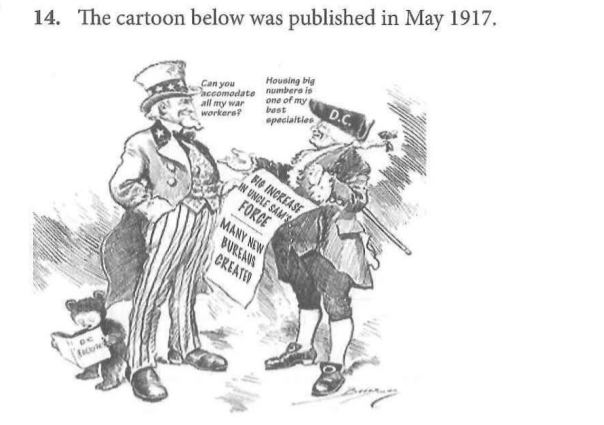
Which was NOT one of the "new bureaus" referred to in this cartoon?
A. War Industries Board
B. Railroad Administration
C. American Federation of Labor
D. Committee of Public Information
C. American Federation of Labor
The excerpt below is from Supreme Court Justice Oliver Wendell Holmes'
opinion in Schenck v. United States {1919).
The question in every case is whether the words used are used in such circumstances and are of such a nature as to create a clear and present danger that they will bring about the substantive evils that Congress has a right to prevent.
Based on the excerpt, with which statement would Oliver Wendell Holmes have
agreed?
A. Freedom of speech is not absolute.
B. Prayer in public schools is unconstitutional.
C. Immigration from other countries cannot be permitted during wartime.
D. Criticism of the policies of allied countries must be temporarily
prohibited in wartime
A. Freedom of speech is not absolute
The excerpt below is from the Covenant of the League of Nations, a part of
the Treaty of Versailles.
ARTICLE 10
The Members of the League undertake to respect and preserve the territorial integrity and existing political independence of all Members of the League against external aggression. In case of any such aggression or threat of such aggression, the [Executive] Council shall advise on the means by which this obligation shall be fulfilled.
Why did many U.S. Senators object to this article?
A. They had plans to seize new overseas territories for the United States.
B. They were afraid that the League would be controlled by hostile powers.
C. They feared Americans would be required to act against aggression in
Europe.
D. They thought it demanded that Americans grant Philippine independence.
C. They feared Americans would be required to act against aggression in Europe
Which sentence best describes the impact of World War I on Florida?
A. Governor Sidney J. Catts lifted the state's prohibition of alcoholic drinks
during wartime.
B. Large numbers of Cubans moved to Florida to find work in America's
wartime industries.
C. Military training centers were located in Florida, the state's farmers sold
more crops, and a thousand Floridians gave their lives.
D. After fighting for democracy abroad, most Floridians became more
willing to grant equal rights to African Americans at home.
C. Military training centers were located in Florida, the state’s farmers sold more crops, and a thousand Floridians gave their lives.
Which best describes how American women reacted to American
participation in World War I?
A. Some protested but most supported the war effort and many filled men's
jobs
B. Because of a shortage of enlisted men, many women served in combat
for the first time.
C. Women's continuing protests for women's suffrage dangerously impeded
the war effort.
D. Large numbers of women were forced to move from their homes to meet
wartime needs.
A. Some protested but most supported the war effort and many filled men’s jobs
Which was NOT one of President Woodrow Wilson's Fourteen Points?
A. creation of an independent Poland
B. lenient treatment of the Central Powers
C. creation of a peace-keeping association of nations
D. autonomous development for the peoples of Austria-Hungary and the
Ottoman Empire
B. Lenient treatment of the Central Powers