Human Physiology: Homeostasis, Cell Types, and Body Systems - Chapter 1
 Call Kai
 Learn
Learn Practice Test
 Spaced Repetition
 Match
Match Flashcards
 Knowt Play
1/54

There's no tags or description
Looks like no tags are added yet.
Name | Mastery | Learn | Test | Matching | Spaced | Call with Kai | Chat |
|---|
No analytics yet
Send a link to your students to track their progress
55 Terms
What is physiology?
The study of how living organisms function.
Define homeostasis.
The maintenance of a stable internal environment in the body.
What are the mechanisms of homeostasis?
Dynamic mechanisms that detect and respond to deviations in physiological variables from their set points.

What are the levels of cellular organization?
Cells, Tissues, Organs, Organ Systems, Organism.
What is cell differentiation?
The process of transforming an unspecialized cell into a specialized, functional cell.
Name the four main categories of cells.
Muscle cells, Neurons, Epithelial cells, Connective tissue cells.
What are tissues?
Groups of similar cells.
List the four main types of tissues.
Muscle tissue, Nervous tissue, Epithelial tissue, Connective tissue.
What is the primary function of muscle cells?
To generate mechanical force.
How many types of muscle cells are there in the human body?
Three types: cardiac, skeletal, and smooth.
What type of muscle control is voluntary?
Skeletal muscle control.
What is a neuron?
A cell of the nervous system specialized to initiate, integrate, and conduct electrical signals.
What is epithelial tissue specialized for?
Selective secretion and absorption of ions and organic molecules, and for protection.
What are the shapes of epithelial cells?
Cuboidal, columnar, squamous, and ciliated.

What are the two types of epithelial tissue arrangements?
Simple epithelium (single-cell thick) and stratified epithelium (multiple layers).
What is the basement membrane?
An extracellular protein layer that epithelial cells rest on.
What are tight junctions?
Extracellular barriers that hold epithelial cells together and regulate the exchange of molecules.

What is the function of connective tissue cells?
To connect, anchor, and support the structures of the body.
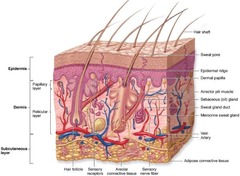
List the types of connective tissues.
Loose Connective, Dense Connective, Blood, Bone, Cartilage, Adipose.

What is extracellular matrix (ECM)?
A mixture of proteins, polysaccharides, and sometimes minerals that surrounds cells.

What are organs composed of?
Two or more tissue types.
What is an organ system?
A collection of organs that together perform an overall function.
What is intracellular fluid?
Fluid located inside the cells, accounting for 67% of all fluid in the body.
What is the significance of maintaining fluid composition differences across cell membranes?
It helps cells regulate their own activity.
What happens to physiological variables during homeostasis?
They are maintained within a predictable range despite changes.
What is the difference between physiology and pathophysiology?
Physiology refers to maintained homeostasis; pathophysiology refers to when homeostasis is not maintained.
What hormone regulates blood glucose levels after eating?
Insulin.
What is dynamic constancy in homeostasis?
Physiological variables change over short periods but remain relatively constant over long periods.
What is a negative feedback system?
A system that brings about responses that move a variable opposite to the direction of its original change.
What is a positive feedback system?
A system that enhances the production of a product or accelerates a process, such as uterine contractions during childbirth.
What is the primary goal of homeostatic control systems?
To maintain stability of an internal environmental variable by balancing inputs and outputs.
What happens to a regulated variable in a negative feedback system?
It moves back toward its initial value (set point) after a change.
What are the three states of total body balance?
Negative balance (loss > gain), Positive balance (gain > loss), and Stable balance (gain = loss).
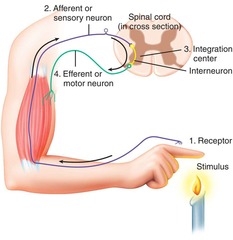
Define a reflex.
A specific, involuntary response to a particular stimulus.
What is a reflex arc?
The pathway mediating a reflex, consisting of a stimulus, receptor, afferent pathway, integrating center, efferent pathway, and effector.
What role do hormones play in homeostatic reflexes?
Hormones act as chemical messengers secreted into the blood, influencing many different cells simultaneously.

What are gap junctions?
Physical linkages connecting the cytosol between two cells, allowing molecules to move directly from one cell to another.
What is juxtacrine signaling?
A type of cell communication where the chemical messenger is located in the plasma membrane of the signaling cell and interacts with a neighboring cell.

What is the difference between adaptation and acclimatization?
Adaptation is a permanent characteristic that favors survival in specific environments, while acclimatization is a temporary improvement in the functioning of an existing homeostatic system.
What is a circadian rhythm?
A biological rhythm that cycles approximately once every 24 hours, affecting functions like sleep and hormone concentrations.

How do biological rhythms relate to homeostasis?
They add an anticipatory component to homeostatic control systems, enabling mechanisms to activate before challenges occur.
What is the function of the suprachiasmatic nucleus?
It acts as the internal pacemaker to set the circadian rhythm.
What is meant by 'set point' in homeostasis?
The ideal value for a regulated variable that homeostatic systems aim to maintain.
What is the role of the integrating center in a reflex arc?
It processes signals from multiple receptors and determines the appropriate response.
What is the significance of the balance between gain and loss in homeostasis?
It determines the concentration of substances in the body and the overall stability of internal conditions.
What is an example of a reflex action?
Pulling your hand away from a hot object.
What is the impact of environmental challenges on homeostatic systems?
They may cause regulated variables to deviate from their normal range, requiring adjustments in homeostatic responses.
What is the role of effectors in homeostatic reflexes?
Effectors, such as muscles and glands, carry out the responses determined by the integrating center.
How does negative feedback differ from positive feedback?
Negative feedback counteracts changes to maintain stability, while positive feedback amplifies changes to enhance a process.
What is the relationship between homeostasis and biological rhythms?
Biological rhythms prepare the body for changes, allowing homeostatic mechanisms to respond more effectively.
What is the importance of the balance concept in homeostatic control?
It emphasizes that stability is achieved not by absolute values but by the relative rates of gain and loss.
What can reset the set point of a regulated variable?
Physiological changes in response to environmental conditions.
What is the role of chemical messengers in intercellular communication?
They facilitate communication between cells, influencing various physiological processes.
What is the significance of the reflex arc's afferent pathway?
It transmits signals from the receptor to the integrating center.
What happens when homeostatic systems fail to maintain balance?
It can lead to physiological disturbances and health issues.